The Best Smart Pet ID Tags of 2026: We Compared ByteTag, PetHub, Crumb & More (Including Ours)
 Shiloh’s House Team
·
·
5 min read
Shiloh’s House Team
·
·
5 min read

Smart pet ID tags have gone from novelty to necessity. Roughly one in three pets goes missing at some point in their life, and the difference between a scary afternoon and a heartbreaking week usually comes down to one thing: how fast the person who finds your pet can reach you.
But the market is crowded now — QR tags, NFC tags, Bluetooth trackers, freemium networks — and every brand says theirs is the best. So we did the thing nobody in our industry likes to do: we compared them honestly, side by side. Full disclosure up front: we make one of the tags on this list. We think it holds up under scrutiny — that’s why we’re comfortable publishing the scrutiny.
The 2026 smart tag landscape at a glance
| Brand | Tech | Price | Subscription? | Companion app |
|---|---|---|---|---|
| Shiloh’s House | NFC tap + engraved backup | $38 | No | Lohji (free) |
| ByteTag | QR code scan | ~$25 | No | Web profile only |
| PetHub | QR code scan | Varies | Free basic, paid premium | Web portal |
| Crumb | QR network tag | Free tag offer | Freemium | Yes |
| YIP | Bluetooth (Apple Find My) | Varies | No | Apple Find My |
| TagsForHope | Printed custom ID (not smart) | Varies | No | None |
How we judged them
A pet tag has exactly one job: get your pet home fast. This 2026 roundup is a snapshot; our evergreen guides to the best smart pet tags and the best pet tags for dogs and cats are kept current. So we weighed each tag on the moments that actually matter when a pet is lost:
- Does it work for a stranger with zero instructions? The person who finds your pet has never seen your tag before. No app download, no account, no friction.
- Does it work with no battery and no signal? Bluetooth and GPS are wonderful — until the battery dies or there’s no network of nearby phones.
- How much information can it carry? A phone number is a start. Medical conditions, vet contacts, and behavioral notes can save a life.
- Is there a physical backup? Tech fails. Engraving doesn’t.
- Total cost of ownership. A cheap tag with a subscription isn’t cheap for long.
ByteTag Best budget QR tag
ByteTag has built a loyal following with simple, affordable QR tags in silicone, metal, and slide-on styles, typically around $25 with no subscription. When someone scans the QR code, they see your pet’s profile and you get an alert with the scan location. It’s a solid product and their scan-alert system works well.
The trade-offs: QR codes have to be visually located, aimed at, and scanned — harder with a squirming dog, a scratched code, or bad lighting. There’s no native app for storing deeper pet records, and no engraved fallback on most styles if the code becomes unreadable.
PetHub Best shelter network
PetHub has been doing QR pet ID since 2010 — they essentially invented the category. Their standout feature is reach: PetHub partners with municipalities on pet licensing and can alert shelters within a 50-mile radius when a lost pet’s tag is scanned. That network is real and valuable.
The trade-offs: the most useful features sit behind a premium subscription, and the tags themselves are utilitarian. Like all QR tags, they depend on a clean, scannable code.
Crumb Best free option
Crumb’s pitch is hard to argue with: a free smart tag, backed by a large scan network. If your budget is zero, a Crumb tag is dramatically better than no tag at all, and we’d rather see every pet wearing one than none.
The trade-offs: free products have to make money somewhere, so expect upsells into paid tiers for the features you’ll actually want. Design options are limited, and you’re betting on the company’s network sticking around.
YIP Best for Apple households
YIP tags work with Apple’s Find My network, which means your pet shows up on a map the way your AirPods do — genuinely useful for tracking a pet’s location in populated areas. Sold at PetSmart, easy to set up.
The trade-offs: it needs a battery, it needs iPhones nearby to relay location, and the stranger who finds your dog can’t tap it to see your contact info the way they can with NFC. We covered this in depth in our AirTag vs NFC smart tag comparison — trackers and ID tags solve different problems, and the safest setups use both.
TagsForHope Best traditional custom tag
Not a smart tag, but impossible to leave off the list: TagsForHope’s driver’s-license-style printed tags are adorable, well made, and every purchase supports rescue animals. Over a million pets wear them.
The trade-offs: a printed tag can only hold what’s printed on it. If you move, change numbers, or your pet develops a medical condition, you’re buying a new tag. There’s no scan alert, no location ping, no medical file.
Shiloh’s House — best overall (yes, we’re biased; here’s the case)

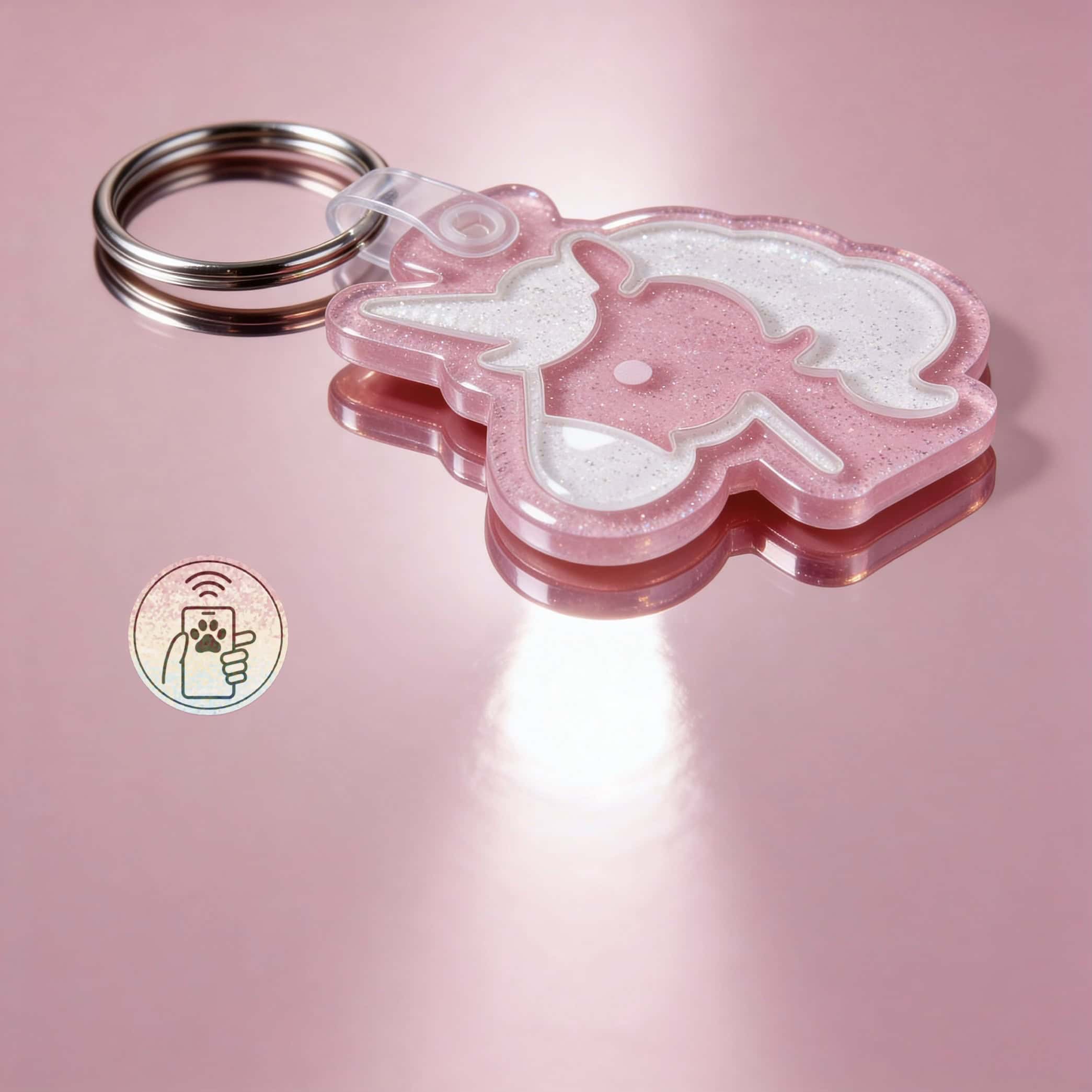
Our tags use NFC — the same tap technology as Apple Pay. Anyone who finds your pet simply holds their phone near the tag and your pet’s profile opens instantly. No app to download, no code to aim at, no battery to die. The tag is engraved with your contact info as a physical backup, and it’s a designer acrylic piece your pet can actually wear proudly — beautiful on the outside, brilliant on the inside.
Every tag comes with Lohji, our free companion app, which goes far beyond contact info: vaccine records, medical history, emergency contacts, voice notes that play when your pet is found — plus the fun stuff like AI pet avatars our community loves. It works in 54 countries and 16 languages, there’s no subscription ever, and tags are made in the USA. One purchase, $38, done.
The trade-offs: we’re not the cheapest tag on this list, and if you want live GPS-style tracking, you’ll want to pair us with a tracker (here’s how the two work together).
Which smart tag should you buy?
- Tightest budget: Crumb’s free tag beats no tag, every time.
- Simple and cheap: ByteTag is a well-executed QR tag.
- City with municipal licensing: PetHub’s shelter network is a genuine asset.
- Apple family who wants location: YIP or an AirTag — paired with a proper ID tag.
- Style over tech: TagsForHope, and update it when life changes.
- The complete package: a Shiloh’s House NFC tag — tap-to-open profile, engraved backup, full medical records in Lohji, no subscription.
Get Your Tag
The complete package: tap-to-ID, engraved backup, and the free Lohji™ app — no subscription, ever.
Smart pet tag FAQ
Do smart pet tags require a subscription?
Some do, some don’t. Shiloh’s House, ByteTag, and TagsForHope are one-time purchases. PetHub and Crumb offer free basics with paid premium tiers. GPS trackers like Fi and Tractive almost always require monthly subscriptions.
What’s the difference between NFC and QR pet tags?
QR codes must be visually located and scanned with a camera; NFC tags just need a phone held nearby — no aiming, no lighting issues, no wear-and-tear on a printed code. We break it down fully in our NFC vs QR vs engraved guide.
Do smart tags replace a microchip?
No — they’re partners. A microchip requires a vet or shelter with a scanner; a smart tag works with any smartphone in seconds. Keep both, and make sure your microchip registration is current.
What should go on the tag itself?
Even with smart tech, physical engraving matters as a backup. Here’s exactly what to put on a dog ID tag.