Halloween Doorbell Anxiety in Dogs: How to Stop the Barking, the Bolting and the Lost-Dog Call
 Shiloh’s House Team
·
·
8 min read
Shiloh’s House Team
·
·
8 min read
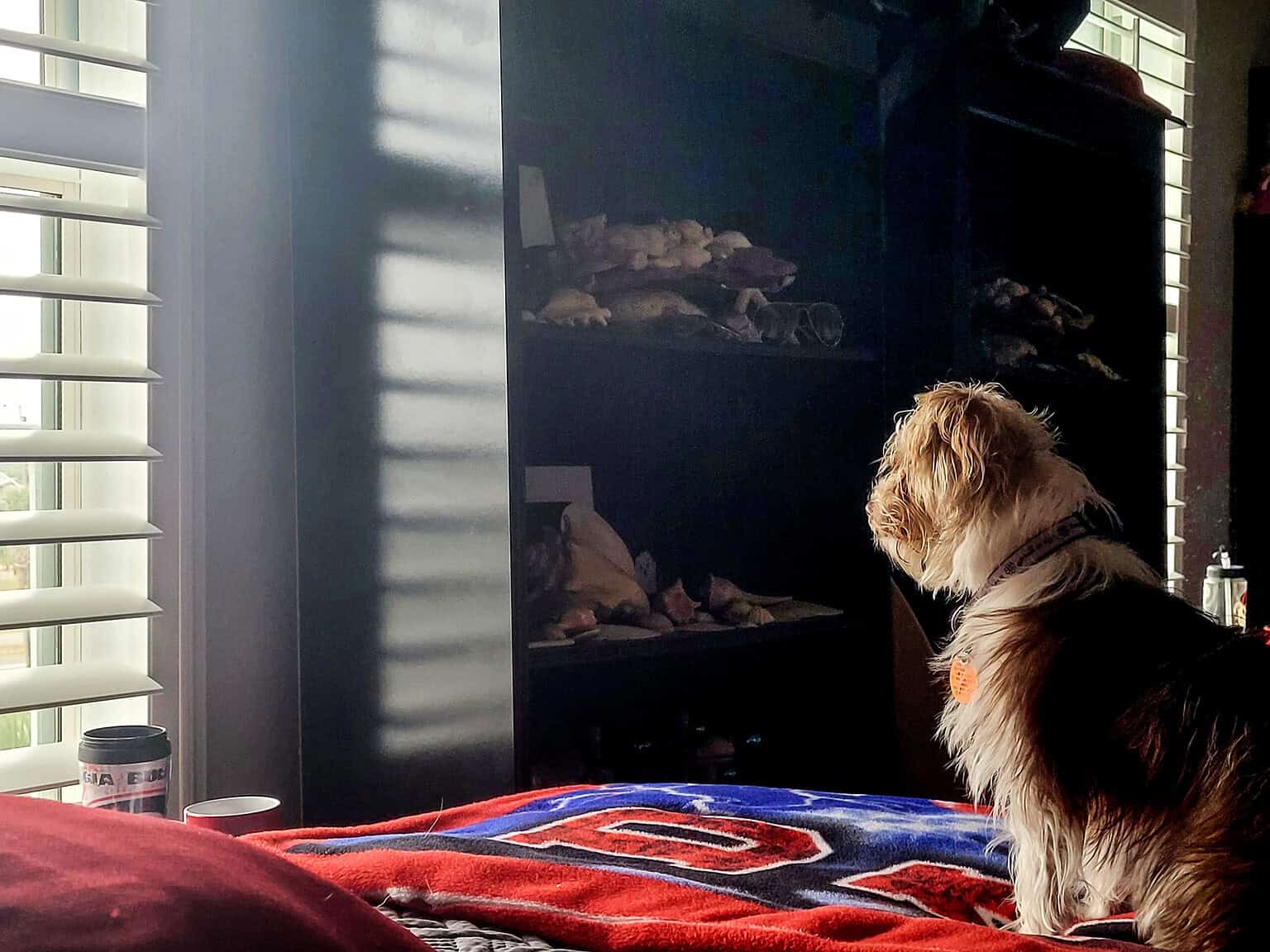
On Halloween night the doorbell rings thirty, fifty, a hundred times, every ring brings a shrieking stranger in a mask, and the door opens every time. For a dog, that is the worst evening of the year, and it’s why shelters see a spike in strays the first week of November. The fix has three parts. Starting now, with five weeks to go, desensitize the doorbell with a recording and treats. On the night, don’t use the doorbell at all: sit outside with the candy, or tape a sign over the button, and keep the dog in a closed room behind a second door. And before dark on October 31, check that the collar is on, the tag is readable and the microchip registration is current, because the dog that slips past you at 7 p.m. needs to be findable at 7:05.
Why Halloween is so hard on dogs
A dog’s doorbell reaction is already a trained reflex: ring, bark, person. Halloween turns the volume up on every part of it. The ring comes every few minutes for three hours. The people are children, who move fast and squeal, in costumes that hide faces and change silhouettes, which is exactly what dogs read to decide whether something is safe. Adults in masks are worse. There are strange smells (face paint, candy, smoke machines), flashing lights, and a front door that opens again and again with a distracted human holding a bowl. Purdue’s Center for Animal Welfare Science lists the signs of a dog that’s past its limit: loud, continuous barking, whining or growling; lowered body, tucked tail; and trying to escape or avoid people. A dog in that state isn’t being bad. It’s scared, and a scared dog goes for the gap.

Five weeks out: desensitize the doorbell
This works for most dogs if you start now and do it daily. You need a recording of your doorbell on your phone (record it, or find a matching chime online), a pocket of high-value treats, and five minutes a day.
| Week | What to do | Goal |
|---|---|---|
| 1 | Play the doorbell recording at very low volume while the dog is calm. The instant it plays, treat. Ten repetitions, twice a day. Raise the volume only when the dog looks at you for the treat instead of running to the door. | Bell = snack, not bell = intruder |
| 2 | Full-volume recording, then the real bell with a family member outside. Add a “go to your mat” cue: bell rings, dog goes to a bed away from the door, treat arrives on the mat. | Bell = go to mat |
| 3 | Add the door opening while the dog stays on the mat. Then a friend at the door. Then the friend in a hat, then a hoodie, then a mask, for a few seconds each, treats flowing. | Open door + stranger = still on mat |
| 4–5 | Several rings in a row, a few minutes apart, with kids if you have willing ones. Keep sessions short and end before the dog gets wound up. Decide honestly whether the dog is ready for the real thing or should spend the night in a quiet room. | Rehearsal; make the call |
If the dog can’t get past week one without barking, or has ever snapped at a visitor, skip to the safe-room plan and talk to your vet or a certified trainer. Purdue’s team is blunt about it: a dog with severe Halloween anxiety is a conversation with a veterinarian, and for some dogs that means short-term anti-anxiety medication for the night. The general approach to doorbell and barrier reactivity is in how to stop a dog barking.
On the night: keep the door from being the problem

Even a well-trained dog shouldn’t be asked to handle a hundred doorbells. The simplest Halloween trick is to remove the door from the equation.
- Sit outside with the candy. A chair on the porch or at the end of the driveway, a bowl, a blanket. The bell never rings and the door never opens. Weather permitting, this is the best option, and kids like it more anyway.
- Disable the bell. Tape a sign over the button (“Please don’t ring or knock, dog inside, we’ll see you!”) and watch for visitors through the window or on a video doorbell. Video and silent doorbells that light up or ping your phone exist for exactly this.
- Two doors between the dog and the street. Set up a safe room at the back of the house, a bedroom or office, with the dog’s bed, water, a stuffed Kong or long-lasting chew, and a white-noise machine, fan or TV loud enough to blur the doorbell. Close that door. Then use a baby gate or a closed hallway door as the second barrier. A dog that gets out of the room still shouldn’t have a straight run to an open front door.
- Walk early. A long walk and a meal before 5 p.m. gives you a tired dog with an empty bladder. No walks during trick-or-treat hours, and no taking the dog along: Purdue recommends most pets stay home, and a dog that refuses to walk, trembles, pants, drools or growls on a Halloween walk needs to go home now.
- No costume unless it’s a bandana. Full costumes restrict movement, sight and hearing, and a dog that’s already on edge doesn’t need less of its senses. A collar bandana does the job.
- Candy up high. Chocolate, xylitol gum and candy, raisins and wrappers all go on a high shelf or in the fridge. Signs of trouble are vomiting, diarrhea, drooling, hyperactivity or lethargy; call your vet or the Pet Poison Helpline at (855) 764-7661.
Our Halloween pet safety guide covers the candy, costume and decoration hazards in full; this article is about the door.
Cats: the same problem, a quieter escape
Cats don’t bark at the bell; they bolt from it. An indoor cat that’s been fine for years can slip out under the legs of a crowd of trick-or-treaters and be gone before anyone notices. Purdue’s list of feline stress signs is hissing, hiding, puffed fur, a straight-up tail or a curved posture. The safe-room rule applies doubly: a cat behind a closed door from an hour before dark until the street empties. Black cats in particular should be indoors through the whole week; shelters commonly pause black-cat adoptions around Halloween for a reason. If a cat does get out, it’s usually hiding within a few houses; our lost cat guide explains how to search.
The ID check that takes two minutes
The last step is the one that matters if the first two fail. Before the first trick-or-treater:
- Collar on. Many dogs go collarless at home. Halloween night, it stays on, snug enough that two fingers fit underneath and no more, so it can’t be slipped.
- Tag readable. Engraved tags fade; if you have to squint, so will the stranger who finds your dog in the dark. A Shiloh’s House smart tag doesn’t need reading: whoever finds the dog taps the tag with any phone and your profile and number come up. No battery, no app for the finder, no subscription. What goes on a tag is in what to put on a dog ID tag.
- Microchip registration current. Purdue puts this at the top of its list, and it’s the one most people skip. If you’ve moved or changed numbers since the chip went in, the chip points to a dead end. Check your pet’s microchip registration takes five minutes online.
- A current photo on your phone, taken tonight, in whatever the dog is wearing.
If the dog does get out, don’t chase: a frightened dog runs from a running person. Sit down, call in a happy voice, hold out treats, and read the lost dog: first 60 minutes plan while someone else starts calling neighbors.
Not tagged yet?
Halloween is the busiest door of the year. Tap-to-find smart ID tags: $38, one-time, no battery, no subscription, made in the USA. Free Lohji app included.
Frequently asked questions
How do I keep my dog calm on Halloween?
Tire the dog out early, then put it in a closed back room with a bed, water, a long-lasting chew and white noise before the first trick-or-treater. Hand out candy from the porch or disable the doorbell so it never rings. If the dog is severely anxious, ask your vet about medication for the night.
Why does my dog go crazy when the doorbell rings?
The bell reliably predicts a stranger at the door, so the dog has learned to react before the person appears. It’s excitement, territorial alarm or fear, and on Halloween the repetition and the costumes push most dogs past their limit. Desensitization with a recording and treats, started weeks ahead, changes what the bell predicts.
Should I take my dog trick-or-treating?
Usually no. Crowds, costumes and darkness stress most dogs, and a scared dog on a leash is a bite or escape risk. If you do, use a collar with ID, a current microchip and a short leash, and go home at the first sign of trembling, panting, drooling or growling.
Do more pets get lost on Halloween?
Shelters and animal control agencies report more stray intakes around Halloween, driven by repeatedly opened doors and frightened animals bolting. It’s one of the busiest lost-pet periods after July 4th.
What should my dog wear on Halloween?
A snug collar with a readable or tap-to-read ID tag, and at most a bandana. Full costumes restrict sight, hearing and movement and add stress to an already stressful night.
Sources
- Purdue University College of Veterinary Medicine, “Trick-or-Treat without the stress: Tips to keep your pets safe this Halloween” (Dr. Candace Croney, Judith Stella and Mikel Delgado, Center for Animal Welfare Science) — porch candy, silent doorbells, door signs, safe rooms, ID and microchip checks, stress signs in dogs and cats, costume and candy guidance, Pet Poison Helpline (855) 764-7661.
- VetPartners, “Helping pets cope with trick-or-treaters” — desensitization and safe-room guidance for Halloween.
- American Veterinary Medical Association, “Halloween pet safety” — candy toxicity, costumes, keeping pets indoors.
- ASPCA Animal Poison Control Center, “Halloween safety tips” — chocolate, xylitol and wrapper hazards.