How to Keep an Indoor Cat From Escaping (and Stop Door Dashing)
 Shiloh’s House Team
·
·
10 min read
Shiloh’s House Team
·
·
10 min read

To keep an indoor cat from escaping, control the door before you open it, give your cat a better place to wait, and make indoor life interesting enough that the door loses its pull. Spay or neuter, keep window screens snug, offer outdoor time only in a catio or on a harness, and keep ID on your cat in case they ever slip past you.
Why do indoor cats try to escape?
Most indoor cats don’t find a secret gap. They walk out an open door. In a 2018 study in Animals, Liyan Huang and colleagues from the University of Queensland and the US-based Missing Pet Partnership analyzed survey responses about 1,210 missing cats. Among cats that were indoors when they went missing and whose escape route was known, this is how they got out:
| How indoor cats got out | Share | First fix |
|---|---|---|
| Open door or garage | 74% | A second barrier and a new door routine |
| Jumped from a window | 11% | Snug, sturdy screens on every window |
| Damaged window or door screen | 6% | Repair or replace torn and loose screens |
| Jumped from a balcony | 5% | No unsupervised balcony time |
Curiosity is a big driver: the Wisconsin Humane Society describes door dashers as curious or adventurous cats, some of whom have lived outdoors before. Cats that aren’t spayed or neutered feel the pull even more. The Anti-Cruelty Society notes that intact males and females in heat tend to bolt when they smell a potential mate. Boredom adds to it. VCA’s behaviorists point out that hunting isn’t driven by hunger, so a well-fed cat still stalks.
Change and fear raise the risk. Of the 57 cats in the Huang study that went missing from an unfamiliar place with a known escape route, 51% escaped shortly after moving into a new house and 34% from a friend’s or pet sitter’s home. Frightened cats run, too, which is why Battersea’s fireworks advice is to close all doors and windows and block off cat flaps.
How do I stop my cat from door dashing?
Start with management, then train. The Wisconsin Humane Society’s first step is to make slipping out physically difficult, so a lesson can’t turn into an escape.
Add a second barrier
Keep an inner door closed so there are always two doors between your cat and the outside. No inner door? The Wisconsin Humane Society suggests an extra-tall gate your cat can’t climb or jump, or a temporary screen door inside the house. The Anti-Cruelty Society sets a tall exercise pen around the doorway as an air lock.
Change the routine at the door
Set your bags down and peek inside before you walk in, the Anti-Cruelty Society advises. Before you leave, give your cat a food puzzle or favorite toys away from the door, or toss a toy across the room before opening it. Keep treats or toys in your bag to toss for your cat as you come back in.
Say hello somewhere else
Do every hello and goodbye, plus petting, play and treats, at a greeting spot well away from the door, the Anti-Cruelty Society suggests. If your cat is waiting at the door when you get home, ignore them and say hello once they meet you at the spot.
Use a safe room on busy days
Brief guests on how to come and go. When lots of people are coming and going, like a party or moving day, the Wisconsin Humane Society suggests a single room with food, water, a litter box, bedding and a treat-dispensing toy. It isn’t a punishment, and nobody has to remember the gate.
How to teach your cat to “go to your spot”
The Wisconsin Humane Society calls it a greeting station: a cat tree level, a chair or a small table a little away from the door but easy for you to reach. Put high-value treats there throughout the day until it’s the best seat in the house. Then pair it with the door: treats on the station, a few steps toward the door, back for more, and gradually farther until you can open the door while your cat stays put, snacking. Put treats on the station as soon as you walk in, too. It takes a lot of repetition, so stick with it.
Trainer Mikkel Becker, writing for Vetstreet, adds a cue. Teach your cat to follow a target, such as a wooden spoon, onto a perch, and say a word like “place” a second or two before you show the target. Once the word alone works, practice at the door in small steps (turn the knob, open it a crack, open it fully), rewarding your cat for staying. If they jump off, close the door, reset and try again, and keep sessions short.
Are open windows safe for indoor cats?
Not without good screens. The ASPCA says veterinarians see window-fall injuries often enough to have a name for them: high-rise syndrome. Most are accidental falls from windows, terraces and fire escapes, sometimes because a cat is so focused on a bird that it loses its balance, and ledges and brick give a poor grip. Low floors aren’t automatically safer: the ASPCA notes cats in one- or two-story buildings may be at greater risk of injury, because a short fall leaves no time to adjust their body before landing.
Its advice is snug, sturdy screens in every window, adjustable screens wedged tightly into the frame, and no reliance on childproof window guards, which cats can slip through. For the view without the open sash, Becker suggests a windowsill perch; here are our best cat window perches.
Not tagged yet?
If your cat ever slips past you, whoever finds them needs a fast way to reach you. A Shiloh’s House smart tag lets anyone tap it with any phone, no app needed, to see your contact info and your cat’s profile and medical notes, and your number is laser-engraved on the back as a backup. It’s $38 one-time, with no battery and no subscription.
Safe outdoor time: catios and harness walks
A catio or a harness gives a curious cat outdoor time on your terms. VCA notes you can buy a catio kit or have one custom built onto almost any window or door.
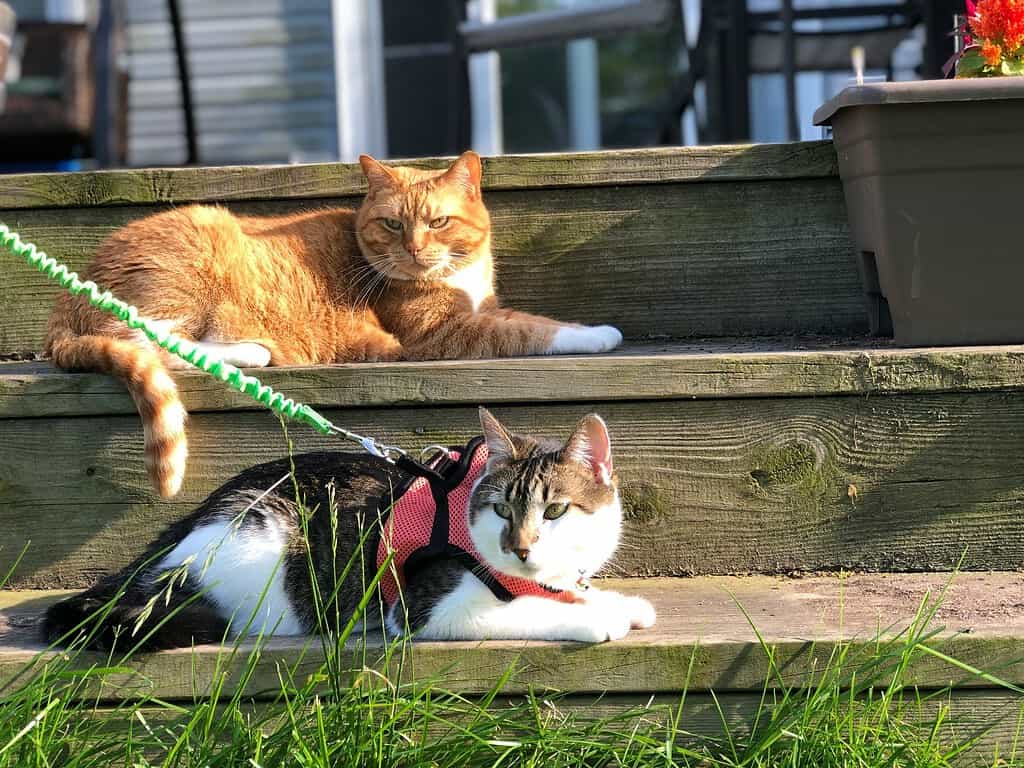
For walks, veterinary behaviorist Jeannine Berger, writing for PetMD, says to use a well-fitted harness, never a neck collar alone; a collar is fine for a name tag, but not for the leash. Her plan is the harness alone indoors for several weeks before adding the leash, then a first trip to a safe, calm, fully enclosed spot, with your cat carried out in their carrier, harness on. She also says to spay or neuter and microchip first, never tie a cat up outside, and never walk where there are predators. Our best cat harnesses guide rounds up escape-proof picks.
Neither option is foolproof. Among cats in the Huang study that were outdoors when they went missing and had a known escape route, 9% got out of an enclosure or catio and 4% escaped while on a leash. Check catio latches, and as Berger advises, check the harness fit before every outing.
Make indoor life worth staying for
The more an indoor cat gets to hunt, climb and explore, the less the door has to offer. VCA’s behaviorists recommend at least three short play sessions a day with prey-like toys, started just before your cat’s usual active times. Put wand toys away afterward, since swallowed string is dangerous, and rotate the rest so they stay new.
Make food a hunt too. Becker suggests hiding about 10 percent of the daily ration around the house and using food puzzles, and VCA’s reminder is to make sure your cat still eats their full daily portion. Add height and hiding places with a cat tree in a room the family actually uses, plus tunnels and cardboard boxes. The Wisconsin Humane Society’s cheapest ideas are crumpled paper and an empty shipping box.
Does an indoor cat need ID?
Yes. In the Huang study, 83% of cats found alive were found outside and 11% inside someone else’s house, while fewer than 2% were in a shelter or municipal animal facility. Microchipping didn’t improve a missing cat’s chance of being found alive in that data. The authors suggest few lost cats reached a place where a chip could be read, and a chip only helps if the owner’s contact details are current; they cite one study in which 37% of microchipped dogs and cats had chips registered to incorrect owner data or not properly registered.
So use both. The AVMA advises that microchipped pets also wear a collar with current identification, and that owners keep their registry details up to date. Battersea’s version for cats is a microchip plus an engraved tag on an easy-release collar. We make the case in do indoor cats need ID tags?, and here’s how to check your pet’s microchip registration.
What to do in the first hour if your cat gets out

Search close, and start now. Indoor-only cats in the Huang study were found a median of 39 m from where they got out, and three-quarters within 137 m; cats allowed outdoors unsupervised went much farther. The authors say a 200-m radius is more likely to suffice for an indoor-only cat, while an outdoor or indoor-outdoor cat may need a search up to 2 km or more.
Look where a scared cat would hide. Most cats found outside were hiding under porches, cars or objects near home, and 18% of them were right outside the owner’s entrances or simply came home, so check your doors and porch first. Half of the found cats appeared scared, so yours may stay hidden when you call. The quickest recoveries were linked with asking neighbors to help look, walking the area at night with a flashlight, searching neighbors’ properties slowly with their permission, and searching your own yard. Overall, 34% of cats were recovered alive by their owner within 7 days, and few were found alive after 90 days.
These findings suggest that thorough physical searching is a useful strategy, and should be conducted within the first week after cats go missing.
Liyan Huang and colleagues, Animals, 2018
Frequently asked questions
Why does my indoor cat keep trying to get out?
Usually curiosity, a mating drive in cats that aren’t spayed or neutered, or too little to do indoors, and cats that once lived outdoors often keep trying. Spay or neuter, add daily play and climbing space, and block the door while you train a greeting spot.
How far do indoor cats go when they escape?
Usually not far. In a 2018 study of missing cats, indoor-only cats were found a median of 39 m from where they got out, and three-quarters within 137 m. The researchers suggest a 200-m search radius for an indoor-only cat.
Will an indoor cat come back on its own?
Some do: in the same study, 18% of cats found outside were at the owner’s entrances or simply came home. Don’t wait, though. There was evidence that searching in person increased the chance of finding a cat alive.
Is it safe to leave windows open with a cat?
Only with snug, sturdy screens. The ASPCA says most cats fall by accident and that childproof window guards aren’t enough, because cats can slip through them.
Should I let my indoor cat outside so it stops trying to escape?
Offer outdoor time on your terms instead: a catio, or harness walks after indoor training. Roaming cats are at high risk of being hit by cars, catching illnesses, falling prey to larger animals and getting trapped, the Wisconsin Humane Society notes.
Sources
- Animals (MDPI) — Search Methods Used to Locate Missing Cats and Locations Where Missing Cats Are Found (Huang et al., 2018)
- Wisconsin Humane Society — Door Dashing
- The Anti-Cruelty Society — Preventing Door Dashing
- Vetstreet — Can I Teach My Cat Not to Dash Out the Door?
- ASPCA — High-Rise Syndrome: Lifesaving Tips for Cat Parents
- VCA Animal Hospitals — Cat Behavior and Training: Enrichment for Indoor Cats
- PetMD — How to Leash Train a Cat
- Battersea — Cats and Fireworks
- American Veterinary Medical Association — Microchips Reunite Pets with Families