Can Dogs Eat Pears? Seeds, Cores and How Much Is Safe
 Shiloh’s House Team
·
·
15 min read
Yes, dogs can eat pears. Fresh, ripe pear flesh cut into small pieces is a safe, low-fat treat for most healthy dogs. Remove the core, seeds and stem first, because the seeds contain amygdalin and the tough core can cause choking or a blockage. Skip canned pears in syrup, keep portions inside the 10% treat rule, and check with your vet before sharing pear with a dog that has diabetes or a sensitive stomach.
Last updated: November 2026
Can dogs eat pears safely?
Yes. Pears are not toxic to dogs, and the American Kennel Club, PetMD and veterinary toxicologists all list the fresh flesh as a safe snack in moderation. Common grocery varieties such as Bartlett, Bosc, Anjou and Comice are fine, and PetMD says Asian pears are safe too when they are prepared the same way.
The “yes” comes with three conditions that matter more than the fruit itself:
- Only the flesh. The core, seeds, stem and any leaves stay out of the bowl. The seeds carry a natural compound that can release cyanide, and the firm core is a choking and blockage risk.
- Only fresh, plain fruit. Canned pears in syrup, pear desserts and pear pastries bring added sugar and, in some baked goods, ingredients that are genuinely dangerous to dogs.
- Only a little. Pear is a treat, not a food group. Too much at once is the most common reason a dog ends up with an upset stomach after eating it.
It also helps to keep expectations realistic. Board-certified veterinary nutritionist Dr. Lisa Weeth told Daily Paws that there is no real nutritional benefit to feeding pears as treats beyond the fun of sharing a snack. A dog eating a complete and balanced food already gets what it needs. Pear earns its place because it is sweet, juicy and much lower in fat and calories than many packaged treats, not because your dog is missing something.
If you already share fruit with your dog, pear fits in beside the other safe options we have covered, like apples, which need the same seed-and-core treatment, and watermelon.

What nutrients does a pear give a dog?
A pear is mostly water, natural sugar and fiber, with small amounts of vitamin C, vitamin K, potassium and copper. It is almost fat-free and has very little protein. The figures below come straight from USDA FoodData Central for raw pears (FDC ID 169118). We scaled the per-100-gram values to the USDA’s medium-pear weight of 178 grams, so the right-hand column is our own simple multiplication, rounded.
| Nutrient | Per 100 g raw pear | Per medium pear (178 g) |
|---|---|---|
| Calories | 57 kcal | 101 kcal |
| Water | 84 g | 149 g |
| Total carbohydrate | 15.2 g | 27.1 g |
| Total sugars | 9.8 g | 17.4 g |
| Dietary fiber | 3.1 g | 5.5 g |
| Protein | 0.36 g | 0.64 g |
| Fat | 0.14 g | 0.25 g |
| Vitamin C | 4.3 mg | 7.7 mg |
| Vitamin K | 4.4 mcg | 7.8 mcg |
| Potassium | 116 mg | 206 mg |
| Copper | 0.08 mg | 0.15 mg |
Two numbers stand out for dog owners. First, the fiber. Fiber can help keep stools regular, but a sudden load of it is also why a dog that eats too much pear may get gas or loose stools. Second, the sugar. Seventeen grams in one pear is natural fruit sugar, not table sugar, but it still counts for dogs managing their weight or blood sugar.
Are pear seeds and cores dangerous for dogs?
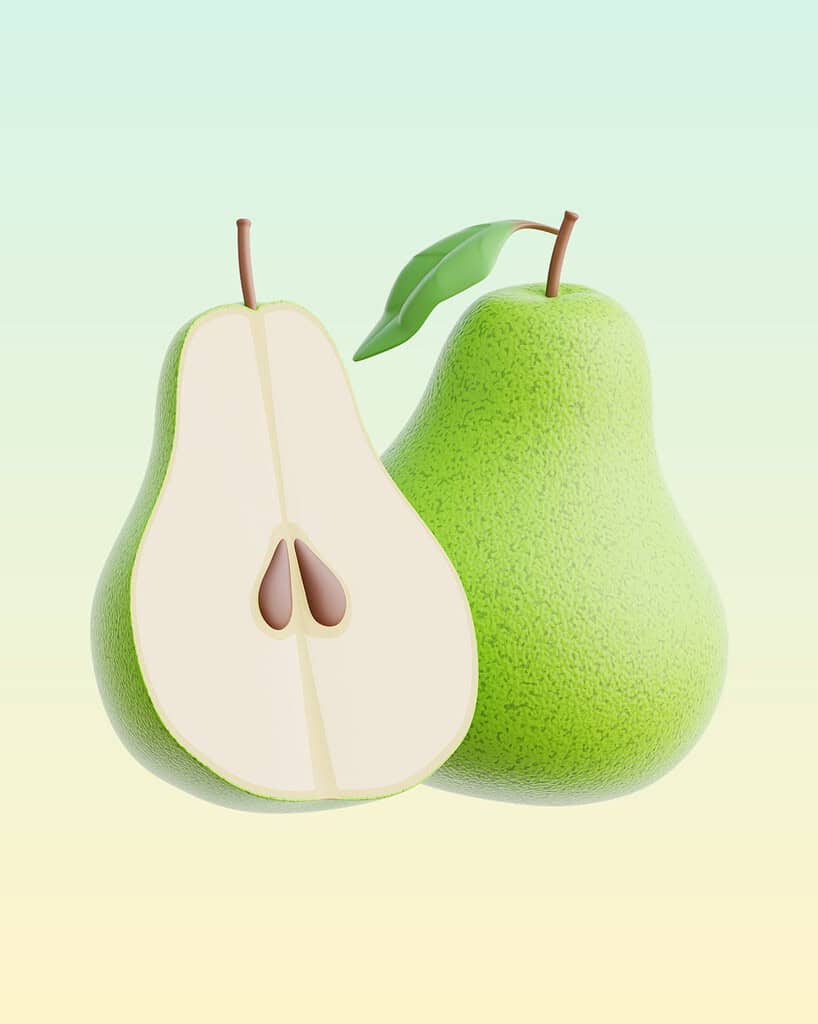
This is the part of the pear question that worries people most, so it is worth being precise. Pear seeds contain amygdalin, a cyanogenic glycoside. That is a sugar-bound compound that can release hydrogen cyanide when the seed is broken down. Cyanide stops cells from using oxygen, which is why the word sounds so alarming. Apple, cherry, peach, apricot and plum seeds and pits all belong to the same plant family and carry the same kind of compound.
The real-world risk from a few pear seeds, though, is low. Three facts explain why.
The first is that the cyanide is locked inside the seed. The Merck Veterinary Manual explains that these compounds turn into cyanide when the seed is compromised, as in chewing or grinding, and that a seed swallowed whole does not release cyanide, so toxicity is not expected. Pear seeds are small, smooth and slippery, and many dogs swallow them without crunching them.
The second is that pear seeds are on the low end of the range. A 2014 study in the journal Food Chemistry measured amygdalin in seeds bought from UK grocery stores. Conference pear seeds contained about 1.3 milligrams of amygdalin per gram of seed. Apple seeds came in at about 3.0, peach at 6.8, apricot at 14.4 and green plum at 17.5. In other words, a gram of pear seed carries less than half the amygdalin of a gram of apple seed and a small fraction of what is inside a stone-fruit kernel. A pear only has a handful of seeds, and each one weighs very little.
The third is that veterinary toxicologists rarely see serious poisoning from grocery fruit. Merck states that fruits bought for human consumption contain very low levels of cyanide within their seeds, and that it would be rare for toxicity to develop in animals eating them. It adds that severe toxicity in small animals is uncommon unless large amounts are eaten, and that most small-animal exposures to cyanogenic plants need only minimal stomach support.
None of that makes seeds a good idea. Low risk is not zero risk, and the amount that matters depends on how many seeds a dog chews, how big the dog is and whether this happens once or every day. A small dog that cracks open the seeds from several pears is a different situation from a Labrador that swallowed one core whole. There is no reliable “safe number” of seeds, which is exactly why every major source, from the AKC to PetMD, simply says to take them all out.
The core is honestly the bigger everyday hazard. It is firmer and more fibrous than the flesh, and a dog that gulps it can choke or end up with a piece stuck in the stomach or intestines. Larger pears have larger, tougher cores, and an underripe pear’s core is harder to break down than a ripe one’s. The stem is another small, woody piece that does not digest well and has no reason to be in your dog’s mouth. PetMD also notes that the stem and leaves contain trace amounts of cyanide compounds, like the seeds.
So the practical rule is simple. Cut the flesh away from the core, throw the core, seeds and stem straight into a lidded trash can, and do not hand over the leftover core from your own snack. If your dog does grab one, the next steps are usually calm ones, which we cover in the last section before the FAQ.
Can dogs eat canned pears, dried pears or pear juice?
Fresh is the only form worth offering on purpose. The processed versions are not poisonous, but each one adds something your dog does not need.
Canned pears. The AKC advises skipping canned or jarred pears with sugary syrups, even ones labeled “in their own juice,” because the extra sugar can irritate a dog’s digestive tract and add to weight gain. Daily Paws adds useful perspective: canned pears in syrup or water are nontoxic, so a slice or two snatched from a fruit cup is not a reason to panic. It is just not a treat to plan around. If you must use canned fruit, pears packed in water with no added sugar and rinsed well are the least-bad option.
Dried pears. Drying removes water and concentrates the sugar and calories into a much smaller, chewier piece, which makes overfeeding easy. Some dried fruit mixes also include raisins, which are toxic to dogs, so check the bag before you share anything from it.
Pear juice and baked goods. Juice keeps the sugar and loses most of the fiber. Pear tarts, muffins and pastries bring butter, sugar and sometimes nutmeg, raisins or xylitol, a sweetener that is dangerous for dogs even in small amounts. Our list of foods dogs can’t eat covers xylitol, raisins and the other ingredients to watch for in desserts.
How much pear can a dog eat?
Veterinary nutritionists at Tufts University recommend that treats of every kind make up no more than 10% of a dog’s daily calories, with the other 90% coming from a complete and balanced dog food. Tufts gives two handy reference points: an average 10-pound dog needs about 300 calories a day, and an average 75-pound dog needs about 1,400.
The table below is our own suggestion, not a veterinary prescription. We estimated daily calories for each size from the Tufts reference points, took 10% of that as the full treat allowance, and converted it to grams of raw pear using the USDA figure of 57 calories per 100 grams. The last column is deliberately smaller than the full allowance, because most dogs also get other treats during the day.
| Dog weight | Est. daily calories | Full 10% treat allowance | Pear that would use all of it | Our suggested pear serving |
|---|---|---|---|---|
| 5 lb | About 180 | 18 kcal | About 30 g (1/6 of a medium pear) | 2 to 3 small cubes (about 15 g, 9 kcal) |
| 10 lb | About 300 | 30 kcal | About 50 g (1/3 of a pear) | 1 to 2 thin slices (about 25 g, 14 kcal) |
| 25 lb | About 600 | 60 kcal | About 105 g (3/5 of a pear) | About 1/4 pear (45 g, 26 kcal) |
| 50 lb | About 1,000 | 100 kcal | About 175 g (1 pear) | 1/3 to 1/2 pear (60 to 90 g, 34 to 51 kcal) |
| 75 lb | About 1,400 | 140 kcal | About 245 g (1.4 pears) | About 1/2 pear (90 g, 51 kcal) |
| 100 lb | About 1,700 | 170 kcal | About 300 g (1.7 pears) | 1/2 to 2/3 pear (90 to 120 g, 51 to 68 kcal) |
Real calorie needs vary a lot with age, activity, body condition and whether a dog is spayed or neutered, so treat these as starting points. If you want to work out your own dog’s number, our dog feeding chart by weight walks through it.
How should you prepare pear for your dog?
Preparation takes about a minute and removes nearly all of the risk. Here is the routine we use:
- Pick a ripe pear. Ripe flesh is softer and easier to chew and digest. Skip fruit that is moldy, fermenting or bruised through.
- Wash it. Rinse under running water to remove dirt and surface residue, even if you plan to peel it.
- Peel if needed. The skin is safe for most dogs, but peeling helps dogs with tender stomachs.
- Cut the flesh off the core. Slice down all four sides of the core, then throw the core, seeds and stem away where your dog cannot reach them.
- Cut to size. Aim for pieces about the size of your dog’s kibble for small dogs and roughly one-inch cubes for large dogs. Never toss a whole pear or a big wedge to a dog that gulps.
Pear works well as a frozen summer treat, a few pieces mashed into a lick mat or a topping stirred into a meal. PetMD also suggests mixing mashed pear with plain, xylitol-free yogurt and freezing it inside a stuffable toy. For more fruit to rotate in, see our guide to bananas for dogs.
“That core can cause a foreign body obstruction; an intestinal obstruction, if it’s swallowed whole.”
Renee Schmid, DVM, DABVT, DABT, veterinary toxicologist with Pet Poison Helpline, Daily Paws (2026)
Choking deserves its own mention. Dogs that inhale food rather than chew it are the ones most likely to get a chunk of firm fruit stuck. Supervise the first few times, and if your dog gulps everything, cut pear smaller than you think you need to.
Which dogs should skip pears or eat less?
For most healthy adult dogs, a few pieces of pear is a non-event. A few groups need more care.
Dogs with diabetes. A medium pear holds about 17 grams of natural sugar. Dr. Weeth recommends steering clear of pears for diabetic dogs, and any change to a diabetic dog’s treats should go through your vet because it can affect insulin dosing and blood sugar control. Our guide to diabetes in dogs explains why consistent meals matter so much.
Dogs with sensitive stomachs. The combination of fiber and natural sugar can cause gas, loose stools or vomiting in dogs that are not used to fruit, especially if they eat a lot at once. Peeled, very small portions are the gentlest way to test.
Dogs on prescription diets. PetMD’s guidance is clear that dogs on a therapeutic diet should not get extra foods unless their vet says it is fine, because even a small treat can work against the diet’s purpose.
Dogs watching their weight. Pear is lighter than most biscuits, but calories still add up. Swap pear in for other treats rather than adding it on top.
Dogs with pancreatitis. Pear is almost fat-free, which is the nutrient vets usually worry about with pancreatitis, so it is less of a concern than fatty table scraps. It is still a question for your vet, since every dog’s plan is different.
What should you do if your dog ate a pear core or a whole pear?
Start by working out what was eaten, how much, and when. Count missing pears and look for leftover cores, stems and seeds. A dog that ate the flesh of a whole pear will usually have, at worst, a day of soft stool or gas. A swallowed core or several chewed-up cores is the scenario to take more seriously, mainly because of the blockage risk.
Watch your dog closely for the next 24 to 48 hours. Call your vet if you see repeated vomiting, retching without bringing anything up, a painful or bloated belly, loss of appetite, lethargy, or straining to poop with little result. Those can be signs of an obstruction. The signs of cyanide poisoning, such as rapid or difficult breathing, collapse or seizures, come on fast and are rare with grocery pears, but they are always an emergency. Do not try to make your dog vomit unless a vet tells you to.
If you are unsure whether the amount was a problem, ASPCA Animal Poison Control is available 24 hours a day at (888) 426-4435, and a consultation fee may apply. Our step-by-step guide for when your dog ate something it shouldn’t covers what to have ready when you call, and our article on why a dog is throwing up explains which vomiting patterns are urgent.
Having your dog’s details in one place makes these calls faster. In Lohji, the free Shiloh’s House app for pet parents, you keep the pet profile that a Shiloh’s House smart tag opens when someone taps it with a phone, including contacts and medical and behavior notes such as “diabetic, no fruit.” The same app turns your dog’s photo into a cartoon avatar, a Lohji, for stickers, slideshows and collector cards. Get it on the App Store or Google Play.
Put your dog’s health notes where a finder can see them
Shiloh’s House smart tags are laser-engraved premium acrylic with a “Tap Phone Here” NFC back. A finder taps with a phone, no app needed, and sees a live profile with call, text and directions, voice notes, medical notes and multiple contacts. Waterproof, scratch-resistant and UV-stable, made in the USA in 35 designs for $38, with 30-day returns. Acrylic is not chew-proof, so keep it away from determined chewers.
Looking for a citrus option instead? Our guide to whether dogs can eat oranges covers peels, seeds, mandarins, juice and safe segment counts by size.
Frequently asked questions
Are pears safe for dogs to eat every day?
A few small pieces of fresh pear a day is fine for most healthy dogs, as long as it fits inside the 10% treat allowance alongside everything else they get. Daily fruit is not necessary, though, and rotating pear with other low-calorie treats keeps sugar and fiber in check. Cut back if you notice gas or soft stools, and ask your vet first if your dog has diabetes.
How many pear seeds are toxic to a dog?
There is no reliable safe or toxic number. Pear seeds contain about 1.3 milligrams of amygdalin per gram, which is low, and the Merck Veterinary Manual says whole swallowed seeds do not release cyanide and that toxicity from grocery fruit is rare. Risk rises when many seeds are chewed, especially by small dogs. Remove all seeds and call your vet or a poison line if a lot were eaten.
Can dogs eat canned pears in juice?
They are not toxic, but they are not a good treat. The AKC recommends skipping canned or jarred pears with sugary syrups, even ones labeled “in their own juice,” because the added sugar can irritate the gut and contribute to weight gain. A slice or two your dog stole from a fruit cup is unlikely to cause more than a mild stomach upset.
Can puppies eat pears?
Healthy puppies can usually have a tiny taste of ripe, peeled pear once they are eating solid food, but their stomachs are more sensitive and their calorie budget for treats is small. Offer one or two very small, soft pieces, watch for loose stools, and remember that training treats already use much of a puppy’s 10% allowance. Ask your vet if your puppy has had stomach issues.
Can dogs eat pear skin?
Yes, washed pear skin is safe for most dogs. It holds extra fiber and some antioxidants, so it is not something you need to remove. PetMD notes the skin’s fiber can be tough on sensitive stomachs, so peel the pear if your dog is prone to digestive problems or is trying pear for the first time. Always wash the fruit before cutting it.
Are Asian pears safe for dogs?
Yes. Asian pears, sometimes called apple pears or nashi pears, are safe when you prepare them like any other pear. Wash the fruit, cut the flesh away from the core, discard all seeds and the stem, and serve small pieces. They are crisp and firm, so cut them a little smaller than soft Bartlett pear for dogs that gulp their food.
Sources
- Pears, raw (FDC ID 169118), USDA FoodData Central (2019)
- Can Dogs Eat Pears?, American Kennel Club (2025)
- Fruits and Vegetables Dogs Can or Can’t Eat, American Kennel Club (2026)
- Can Dogs Eat Pears? Benefits, Risks, and Feeding Tips, PetMD (2025)
- Can Dogs Eat Pears? Sure, but Only a Little, Daily Paws (2026)
- Houseplants and Ornamentals Toxic to Animals: Cyanogenic Glycoside Plants, Merck Veterinary Manual
- Amygdalin content of seeds, kernels and food products commercially-available in the UK, Bolarinwa, Orfila and Morgan, Food Chemistry (2014)
- Are pear, plum, and prune seeds toxic?, National Capital Poison Center (2026)
- Treat Options for Dogs and Cats Without Unbalancing Their Diet, Tufts Cummings School of Veterinary Medicine, Petfoodology (2021)
- Can My Pet Have Sweets?, Tufts Cummings School of Veterinary Medicine, Petfoodology (2022)
- ASPCA Poison Control, ASPCA