Can Dogs Eat Peaches? Pits, Safe Amounts and What to Avoid
 Shiloh’s House Team
·
·
16 min read

Yes, dogs can eat fresh peach flesh in small amounts; the pit is the dangerous part, along with the stem and leaves. The seed inside the pit holds amygdalin, a compound that releases cyanide when crushed, and the hard, ridged pit itself can choke a dog, block the intestine or scrape the gut on the way through. Serve ripe peach washed, pitted and cut into half-inch pieces, keep it to a few bites, and skip canned peaches in syrup, preserves, peach yogurt and peach ice cream.
Last updated: November 2026
Can dogs eat peaches safely?
The peach itself is not the problem. Every veterinary source we opened, from PetMD and the AKC to VCA Animal Hospitals and the Pet Poison Helpline, agrees that the flesh of a ripe peach is safe for dogs in moderation. PetMD, in an article reviewed by Jennifer Coates, DVM, says both puppies and adult dogs can enjoy peaches as long as the pit and stem are removed first.
The danger lives in the parts you would never eat yourself. The ASPCA Animal Poison Control Center lists the peach tree, Prunus persica, as toxic to dogs, cats and horses, names cyanogenic glycosides as the toxic principle, and specifies that the stems, leaves and seeds contain cyanide, particularly as they wilt. The pit is also a choking and obstruction hazard in its own right, which is why this fruit needs more care than a blueberry.
Peaches do not appear on the list of foods that truly poison dogs, which we walk through in our guide to foods dogs cannot eat. Think of them the way vets do: a sugary, low-fat, occasional treat that is safe when you do the prep work and risky when a dog helps itself to a whole peach, pit and all.

Are peaches good for dogs?
A peach is mostly water with a real dose of natural sugar and a little fiber. Here is what USDA FoodData Central reports for raw yellow peaches (SR Legacy, FDC ID 169928), per 100 grams and per medium peach, using USDA’s 147-gram serving.
| Nutrient (raw yellow peach) | Per 100 g | Per medium peach (147 g) |
|---|---|---|
| Calories | 39 kcal | 57 kcal |
| Water | 88.9 g | 130.7 g |
| Total sugars | 8.39 g | 12.3 g |
| Dietary fiber | 1.5 g | 2.2 g |
| Total fat | 0.25 g | 0.37 g |
| Potassium | 190 mg | 279 mg |
| Vitamin C | 6.6 mg | 9.7 mg |
| Vitamin A (RAE) | 16 mcg | 24 mcg |
| Vitamin E | 0.73 mg | 1.07 mg |
| Sodium | 0 mg | 0 mg |
Two lines matter most. The first is sugar: at 8.39 grams per 100 grams, peach lands in the same range as apples and blueberries. That is why PetMD flags peaches as high in sugar and warns that too much over time is a problem for dogs with diabetes or obesity.
The second is fat: essentially none, which makes peach a gentler choice than peanut butter or cheese for a dog that needs a low-fat treat. The vitamins are nice to see on the label, but a dog eating a complete and balanced food already gets everything it needs, and dogs make their own vitamin C. The honest case for a peach is that it is juicy, low in fat and tastes like dessert to a dog.
Why is the peach pit so dangerous for dogs?
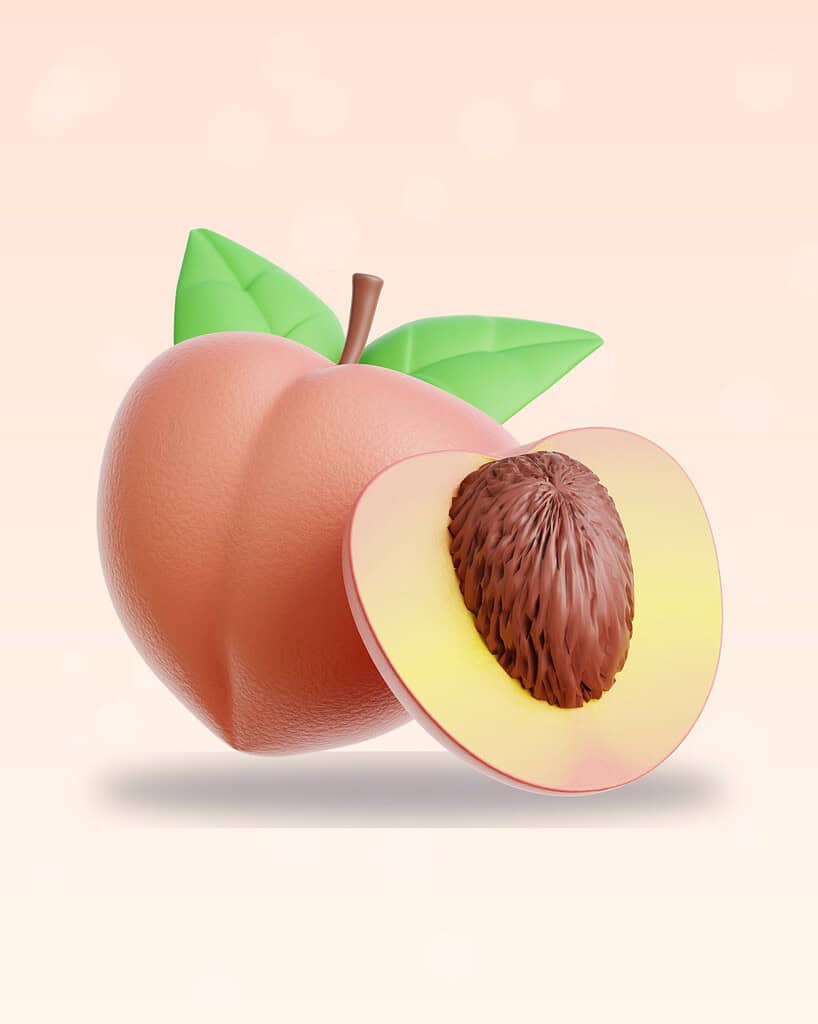
A peach pit is really two things: a woody shell and the almond-shaped seed, or kernel, inside it. Both cause trouble, for different reasons, and the difference tells you how worried to be when a pit goes missing.
Start with the chemistry. The kernel stores amygdalin, a cyanogenic glycoside that is harmless while it sits intact in the seed. When the seed is crushed or chewed, plant enzymes break amygdalin down and release hydrogen cyanide. A 2014 study in Food Chemistry by Islamiyat Bolarinwa and colleagues at the University of Leeds measured 6.81 milligrams of amygdalin per gram of peach seed, in the same range as apricot and plum kernels. A 2017 study in Preventive Nutrition and Food Science found that the flesh of ripe fruit had very low or undetectable amygdalin, with nearly all of it concentrated in the seed. The fruit you serve is clean; the kernel is where the poison lives.
Cyanide works by blocking the enzyme cells use to make energy from oxygen, so tissues suffocate even while the dog is breathing. The Merck Veterinary Manual puts the acute lethal oral dose of hydrogen cyanide at roughly 2 milligrams per kilogram of body weight in most species and notes that dogs have lower activity of rhodanese, the enzyme that detoxifies cyanide, than other animals. Signs come fast: brick-red gums, dilated pupils, gasping, drooling, collapse and seizures.
Here is the reassuring part. The Pet Poison Helpline explains that because dogs and cats do not thoroughly chew their food, it is unlikely that cyanide poisoning would follow a peach pit ingestion. The FDA says the same thing in plain language: cyanide poisoning is rare unless a pet eats a lot of pits and chews them up, because the pits must be crushed or ground to release the cyanide. A dog that gulps a pit whole has swallowed a sealed container. The dog that worries toxicologists is the one that cracks several pits open with its molars, or a small dog that grinds through a single kernel.
The second danger does not depend on chemistry at all. A peach pit is a hard, ridged oval roughly an inch across, which is exactly the wrong size for a dog’s digestive tract. VCA veterinarians Tammy Hunter and Lynn Buzhardt write that hard pits can fracture teeth, cause choking or obstruct the GI tract, and that pits with rough edges can injure the esophagus as they are swallowed, leaving ulcers or tears. The Pet Poison Helpline adds that a single pit swallowed by a small-breed dog may be enough to cause a gastrointestinal obstruction. The FDA calls obstruction the bigger risk for dogs and cats that eat stone fruit pits.
An obstruction is a surgical emergency, and the early signs look like an upset stomach. Watch for repeated vomiting, straining to pass stool or passing none, a painful or tense belly, drooling, lethargy and refusal to eat. A pit lodged in the esophagus causes gagging and regurgitation within minutes.
Finally, remember the rest of the tree. The ASPCA notes that peach stems and leaves also contain cyanogenic glycosides and are particularly toxic in the process of wilting. A dog that chews fallen branches or pruned leaves under a backyard peach tree is at greater risk than one that swallowed a single pit, and the dropped fruit under that tree is usually bruised or moldy as well.
How much peach can a dog eat?
Veterinary nutritionists use one guardrail for every treat: all treats combined should stay under 10 percent of a dog’s daily calories, and PetMD applies that rule to peaches specifically. The American Animal Hospital Association’s 2021 nutrition guidelines supply the rest of the math: resting energy requirement is 70 times body weight in kilograms raised to the 0.75 power, multiplied by a life-stage factor of 1.4 to 1.6 for a neutered adult.
We ran that math for four weights using the 1.6 factor, took 10 percent as the treat budget, and converted it to raw peach at 39 calories per 100 grams. The table is our suggestion, not a prescription, and the right-hand column sits far below what the calories allow, because peach sugar upsets a stomach first. A half-inch cube of peach weighs about 8 grams and carries about 3 calories.
| Dog weight | Daily treat budget (10%) | Peach if it were the only treat | Our suggested serving (a few times a week) |
|---|---|---|---|
| 10 lb (4.5 kg) | About 35 kcal | About 89 g | 1 to 2 half-inch cubes |
| 25 lb (11.3 kg) | About 69 kcal | About 177 g | 2 to 3 cubes |
| 50 lb (22.7 kg) | About 116 kcal | About 299 g | 3 to 5 cubes, about a quarter of a peach |
| 80 lb (36.3 kg) | About 166 kcal | About 425 g | 5 to 6 cubes, about half a peach |
Notice the gap between the third and fourth columns. A 50-pound dog could in theory eat two whole peaches before touching its treat budget, and it would spend the next day with loose stools. The AKC notes that temporary diarrhea after fresh peach is not uncommon, and PetMD advises starting slowly.
Preparation is the same every time. Wash the peach, cut the flesh away from the pit, discard the pit and stem out of reach, and cut the flesh into half-inch pieces. PetMD suggests mashing a little into kibble or mixing it into plain, xylitol-free yogurt on a lick mat, about 2 tablespoons per 10 pounds of dog.
Can dogs eat canned peaches, peach yogurt or peach ice cream?
Fresh is the only form of peach we would share freely. The trouble with every packaged version is what gets added. USDA FoodData Central lists canned peaches in heavy syrup (SR Legacy, FDC ID 169112) at 74 calories and 18.6 grams of sugar per 100 grams, more than double the sugar of fresh fruit. A single canned half with its syrup weighs about 98 grams, so one piece uses up a small dog’s whole treat budget. PetMD says to avoid heavy syrup and notes that peaches canned in juice are a better option.
Peach preserves, jam and pie filling are concentrated sugar, and some low-sugar versions swap in artificial sweeteners. Peach yogurt is the sneakiest. PetMD warns that some store-bought flavored yogurts contain xylitol, a sweetener that is toxic to dogs. The FDA explains why: in dogs, xylitol triggers a rapid insulin release and a profound drop in blood sugar within 10 to 60 minutes, and it lists sugar-free desserts, including “skinny” ice cream, among products that have poisoned dogs. Xylitol may be labeled birch sugar, which is why our peanut butter guide says to read every label twice.
Peach ice cream has the same sweetener risk if it is labeled sugar-free, plus dairy fat that gives many dogs diarrhea. Dried peaches concentrate the sugar, and the AKC’s Dr. Casper notes that canned or dehydrated peaches often contain excess sugars and ingredients that are not recommended. For a frozen treat, blend fresh peach with plain yogurt and freeze it in a KONG.
Make sure the person who finds your dog knows the no-treat rule
A Shiloh’s House Smart Tag pairs laser-engraved acrylic with a “Tap Phone Here” NFC back, so a finder, sitter or neighbor taps the tag and sees your contacts, medical notes and feeding rules before anyone shares a peach cobbler. $38 one-time, no subscription, no battery, made in the USA, 30-day returns.
What should you do if your dog swallows a peach pit?
First, figure out what happened: whole or chewed, how many pits, how big a dog, and when. Then call your veterinarian, the Pet Poison Helpline at (855) 764-7661 or the ASPCA Animal Poison Control Center at (888) 426-4435. Both lines are staffed around the clock and both charge a consultation fee. Do not induce vomiting at home unless they tell you to; a hard, ridged pit can do more damage coming back up than it did going down.
“A peach’s pit is not safe for a dog to ingest. When feeding peaches, make sure to remove the pit, stem, and leaves. The pit is a choking hazard and can even lead to an intestinal blockage if ingested. Peach pits also contain a form of cyanide that can be toxic if ingested.”
Gavin Casper, DVM, Medical Director at Hometown Animal Hospital in Weston, Florida (American Kennel Club, 2025)
A whole pit swallowed by a large dog will often pass on its own within a few days, and your vet may simply have you watch for it. For a small dog, or any dog that swallowed several pits, the vet may want X-rays. VCA notes that after swallowing a pit a dog may gag, drool, vomit, have difficulty passing stool and show abdominal pain, and that any of those signs deserves a call. A swollen belly or vomiting that will not stop means go in now.
A chewed pit is the other scenario. If your dog cracked the shell and ate the kernel, cyanide is on the table, and the Pet Poison Helpline lists vomiting, drooling, gasping, collapse and seizures as the signs. VCA is blunt that cyanide toxicity in any amount is an emergency and says to call right away if your pet breaks open a pit. Treatment exists, but it has to happen fast. Our step-by-step guide to what to do when your dog eats something it should not walks you through the first hour for either case.
Which dogs should skip peaches?
For a healthy adult dog, a few cubes of ripe peach are an easy yes. For these dogs, we would pause and ask the vet first.
Dogs with diabetes. A medium peach carries about 12 grams of sugar, and PetMD specifically names diabetes among the conditions that make peach sugar a problem. A diabetic dog’s insulin dose is matched to a consistent diet, and sweet treats between meals push glucose around. Our guide to diabetes in dogs explains why treat timing matters as much as treat size.
Dogs with a history of pancreatitis. Peach is very low in fat, so it is not a classic trigger the way bacon is, but dogs recovering from a flare are usually on a strict prescription diet, and PetMD’s rule applies: no food or treats outside the diet unless the veterinarian says so.
Dogs with sensitive stomachs. The AKC notes that temporary diarrhea after fresh peach is common. If your dog already has a touchy stomach, peel the peach, keep it to a single cube, or choose cucumber instead.
Overweight dogs. Sweet treats add up, and PetMD lists obesity next to diabetes as a reason to limit sugar. Swap half the serving for green beans.
Puppies and small gulpers. PetMD says puppies can have peach too, but the pit and large chunks are a bigger choking risk in a small mouth. Cut smaller and supervise.
Whatever the rule is for your dog, write it somewhere other people will see it. In the free Lohji app from Shiloh’s House, you keep a live pet profile with contacts, medical notes and voice messages that a Shiloh’s House NFC tag links to, so a sitter or finder who taps the tag reads “diabetic, no treats” or “food sensitivity, kibble only” before anyone offers a snack. The app also makes cartoon Lohji avatars, stickers and slideshows of your pet. Get it on the App Store or Google Play.
How do peaches compare with apples, pears and blueberries?
Here is how peach stacks up against the other fruits pet parents reach for, raw, per 100 grams, from USDA FoodData Central’s SR Legacy records.
| Fruit (raw, per 100 g) | Calories | Sugars | Fiber | Potassium | USDA FDC ID |
|---|---|---|---|---|---|
| Peach, yellow | 39 kcal | 8.4 g | 1.5 g | 190 mg | 169928 |
| Apple, with skin | 52 kcal | 10.4 g | 2.4 g | 107 mg | 171688 |
| Pear | 57 kcal | 9.8 g | 3.1 g | 116 mg | 169118 |
| Blueberries | 57 kcal | 10.0 g | 2.4 g | 77 mg | 171711 |
Peach is the lightest of the four, with the fewest calories and the least sugar per 100 grams, but also the least fiber. Apples bring more fiber and the same seed concern in miniature; our guide to apples for dogs covers the core and seeds. Pears top the fiber column and share the amygdalin-in-the-seeds story, as we explain in pears for dogs. Blueberries win on portion control, because a single berry is a complete, pit-free treat; see blueberries for dogs.
The real difference is not on the label. An apple or pear seed is tiny and usually passes unnoticed; a peach pit is a one-inch stone that can block a small dog on its own. That is why peach prep takes more care than any of the three.
Frequently asked questions
Can dogs eat peach skin?
Yes, most dogs can eat peach skin, according to PetMD, but it can be hard to digest. If your dog has a sensitive stomach or is trying peach for the first time, peel the slice. Either way, wash the fruit well and cut it into half-inch pieces.
What happens if a dog eats a peach pit?
It depends on whether the pit was swallowed whole or chewed. A whole pit is mainly a choking and blockage risk, especially for small dogs; the Pet Poison Helpline says cyanide poisoning is unlikely because dogs rarely chew pits thoroughly. A cracked pit exposes the kernel, which can release cyanide. Either way, call your vet or a poison helpline right away.
Can dogs eat canned peaches?
Not the kind packed in heavy syrup. USDA data puts them at 18.6 grams of sugar per 100 grams, more than double fresh peach, and PetMD says to avoid them. Peaches canned in juice are a better choice in tiny amounts, but fresh is always better. Skip preserves, pie filling and anything labeled sugar-free, which may contain xylitol.
How much peach can I give my dog?
Treats should stay under 10 percent of daily calories, but with peach the sugar sets the limit first. Our suggestion, a few times a week: one or two half-inch cubes for a 10-pound dog, two or three for a 25-pound dog, three to five for a 50-pound dog and five or six for an 80-pound dog. Start with one cube and watch for loose stools.
Can dogs eat peach yogurt or peach ice cream?
Be careful. PetMD warns that some store-bought flavored yogurts contain xylitol, which is toxic to dogs, and the FDA has logged poisonings from sugar-free “skinny” ice cream. Regular versions are heavy in sugar and dairy fat. The safe version is homemade: mash fresh peach into plain, unsweetened, xylitol-free yogurt and freeze it in a lick mat or KONG.
Can puppies eat peaches?
Yes, PetMD says both puppies and adult dogs can eat peaches in moderation once they are on solid food. Keep pieces tiny, remove the pit, stem and skin, and offer only one or two cubes, because puppies have sensitive stomachs and small mouths. The bigger risk is a whole peach left within reach, so keep the fruit bowl out of range.
Sources
- USDA Agricultural Research Service, “Peaches, yellow, raw (SR Legacy, FDC ID 169928)”, USDA FoodData Central, 2019 — https://fdc.nal.usda.gov/food-details/169928/nutrients
- USDA Agricultural Research Service, “Peaches, canned, heavy syrup pack, solids and liquids (SR Legacy, FDC ID 169112)”, USDA FoodData Central, 2019 — https://fdc.nal.usda.gov/food-details/169112/nutrients
- USDA Agricultural Research Service, “Apples, raw, with skin (SR Legacy, FDC ID 171688)”, USDA FoodData Central, 2019 — https://fdc.nal.usda.gov/food-details/171688/nutrients
- USDA Agricultural Research Service, “Pears, raw (SR Legacy, FDC ID 169118)”, USDA FoodData Central, 2019 — https://fdc.nal.usda.gov/food-details/169118/nutrients
- USDA Agricultural Research Service, “Blueberries, raw (SR Legacy, FDC ID 171711)”, USDA FoodData Central, 2019 — https://fdc.nal.usda.gov/food-details/171711/nutrients
- Victoria Lynn Arnold, reviewed by Jennifer Coates, DVM, “Can Dogs Eat Peaches?”, PetMD, 2025 — https://www.petmd.com/dog/nutrition/can-dogs-eat-peaches
- Colt Dodd, with Gavin Casper, DVM, “Can Dogs Eat Peaches?”, American Kennel Club, 2025 — https://www.akc.org/expert-advice/advice/can-dogs-eat-peaches/
- ASPCA Animal Poison Control Center, “Toxic and Non-toxic Plants: Peach”, ASPCA, accessed 2026 — https://www.aspca.org/pet-care/aspca-poison-control/toxic-and-non-toxic-plants/peach
- Pet Poison Helpline, “Peach Pits”, Pet Poison Helpline, accessed 2026 — https://www.petpoisonhelpline.com/poison/peach-pits/
- Tammy Hunter, DVM, and Lynn Buzhardt, DVM, “Summer Fun and Follies”, VCA Animal Hospitals, accessed 2026 — https://vcahospitals.com/know-your-pet/summer-fun-and-follies
- U.S. Food and Drug Administration, “Potentially Dangerous Items for Your Pet”, FDA, accessed 2026 — https://www.fda.gov/animal-veterinary/animal-health-literacy/potentially-dangerous-items-your-pet
- U.S. Food and Drug Administration, “Paws Off Xylitol; It’s Dangerous for Dogs”, FDA, accessed 2026 — https://www.fda.gov/consumers/consumer-updates/paws-xylitol-its-dangerous-dogs
- Scott Radke, DVM, MS, DABVT, “Cyanide Poisoning in Animals”, Merck Veterinary Manual, 2026 — https://www.merckvetmanual.com/toxicology/cyanide-poisoning/cyanide-poisoning-in-animals
- Islamiyat F. Bolarinwa, Caroline Orfila and Michael R.A. Morgan, “Amygdalin content of seeds, kernels and food products commercially-available in the UK”, Food Chemistry, 2014 — https://eprints.whiterose.ac.uk/id/eprint/83873/2/Bolarinwa.pdf
- Suk-Hee Lee et al., “Amygdalin Contents in Peaches at Different Fruit Development Stages”, Preventive Nutrition and Food Science, 2017 — https://pmc.ncbi.nlm.nih.gov/articles/PMC5642807/
- American Animal Hospital Association, “Energy Requirement Calculations (2021 AAHA Nutrition and Weight Management Guidelines)”, AAHA, 2021 — https://www.aaha.org/wp-content/uploads/globalassets/02-guidelines/2021-nutrition-and-weight-management/resourcepdfs/nutritiongl_box1.pdf