Can Dogs Eat Mushrooms? Store-Bought vs Wild, Toxic Species and What to Do
 Shiloh’s House Team
·
·
16 min read

Dogs can eat plain, cooked store-bought mushrooms such as white button, cremini, portobello, shiitake and oyster in small amounts, but they should never eat a wild mushroom. Grocery mushrooms are low-calorie and non-toxic, though they add little a dog needs. Wild mushrooms are a different matter. A few species, led by the death cap and destroying angels, cause liver failure that shows up only after a silent delay, and most dogs who eat them die. Treat any wild-mushroom bite as an emergency and call a vet or poison line immediately.
Last updated: September 2025
Can dogs eat mushrooms safely?
The answer splits in two. Mushrooms sold for people are fine for dogs. PetMD, in an article reviewed by Sandra C. Mitchell, DVM, DABVP, lists white button, cremini, portabella, baby bella, shiitake, porcini and maitake as grocery-store mushrooms that are not toxic to dogs, as long as they are washed, cut small and served plain, and its general rule covers other supermarket staples such as oyster mushrooms. The American Kennel Club agrees that chain grocery-store mushrooms are generally safe, then adds that dogs do not need them.
Wild mushrooms are the half that matters. Tina Wismer, DVM, who directs the ASPCA Animal Poison Control Center, put it plainly more than a decade ago and nothing has changed since.
“If your dog eats a mushroom bought at the grocery store, there is little risk of poisoning. Most mushrooms that are safe for people are also safe for pets. Wild mushrooms, unfortunately, may be deadly.”
Tina Wismer, DVM, DABVT, DABT, medical director of the ASPCA Animal Poison Control Center (Vetstreet, 2014)
Only a small percentage of mushroom species are toxic, as the AKC points out, but the toxic ones are extremely dangerous and hard to tell from harmless ones. So the rule every veterinary source we opened agrees on is simple: no wild mushrooms, ever, and any ingestion is a vet call, not a wait-and-see.
Are mushrooms good for dogs?
Here is what USDA FoodData Central reports for raw white mushrooms (SR Legacy, FDC ID 169251) per 100 grams, a little more than a cup of whole mushrooms. One medium mushroom is about 18 grams and 4 calories.
| Nutrient (raw white mushrooms) | Per 100 g |
|---|---|
| Calories | 22 kcal |
| Water | 92.4 g |
| Protein | 3.09 g |
| Total fat | 0.34 g |
| Carbohydrate (incl. 1.0 g fiber, 1.98 g sugars) | 3.26 g |
| Potassium | 318 mg |
| Phosphorus | 86 mg |
| Riboflavin / niacin | 0.40 mg / 3.61 mg |
| Selenium / copper | 9.3 mcg / 0.32 mg |
So a white mushroom is mostly water with a little protein, a little fiber and a respectable dose of B vitamins, selenium and copper for 22 calories per 100 grams. That is a decent profile for a treat, not a reason to feed one; PetMD says mushrooms give dogs less of these benefits than people and that there is no real advantage to feeding them. Here is how they compare with three other produce-drawer treats, raw, from USDA.
| Food (raw, per 100 g) | Calories | Water | Protein | Fiber | Sugars | Potassium | USDA FDC ID |
|---|---|---|---|---|---|---|---|
| White mushrooms | 22 kcal | 92.4 g | 3.1 g | 1.0 g | 2.0 g | 318 mg | 169251 |
| Cucumber, with peel | 15 kcal | 95.2 g | 0.7 g | 0.5 g | 1.7 g | 147 mg | 168409 |
| Green beans | 31 kcal | 90.3 g | 1.8 g | 2.7 g | 3.3 g | 211 mg | 169961 |
| Carrots | 41 kcal | 88.3 g | 0.9 g | 2.8 g | 4.7 g | 320 mg | 170393 |
Mushrooms bring the most protein of the four and little sugar, but less fiber than green beans or carrots; for a crunchy, filling reward, green beans or broccoli do more.
Cooked beats raw. A raw mushroom is firm and springy, and PetMD warns that mushrooms should be cut small to prevent choking; a whole raw button is exactly what a gulping dog inhales. Steam or roast them with nothing added, then chop, and keep all treats under PetMD’s 10 percent of daily calories.
Why are wild mushrooms a different story?
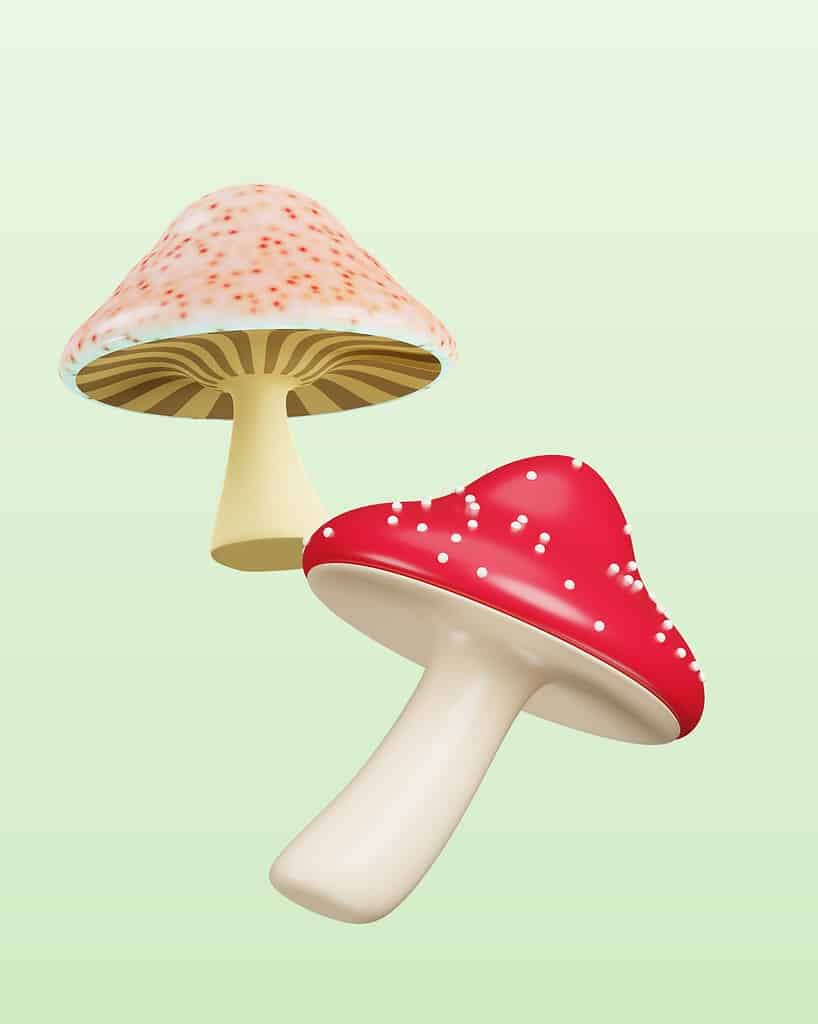
Everything above applies to farmed mushrooms. The moment a mushroom comes out of the ground on its own, the question changes from nutrition to toxicology, and the answer from any veterinary toxicologist is the same: assume it is poisonous. The reason is a family of chemicals called amatoxins.
Amatoxins are small, stable peptides found in the death cap, Amanita phalloides, in its relatives Amanita ocreata and Amanita bisporigera, both called destroying angel, in the little brown Galerina marginata, and in several Lepiota and Conocybe species. The Merck Veterinary Manual, in a chapter by veterinary toxicologist Birgit Puschner of Michigan State University, says these species account for most reported mushroom deaths, are common throughout North America and grow in association with oak, pine and birch. Rhian Cope, a veterinary toxicologist writing in Veterinary Medicine, reported that the death cap alone accounts for more than half of mushroom deaths in people and most reported fatal cases in dogs.
The dose is tiny. Merck reports that death caps and Amanita ocreata average 1.5 to 2.3 milligrams of amanitins per gram of dried mushroom, so one cap can hold a lethal dose for an animal or a person. Once absorbed, the toxin enters liver cells and shuts down RNA polymerase II, the enzyme a cell needs to make proteins. The hardest-working cells fail first: the liver, the gut lining and the kidney tubules. There is no proven antidote.
What makes amatoxins so dangerous in practice is the timing. Merck describes four phases. First a latent period of about 6 to 12 hours, sometimes up to 24, during which the dog looks completely normal. Then a gastrointestinal phase of vomiting, abdominal pain, diarrhea and lethargy lasting up to a day. Then a false recovery, when the dog seems better and a worried owner relaxes. Then, 36 to 72 hours after the mushroom was eaten, liver failure, bleeding problems and often kidney failure, ending in recovery or death over the following one to two weeks. Severe low blood sugar can strike after the gut phase; Merck cites a study in which half of dogs given lethal doses died of hypoglycemia within a day or two.
That silent first window is why you cannot use symptoms to decide whether to call. By the time a dog looks sick, the toxin has been working in the liver for hours, and Cope notes that making a dog vomit is probably no longer useful more than four hours after ingestion. Cope also writes that mushroom poisoning in dogs is probably underestimated, and the AKC calls it an under-reported cause of fatal poisoning. The numbers that do get recorded are grim. The North American Mycological Association, which keeps a voluntary poison case registry for people and animals, logged 25 dogs with amatoxin poisoning between 2018 and 2020. Twenty died and two were recorded as recovering. Michael Beug, chair of NAMA’s toxicology committee, calls dog deaths from amatoxin mushrooms a critical problem and notes that reporting to NAMA has dropped sharply under newer privacy laws, so the real toll is larger.
Amatoxins are the worst case, not the only case. Other wild mushrooms cause drooling and collapse within minutes, drunken staggering within an hour or two, or a day of miserable vomiting. But because a yard can hold several species side by side, one rule covers all of them. Wild mushroom in the mouth means a phone call now.
Which wild mushrooms poison dogs?
Toxicologists group poisonous mushrooms by toxin rather than by looks. Merck’s rule of thumb is that species producing signs within about 3 hours are usually not life-threatening, while those with a delay longer than 6 hours are. This table draws on Merck, Dr. Wismer and NAMA.
| Toxin group | Example species | First signs | Onset after eating | Danger to dogs |
|---|---|---|---|---|
| Amatoxins (cyclopeptides) | Amanita phalloides (death cap), A. ocreata and A. bisporigera (destroying angels), Galerina marginata, Lepiota spp. | Vomiting, diarrhea, belly pain, lethargy, then false recovery | 6 to 24 hours, usually 6 to 12 | Life-threatening; liver then kidney failure; most dogs die |
| Gyromitrin | Gyromitra esculenta (false morel) | Vomiting, watery diarrhea, belly pain, seizures | 6 to 12 hours | Serious; can end in liver and kidney failure; one NAMA dog death in 2020 |
| Muscarine | Inocybe spp., Clitocybe spp. | Drooling, tearing, urination, diarrhea, vomiting | 5 to 30 minutes, within 2 hours | Usually responds to atropine; two NAMA dog deaths, 2018 to 2020 |
| Isoxazoles (ibotenic acid, muscimol) | Amanita muscaria (fly agaric), A. pantherina (panther cap) | Vomiting, then disorientation, staggering, tremors, seizures, deep sleep | 30 minutes to 2 hours; recovery 4 to 24 hours | Usually survivable with support; three NAMA dog deaths, 2018 to 2020 |
| Psilocybin | Psilocybe, Panaeolus, Gymnopilus spp. | Agitation, hallucination-like behavior, drunkenness, fever | 30 to 60 minutes; recovery 6 to 12 hours | Rarely fatal; dogs can hurt themselves while agitated |
| Gastrointestinal irritants | Chlorophyllum molybdites, Russula emetica, Paxillus involutus | Vomiting and diarrhea | 15 minutes to 3 hours | Usually over in 1 to 2 days, but small dogs dehydrate fast |
The fly agaric, the red toadstool with white spots, is not the deadly one, but NAMA’s Beug is struck by how often dogs eat it and the panther cap, and warns that atropine, the antidote for muscarine mushrooms, intensifies their toxins and has been involved in dog deaths. And Galerina marginata, the AKC’s deadly Galerina, is a plain little brown mushroom with the same amanitins as the death cap; Dr. Wismer warns that such look-alikes can cause different, sometimes lethal, effects.
Put “ate a wild mushroom” where a sitter or finder will see it
Mushroom poisoning hides for hours, and the person with your dog when symptoms start may not be you. A Shiloh’s House Smart Tag is laser-engraved premium acrylic with a “Tap Phone Here” NFC back; a sitter or finder taps it with any modern phone and sees your live profile with contacts, medical notes and voice messages. About $38 one-time, no subscription, no battery, waterproof, made in the USA, 30-day returns.
Where do dogs find toxic mushrooms?
Closer to home than most people expect. Dr. Wismer notes that mushrooms turn up in parks, yards and woods, and that dogs are poisoned more often than cats because they scavenge. The University of Georgia’s extension service explains that mushrooms appear in turf, mulch and landscape beds when rain follows a dry spell, feeding on buried wood, roots, leaf piles, thatch and mulch.
Season matters too. Cope writes that spring, summer and fall are the principal seasons for mushroom poisoning in North America, and Dr. Wismer flags fall and spring in particular. Merck places the death-cap group under oak, pine and birch, and the false morels under conifers and aspens in spring. NAMA’s 2018 to 2020 registry is thick with California death cap cases, many of them puppies. The places to check are the ones you pass every day:
- Lawns and the base of trees, especially oaks, after rain
- Mulched beds, wood-chip paths and playground chips
- Rotting logs, old stumps and firewood piles
- Shaded, overwatered corners and the spot under a leaky spigot
- Trail edges and campsites
Dogs that eat grass are the ones most likely to pick up a mushroom with the mouthful, so for grazers the daily yard check below is not optional. For trail days, our hiking with a dog checklist covers leash rules and the numbers to save before you lose signal.
What should you do if your dog eats a wild mushroom?
Act as if it is the worst kind, because treatment helps most while your dog still looks fine. Here is the sequence Dr. Wismer, Cope, NAMA and the AKC all point to.
- Get the rest out of the mouth, move the dog away from the patch and note the time.
- Photograph the mushrooms where they grow, top, underside and stem base. Dr. Wismer notes the one your dog ate may not be the one still standing, so shoot everything nearby.
- Bag a sample in a paper bag or wax paper, never plastic, wrapped in a damp paper towel, and refrigerate it; Cope, NAMA and the AKC all say so. Note where it grew, since NAMA says location helps identification.
- Call now. Your veterinarian, the ASPCA Animal Poison Control Center at (888) 426-4435, or Pet Poison Helpline at (855) 764-7661. Both are open around the clock and charge a fee; as of 2024 and 2025 that was $95 for the ASPCA and $89 per incident for Pet Poison Helpline, follow-ups included. Have the dog’s weight, the time and your photos ready.
- Go to the vet if told to, and do not wait for symptoms. Cope says inducing vomiting is probably useless more than four hours after ingestion and should only be done in a dog that is still symptom-free.
- Save any vomit. Mushroom pieces in it are often the best identification evidence a vet will get.
Our guide to what to do when your dog ate something it should not have covers the first hour in detail, our post on why your dog is throwing up lists mushrooms among the same-day-call causes, and a stocked pet first aid kit with paper bags, gloves and both hotline numbers saves fumbling.
How do vets treat mushroom poisoning in dogs?
Merck sums up the position bluntly: with no proven antidotes, treatment is directed at decontamination and intensive supportive care.
Decontamination means inducing vomiting if the dog is still well and the mushroom is recent, then activated charcoal; for amatoxins, Merck recommends 1 to 2 grams per kilogram, repeated in half doses within the first 24 hours. Supportive care for the deadly groups means IV fluids, dextrose for blood sugar, vitamin K1 and plasma for clotting, anti-nausea drugs, and close monitoring of liver and kidney values. For the muscarine group, Dr. Wismer says signs resolve quickly with atropine. For the fly agaric group, the job is controlling seizures and protecting breathing, carefully, because Dr. Wismer notes that some of these patients stop breathing after a sedative.
Liver support is where the research is. Merck notes that silibinin, a milk-thistle extract used in Europe but not approved in the United States, reduced liver uptake of the toxin in dogs when given at 5 and 24 hours after exposure. More hopeful, Ryan Goupil and colleagues reported in the Journal of Veterinary Emergency and Critical Care in 2021 that five dogs with confirmed amatoxin poisoning and liver failure all survived on an adapted Santa Cruz protocol, built around draining the gallbladder through the skin, the drug octreotide and withholding food early. Five dogs is a small series, but it is the first good news in this corner of toxicology in a long time.
The honest summary: dogs that eat the fast-acting groups usually go home within a day or two. Dogs that eat an amatoxin mushroom are fighting for their lives, and most lose. The one variable an owner controls is the clock.
How do you keep your dog away from mushrooms?
- Walk the yard every morning in mushroom season and after any rain. Pick mushrooms with a gloved hand, bag them and trash them. UGA recommends removing them as soon as they sprout, before they drop spores, and Dr. Wismer’s advice is the same: mushrooms on the lawn or in mulched areas get removed.
- Dry things out and starve the fungus. Fix the leaky spigot, cut back on irrigation, grind out old stumps, rake out leaf piles, and rethink wood-chip mulch where your dog patrols.
- Train a rock-solid “leave it” and “drop it”, paid with something better than whatever is on the ground, and practice in the yard before you need it on a trail.
- Use a leash or a basket muzzle in the woods during peak season if your dog is a known forager. A well-fitted basket muzzle lets a dog pant and drink but not grab a mushroom.
- Keep foraged mushrooms out of reach at home. A dog does not need a whole patch: NAMA’s registry includes a puppy killed by half of one immature death cap.
Write the plan where other people will see it. In the free Lohji app from Shiloh’s House, you keep a live pet profile with contacts, medical notes, behavior notes and voice messages that a Shiloh’s House NFC tag links to, so a sitter who taps the tag reads “forager, check the yard” first. The app also turns pet photos into cartoon Lohji avatars, stickers and mini movies. Get it on the App Store or Google Play.
Frequently asked questions
Can dogs eat raw mushrooms from the store?
Store-bought mushrooms are non-toxic raw or cooked, and PetMD lists white button, cremini, portabella, shiitake, porcini and maitake as safe. Raw ones are firm and should be washed and diced small so a gulping dog does not choke on a whole button. Lightly cooked plain mushrooms are softer, which is why we prefer them.
Can dogs eat mushrooms cooked with garlic, onion or butter?
No. PetMD says garlic and onions are toxic to dogs and that salt, oils and butter are unhealthy for them, and the AKC warns against the sauces and seasonings we usually cook mushrooms in. Set a few plain pieces aside before you season the pan. Mushroom soup, gravy and stuffed mushrooms stay on your plate.
What happens if a dog eats a wild mushroom?
It depends on the species, which is why you cannot wait to find out. Fast-acting mushrooms cause drooling, vomiting, staggering or seizures within minutes to a couple of hours. Death-cap-type mushrooms cause nothing for 6 to 12 hours, then vomiting, a false recovery and liver failure. Merck notes a delay over 6 hours usually signals the life-threatening kind.
How long after eating a mushroom will a dog show symptoms?
Anywhere from 5 minutes to 24 hours. Merck’s table puts muscarine signs at 15 minutes to 2 hours, fly agaric and psilocybin at 30 minutes to 2 hours, gut irritants at 15 minutes to 3 hours, and amatoxins at 6 to 24 hours. Because the most dangerous group is the slowest, no symptoms yet is not reassurance.
Should I make my dog throw up after eating a mushroom?
Not on your own. Call your vet, the ASPCA Animal Poison Control Center at (888) 426-4435 or Pet Poison Helpline at (855) 764-7661 first. Cope notes vomiting should only be induced in a dog that still looks well and is unlikely to help more than four hours after ingestion, and some mushrooms cause seizures or sedation that make vomiting at home dangerous.
Can a dog survive eating a death cap mushroom?
Sometimes, with fast and aggressive care. Merck says most animals do not survive amatoxin poisoning, and NAMA recorded 20 deaths among 25 dogs between 2018 and 2020. But a 2021 case series in the Journal of Veterinary Emergency and Critical Care reported five dogs that all survived on an adapted Santa Cruz protocol with gallbladder drainage and octreotide. Early treatment matters.
Sources
- USDA Agricultural Research Service, “Mushrooms, white, raw (SR Legacy, FDC ID 169251)”, USDA FoodData Central, 2019 — https://fdc.nal.usda.gov/food-details/169251/nutrients
- USDA Agricultural Research Service, “Cucumber, with peel, raw (SR Legacy, FDC ID 168409)”, USDA FoodData Central, 2019 — https://fdc.nal.usda.gov/food-details/168409/nutrients
- USDA Agricultural Research Service, “Beans, snap, green, raw (SR Legacy, FDC ID 169961)”, USDA FoodData Central, 2019 — https://fdc.nal.usda.gov/food-details/169961/nutrients
- USDA Agricultural Research Service, “Carrots, raw (SR Legacy, FDC ID 170393)”, USDA FoodData Central, 2019 — https://fdc.nal.usda.gov/food-details/170393/nutrients
- Birgit Puschner, DVM, PhD, DABVT, “Overview of Mushrooms Toxic to Animals”, Merck Veterinary Manual, 2022 (last updated May 2025) — https://www.merckvetmanual.com/toxicology/poisonous-mushrooms/overview-of-mushrooms-toxic-to-animals
- Birgit Puschner, DVM, PhD, DABVT, “Toxin Latent Period >6 Hours After Ingestion of Mushrooms”, Merck Veterinary Manual, 2022 (last updated September 2024) — https://www.merckvetmanual.com/toxicology/poisonous-mushrooms/toxin-latent-period-6-hours-after-ingestion-of-mushrooms
- Tina Wismer, DVM, DABVT, DABT, “Why Wild Mushrooms Are Dangerous to Dogs and Cats”, Vetstreet, 2014 — https://www.vetstreet.com/our-pet-experts/why-wild-mushrooms-are-dangerous-to-dogs-and-cats
- Michael W. Beug, PhD, “Summary of the Poisoning Reports in the NAMA Mushroom Poisoning Case Registry: 2018 through 2020”, McIlvainea (North American Mycological Association), 2021 — https://namyco.org/wp-content/uploads/2023/08/2018-2020_Summary_of_Mushroom_Poisoning_Reports_Corrected_final.pdf
- Rhian B. Cope, BVSc, PhD, DABT, “Toxicology Brief: Mushroom poisoning in dogs”, Veterinary Medicine (via ASPCApro), 2007 — https://www.aspcapro.org/sites/default/files/zd-vetm0207f_095-100_.pdf
- R. C. Goupil, M. Davis, A. Kaufman, D. Roberts, T. Mitchell, “Clinical recovery of 5 dogs from amatoxin mushroom poisoning using an adapted Santa Cruz protocol for people”, Journal of Veterinary Emergency and Critical Care, 2021 — https://pubmed.ncbi.nlm.nih.gov/33458945/
- Anna Burke, “Can Dogs Eat Mushrooms?”, American Kennel Club, updated November 2024 — https://www.akc.org/expert-advice/nutrition/can-dogs-eat-mushrooms/
- Victoria Lynn Arnold, reviewed by Sandra C. Mitchell, DVM, DABVP, “Can Dogs Eat Mushrooms?”, PetMD, 2022 — https://www.petmd.com/dog/nutrition/can-dogs-eat-mushrooms
- University of Georgia Cooperative Extension, Colquitt County, “I have a bunch of mushrooms in the yard!!!”, UGA Extension, 2021 — https://site.extension.uga.edu/colquittag/2021/07/i-have-a-bunch-of-mushrooms-in-the-yard/
- Lauren Lee, reviewed by Ghanasyam Bey, DVM, “What Are Pet Poison Helplines, and When Should You Call Them?”, GoodRx, updated May 2024 — https://www.goodrx.com/pet-health/pets/pet-poisoning-helpline