Can Dogs Eat Asparagus? Raw vs Cooked, the Asparagus Fern Danger and How Much Is Safe
 Shiloh’s House Team
·
·
16 min read

Yes, dogs can eat asparagus, and the safe version is plain, cooked soft and cut small. The vegetable is not toxic; the problems are the tough raw stalk, which can lodge in a small dog’s throat, and the butter, salt, garlic or onion it usually arrives with. Trim the woody ends, steam or boil without seasoning, chop to kibble size, and keep it to a few pieces. The asparagus fern houseplant is a different plant and is toxic.
Last updated: September 2025
Can dogs eat asparagus safely?
Asparagus is not toxic to dogs. The American Kennel Club says so plainly, and PetMD, in an article reviewed by Sandra C. Mitchell, DVM, DABVP, calls it safe and non-toxic. Dr. Bartley Harrison, DVM, writing for Adopt a Pet, describes it as a healthy snack that adds bulk without many calories.
The warnings start right after the word safe. The AKC points out that people rarely eat raw asparagus because it is hard to chew, and a dog that tries to swallow a stalk whole can choke. PetMD adds that raw asparagus can cause an intestinal blockage, vomiting, gas or diarrhea. And every source we opened agrees that asparagus cooked with butter or oil is the real-world problem.
So it is a yes with conditions: cooked soft, plain, chopped small, offered occasionally. Asparagus is not on our list of foods dogs cannot eat, but it is more work than carrots.

Is asparagus good for dogs?
Here is what USDA FoodData Central reports for raw asparagus (SR Legacy, FDC ID 168389), per 100 grams and per cup, using USDA’s 134-gram cup.
| Nutrient (raw asparagus) | Per 100 g | Per cup (134 g) |
|---|---|---|
| Calories | 20 kcal | 27 kcal |
| Water | 93.2 g | 125 g |
| Protein | 2.2 g | 2.9 g |
| Total fat | 0.12 g | 0.16 g |
| Dietary fiber | 2.1 g | 2.8 g |
| Total sugars | 1.88 g | 2.5 g |
| Potassium | 202 mg | 271 mg |
| Sodium | 2 mg | 3 mg |
| Vitamin C | 5.6 mg | 7.5 mg |
| Folate | 52 mcg | 70 mcg |
| Vitamin K | 41.6 mcg | 55.7 mcg |
The headline is water. Raw asparagus is 93 percent water, so a whole cup carries only 27 calories, and fat is close to zero. Dr. Harrison notes that this helps a dog feel full without adding much, which is why asparagus shows up in some weight-loss plans. Fiber cuts both ways: Gabrielle Fadl, DVM, director of primary care at Bond Vet, tells The Spruce Pets that it encourages healthy gut bacteria and regular stools, while PetMD lists the same fiber as the reason too much asparagus causes gas, vomiting and diarrhea. The vitamins are modest; a complete dog food already supplies them.
Should asparagus for dogs be raw, steamed, boiled or grilled?
Raw is the version every source hedges on. PetMD says dogs can eat raw asparagus but that its hard, tough texture makes it difficult to chew and digest and turns it into a choking hazard. The Spruce Pets says dogs should not eat raw asparagus at all. The AKC splits the difference: raw is acceptable chopped into small pieces, and if a dog vomits or gets gas or diarrhea afterward, cook it lightly next time.
Steamed and boiled are the preparations everyone endorses. PetMD suggests steaming or boiling plain asparagus, letting it cool and chopping it small as a treat or food topper. The AKC says the same: boil or steam it, with no butter or cooking oil. Cook until a fork slides through without resistance.
Grilled or roasted asparagus is where good intentions go wrong. Grilling does nothing bad to the vegetable, but almost nobody grills asparagus dry; it gets oiled, salted and finished with garlic. Set aside a few plain spears before the oil goes on.
Frozen asparagus works if it is thawed and cooked first. Canned is soft, but Dr. Harrison warns about the sodium. Dr. Fadl’s verdict is the one we keep coming back to.
“There are many other veggie options that are safe for dogs, many without the hassle of so much tough fiber, that might make better options for a daily treat.”
Gabrielle Fadl, DVM, Director of Primary Care at Bond Vet (The Spruce Pets, 2023)
Are the woody ends a choking risk for small dogs?
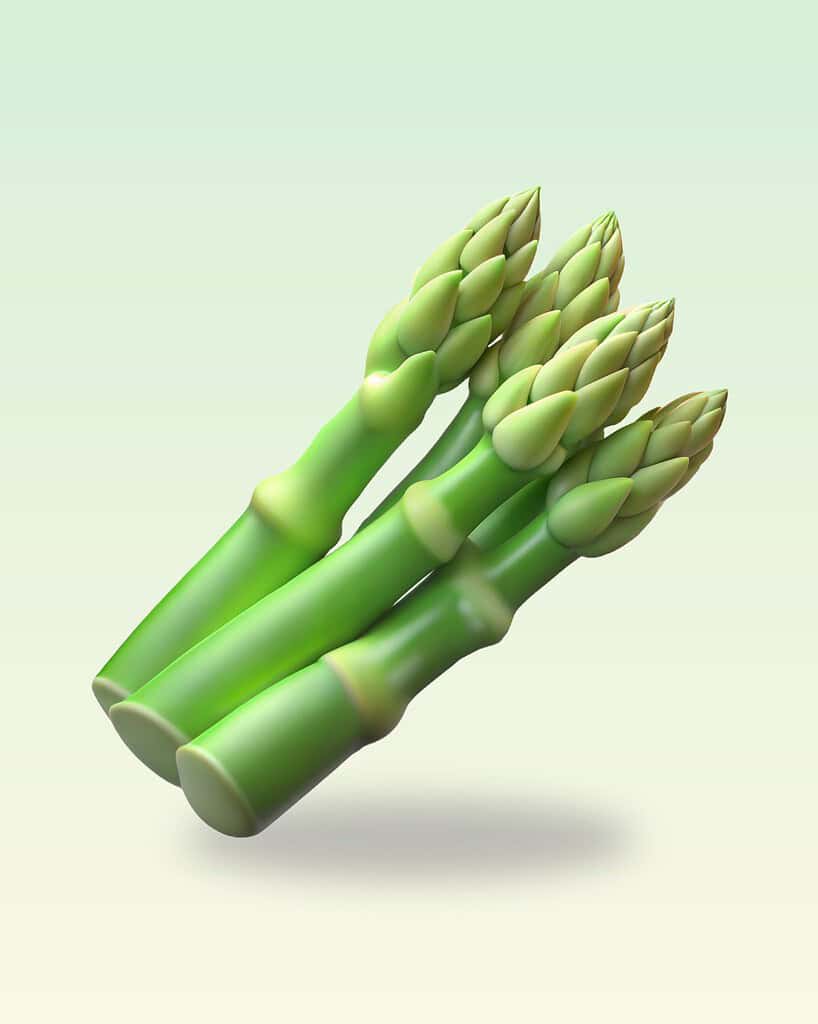
The bottom inch or two of an asparagus spear is the part most likely to cause trouble, and the reason is physical rather than chemical. Where the spear was cut from the plant, the stalk is pale, dry and stringy, the texture that makes you snap the ends off before cooking. Dr. Harrison describes those cut stems as very dry and woody, and warns that if a dog chews them poorly they can get stuck in the esophagus more easily than the tender parts of the spear, and digest badly besides. His advice is simple: toss the ends and share the good part.
It is tempting to do the opposite, since the ends are the part you were going to throw away and a dog begging in the kitchen looks like a fine disposal system. But a dog that gulps rather than chews can swallow a piece of stalk whole, and a piece wide enough to wedge at a narrow point of the esophagus simply stops there. The Merck Veterinary Manual, in an entry by Alice Defarges, DVM, DACVIM, explains that objects tend to lodge where the esophagus is least stretchy: at the base of the neck, over the heart, or just in front of the diaphragm. Bones are the most common culprit in dogs, but wood, rawhide and dental chews make the list too, and a dried-out asparagus butt behaves more like a twig than a vegetable.
The early signs are easy to mistake for a dog that ate too fast. Merck lists drooling, gagging, difficulty swallowing, regurgitation and repeated attempts to swallow. A partial obstruction may let water through but not food, so a dog can drink normally and still be in trouble. If the piece stays put, the esophagus can scar into a permanent narrowing called a stricture, the most common complication, and an object lodged long enough can perforate the wall. That is why Merck says an esophageal foreign body should be removed immediately once diagnosed.
Size decides the risk. A Labrador can swallow a two-inch piece of stalk and never notice; the same piece can be wider than a Chihuahua’s esophagus. A medium spear weighs about 16 grams on USDA’s scale, most of it in the lower half. For a toy breed, a senior with missing teeth or any dog that inhales food, the tender tips are the only part worth offering, cooked soft and cut no larger than the dog’s kibble.
Preparation solves most of this. Snap the spears where they break naturally, usually an inch or two from the bottom, and discard the woody section. Cook until soft, then slice crosswise into thin coins rather than lengthwise strips, because a long fibrous strip is exactly the shape that folds and lodges. Offer one piece and watch how the dog handles it before offering a second.
If a piece does go down wrong, watch closely for the next hour. Gagging that will not stop, drooling, pawing at the mouth, retching without producing anything, or bringing up water right after drinking all point toward something stuck, and all of them deserve a call to the vet or an emergency clinic. Do not push the piece down with bread or fish for it with your fingers unless you can clearly see and grasp it. Our guide to what to do when your dog ate something it should not have walks through that first hour.
Is asparagus fern poisonous to dogs?
Yes, and this is the source of most of the confusion online. The ASPCA Animal Poison Control Center lists asparagus fern, Asparagus densiflorus cv. sprengeri, as toxic to dogs and cats, with allergic dermatitis from repeated skin contact and vomiting, abdominal pain or diarrhea if the berries are eaten. The ASPCA’s list of alternate names for the plant starts with the word asparagus, which is how a houseplant warning gets attached to a vegetable.
They are relatives, not the same plant. Garden asparagus is Asparagus officinalis; the fern is Asparagus densiflorus, and Dr. Harrison says directly that its toxicity is not a worry for the spears your dog eats. The North Carolina Extension Gardener Plant Toolbox adds that the fern is not a fern at all but an arching, woody perennial in the asparagus family, rated low in poison severity, with berries that upset the gut and sap that causes redness, swelling and blisters.
Telling them apart is easy. The fern has long, arching, often spiny stems covered in soft, needle-like “leaves,” small bell-shaped flowers and bright red berries smaller than a pea. Grocery-store asparagus is a thick green spear with a tight, scaly tip and no leaves, berries or thorns.
One overlap is worth knowing. If you let garden asparagus mature, it leafs out into a feathery bush that looks remarkably like the fern and can produce red berries of its own. The AKC says eating this inedible part of the plant can cause vomiting, diarrhea and severe abdominal pain, and recommends fencing the bed. Our guide to spring plants that are toxic to dogs covers the rest of the garden.
Why does asparagus make a dog’s pee smell?
It does, at least sometimes. The AKC notes that asparagus can result in urine that smells unpleasant, and PetMD says it can give a dog strange-smelling pee and flatulence, just as in people. In a housebroken dog it is a curiosity, not a problem.
The chemistry comes from human research. Asparagus contains a sulfur compound called asparagusic acid, and when the body breaks it down it releases volatile sulfur compounds, chiefly methanethiol, that leave through the urine. A 2011 study in Chemical Senses by Marcia Pelchat and colleagues at the Monell Chemical Senses Center found that about 8 percent of people did not produce the odor at a detectable level and about 6 percent could not smell it, a specific anosmia linked to olfactory receptor genes on chromosome 1.
Here is what we could not find: a single published study on dogs. Nobody has measured whether every dog produces the metabolites or how long the smell lasts in canine urine. The veterinary pages that mention it are extrapolating from people, as are we. The compounds are considered harmless and the smell should fade within a day. A change in urine odor that lasts longer, or comes with straining, frequent small puddles or blood, is a urinary problem and not the asparagus.
What should never go on your dog’s asparagus?
The asparagus on your plate is the problem, not the vegetable in the crisper. It arrives roasted in olive oil, tossed with butter and salt, wrapped in bacon or sauteed with garlic. PetMD’s instruction is to cook it completely plain, with no butter, salt, onion, garlic or any other ingredient that can harm a dog, and the AKC names butter and cooking oil as things that can make a dog sick. The Spruce Pets adds that seasonings and oils bring fat and calories a dog does not need, and rich, fatty foods are a familiar trigger for vomiting and, in some dogs, pancreatitis.
Garlic and onion are more than a stomach risk. Both are Allium plants, and Dr. Fadl warns that they can cause anemia in dogs, with signs that include lethargy, weakness, pale gums, a wobbly gait, vomiting and diarrhea. Salt matters too; Dr. Harrison says dogs with heart disease, kidney disease or high blood pressure should skip canned asparagus for its sodium.
Let the person who finds your dog know what is off the menu
A Shiloh’s House Smart Tag is laser-engraved acrylic with a “Tap Phone Here” NFC back. A finder or sitter taps it with any modern phone and sees your contacts, medical notes and feeding rules before anyone shares the garlic asparagus. About $38 one-time, no subscription, no battery, waterproof, made in the USA, 30-day returns.
How much asparagus can a dog eat?
PetMD applies the 10 percent rule: treats of any kind, asparagus included, should make up no more than 10 percent of a dog’s diet. To turn that into grams, we used the American Animal Hospital Association’s 2021 nutrition guidelines, which set resting energy requirement at 70 times body weight in kilograms raised to the 0.75 power, multiplied by a life-stage factor of 1.4 to 1.6 for a neutered adult. We ran the math at 1.6, took 10 percent as the treat budget, and converted it to raw asparagus at 20 calories per 100 grams.
The table is our suggestion, not a prescription; the fourth column sits far below the third because the gut gives out long before the calorie budget does. One medium spear weighs about 16 grams and carries about 3 calories.
| Dog weight | Daily treat budget (10%) | Asparagus if it were the only treat | Our suggested serving (1 to 3 times a week) |
|---|---|---|---|
| 10 lb (4.5 kg) | About 35 kcal | About 170 g | 1 to 2 teaspoons, about half a cooked spear |
| 25 lb (11.3 kg) | About 69 kcal | About 350 g | 2 teaspoons to 1 tablespoon, one spear |
| 50 lb (22.7 kg) | About 116 kcal | About 580 g | 1 to 2 tablespoons, one or two spears |
| 80 lb (36.3 kg) | About 166 kcal | About 830 g | 2 to 3 tablespoons, two or three spears |
Our servings sit close to PetMD’s, which run from one teaspoon for dogs under 20 pounds to two or three tablespoons for dogs over 90. Our dog feeding chart by weight shows how meals fit around that shared treat budget.
Which dogs should skip asparagus?
For a healthy adult dog, a few soft pieces a couple of times a week is an easy yes. These dogs need a vet’s okay first.
Dogs with urinary stones. Dr. Harrison notes that asparagus contains a moderate amount of oxalate and that a vet may recommend avoiding it in dogs with a history of calcium oxalate crystals or stones. The Minnesota Urolith Center files asparagus under moderate oxalate, feed in limited amounts, alongside carrots, while telling owners to avoid celery and green beans outright; it also lists asparagus among foods to use sparingly for urate stones because of its purine content. Oxalate lists disagree with one another, so follow your vet’s.
Dogs on warfarin or other anticoagulants. Asparagus carries 41.6 micrograms of vitamin K per 100 grams, and vitamin K is what warfarin works against. VCA Animal Hospitals lists vitamin K among the substances that call for caution and possible dose adjustment in dogs on warfarin. A few pieces are a small dose, but consistency matters, so tell the vet who manages the clotting tests.
Dogs on prescription diets. PetMD is firm that they should get nothing outside the diet.
The woody-end warning is written for them. Tips only, cooked soft.
Write your dog’s rule where other people will see it. In the free Lohji app from Shiloh’s House, you keep a live pet profile with contacts, medical notes and voice messages that a Shiloh’s House NFC tag links to, so a sitter or finder who taps the tag reads “oxalate stones, prescription diet only” before offering a snack. The app also turns your pet into cartoon Lohji avatars and stickers. Get it on the App Store or Google Play.
How does asparagus compare with green beans, broccoli, carrots and celery?
Here is how asparagus stacks up against the other vegetables pet parents reach for, raw, per 100 grams, from USDA FoodData Central.
| Vegetable (raw, per 100 g) | Calories | Sugars | Fiber | Vitamin K | Folate | USDA FDC ID |
|---|---|---|---|---|---|---|
| Asparagus | 20 kcal | 1.9 g | 2.1 g | 41.6 mcg | 52 mcg | 168389 |
| Green beans | 31 kcal | 3.3 g | 2.7 g | 43.0 mcg | 33 mcg | 169961 |
| Broccoli | 34 kcal | 1.7 g | 2.6 g | 101.6 mcg | 63 mcg | 170379 |
| Carrots | 41 kcal | 4.7 g | 2.8 g | 13.2 mcg | 19 mcg | 170393 |
| Celery | 14 kcal | 1.3 g | 1.6 g | 29.3 mcg | 36 mcg | 169988 |
Asparagus is the second-lightest of the five, low in sugar, with a respectable dose of folate. It is also the most work. Green beans go in raw or steamed with no trimming and are the classic swap for a dog on a diet. Carrots are sweeter and make a satisfying raw chew. Broccoli packs the most vitamin K and fiber, but its florets cause gas. Celery is the lightest of all and the closest cousin in texture, with the same cut-it-small rule.
Frequently asked questions
Can dogs eat raw asparagus?
Technically yes, but most vets steer you away from it. PetMD says raw asparagus is hard to chew and digest and can become a choking hazard or cause a blockage, and The Spruce Pets says dogs should not eat it raw at all. If you do, the AKC says chop it small and switch to lightly cooked if your dog gets gas or diarrhea.
Can dogs eat asparagus ends or stalks?
Skip the woody bottom section. Dr. Bartley Harrison, DVM, of Adopt a Pet says the cut stems are dry and fibrous, can lodge in the esophagus more easily than the tender spear, and digest poorly. The rest of the stalk is fine once cooked soft and sliced into thin coins. For toy breeds and gulpers, offer the tips only.
How much asparagus can I give my dog?
Keep asparagus and all other treats under 10 percent of daily calories, and in practice feed far less. Our suggestion, one to three times a week: one to two teaspoons for a 10-pound dog, up to a tablespoon for a 25-pound dog, one to two tablespoons for a 50-pound dog and two to three tablespoons for an 80-pound dog, cooked and chopped.
Is asparagus fern toxic to dogs?
Yes. The ASPCA lists asparagus fern, Asparagus densiflorus, as toxic to dogs and cats, with skin irritation from repeated contact and vomiting, abdominal pain or diarrhea if the berries are eaten. It is a houseplant and floral filler with needle-like foliage and red berries. Grocery-store asparagus spears are a different plant and are not toxic.
Why does my dog’s pee smell after eating asparagus?
Asparagus contains asparagusic acid, which the body breaks into sulfur compounds such as methanethiol that leave through the urine. That is well documented in people, where a 2011 Chemical Senses study found most people produce the odor and some cannot smell it. No study has looked at dogs, but the AKC and PetMD both report the smell, and it is harmless.
Can dogs eat asparagus cooked with butter or garlic?
No. PetMD says to cook asparagus completely plain, with no butter, salt, onion or garlic, and the AKC says butter and cooking oil can make a dog sick. Garlic and onion are Allium plants that can damage red blood cells and cause anemia. If your dog eats a lot of garlic or onion asparagus, call your vet or the ASPCA Animal Poison Control Center.
Sources
- USDA Agricultural Research Service, “Asparagus, raw (SR Legacy, FDC ID 168389); also Asparagus, cooked, boiled, drained (168390), Beans, snap, green, raw (169961), Broccoli, raw (170379), Carrots, raw (170393) and Celery, raw (169988)”, USDA FoodData Central, 2019 — https://fdc.nal.usda.gov/food-details/168389/nutrients
- Katherine Ripley, “Can Dogs Eat Asparagus?”, American Kennel Club, 2022 — https://www.akc.org/expert-advice/nutrition/can-dogs-eat-asparagus/
- Victoria Lynn Arnold, reviewed by Sandra C. Mitchell, DVM, DABVP, “Can Dogs Eat Asparagus?”, PetMD, 2022 — https://www.petmd.com/dog/nutrition/can-dogs-eat-asparagus
- Austin Cannon, with Gabrielle Fadl, DVM, “Can Dogs Eat Asparagus?”, The Spruce Pets, 2023 — https://www.thesprucepets.com/can-dogs-eat-asparagus-7485056
- Bartley Harrison, DVM, “Can Dogs Eat Asparagus?”, Adopt a Pet, 2024 — https://www.adoptapet.com/blog/nutrition/can-dogs-eat-asparagus
- ASPCA Animal Poison Control Center, “Toxic and Non-toxic Plants: Asparagus Fern”, ASPCA, accessed 2025 — https://www.aspca.org/pet-care/animal-poison-control/toxic-and-non-toxic-plants/asparagus-fern
- North Carolina Extension Gardener Plant Toolbox, “Asparagus densiflorus Sprengeri Group (Asparagus Fern)”, NC State Extension, accessed 2025 — https://plants.ces.ncsu.edu/plants/asparagus-densiflorus-sprengeri-group/
- Alice Defarges, DVM, DACVIM, “Esophageal Foreign Bodies in Small Animals”, Merck Veterinary Manual, 2024 — https://www.merckvetmanual.com/digestive-system/diseases-of-the-esophagus-in-small-animals/esophageal-foreign-bodies-in-small-animals
- Minnesota Urolith Center, “Treatment Recommendations: Human foods to limit/avoid feeding dogs with calcium oxalate uroliths”, University of Minnesota College of Veterinary Medicine, accessed 2025 — https://vetmed.umn.edu/urolith-center/urolith-analysis/treatment-recommendations
- Marcia Levin Pelchat, Cathy Bykowski, Fujiko F. Duke and Danielle R. Reed, “Excretion and Perception of a Characteristic Odor in Urine after Asparagus Ingestion: a Psychophysical and Genetic Study”, Chemical Senses, 2011 — https://academic.oup.com/chemse/article/36/1/9/442551
- Lauren R. Forsythe, PharmD, and Rania Gollakner, DVM, MPH, “Warfarin”, VCA Animal Hospitals, accessed 2025 — https://vcahospitals.com/know-your-pet/warfarin
- American Animal Hospital Association, “Energy Requirement Calculations (2021 AAHA Nutrition and Weight Management Guidelines)”, AAHA, 2021 — https://www.aaha.org/wp-content/uploads/globalassets/02-guidelines/2021-nutrition-and-weight-management/resourcepdfs/nutritiongl_box1.pdf