Can Dogs Eat Corn? Kernels Yes, Cobs Never, and How Much Is Safe
 Shiloh’s House Team
·
·
16 min read

Yes, dogs can eat plain cooked corn kernels cut off the cob in small amounts, because corn is not toxic and most dogs digest it well. The cob is the real danger: it does not break down in the gut, and veterinarians list corn cobs among the most common objects they surgically remove from dogs. Skip buttered, salted, creamed and canned versions, keep kernels to a spoonful or two, and if your dog swallows any part of a cob, call a vet right away.
Last updated: November 2026
Can dogs eat corn safely?
Corn is one of the few holiday foods where the answer depends almost entirely on the shape it arrives in. PetMD, in an article reviewed by Sandra C. Mitchell, DVM, DABVP, says raw and cooked corn are both safe for dogs in small portions. The American Kennel Club agrees that plain kernels cut off the cob are safe as an occasional treat, and notes that many veterinary nutritionists consider corn a normal part of a balanced diet.
The same sources draw a hard line at the cob. PetMD calls corncobs and husks a choking hazard and a cause of intestinal blockage, and the AKC says corn on the cob should never be fed to dogs. The ASPCA Animal Poison Control Center’s barbecue guidance says corncobs are a common cause of intestinal blockages in dogs because dogs tend to swallow large pieces instead of chewing them up.
So the verdict has two halves. Kernels are fine, and we show you how many below. Cobs belong in a lidded trash can, and if one goes missing you treat it like your dog ate something off our list of foods dogs cannot eat, even though corn itself is not on that list.
Plain also means plain. PetMD warns that butter can set off pancreatitis, too much salt can cause salt poisoning, and corn cooked with onions or garlic should not be shared at all.

Is corn good for dogs?
Here is what USDA FoodData Central reports for yellow sweet corn, boiled and drained without salt (SR Legacy, FDC ID 169999), per 100 grams, per USDA’s 149-gram cup of cut kernels, and per level tablespoon of about 9 grams.
| Nutrient (boiled sweet corn kernels) | Per 100 g | Per cup cut (149 g) | Per tablespoon (about 9 g) |
|---|---|---|---|
| Calories | 96 kcal | 143 kcal | 9 kcal |
| Carbohydrate | 21.0 g | 31.3 g | 1.9 g |
| Starch | 7.2 g | 10.7 g | 0.6 g |
| Total sugars | 4.5 g | 6.8 g | 0.4 g |
| Dietary fiber | 2.4 g | 3.6 g | 0.2 g |
| Protein | 3.4 g | 5.1 g | 0.3 g |
| Total fat | 1.5 g | 2.2 g | 0.1 g |
| Potassium | 218 mg | 325 mg | 20 mg |
| Sodium | 1 mg | 1.5 mg | 0.1 mg |
Corn is a starchy vegetable, so most of those calories are carbohydrate. That is not a flaw. PetMD lists carbohydrate for energy, fiber, B vitamins, magnesium and potassium among corn’s benefits, and both PetMD and the AKC point to linoleic acid, an essential omega-6 fat that supports skin and coat. Cailin R. Heinze, VMD, MS, DACVIM (Nutrition), writing for Tufts University’s Petfoodology, adds that corn is an excellent source of carotenoids such as lutein and beta-carotene.
What corn does not have is anything a dog on a complete diet is missing. A medium ear’s worth of kernels, 103 grams by USDA’s measure, is about 99 calories, roughly a third of a small dog’s whole day. Green beans and carrots deliver crunch at a fraction of the calories.
Why is a corn cob so dangerous for dogs?
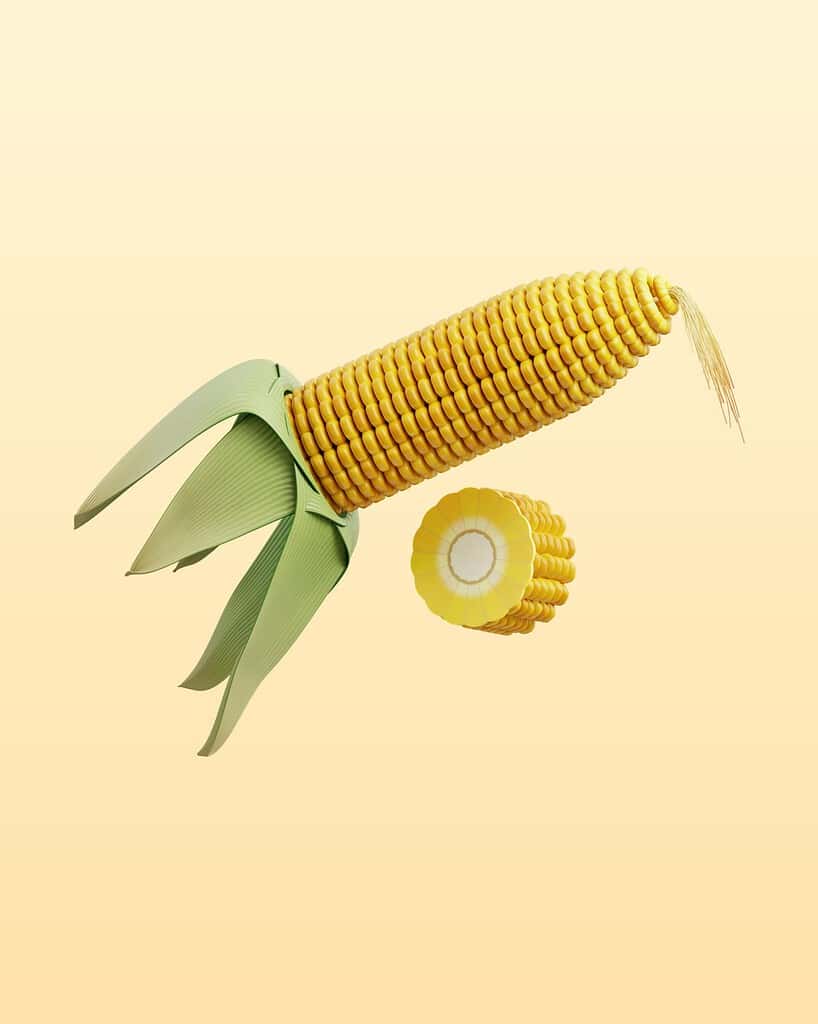
A corn cob is almost perfectly designed to get stuck in a dog. It is cylindrical, firm, fibrous and roughly the diameter of a dog’s small intestine, and it does not soften in stomach acid the way bread, meat or even bone eventually does. The Merck Veterinary Manual describes foreign bodies as objects that cannot be digested, are digested slowly, or are too large to pass, and a cob manages all three.
The way dogs eat makes it worse. The ASPCA notes that dogs tend to swallow large pieces of cob instead of chewing them up, and the AKC says many dogs can chew and swallow big sections in moments. A Labrador working through a buttered cob is not grinding it to pulp. It is shearing off two-inch chunks and gulping them, and each chunk is a plug waiting for a narrow spot. Merck notes that young, large-breed dogs are the most likely to develop a foreign body obstruction, which describes a lot of the dogs circling the Thanksgiving table.
Where the chunk lodges decides how the week goes. A piece still in the stomach can sometimes be retrieved with an endoscope, though Veterinary Emergency Group notes that the scope cannot always handle the weight of a cob. Once a piece moves into the small intestine, Merck says endoscopy is no longer an option and an exploratory laparotomy is indicated. Merck’s own teaching image for small intestinal obstruction is a radiograph of a two-year-old Labrador Retriever with a corncob lodged in the bowel.
What happens next is the reason this is an emergency and not a wait-and-see. Merck explains that an unresolved obstruction causes the gut above the blockage to balloon with fluid and gas. Venous blood flow out of that stretched wall is impaired while arterial flow keeps coming in, so the tissue becomes congested, starved of oxygen and eventually necrotic, and gut bacteria can cross the damaged wall. VCA Animal Hospitals puts a clock on it: if the blood supply is interrupted for more than a few hours, the tissue may die, with irreparable damage or shock to follow. A dead segment can perforate, and Cornell’s Riney Canine Health Center describes the result as peritonitis and potentially life-threatening sepsis.
The signs unfold over days, and the first day can look deceptively mild. Many dogs act normal for several hours and may even keep passing stool, because liquid can squeeze past a partial blockage. Then comes vomiting, usually repeated and often soon after eating. By the second day appetite fades, the belly becomes tender or hunched, and lethargy sets in as dehydration builds. PetMD notes that vomiting with no stool at all is a strong indicator of a complete blockage. By the third day a dog with a complete obstruction is seriously ill, and PetMD puts survival with an untreated complete obstruction at only a few days.
Surgery is usually straightforward if it happens early. Cornell describes an enterotomy, a single incision into the intestine to lift the cob out, as the common procedure, with a resection and anastomosis, cutting out the damaged segment and joining the healthy ends, reserved for bowel that has already died or torn. Merck notes that the surgical site is at its most fragile three to five days after the operation, when the closure can fail and leak, a complication that usually means a second surgery and carries a high mortality rate. Dogs left to see whether the cob would pass are the ones who end up with resections, drains and long hospital stays.
How much corn can a dog eat?
PetMD applies the standard rule to corn: all treats together should make up no more than 10 percent of a dog’s daily calories. To turn that into kernels we used the American Animal Hospital Association’s 2021 nutrition guidelines, which set resting energy requirement at 70 times body weight in kilograms to the 0.75 power, times a life-stage factor of 1.4 to 1.6 for a neutered adult.
Here is the math for one dog. A 50-pound dog weighs 22.7 kilograms; 22.7 to the 0.75 power is 10.4; times 70 gives a resting requirement of 728 calories; times 1.6 gives about 1,165 calories a day; and 10 percent of that is about 116 calories of treats. At 96 calories per 100 grams, that would buy about 120 grams of corn if corn were the only treat all day. It never is, and that much starch at once means gas, so our suggested serving is a fraction of the ceiling. The table is our suggestion, not a prescription.
| Dog weight | Daily treat budget (10%) | Corn if it were the only treat | Our suggested serving |
|---|---|---|---|
| 10 lb (4.5 kg) | About 35 kcal | About 36 g (1/4 cup) | 1 tablespoon, about 9 kcal |
| 25 lb (11.3 kg) | About 69 kcal | About 72 g (1/2 cup) | 2 tablespoons, about 18 kcal |
| 50 lb (22.7 kg) | About 116 kcal | About 120 g (3/4 cup plus) | 1/4 cup, about 36 kcal |
| 80 lb (36.3 kg) | About 166 kcal | About 173 g (1 cup plus) | 1/3 cup, about 48 kcal |
Serve the kernels cooked and cooled, since PetMD says steamed or boiled corn is easier to digest than raw, and cut them off the cob yourself before anyone hands over the whole ear. Our dog feeding chart by weight shows how the main meals fit around that shared 10 percent.
Puppies can have corn too, PetMD says, in small amounts, plain, cooked and off the cob. Dogs on prescription diets should get nothing outside the diet without the vet’s say-so.
Holiday leftovers, house guests and a dog who works the room
A Shiloh’s House Smart Tag is laser-engraved acrylic with a “Tap Phone Here” NFC back. A sitter, a relative or a finder taps it with any modern phone and sees your contacts, medical notes and feeding rules, including “kernels only, never the cob.” About $38 one-time, no subscription, no battery, waterproof, made in the USA, 30-day returns.
What should you do if your dog ate a corn cob?
Call your veterinarian or an emergency clinic right away, even if your dog looks completely fine. The reasoning is about timing. PetMD’s Veronica Higgs, DVM, explains that a vet can sometimes make a dog vomit up a swallowed object before it causes a blockage, but only within about 30 minutes to two hours of ingestion. After that, or once symptoms start, the plan shifts to X-rays, possibly ultrasound, and either endoscopy or surgery.
Do not try to make your dog vomit at home unless a veterinarian on the phone tells you to. A cob fragment that went down whole can do damage coming back up. Our guide to what to do when your dog ate something it should not have walks through that first hour.
If you only found a chewed cob or a missing corn holder, watch for the pattern Cornell, PetMD and the AKC all list: repeated vomiting, loss of appetite, lethargy, a tender belly, diarrhea or straining with little or no stool, and dehydration. Dr. Liz Moses of Veterinary Emergency Group warns that a dog can keep pooping for a while with part of a cob lodged in the gut, and that full obstruction can take hours or days to develop, so a normal first evening proves nothing.
“Dogs fed corn on the cob, or who access cobs from the compost or trash, often swallow large portions of the cob which frequently cause gastrointestinal obstruction and require surgery to resolve.”
Cailin R. Heinze, VMD, MS, DACVIM (Nutrition) (Petfoodology, Cummings School of Veterinary Medicine at Tufts University, 2023)
Merck notes that small, smooth objects can sometimes be monitored with repeat X-rays in the hospital, but that failure to move within 36 to 48 hours, or any worsening of signs, means surgery. A cob is neither small nor smooth, which is why most clinics do not plan on it passing. PetMD puts blockage surgery anywhere from $500 to several thousand dollars depending on the practice and whether it is an emergency.
Can dogs eat canned corn, creamed corn or cornbread?
Plain kernels are the only version we would hand over on purpose. Here is how common corn products compare, using USDA FoodData Central figures.
| Product (USDA FDC ID) | Calories per 100 g | Sodium per 100 g | Fat per 100 g | Typical serving | Verdict for dogs |
|---|---|---|---|---|---|
| Boiled kernels, no salt (169999) | 96 kcal | 1 mg | 1.5 g | 1 tbsp: 9 kcal | OK in small amounts, off the cob |
| Canned whole kernel, drained (169214) | 67 kcal | 205 mg | 1.2 g | 1 cup (164 g): 110 kcal, 336 mg sodium | Rinse well or choose no-salt-added; a spoonful at most |
| Canned cream style (169215) | 72 kcal | 261 mg | 0.4 g | 1 cup (256 g): 184 kcal, 668 mg sodium | Skip; salt, sugar and starch thickeners |
| Cornbread from recipe (174910) | 266 kcal | 658 mg | 7.1 g | 1 piece (65 g): 173 kcal, 428 mg sodium | Skip; a dropped crumb is not an emergency |
| Butter, salted (173410) | 717 kcal | 643 mg | 81.1 g | 1 tbsp (14 g): 102 kcal, 11.5 g fat | Skip; the reason buttered corn is off the menu |
Canned corn is the closest to acceptable. USDA lists drained canned kernels at 205 milligrams of sodium per 100 grams, about 200 times the sodium in fresh boiled corn. Rinsing helps and no-salt-added cans are better, but plain frozen kernels do the same job with none of the salt.
Creamed corn and cornbread are a different category. Cream-style corn adds salt, sugar and starch thickeners, and the sodium climbs to 261 milligrams per 100 grams. Cornbread brings fat and 658 milligrams of sodium per 100 grams, and a single 65-gram square is 173 calories, more than a 50-pound dog’s entire daily treat budget. Cornbread stuffing usually adds onion, and PetMD is firm that onion and garlic make a dish off limits regardless of the corn.
Then there is butter, which is why the ear your uncle is holding is a worse idea than the ear in the pot. A tablespoon of salted butter is 102 calories and 11.5 grams of fat, and PetMD warns that high-fat extras can lead to pancreatitis. Corn chips, kettle corn and corn tortillas fall into the same salty, oily bucket. For the one corn snack that works as a treat, see our guide to popcorn for dogs.
Are dogs allergic to corn, and is corn in dog food bad?
Corn has a reputation as a common allergen and a cheap filler, and neither claim survives the veterinary literature. A 2016 review in BMC Veterinary Research by Ralf S. Mueller, Thierry Olivry and Pascal Prélaud pooled published reports of confirmed food allergy in dogs. Across 297 dogs, the most common triggers were beef (34 percent), dairy (17 percent), chicken (15 percent), wheat (13 percent) and lamb (5 percent). Corn was confirmed in 13 dogs, or 4 percent, behind soy and tied with egg.
The authors note that most dogs were challenged with only a handful of foods, so the true rate for every ingredient is probably higher than reported. Even so, an itchy dog is far more likely to be reacting to the beef or chicken in its food than to the corn. Dr. Heinze says the same from the clinic side: when a family suspects corn, the culprit usually turns out to be an animal protein or something unrelated to food. Our guide to the best dog foods for allergies explains how an elimination trial works.
The filler claim fails for a related reason. Whole kernels pass through partly intact because of their hull, but the corn in kibble is ground and cooked, and Dr. Heinze reports that its starch is 90 to 99 percent digestible in feeding studies. Corn gluten, she adds, is a different protein from wheat gluten.
The day after a holiday is a good time to write the rule down where other people will see it. In the free Lohji app from Shiloh’s House, you keep a live pet profile with up to three contacts, medical notes, behavior notes and short voice messages that a Shiloh’s House NFC Smart Tag links to, so the sitter or cousin on dog duty who taps the tag reads “kernels fine, no cobs, no butter,” or, if the worst happened, “ate part of a corn cob on November 26, watching for vomiting, vet number below.” The app also turns one photo into cartoon Lohji avatars, stickers and short videos. Get it on the App Store or Google Play.
Frequently asked questions
Can dogs eat corn on the cob?
No. The kernels are safe, but the cob cannot be digested and lodges in the stomach or small intestine. The ASPCA calls corncobs a common cause of intestinal blockages in dogs because dogs swallow large pieces instead of chewing, and Tufts veterinary nutritionist Cailin Heinze says cobs frequently cause obstruction that requires surgery. Cut the kernels off and bin the cob.
How long after eating a corn cob will a dog show symptoms?
Often not for several hours, and sometimes a day or more. Veterinary Emergency Group notes that a dog can keep pooping for a while before the cob fully blocks the gut. Repeated vomiting usually comes first, followed by loss of appetite, belly pain, lethargy and straining without stool. Call a vet as soon as you know a cob is missing.
Can dogs eat canned corn?
A spoonful of rinsed, drained canned corn is not dangerous, but it is not the best choice. USDA lists drained canned kernels at 205 milligrams of sodium per 100 grams, versus 1 milligram in plain boiled corn, and cream-style corn is saltier still at 261 milligrams. Plain frozen or fresh kernels, cooked and cooled, give the same treat without the salt.
Can dogs eat cornbread?
Best not. USDA puts homemade cornbread at 266 calories, 7 grams of fat and 658 milligrams of sodium per 100 grams, and one 65-gram piece is 173 calories, more than most dogs’ daily treat budget. Cornbread stuffing usually adds onion, which is toxic to dogs. A dropped crumb is harmless.
Are dogs allergic to corn?
Rarely. A 2016 review in BMC Veterinary Research of 297 dogs with confirmed food allergy found beef, dairy, chicken, wheat and lamb were the common triggers, while corn was confirmed in just 13 dogs, or 4 percent. If your dog is itchy, the protein in the food is the likelier suspect, and a vet-guided elimination diet is the only reliable way to find out.
Is corn in dog food bad for dogs?
No. Tufts veterinary nutritionists report that the starch in ground, cooked corn is 90 to 99 percent digestible, and corn contributes linoleic acid, B vitamins, magnesium, potassium and carotenoids. Whole kernels in a dog’s stool reflect the tough hull, not poor digestion. The AKC notes that many veterinary nutritionists consider corn a normal part of a balanced diet.
Sources
- USDA Agricultural Research Service, “Corn, sweet, yellow, cooked, boiled, drained, without salt (SR Legacy, FDC ID 169999)”, USDA FoodData Central, 2019 — https://fdc.nal.usda.gov/food-details/169999/nutrients
- USDA Agricultural Research Service, “Corn, sweet, yellow, canned, whole kernel, drained solids (SR Legacy, FDC ID 169214)”, USDA FoodData Central, 2019 — https://fdc.nal.usda.gov/food-details/169214/nutrients
- USDA Agricultural Research Service, “Corn, sweet, yellow, canned, cream style, regular pack (SR Legacy, FDC ID 169215; cornbread prepared from recipe is FDC ID 174910 and salted butter is FDC ID 173410 in the same database)”, USDA FoodData Central, 2019 — https://fdc.nal.usda.gov/food-details/169215/nutrients
- Victoria Lynn Arnold, reviewed by Sandra C. Mitchell, DVM, DABVP, “Can Dogs Eat Corn?”, PetMD, 2025 — https://www.petmd.com/dog/nutrition/can-dogs-eat-corn
- AKC Staff, “Can Dogs Eat Corn?”, American Kennel Club, 2026 — https://www.akc.org/expert-advice/nutrition/can-dogs-eat-corn
- Cailin R. Heinze, VMD, MS, DACVIM (Nutrition), “Stalk About Nutritious: It’s Corn!”, Petfoodology, Cummings School of Veterinary Medicine at Tufts University, 2023 — https://sites.tufts.edu/petfoodology/2023/09/19/stalk-about-nutritious-its-corn
- Ralf S. Mueller, Thierry Olivry and Pascal Prélaud, “Critically appraised topic on adverse food reactions of companion animals (2): common food allergen sources in dogs and cats”, BMC Veterinary Research, 2016 — https://pmc.ncbi.nlm.nih.gov/articles/PMC4710035
- Kevin P. Winkler, DVM, DACVS, “Gastrointestinal Obstruction in Small Animals”, Merck Veterinary Manual, 2025 — https://www.merckvetmanual.com/digestive-system/diseases-of-the-stomach-and-intestines-in-small-animals/gastrointestinal-obstruction-in-small-animals
- Cornell Richard P. Riney Canine Health Center, “Gastrointestinal foreign body obstruction in dogs”, Cornell University College of Veterinary Medicine, 2024 — https://www.vet.cornell.edu/departments-centers-and-institutes/riney-canine-health-center/canine-health-information/gastrointestinal-foreign-body-obstruction-dogs
- VCA Animal Hospitals (LifeLearn), “Ingestion of Foreign Bodies in Dogs”, VCA, 2024 — https://vcahospitals.com/know-your-pet/ingestion-of-foreign-bodies-in-dogs
- Veronica Higgs, DVM, reviewed by Brittany Kleszynski, DVM, “Dog Intestinal Blockage: Signs and What to Do”, PetMD, 2025 — https://www.petmd.com/dog/conditions/digestive/dog-intestinal-blockage-signs-and-what-to-do
- Liz Moses, “My Dog Ate a Corn Cob – What Should I Do?”, Veterinary Emergency Group, 2025 — https://www.veg.com/post/can-dogs-eat-a-corn-cob
- ASPCA Animal Poison Control Center, “Our Top Five Tips for Labor Day BBQ Safety”, ASPCA, 2019 — https://www.aspca.org/news/our-top-five-tips-labor-day-bbq-safety
- American Animal Hospital Association, “Energy Requirement Calculations (2021 AAHA Nutrition and Weight Management Guidelines)”, AAHA, 2021 — https://www.aaha.org/wp-content/uploads/globalassets/02-guidelines/2021-nutrition-and-weight-management/resourcepdfs/nutritiongl_box1.pdf