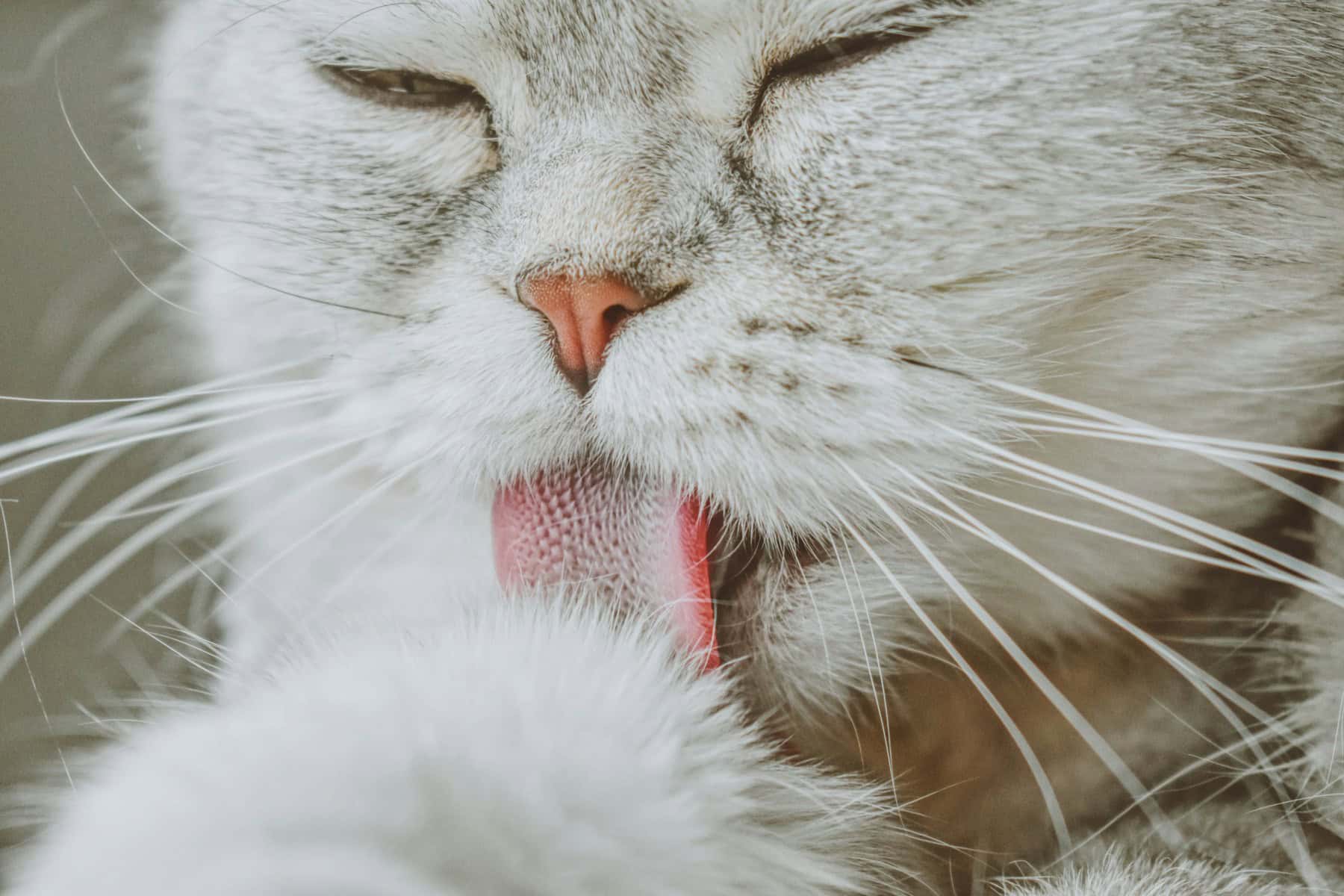
Cats get hairballs because their tongues are covered in backward-facing barbs that catch loose fur during grooming, and that fur has to go somewhere. Most of it passes through and out in the stool; what comes back up is the fraction that did not. An occasional hairball — roughly one a month or less — is normal. Weekly hairballs are not, and are usually a shedding, grooming, or gut problem worth fixing.
Spring is peak season for this. As daylight lengthens, cats drop their winter undercoat, swallow far more of it, and March through May is when most owners suddenly find one on the rug at 6 a.m.
How many hairballs are normal for a cat?
Fewer than one a month for most cats, and a long-haired cat in a heavy shed might reasonably produce one every couple of weeks. More than one a week is a signal, not a quirk — it usually means your cat is either shedding excessively, over-grooming, or has a gut that is not moving hair through the way it should.
Is it a hairball or is my cat actually vomiting?
A true hairball is a cylindrical wad of matted fur, often with a little fluid, produced with retching and usually with your cat looking completely fine ten seconds later. Repeated vomiting without a hairball at the end, vomiting food, or vomiting that leaves your cat flat and quiet is a different problem — we cover the whole list in why is my cat throwing up.
The 7 real reasons your cat has hairballs
1. Seasonal shedding
The obvious one and the most common. More loose fur in the coat means more swallowed fur. Indoor cats under artificial light shed somewhat year-round, but almost all of them still spike in spring.
2. Long or dense coat
Persians, Maine Coons, Ragdolls and other long-haired cats swallow far more hair per grooming session, simply because there is more of it and it is longer. Long hair also tangles into a wad more readily than short hair, which is why a short-haired cat can swallow a lot of fur and never produce a visible hairball.
3. Over-grooming from stress, allergies, or itch
A cat who grooms compulsively swallows far more fur than a cat who grooms normally. Look for thin patches, especially on the belly, inner thighs, and forelegs. Flea allergy, food allergy, and anxiety are the usual drivers. This one is worth taking seriously, because the hairballs are the visible symptom of something less visible.
4. Slow gut motility
Hair is meant to pass through. If it does not move at a normal pace — because of dehydration, low fiber, inflammatory bowel disease, or simply age — more of it collects in the stomach and comes back up. This is the reason frequent hairballs in a senior cat deserve a vet visit rather than a lubricant.
5. Not enough water
Cats are famously bad drinkers, and dry-food-only cats run at a chronic mild deficit. Drier stool moves slower, and slower transit means more hair retained. A fountain and some wet food do more for hairballs than most people expect.
6. Low-fiber diet
Fiber is what carries swallowed hair through and out. Diets built for hairball control are mostly just higher-fiber diets. See our comparison of the best cat food for indoor cats, which is where most of the hairball formulas live.
7. Pica or fabric eating
Less common, but some cats swallow carpet fibers, wool, or their own bedding along with fur, which makes the resulting mass harder to pass.
How to stop cat hairballs: what actually works
Brushing is the single most effective thing you can do, because fur you remove is fur your cat cannot swallow. Everything else helps at the margins.
| Fix | How much it helps | Effort |
|---|---|---|
| Daily or near-daily brushing | Most effective single change | 5 minutes a day |
| Hairball-control or high-fiber food | Meaningful for frequent cases | One-time switch |
| More wet food and a water fountain | Helps transit, helps kidneys too | Low |
| Petroleum or malt lubricant gels | Modest, short-term | Low, most cats like the taste |
| Fiber add-ins (pumpkin, psyllium) | Modest; ask your vet on dose | Low |
| Treating the underlying itch or stress | Fixes the cause, not the symptom | Vet visit |
| Professional groom for mats | Big help for long-haired cats | Seasonal |
On brushing: a slicker brush or a de-shedding tool used a few minutes a day during shed season removes a startling amount of coat. Our cat brush comparison goes through which tools suit which coats, and which ones cats will actually tolerate.
When hairballs are an emergency
Go to the vet immediately if your cat is retching repeatedly without producing anything, has stopped eating, is lethargic, has a swollen or painful belly, or has not passed stool in more than a day or two. A hairball that lodges in the intestine is a surgical blockage, and it is uncommon but genuinely dangerous. Dry, unproductive retching in a cat who otherwise seems off is the pattern to watch for — it can also be a sign of asthma or a heart problem rather than hair at all.
Also call if hairballs are new and frequent in a cat over ten, or if you are seeing bald patches. Those are usually about something other than fur.
Frequently asked questions
How often should a cat have a hairball?
Occasionally — once a month or less for most cats. Weekly or more often is worth investigating rather than managing with lubricant.
Do short-haired cats get hairballs?
Yes, though less often. Short-haired cats still shed and still groom; the swallowed hair is just less likely to mat into a visible wad before it passes.
Does hairball food really work?
For cats whose problem is fiber and transit, yes, and the effect is reasonably well established. It will not help a cat whose real issue is a skin allergy driving over-grooming.
Is petroleum jelly safe for cat hairballs?
The petroleum-based hairball gels sold for cats are formulated for this and are generally considered safe short-term. Ask your vet before making it a daily habit, especially if your cat is on other medication, since lubricants can affect absorption.
Why is my cat having more hairballs in spring?
Longer days trigger the seasonal shed. Your cat is swallowing far more loose undercoat than usual for six to eight weeks. Brushing frequency should go up to match.
Can hairballs make a cat stop eating?
Yes, and that is the warning sign. A cat who skips meals for more than about 24 hours needs a vet regardless of the cause — cats decompensate faster than dogs when they stop eating.
The bottom line
An occasional hairball is a cat being a cat. A weekly one is your cat telling you something about their coat, their gut, or their skin. Brush more, add water, look at fiber, and if the pattern changes suddenly, get bloodwork rather than another tube of gel.
One unrelated note while you have your cat cornered for a brushing session: check the collar and the ID on it. Grooming time is the easiest moment of the month to notice that a tag has gone missing — and for an indoor cat, that tag is the whole plan if a door gets propped open. Full disclosure, that is what we make: Shiloh’s House sells $38 designer acrylic NFC smart tags that any phone can tap, with engraving on the back as a backup, and no subscription. More on why indoor cats need one in do indoor cats need ID tags?
Get Your Tag
A $38 designer acrylic NFC tag light enough for a cat, engraved on the back, no app needed by whoever finds them.