Most healthy dogs need a bath about once a month. The honest range is every week to every three months, and where your dog lands depends on coat type, skin condition, and how muddy her life is — not on a calendar. Short-coated dogs can go six to eight weeks. Double-coated breeds do better with brushing than bathing. Oily coats like Basset Hounds need it every couple of weeks. Below is the coat-by-coat schedule, the signs you are overdoing it, and how to make bath day survivable.
How often should you bathe a dog?
Once a month is the sensible default for a typical dog with a normal coat and no skin condition. That is frequent enough to keep her clean and the house pleasant, and infrequent enough that you are not stripping the skin.
The reason there is no single right answer: a bath removes dirt and sebum, the oil that keeps a dog’s skin barrier intact. Wash too often and you get flaking, itching, and a dog who paradoxically smells worse as her skin overproduces oil to compensate. Wash too rarely and you get dander, odor, and matting. The goal is the least frequent bath that keeps the coat and skin healthy.
Does my dog need a bath at all?
Dogs do not need baths the way people do. Brushing does most of the work — it lifts dirt, distributes oils, and removes dead coat far more effectively than water. If you brush a healthy short-coated dog properly twice a week, she may genuinely need four baths a year. We compared the tools that make that possible in best dog brushes for shedding.
Dog bathing schedule by coat type
Short version: short and smooth coats every 6 to 8 weeks, double coats every 8 to 12 weeks, curly and long coats every 3 to 4 weeks, oily coats every 1 to 2 weeks, and hairless breeds weekly.
| Coat type | Examples | How often | Notes |
|---|---|---|---|
| Short and smooth | Beagle, Boxer, Greyhound, Vizsla | Every 6 to 8 weeks | Wipe-downs cover most of the gap |
| Double coat | Husky, German Shepherd, Golden, Corgi | Every 8 to 12 weeks | Brush far more than you bathe; dry to the skin |
| Curly or wool | Poodle, Doodle, Bichon, Portuguese Water Dog | Every 3 to 4 weeks | Must be brushed out first or it mats |
| Long silky | Yorkie, Shih Tzu, Maltese, Afghan | Every 2 to 4 weeks | Conditioner is not optional |
| Oily | Basset Hound, Cocker Spaniel, Labrador (some) | Every 1 to 2 weeks | Check ears and skin folds every time |
| Wire | Terriers, Schnauzer, Wirehaired Pointer | Every 6 to 8 weeks | Frequent bathing softens the wire texture |
| Hairless | Chinese Crested, Xoloitzcuintli | Weekly | Skin needs the same care as human skin |
Override all of it for two situations: a dog on a medicated shampoo follows the vet’s schedule, not this one, and a dog who rolled in something follows common sense.
What happens if you bathe a dog too often?
You strip the skin barrier, and the dog gets itchier, flakier, and often smellier. The signs of over-bathing are specific: dandruff, a dull coat, redness in the armpits and belly, increased scratching within a day or two of the bath, and a dog who starts to smell again faster than she used to.
If that sounds like your dog, stretch the interval and switch to a gentler, soap-free or oatmeal shampoo before you assume it is allergies. If the itching continues after you have backed off, that is a different conversation — we walk through the causes in why is my dog scratching so much?
Can I use human shampoo on my dog?
No. Canine skin has a different pH and a thinner outer layer than human skin, and human shampoos — including baby shampoo — are formulated for the wrong one. Occasional emergency use will not injure a dog, but routine use causes exactly the dryness and irritation you are trying to avoid. Use a dog shampoo; there are good ones at every price. Ours are ranked in best dog shampoos of 2026.
How to bathe a dog properly
Brush first, use lukewarm water, lather twice if she is genuinely dirty, rinse until you are certain and then rinse again, and dry to the skin. The order matters more than the products.
Brush before water touches her. Wetting a matted coat tightens the mats into felt, which then has to be shaved off. This is the single most common at-home grooming mistake on long and curly coats.
Lukewarm, not hot. Dogs run warmer than we do and their skin is more sensitive. Water that feels pleasantly warm to your wrist is already warm for her.
Rinse longer than feels necessary. Leftover shampoo is a leading cause of post-bath itching. Rinse until the water runs completely clear, then spend another minute on the belly, armpits, and between the back legs where residue hides.
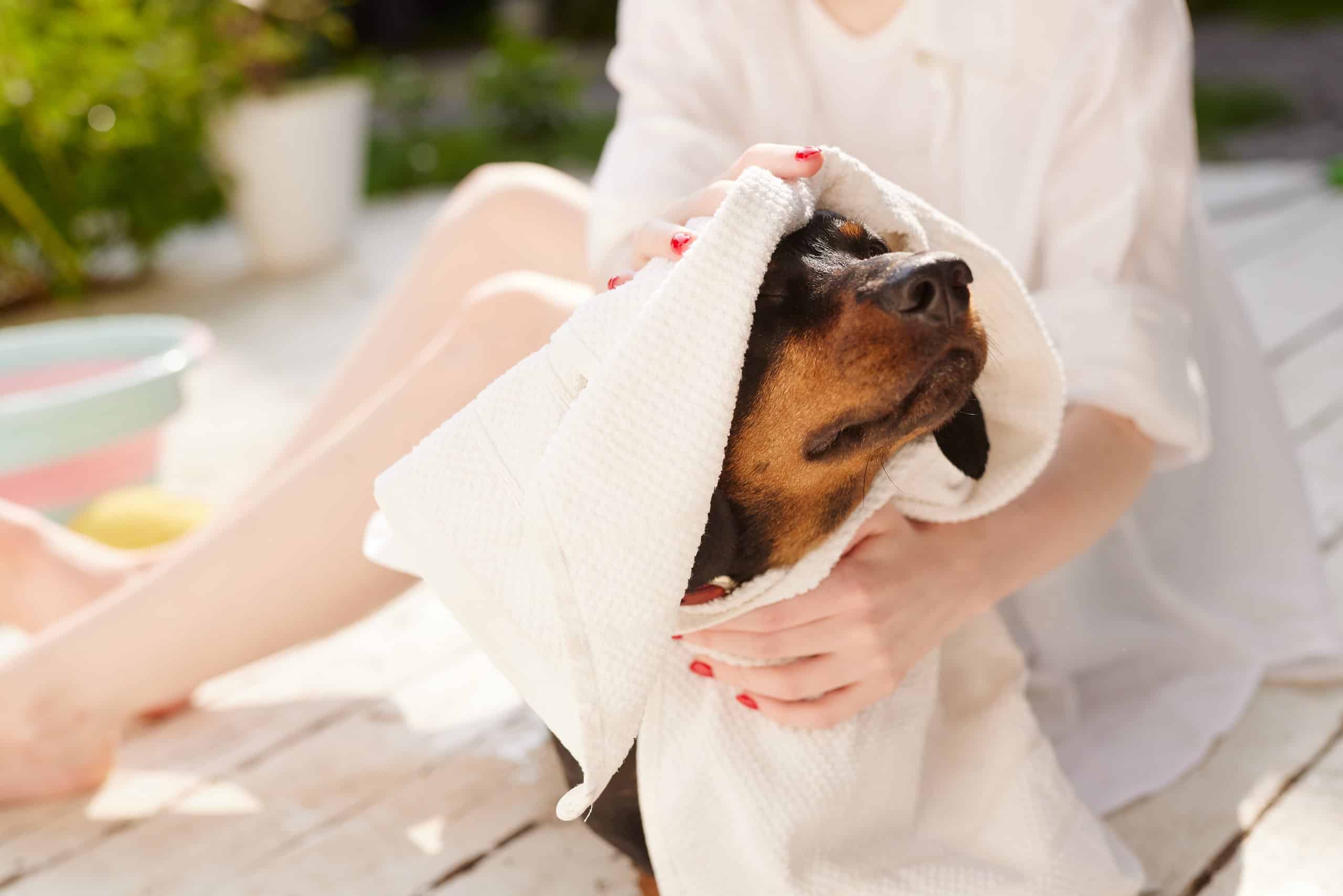
Dry properly, especially double coats. A damp undercoat trapped against the skin is how hot spots start. Towel hard, then use a dryer on cool or low if your dog tolerates it.
Do the extras while she is already captive. Ears, nails, and paws. Bath day is the natural time for a nail trim — the tools are in best dog nail clippers and grinders — and a paw check afterward catches cracking early.
What about the tag and collar?
Full disclosure, this is our business: Shiloh’s House makes designer acrylic NFC smart pet ID tags — $38, engraved on the back, tap with any phone, no subscription. We do not sell shampoo.
We bring it up because bath day is when collars come off, and a surprising number of dogs go missing on exactly the day someone forgot to put one back on. Wet collars also stay wet against the skin for hours, so the habit worth building is: collar off, dog washed and dried, collar dried and back on before she goes anywhere near a door. Our acrylic tags do not rust, tarnish, or fade when they get wet, which is a small thing until you have watched an engraved metal tag go illegible in a year. If your tags keep disappearing entirely, the reason is usually the attachment — we broke that down in why do dog tags fall off?
Frequently asked questions
Is it OK to bathe a dog once a week?
For most dogs, no — weekly bathing tends to dry the skin unless the dog has an oily coat, a skin condition being treated with medicated shampoo, or a genuinely filthy lifestyle. Weekly rinsing with plain water is gentler than weekly shampooing if you need the frequency.
How often should you bathe a puppy?
Wait until about 8 weeks old, then no more than monthly unless she gets into something. Puppies have thin, sensitive skin and lose body heat fast. Keep early baths short, warm, and heavy on praise — you are training her opinion of baths for life.
How often should you bathe a dog with allergies?
Often more than you would think. Bathing physically removes pollen and allergens from the coat, and for environmental allergies many vets recommend weekly or twice-weekly baths with a gentle or prescribed shampoo. Follow your vet’s schedule, not the general rule. See also dog allergy relief options compared.
Why does my dog smell bad right after a bath?
Usually a damp coat drying slowly, leftover shampoo, or a yeast or bacterial problem the bath disturbed rather than fixed. Ears and skin folds are the usual sources. A smell that returns within a day or two of every bath is a vet visit, not a shampoo problem.
Do I need to bathe my dog in winter?
Yes, just less often, and dry her completely before she goes outside. Indoor heating already dries skin, so winter is the season to stretch the interval and add a conditioner rather than bathe more.
Should I bathe my dog before or after grooming?
Brush out and de-mat before, bathe, dry completely, then cut or trim. Professional groomers clip a clean, dry coat because dirty or damp hair dulls blades and gives an uneven finish.
The bottom line
Once a month suits most dogs, but let the coat and the skin set the schedule — every 8 to 12 weeks for a double coat, every 2 weeks for an oily one, weekly only if a vet or a hairless breed says so. Brush first, rinse twice as long as you think, dry to the skin, and put the collar and the tag back on before she goes out the door.
Get Your Tag
A $38 designer acrylic NFC tag any phone can tap — waterproof, engraved on the back, no subscription.