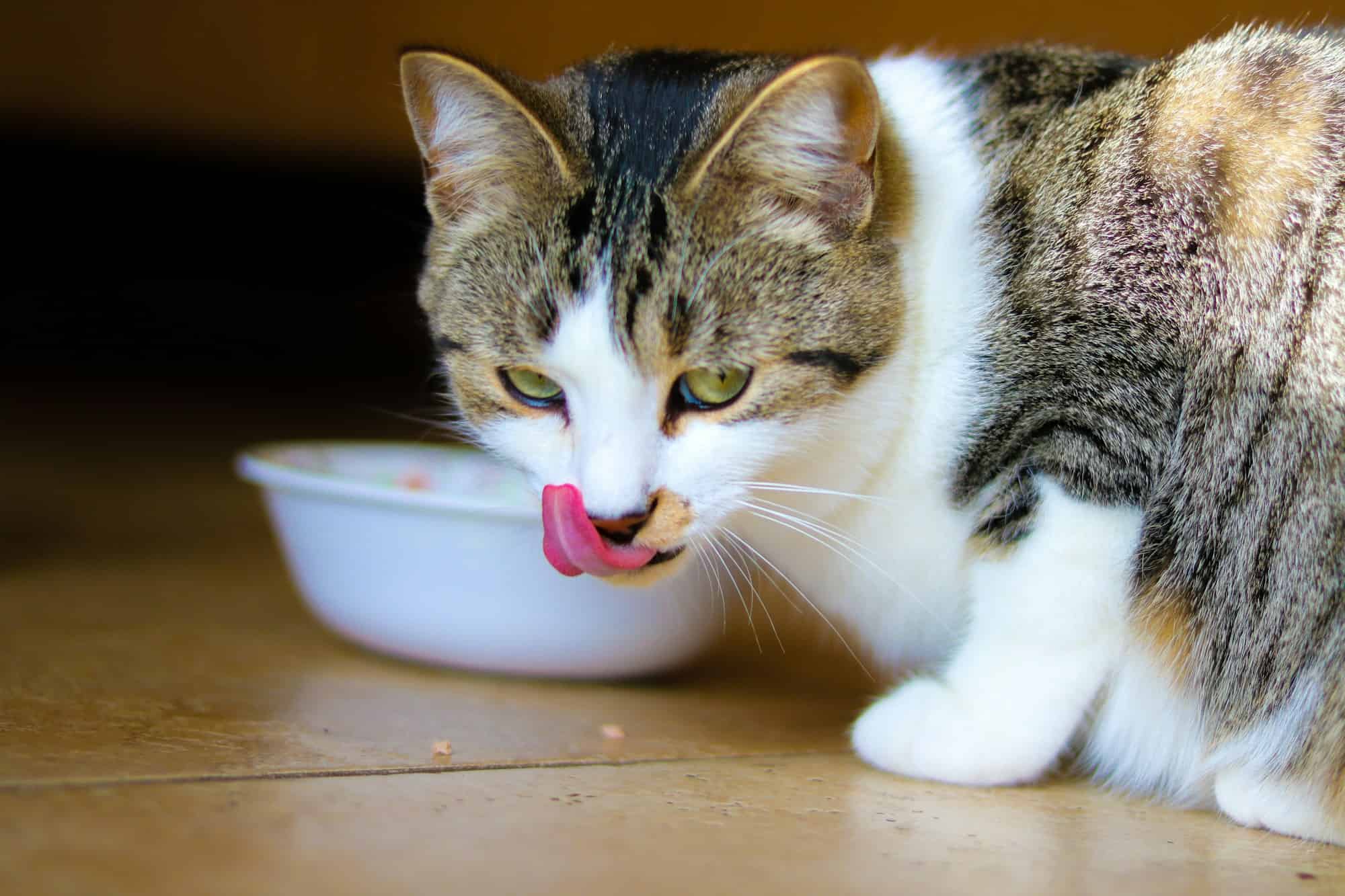
Most healthy adult indoor cats need roughly 20 to 26 calories per pound of ideal body weight per day – about 200 to 260 calories for a typical 10-pound cat. In practical terms that is around ½ to ⅔ cup of dry food, or about one and a half 5.5-ounce cans of wet food, split across two meals. The exact number depends on whether your cat is spayed or neutered, how much they actually move, and how calorie-dense your specific food is. Here is the chart, the math it comes from, and the one check that matters more than any number on a bag.
Cat feeding chart by weight
These figures assume a spayed or neutered adult indoor cat, using a dry food at about 400 calories per cup and 5.5-ounce wet cans at about 180 calories each. Always feed to your cat’s ideal weight, not their current weight – if your 18-pound cat should be 13 pounds, use the 13-pound row.
| Ideal cat weight | Approx. daily calories | Dry food per day | Wet food per day |
|---|---|---|---|
| 5 lb | 130–160 kcal | about ⅓ cup | about ¾ of a can |
| 8 lb | 185–220 kcal | about ½ cup | about 1 can |
| 10 lb | 220–260 kcal | ½ to ⅔ cup | about 1⅓ cans |
| 12 lb | 250–300 kcal | ⅔ to ¾ cup | about 1½ cans |
| 15 lb | 295–355 kcal | ¾ to 1 cup | about 1¾ cans |
| 18 lb | 340–405 kcal | about 1 cup | about 2 cans |
| 20 lb | 365–440 kcal | 1 to 1¼ cups | about 2¼ cans |
Check your own labels before you trust those columns. Cat kibble ranges from roughly 330 to 500 calories per cup, and a 5.5-ounce can can be anywhere from 120 to 250 calories. The calorie content is printed on every bag and can sold in the US – look for the “kcal/cup” or “kcal/can” line, usually near the guaranteed analysis.
Where those numbers come from
Veterinary nutrition starts with resting energy requirement: 70 × (body weight in kilograms) raised to the power of 0.75, then multiplied by a lifestyle factor. For a neutered indoor adult cat that factor is commonly around 1.0 to 1.2. A 10-pound cat is 4.5 kg, which gives a resting requirement of about 218 calories – and 218 to 260 once you apply the factor. That is where the chart’s ranges come from.
Notice how flat the curve is. A 20-pound cat does not need twice what a 10-pound cat needs; it needs about 1.7 times as much. This is exactly why bag guidelines, which tend to scale linearly, quietly overfeed bigger cats.
Wet food, dry food, or both
You match calories, not volume – wet food is roughly 75 percent water, so a bowl that looks generous may hold a third of the calories the same bowl of kibble would. Both formats can feed a cat well. Wet food carries a real hydration advantage, which matters because cats evolved as desert animals with a weak thirst drive and a lifelong tendency toward urinary and kidney trouble.
Plenty of households do a hybrid: a measured wet meal morning and evening, with a small measured portion of kibble for enrichment or a puzzle feeder. If you are choosing brands, our best dry cat food guide and best wet cat food comparison break down what is actually different between the big names. Cats with chronic loose stool or vomiting may do better on a formula built for it – see our sensitive stomach picks.
Kittens, seniors and cats who need to lose weight
Kittens need roughly two to three times the adult calories per pound, seniors often need slightly more protein rather than less food, and weight loss should be slow – no more than about 1 to 2 percent of body weight per week.
Kittens under six months: free access to a growth-formula food is normal and appropriate. They are building a body, not maintaining one.
Newly spayed or neutered cats: expect a genuine drop in energy needs. A lot of cats put on their first extra pound in the six months after surgery simply because nobody adjusted the scoop.
Overweight cats: never crash-diet a cat. Rapid calorie restriction in cats can trigger hepatic lipidosis, a serious liver condition. Reduce by about 10 percent, hold for a month, weigh, and adjust again – with your vet in the loop.
Treats count, and cats have a tiny budget
Treats should stay under 10 percent of daily calories, which for a 10-pound cat is about 25 calories – roughly three or four small commercial treats, total. A lick-tube or a spoon of tuna can eat the whole allowance in one go. If your cat is treat-motivated, break treats in half; cats respond to the event, not the size.
How many meals a day?
Two measured meals a day works for most adult cats; free-feeding a full bowl of kibble is the single most common cause of feline obesity in indoor cats. Some cats do better on three or four small meals, which is closer to how they would eat naturally – a wild cat eats around eight to ten tiny meals a day. Puzzle feeders and slow bowls stretch mealtime and give an indoor cat something to do. An automatic feeder is genuinely useful here, because it keeps portions honest on the days your schedule is not.
The body condition check that beats any chart
Run your hands along your cat’s ribs: you should feel them easily under a thin layer of fat without pressing, see a waist behind the ribs when looking from above, and feel only a small primordial pouch of loose skin on the belly. If you have to press to find ribs, cut the daily amount by roughly 10 percent and re-check in a month. If the ribs and spine are sharply visible, feed more – and if the weight loss was not deliberate, call your vet.
Weigh monthly on the same scale. A one-pound change in a 10-pound cat is 10 percent of their body weight; on a human that would be headline news. A cat who suddenly stops eating is a different problem entirely – our guide to why cats stop eating covers when that becomes an emergency.
Frequently asked questions
How much should I feed my cat per day in cups?
At roughly 400 calories per cup: about ⅓ cup for a 5-pound cat, ½ cup at 8 pounds, ½ to ⅔ cup at 10 pounds, ¾ cup at 12 to 15 pounds, and about 1 cup at 18 to 20 pounds, split into two meals. Check the kcal-per-cup figure on your bag and scale from there.
How many cans of wet food should a cat eat a day?
For a typical 10-pound cat eating 5.5-ounce cans at about 180 calories each, roughly one and a third cans a day. Smaller 3-ounce cans usually run 70 to 100 calories, so the same cat would need three of those.
Is my cat overweight?
If you cannot feel the ribs without pressing, there is no visible waist from above, and the belly hangs in a broad pad rather than a small pouch, yes. Roughly half of pet cats in the US are estimated to be overweight or obese, so it is far more common than most owners expect.
Should I free-feed my cat?
Generally no, at least not with dry food. Most cats will eat past their needs when food is always available. Measured meals or a portion-controlled feeder give you the one thing free-feeding removes: information about how much your cat actually ate.
How much should I feed a kitten?
Follow the growth chart on a kitten-formula food by age, feed three to four times daily under six months, and let them eat freely if they are underweight. Kittens should look lean and springy, not round. Our new kitten checklist covers the rest of the first weeks.
My cat begs constantly – am I underfeeding?
Usually not. Persistent begging in a cat at a healthy weight is more often boredom or routine than hunger. But a genuinely ravenous cat who is losing weight needs a vet visit, because hyperthyroidism and diabetes both present that way.
One last thing that has nothing to do with food
Mealtime is the one predictable moment each day when your cat comes to you. It is a good habit to run a finger under the collar while they are eating and check that the ID tag is still there, still readable, and still shows a number you actually answer. Indoor cats slip out – through a propped door on moving day, through a window screen, through a contractor’s open gate – and an indoor cat with no ID is the hardest kind to get home. We make NFC smart pet ID tags that a finder taps with any phone to pull up your cat’s profile, with contact details engraved on the back as backup, and yes, we are openly biased about ours. If your cat has nothing on the collar at all, though, any tag beats none – here is what cat parents actually need on one.
Get Your Tag
Designer acrylic NFC tags with engraved backup contact info. One tap, any phone, no app for the finder, no subscription ever.