Why Does My Dog Pant So Much? Normal Panting vs. Real Warning Signs
 Shiloh’s House Team
·
·
6 min read
Shiloh’s House Team
·
·
6 min read
Dogs pant because it is how they cool down — they barely sweat, so evaporating moisture off the tongue and airway is their main air conditioning. Panting after a walk, on a warm day, or during excitement is completely normal and settles within about 10 to 30 minutes of rest in the shade. Panting that is heavy, noisy, out of nowhere, or that does not stop when your dog is cool and calm is a different thing entirely, and can point to heatstroke, pain, anxiety, or a heart or hormone problem.
Why do dogs pant in the first place?
The evaporation pulls heat out of the blood flowing through those tissues. It is remarkably effective, and it is also the reason a dog in a hot car or a stuffy room is in real danger: if the air is already hot and humid, evaporation slows down, and the whole cooling system stalls.
A resting dog typically breathes somewhere in the range of 15 to 35 breaths a minute. A panting dog is doing something many times faster and shallower. That is normal. What matters is the context, and whether it stops.
When is panting normal?
Panting is normal when there is an obvious cause and it resolves with rest. The everyday triggers:
- Heat. The most common reason by a long way.
- Exercise. A dog who has been running should be panting.
- Excitement. You came home. Somebody picked up the leash. The panting starts before the walk does.
- Recovery from play. Expect 10–30 minutes to settle in a cool spot with water.
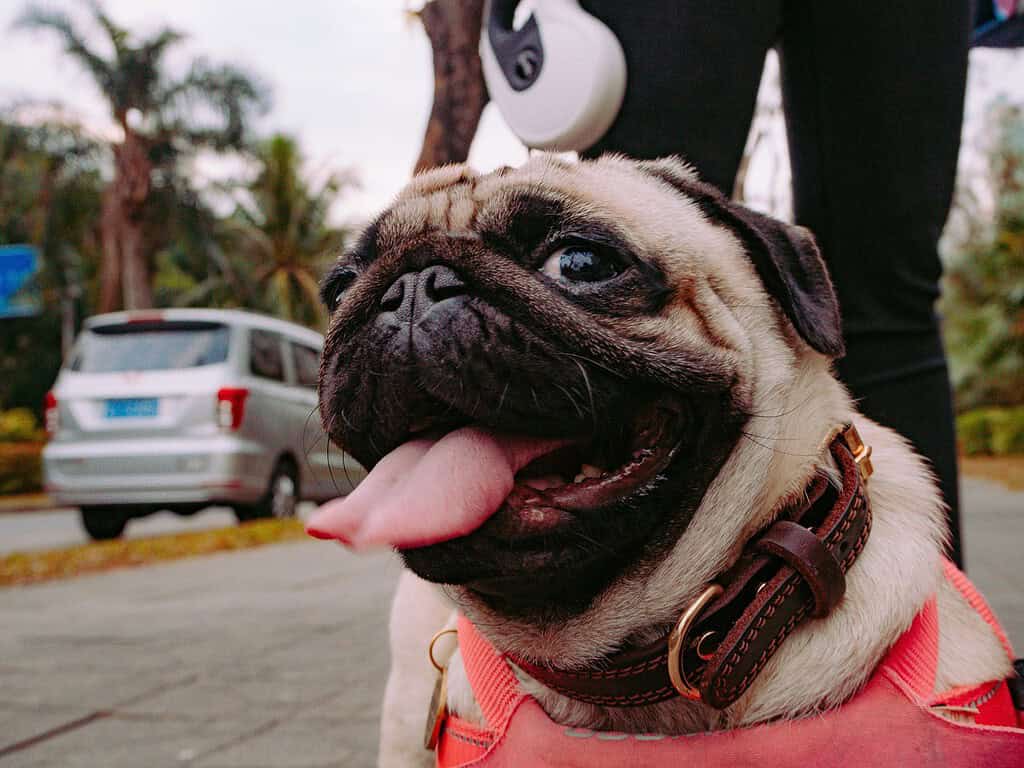
- Being a flat-faced breed. Bulldogs, Pugs, Frenchies, Boxers and Boston Terriers pant more, louder, and at lower temperatures than other dogs, because their airways are shorter and more crowded. Normal for them is still a narrower safety margin than for a Lab.
When is panting a red flag?
Call your vet if panting is happening with no heat, no exercise and no excitement to explain it — or if it comes with any of the signs below. These are the ones worth memorising:
| What you are seeing | What it can mean | How fast to act |
|---|---|---|
| Frantic panting, drooling, bright red or very pale gums, wobbling, vomiting on a hot day | Heatstroke | Emergency — cool and go now |
| Panting plus a soft, wet cough, or panting while lying down at night | Heart disease or fluid on the lungs | Same-day vet visit |
| Panting with a hunched posture, restlessness, reluctance to be touched or lie down | Pain — often abdominal, spinal or dental | Same-day vet visit |
| Noisy, raspy panting; a change in bark; gagging after drinking | Laryngeal paralysis or airway obstruction | Urgent — worsens fast in heat |
| Older dog panting constantly, drinking and peeing more, pot-bellied, thinning coat | Cushing’s disease | Book a workup this week |
| Panting with pacing, trembling, hiding, drooling during storms or fireworks | Anxiety or a phobia | Manageable — talk to your vet about a plan |
| Panting plus pale or white gums, weakness, collapse | Anaemia or internal bleeding | Emergency |
| Panting that started after a new medication | Drug side effect — steroids are a common culprit | Call the prescribing vet |
Heatstroke: the one you cannot afford to get wrong
A dog’s normal body temperature sits around 101–102.5°F (38.3–39.2°C). Above roughly 104°F (40°C) you are in heatstroke territory, and above 106°F the risk of serious internal damage climbs sharply.
What to do, in order:
- Get out of the heat. Shade, indoors, air conditioning, a fan.
- Start cooling with cool — not ice-cold — water. Pour or hose it over the whole body, especially the belly, armpits and groin. Ice water can constrict surface blood vessels and slow cooling down.
- Offer small amounts of cool water to drink. Do not force it.
- Go to the vet, even if your dog seems to recover. Heatstroke damage to kidneys, gut and clotting can show up hours later.
Prevention beats all of it: walk early or late, test the pavement with the back of your hand for seven seconds, never leave a dog in a parked car, and give heat-sensitive dogs somewhere cool to lie. We go deep on this in our dog heat safety guide, and our roundup of the best dog cooling mats and vests of 2026 covers what actually helps versus what just looks the part.
Is my dog panting from anxiety?
Anxious panting usually travels with other tells: pacing, whining, trembling, tucked tail, yawning, lip-licking, sticking to you like glue, or trying to hide in a bathroom or closet. The classic triggers are thunderstorms, fireworks, car rides, vet visits and being left alone. The panting is real — stress raises heart rate and body temperature — but the fix is behavioural, not a fan.
Give your dog a safe den they chose themselves, use white noise to blunt the bangs, and talk to your vet about pheromone products, supplements or situational medication before the next storm season rather than during it. A dog who panics and bolts is also a dog who ends up on a shelter intake list, which is why panicky dogs need identification they cannot lose.
Frequently asked questions
How much panting is too much for a dog?
If your dog is panting hard with no heat, exercise or excitement to explain it, or is still panting heavily 30 minutes after cooling down and resting, that is too much. Sudden changes in panting pattern matter more than the absolute amount.
Why is my dog panting at night when it is cool?
Night panting in a cool room is one of the more meaningful patterns, because heat and exertion are ruled out. Common causes are pain, heart disease, Cushing’s disease and anxiety. It is worth a vet visit rather than a wait-and-see.
Why is my old dog panting so much?
Senior dogs pant more for several overlapping reasons: arthritis pain, reduced heart and lung reserve, Cushing’s disease, laryngeal paralysis, and canine cognitive dysfunction causing night-time restlessness. It is common, but it is not something to write off as “just old age” without a check.
Do dogs pant when they are in pain?
Yes, and it is one of the most reliable signs owners miss. Pain panting usually comes with restlessness, an inability to settle, a hunched or praying posture, or flinching when touched in one area.
Is heavy panting normal after a walk?
Yes, if it settles. A fit dog should be noticeably calmer within 10 to 30 minutes in a cool spot with water. If your dog is still going hard after that, or seems distressed rather than just hot, shorten the walks and get them checked.
Do flat-faced dogs pant more?
Considerably. Brachycephalic breeds move air far less efficiently, which makes panting both louder and less effective. They overheat at temperatures other dogs handle easily, and a panting Frenchie deserves faster intervention than a panting Border Collie.
The safety net for the dog who bolts
Panting from fear and running from fear are the same reflex. Storm season and the days around the Fourth of July are the busiest of the year for shelter intakes, and a frightened dog can cover a lot of ground before anyone catches up. Full disclosure — we make them — but this is exactly what our Shiloh’s House NFC smart tags are for: $38 designer acrylic, tap with any phone to open your dog’s profile with no app needed by the person who found them, your number engraved on the back as a backup, and no subscription. The free Lohji app that pairs with it stores vet contacts and medical notes, which is useful in a panic even if your tag came from somewhere else. If your dog struggles with being left, our piece on why dogs follow you everywhere is a good companion read, and if summer travel is coming up, so is our 2026 road trip safety guide.
Get Your Tag
A $38 designer acrylic NFC tag any phone can tap — engraved backup, made in USA, no subscription, ever.