Why Does My Dog Twitch in His Sleep? Dreams, REM Sleep and When to Worry
 Shiloh’s House Team
·
·
16 min read
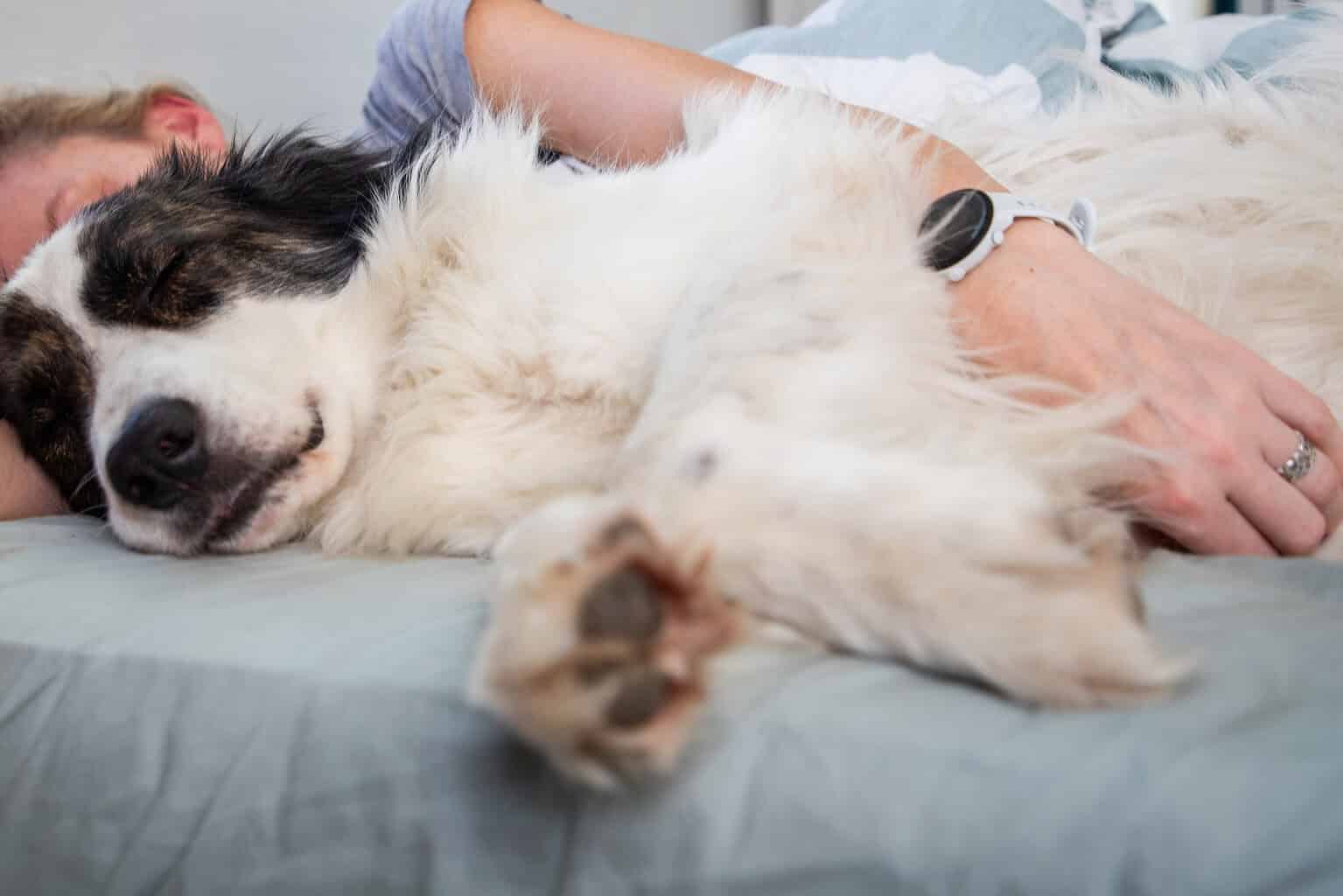
Twitching, paddling, whisker flicks and muffled barks during sleep are almost always normal REM-sleep behavior, and your dog is very likely dreaming. Dreams begin about 20 minutes after a dog dozes off, the movements are brief and loose, and the dog wakes easily if you call. A seizure looks different: rigid limbs, violent jerking that lasts a minute or more, drooling, urinating, and a dog who cannot be roused and is confused afterward. Puppies and seniors twitch most. Do not touch a dreaming dog; film anything that worries you.
Last updated: October 2025
Why does my dog twitch in his sleep?
Dogs sleep in cycles, just as people do. They drift from drowsiness into slow-wave sleep, where the brain is quiet and the body still, and then into rapid eye movement (REM) sleep, where the brain lights up with activity that looks a lot like being awake. The twitching you see almost always happens in REM. Brain-wave recordings in dogs show the same stages, in the same order, that researchers see in humans.
During REM sleep, a structure in the brainstem called the pons switches off the large muscles so the sleeper does not act out the dream. That paralysis is not perfect. Small muscles still fire, which is why you see paws paddling, lips flapping, whiskers flicking, eyes darting under closed lids and the occasional muffled “woof.” Psychologist Stanley Coren, writing in Psychology Today, puts the first dream of a nap at roughly 20 minutes after an average-sized dog falls asleep, marked by shallow, irregular breathing.
Most dream twitches are quick. The American Kennel Club’s chief veterinarian describes them as brief, usually under 30 seconds, and intermittent. A few seconds of running paws, a pause, a sigh, then stillness: that is the normal pattern.
If your dog seems to spend a surprising amount of the day asleep, that is normal too. Our guide to why dogs sleep so much covers a typical day of rest and the few changes that mean something is wrong.

Do dogs actually dream?
Nobody can ask a dog what it saw, so the honest answer is “almost certainly.” The strongest evidence comes from a 2001 study at MIT. Kenway Louie and Matthew Wilson recorded neurons in the hippocampus of rats while the animals ran a track for food, then kept recording while the rats slept. During REM sleep the same firing sequences reappeared, stretched over tens of seconds to minutes, at close to the original speed: “long temporal sequences of patterned multineuronal activity suggestive of episodic memory traces,” as the authors put it.
If a rat replays its day in REM sleep, it would be odd if a dog, with a larger brain and the same sleep stages, did not. Coren makes that argument and adds a second line of evidence. In older experiments where the part of the pons that paralyzes the body was inactivated, sleeping dogs acted out what they were apparently dreaming: a pointer went on point, a Springer Spaniel flushed an invisible bird, and a Doberman squared off with a dream intruder. In his words, “dogs dream doggy things.”
What those doggy things are is still a guess. Harvard Medical School psychologist Deirdre Barrett gave People the most quoted answer in 2016.
“Humans dream about the same things they’re interested in by day, though more visually and less logically. There’s no reason to think animals are any different. Since dogs are generally extremely attached to their human owners, it’s likely your dog is dreaming of your face, your smell and of pleasing or annoying you.”
Deirdre Barrett, PhD, clinical and evolutionary psychologist, Harvard Medical School, People (2016)
Barrett was clear in the same interview that this is an educated extrapolation and that anything about what animals dream “is speculative.” We can show that the dreaming brain replays waking experience, and we can watch dogs act out waking behaviors when the paralysis is removed. We cannot see the pictures.
Whether dogs have nightmares is even less certain; a mid-dream growl can just as easily be excitement or rough play. The soft exhale as the twitching stops is usually the shift back to deeper sleep (more in why dogs sigh).
How is a dog’s sleep different from ours?
The stages are the same, but the schedule is nothing like a human night. The classic field study is Adams and Johnson’s 1993 paper in Applied Animal Behaviour Science, which watched 24 pet dogs in their own homes and yards through the night. Over 8-hour observations the dogs woke about three times an hour, in cycles averaging 16 minutes asleep and 5 minutes awake, and even in active (REM) sleep they responded to other dogs barking.
Laboratory recordings add detail. In the 1977 pointer study, total sleep came to about 35 percent of the day, split into slow-wave sleep (23 percent) and REM (12 percent). More recently, a Budapest group led by Anna Kis developed a non-invasive polysomnography method for pet dogs. In their 2014 study of 22 adult dogs napping beside their owners, the sleep EEG looked much like the human pattern, and sleep efficiency ranged from about 8 percent to 81 percent of the 3-hour session, so some dogs barely slept while others were out cold.
| Measure | Figure | Source |
|---|---|---|
| Puppy sleep per day | Up to 18 to 20 hours | American Kennel Club, 2020 |
| Adult dog sleep per day | About half the day (roughly 12 hours), plus 30% awake but resting | American Kennel Club, 2020 |
| Senior dog sleep per day | 12 to 15 hours; over 20 hours is a flag | American Kennel Club, 2019 |
| Share of 24 hours in REM sleep | 12% | Lucas et al., 1977 |
| Length of one REM episode | About 6 minutes | Lucas et al., 1977 |
| Night-time sleep bout at home | 16 minutes asleep, 5 minutes awake, about 3 wakings per hour | Adams and Johnson, 1993 |
| Typical dream twitch | Under 30 seconds, intermittent | AKC (Klein), 2017 |
| Typical generalized seizure | 30 to 90 seconds, sometimes a few minutes | AKC (Coile), 2025 |
| Emergency threshold (status epilepticus) | Seizure lasting more than 5 minutes | AKC (Coile), 2025 |
Two takeaways. A dog that wakes, repositions and drops back off every 20 minutes is not restless; that is the species. And because dogs sleep in light, fragmented stretches, where they sleep matters. A supportive bed in a quiet corner gives an older dog undisturbed REM that a hard floor by the door does not; our tested picks are in best dog beds. The Kis study also found that dogs who had an active, novel day fell asleep faster and slept more deeply that afternoon.
Why do puppies and senior dogs twitch more?
If you have raised a puppy, you know the show: whole-body wriggles, paddling legs, squeaks and the occasional tail wag while fast asleep. Old dogs often do the same. Coren’s explanation, repeated by the AKC and VCA Animal Hospitals, is that the pons is underdeveloped in puppies and less efficient in old dogs. The muscle brake is weaker at both ends of life, so more of the dream leaks out, just as it does in human infants and older adults.
Puppies also simply sleep more. The AKC puts puppy sleep at up to 18 to 20 hours a day, which means more REM episodes and more chances for you to catch one.
Senior dogs sleep more because they tire more easily, and 12 to 15 hours a day is typical. Their twitching is usually the same harmless REM movement, but seniors are also the age group where new seizures, pain and cognitive decline show up, so a change in how an older dog sleeps deserves more attention. A senior who suddenly twitches far more, cries out, or wakes confused and paces at night should see the vet.
How can you tell a dream twitch from a seizure?

The two events look different enough that a calm observer can usually tell them apart. Start with the limbs. A dreaming dog’s legs stay loose. The paws paddle in a soft running rhythm, a lip curls, the tail thumps once, and then the body goes slack again. A seizing dog’s legs are rigid. In a generalized seizure the body stiffens first, often with the head and neck pulled back, and then jerks in hard, repetitive movements that look nothing like running. The AKC’s chief veterinarian, Jerry Klein, describes seizing limbs as stiff and rigid with more violent movement, in contrast to the brief, intermittent twitching of a dream.
Next, watch the clock. Dream movements usually last under 30 seconds and come in bursts with quiet stretches between. A generalized seizure typically runs 30 to 90 seconds and can stretch to a few minutes, and it does not pause and restart the way a dream does. The eyes help too. In REM sleep the eyes are closed or barely open and flick under the lids. In a seizure the eyes are often wide open, fixed or rolled, and the dog is clearly not seeing you. Many seizing dogs chomp at the air and drool heavily; dreaming dogs may smack their lips, but they do not foam.
Then look at what else the body is doing. Loss of bladder or bowel control during the episode points strongly to a seizure; dreaming dogs almost never soil themselves. Paddling while the dog lies on its side with legs fully extended and back arched is a seizure posture. A dog mid-dream is curled or stretched in a relaxed way and may shift position between twitches.
The most useful single test is whether you can wake the dog. A dreaming dog can be roused by a voice. Say the dog’s name loudly from a few feet away or make a sharp sound such as dropping a shoe. If the dog lifts its head, blinks and looks at you, it was dreaming. A dog in a true seizure cannot be woken by sound or touch; the episode runs its course regardless of what you do. Do not try to wake a suspected dreamer by grabbing or shaking, for reasons we cover below.
Finally, pay attention to what happens afterward. A dog waking from a dream is a dog waking up: a stretch, a shake, maybe a drink, then normal behavior within seconds. A dog coming out of a seizure enters what veterinarians call the post-ictal phase. For minutes to hours the dog may be disoriented, pace, bump into furniture, seem temporarily blind, pant, drool, act clingy or, occasionally, aggressive. That recovery period is one of the clearest markers of a true seizure, because dreams do not leave a dog confused.
Keep two caveats in mind. Seizures can begin during sleep, and in dogs with idiopathic epilepsy they often do, so “it happened while he was asleep” does not rule a seizure out. And focal seizures, which involve only part of the brain, can be subtle: a single leg that jerks rhythmically, fly-biting at nothing, or a blank stare with jaw chomping while the dog stays conscious. If a movement repeats the same way every time and cannot be interrupted by calling the dog, treat it as a possible seizure even if it is small.
What else makes a sleeping dog twitch or shake?
A handful of other conditions produce movement in a sleeping or resting dog.
REM sleep behavior disorder. This is the dream brake failing badly. Instead of paddling paws, the dog has violent limb movements, howling, barking, growling, chewing or biting during sleep, at night and during daytime naps. A 2011 case series in the Journal of Small Animal Practice reviewed 14 dogs with suspected REM sleep behavior disorder: 64 percent were a year old or younger at onset, none recovered on their own, and potassium bromide reduced the episodes in 78 percent of treated dogs. The telltale difference from a seizure is that these dogs wake instantly and the movement stops the moment they are roused.
Narcolepsy. A rare inherited disorder, best known in Doberman Pinschers, Labrador Retrievers and Dachshunds, in which a dog suddenly collapses limp mid-excitement, then snaps back to normal. It is sometimes mistaken for a seizure and usually appears in puppies two to four months old.
Cold and pain. Shivering is a tremor, and a dog that is cold or hurting may shake while resting. It is fine and rhythmic, involves the whole body, and stops when the dog warms up. If your dog trembles at night in a chilly room, a warmer bed solves it; see keeping a dog warm at night. Trembling that continues in a warm room, especially in an older dog, can be arthritis or back pain.
Low blood sugar. Toy-breed puppies and underfed or overworked dogs can tremble, twitch, go weak and eventually seize when blood glucose falls. Stress, cold and skipped meals are the usual triggers in small puppies.
Toxins. Tremors that persist through sleep, or appear after a dog raided the trash or compost, are a poisoning picture. The Merck Veterinary Manual notes that tremorgenic mycotoxins from moldy food cause vomiting, fine tremors, incoordination and, at higher doses, seizures within hours; permethrin overdoses and snail bait do the same. After a possible ingestion, follow the steps in what to do when your dog eats something it should not and call a vet or poison line right away.
Put your dog’s seizure history and medications where a sitter or finder can see them
Shiloh’s House smart tags pair a laser-engraved name and number with a tap-to-open profile that holds medical notes, medications and your vet’s details, so whoever is with your dog when something happens knows what to do. $38 one-time, no subscription, made in the USA.
Should you wake a dreaming dog?
No, and the old saying exists for a reason. A dog pulled out of REM sleep by a hand on its flank wakes disoriented, mid-dream, with its startle reflex fully loaded. The AKC warns that disrupting the REM cycle can produce an unintended bite or scratch, even from a gentle dog, because the dog reacts before its brain has caught up with where it is.
That risk is highest around children, who are drawn to a twitching, whimpering dog and want to comfort it. Teach kids that a sleeping dog is off limits and is just “dreaming about squirrels.” If a child must get the dog’s attention, the rule is voice first, from a distance, never hands. We cover those boundaries in pets and kids.
If you cannot tell whether your dog is dreaming or seizing, the AKC’s advice is to call the dog’s name loudly or drop something. A dog that wakes was dreaming; reassure it quietly. A dog that does not respond needs the seizure plan: clear the space, keep your hands away from the mouth, and start timing.
Whimpering in sleep is not evidence of a nightmare, and waking the dog will not change the dream. If the whimpering carries into waking hours, see why dogs whine so much.
If your dog has a seizure disorder, make sure the people who care for him know it. In the free Lohji app from Shiloh’s House, the Smart Tag profile behind a Shiloh’s House tag has a medical notes field and a vet field, so a sitter or a stranger who taps the tag sees “epileptic, on phenobarbital, call Dr. Patel” before anyone has to guess. The app is on the App Store and Google Play.
When should you film it and call the vet?
Most sleep twitching never needs a vet. Film and call when you see any of these.
- Stiff, rigid limbs or violent jerking that lasts longer than a minute.
- Drooling, foaming, urinating or defecating during the episode.
- A dog that cannot be woken by a loud voice or sharp noise.
- Confusion, pacing, apparent blindness or unsteadiness afterward.
- Episodes that repeat the same way, or happen while awake as well as asleep.
- Twitching plus weakness, wobbliness or refusal to eat in a small puppy.
- Any tremor after possible access to moldy food, compost, trash or pesticides.
Two situations are emergencies: a seizure lasting more than five minutes, and two or more seizures within 24 hours. Both can push body temperature to dangerous levels and need a clinic now. Note when the episode started and stopped and anything the dog might have eaten.
Video is the most useful thing you can bring. Neurologists rely on owner videos to separate seizures from REM sleep behavior disorder, narcolepsy and ordinary dreams, because by the time the dog reaches the clinic the episode is over.
Frequently asked questions
Is it normal for a dog to twitch in his sleep?
Yes. Twitching, paddling, lip movements and soft vocalizing during sleep are normal REM-sleep behavior. The brainstem blocks most large muscle movement during dreams, but small movements leak through. Episodes are brief, usually under 30 seconds, and the dog wakes easily if called. Puppies and seniors twitch most because that muscle brake is weaker at both ends of life.
What do dogs dream about?
Probably their everyday lives. Rat studies show the brain replays the day’s experiences during REM sleep, and dogs whose dream paralysis was switched off acted out breed-typical behaviors such as pointing and flushing birds. Harvard psychologist Deirdre Barrett has suggested dogs likely dream about their owners’ faces and smells, though she calls that an educated guess.
How do I know if my dog is having a seizure or a dream?
Dreaming dogs twitch loosely for a few seconds at a time and wake when you call their name. Seizing dogs go rigid, jerk violently for a minute or more, often drool, urinate or defecate, cannot be woken by sound, and are confused or unsteady afterward. If you are unsure, film the episode, time it, and send the video to your veterinarian.
Should I wake my dog when he is twitching?
No. A dog startled out of REM sleep can bite or scratch reflexively before it knows where it is, and the dream itself is harmless. Keep children away from a sleeping dog. To check whether the dog is dreaming or seizing, call its name loudly or drop something from across the room; a dreaming dog will lift its head and look at you.
Why does my puppy twitch so much in his sleep?
Puppies sleep up to 18 to 20 hours a day and the brainstem structure that suppresses movement during dreams is not fully developed, so their dreams show more. That is normal. The exception is a toy-breed puppy under three months whose trembling comes with weakness, wobbliness or refusing food; that can be low blood sugar and needs sugar on the gums, warmth and a vet.
Why does my dog bark or whimper in his sleep?
Muffled barks, yips and whimpers during sleep are vocal twitches from REM sleep, the same leak of dream activity that moves the paws. They do not mean your dog is having a nightmare; a growl can just as easily be a dream about play. Loud, violent howling and biting during sleep, night after night, is worth a vet visit to rule out REM sleep behavior disorder.
Sources
- Temporally structured replay of awake hippocampal ensemble activity during rapid eye movement sleep, Louie and Wilson, Neuron (2001)
- Do Dogs Dream?, Stanley Coren, PhD, Psychology Today (2010)
- What Is Your Cat or Dog Dreaming About? A Harvard Expert Has Some Answers, Kelli Bender, People (2016)
- Baseline sleep-wake patterns in the pointer dog, Lucas, Powell and Murphree, Physiology & Behavior (1977)
- Nocturnal behaviour of domestic dogs Canis familiaris (reporting the Adams and Johnson 1993 sleep-wake study in Applied Animal Behaviour Science), Graham Adams, Murdoch University (1994)
- Development of a non-invasive polysomnography technique for dogs (Canis familiaris), Kis et al., Physiology & Behavior (2014)
- Clinical characteristics, management and long-term outcome of suspected rapid eye movement sleep behaviour disorder in 14 dogs, Schubert, Chidester and Chrisman, Journal of Small Animal Practice (2011)
- Sleep disorders: differential diagnoses and treatment, Vet Times (2015)
- Is My Dog Dreaming or Having a Seizure? How to Tell the Difference, Jerry Klein, DVM, American Kennel Club (2017)
- Epilepsy in Dogs: Causes, Diagnosis and Treatment, Caroline Coile, PhD, American Kennel Club (2025)
- Why Do Dogs Sleep So Much?, Robert DiGiacomo, American Kennel Club (2020)
- Too Much Sleep: Is There Such a Thing for Senior Dogs?, Colt Dodd, American Kennel Club (2019)
- Tremorgenic Neuromycotoxicosis in Dogs, Michelle Mostrom, DVM, PhD, Merck Veterinary Manual (2024)
- Managing Hypoglycemia in Toy Breed Dogs, Purina Pro Club (2018)