Most dog yawns aren’t about sleep. A dog that yawns a lot is usually telling you how they feel — mild stress, a wish to calm a tense moment, confusion in training, or empathy when they catch a yawn from you. Frequent yawning with drooling, pawing at the mouth, or other tension signs deserves a closer look.
Yawning is a calming signal, not just a sleepy reflex
Norwegian trainer Turid Rugaas popularized the term “calming signals” in her book On Talking Terms With Dogs. From years of watching dogs interact, she cataloged around 30 behaviors dogs use when they feel uncomfortable or want to defuse tension. Yawning sits near the top, alongside turning away, lip licking, sniffing the ground, and approaching in a curve instead of head-on.
A yawn works in two directions: it lets the dog release a little tension, and it tells the other party, “I’m not a threat, let’s keep this calm.” PetMD calls it social signaling to diffuse tension.
Science is catching up with Rugaas. A 2017 pilot study from the University of Pisa (Mariti and colleagues) filmed 24 dogs in pairs and logged 2,130 calming signals. When a dog answered an aggressive act with a calming signal, the hostility de-escalated in more than 79% of cases.
Researchers still debate whether dogs yawn on purpose or whether it’s a reflexive “displacement” behavior that leaks out under stress. Either way, a yawn outside of bedtime means your dog is feeling some kind of pressure.

Stress yawn vs sleepy yawn: how to tell the difference
A stressful yawn is more prolonged and intense than a sleepy yawn.
Ellen Lindell, VMD, DACVB and colleagues, VCA Animal Hospitals
Start with context. PetMD notes that tired yawns happen at the transitions — winding down for a nap, waking up from one — while stress yawns show up mid-event: a vet exam, a training session, a stranger’s greeting, a child climbing on the sofa. A yawn after a stretch is sleepy. A yawn as a new dog approaches is communication.
Next, read the rest of the body. Stress yawns rarely travel alone. VCA lists the company they keep: lip licking, wide eyes showing more white than usual (“whale eye”), ears pinned back, a stiff body, a tucked tail, panting without exercise, and turning the head or body away. A shake-off often follows once the tense moment passes.
Frequency matters too. One yawn on a walk is nothing. Three yawns in a minute while you’re putting on a harness is a dog saying “this is a lot.” PetMD notes there’s no fixed number that counts as excessive — watch for a change from your dog’s normal. If your dog also whines or pants in the same situations, see our guides on why dogs pant so much and why dogs whine.
Contagious yawning: your dog may be catching yours
Dogs really do catch yawns, and they’re picky about whose. In a 2013 study in PLOS ONE, Teresa Romero, Akitsugu Konno, and Toshikazu Hasegawa at the University of Tokyo tested 25 pet dogs. Each dog watched their owner and an unfamiliar researcher either yawn for real or make a fake yawning mouth movement.
The dogs yawned significantly more at real yawns than at the fakes, so they were responding to the yawn itself, not just an open mouth. They also yawned more when their owner yawned than when the stranger did. That “familiarity bias” is the same pattern seen in humans, who catch yawns most easily from people they’re close to.
Heart-rate monitors tested the obvious objection — that the dogs were simply stressed by someone staring and yawning at them. Heart rate didn’t differ between conditions, which the authors read as evidence the yawns were not a stress response. Romero described dogs’ contagious yawning as “emotionally connected in a way similar to humans.” One caveat: only 13 of the 25 dogs yawned at all, so a dog that doesn’t yawn back isn’t unbonded.
Yawning during training usually means “I don’t get it”
You ask for a behavior, the dog hesitates, then yawns. It looks like boredom or stubbornness, but PetMD files it under confusion and frustration: the dog knows you want something, isn’t sure what, and the yawn is the overflow valve.
The fix is to make the task easier, not to repeat the cue louder. Drop back to a step your dog already succeeds at, reward it, then rebuild in smaller increments. Keep sessions short — a few minutes of confident wins beats fifteen minutes of frustrated yawning.
Check your own body language too. Owners create pressure without realizing it: looming over the dog, standing square and face-on, using a sharp tone on a recall. If your dog yawns or sniffs the ground when you call, soften your voice, turn sideways, and crouch. Punishing slowness tends to produce a slower dog, because slowing down is itself a calming signal.
Not tagged yet?
A Shiloh’s House smart tag puts your phone number, your pet’s medical notes and a tap-to-call profile on their collar — no battery, no subscription. A stressed dog is a dog more likely to bolt, and one tap of any phone lets a finder reach you.
Yawning in the car, at the vet, and when you hug them
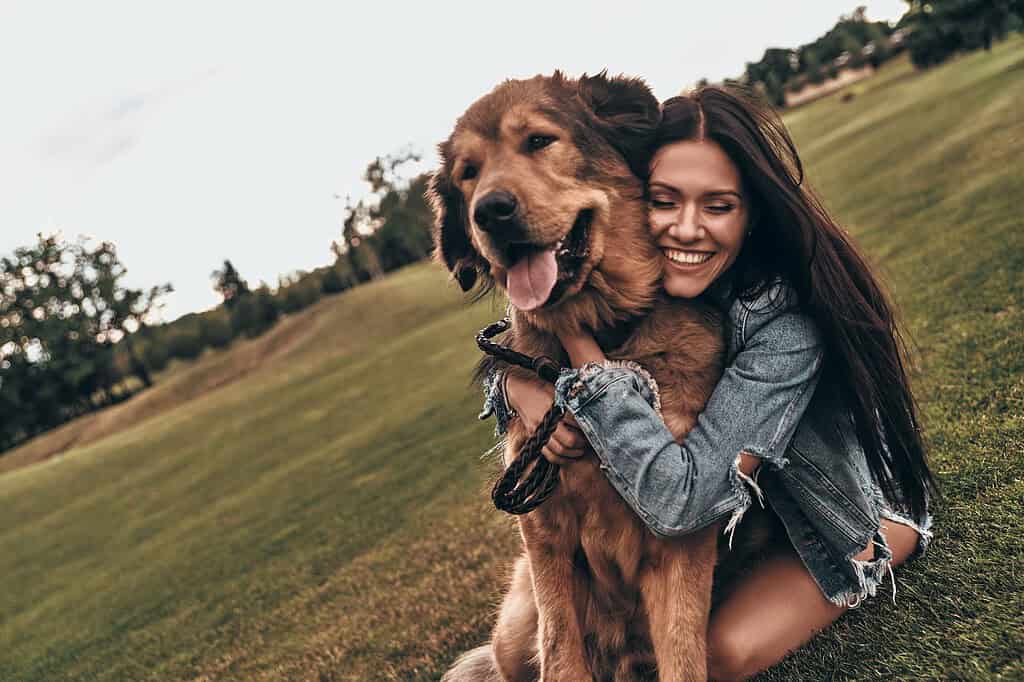
Hugs are the big one. In 2016, psychologist Stanley Coren scored the body language in the first 250 “hug dog” images from Google and Flickr. 81.6% of dogs showed at least one stress sign — face turned away, half-moon whites of the eyes, ears down, or tongue-flicking — and only 7.6% looked relaxed. It wasn’t a controlled study, but PetMD reads a mid-hug yawn the same way: “I’m a little overwhelmed, give me some room.”
Car yawning can be emotion, nausea, or both. WebMD’s vet-reviewed guide lists yawning alongside whining, drooling, lip licking, and vomiting as signs of motion sickness. Puppies are especially prone because the inner ear isn’t fully developed, and VCA notes many outgrow it by about a year old. The catch: a few queasy rides can teach a dog to dread the car, so the yawning outlasts the nausea.
If your dog yawns, licks their lips, and drools in the car, treat it as nausea first: face them forward in a seat belt harness, crack the windows, skip the big meal before the trip, and build up from short rides. The vet clinic adds strange smells, slippery tables, and hands on the body; VCA names the post-exam “shake off” and heavy shedding in clinics as stress tells, and waiting-room yawns belong to the same cluster.
When yawning is medical
Yawning alone is almost never a disease. Yawning that is new, constant, and paired with mouth-related symptoms is different. PetMD puts it plainly: excessive yawning can signal stress or an underlying condition that needs veterinary attention, so rule out a physical cause before you assume anxiety.
Nausea comes first. Dogs that feel sick drool and lick their lips, and the Merck Veterinary Manual lists excessive drooling and retching among the signs that precede vomiting. Repeated yawning, swallowing, and lip-smacking in a dog that has gone off their food points toward the stomach, not the mind.
Dental pain comes second. The AVMA’s reasons to have a dog’s mouth checked include foul breath, drooling, chewing problems or dropping food, eating less, bleeding or swelling around the mouth, and new irritability. Pawing at the mouth, an oddly stretched yawn, or a yelp mid-yawn can point to a cracked tooth, an abscess, or gum disease — and the AVMA notes most pets show early periodontal disease by age 3.
What to do about a dog who yawns a lot
Give space first. VCA’s top advice for a stressed dog is to remove them from the stressor and move somewhere quiet, without fuss. Crowding in to comfort adds pressure; luring them away with a treat works better than scooping them up.
Change the situation, not the dog. If the yawning starts when guests arrive, give your dog a room to retreat to before the doorbell goes. If it’s the harness, pair it with food and go slowly. If it’s a dog on your route, cross the road and let yours curve around rather than meet head-on — Rugaas’s advice is to let dogs use their signals instead of hurrying them through.
Walk it off. VCA recommends exercise such as walking or fetch to release tension. Trainers call the best version a “decompression walk”: a long, loose-leash wander somewhere quiet where your dog sets the pace and sniffs freely.
Note the triggers and get help if the list is long. PetMD’s checklist is a predictable routine, a calm space, positive-reinforcement training, and enough exercise. If stress signs are frequent, VCA advises a vet visit to rule out pain and possibly a referral to a veterinary behaviorist. We compared pheromones and supplements in our guide to dog calming aids.
Quick body-language guide
A yawn makes the most sense read with the rest of the dog. Here’s a cheat sheet built from the VCA, PetMD, and calming-signals lists.
| Signal | What it usually means | Your move |
|---|---|---|
| Yawn + stretch, soft eyes, loose body | Sleepy or contented | Nothing to do |
| Yawn + lip licking + looking away | Mild discomfort; a calming signal | Ease off, give a little distance |
| Yawn + whale eye + ears pinned + stiff body | Real stress; escalation possible | Remove the pressure now, move somewhere quiet |
| Yawn + drooling + lip smacking in the car | Motion sickness or travel anxiety | Short trips, face forward, fresh air, ask the vet |
| Yawn + pawing at mouth, bad breath, dropped food | Possible dental pain or something stuck | Vet visit |
Frequently asked questions
Why does my dog yawn when I pet him?
Often the petting is slightly more than they want right now, especially if it comes with lip licking or a turned head. Pause and see whether they lean back in. If they move away or shake off, they wanted space.
Why does my dog yawn when I yawn?
That’s contagious yawning. A University of Tokyo study found dogs catch yawns more readily from their owners than from strangers, and heart-rate data showed it wasn’t stress. It’s generally read as a sign of empathy.
Is excessive yawning a sign of anxiety in dogs?
It can be. Yawning is one of the most common stress signals, but alone it isn’t proof of anxiety. Look for pinned ears, whale eye, a stiff body, panting without exercise, or hiding at the same time, and note when it happens.
When should I worry about my dog yawning?
See a vet if yawning is new and frequent and comes with drooling, pawing at the mouth, bad breath, dropped food, refusing meals, lethargy, coughing, or breathing changes. Sudden continuous drooling is an urgent call.
Sources
- VCA Animal Hospitals — Signs Your Dog Is Stressed and How to Relieve It
- PetMD — Why Do Dogs Yawn? Possible Causes and What To Do
- PLOS ONE — Familiarity Bias and Physiological Responses in Contagious Yawning by Dogs Support Link to Empathy (Romero, Konno & Hasegawa, 2013)
- Psychology Today — What Are Canine Calming Signals and Do They Work?
- American Veterinary Medical Association — Pet Dental Care
- WebMD — Dogs and Motion Sickness
- Merck Veterinary Manual — Vomiting in Dogs