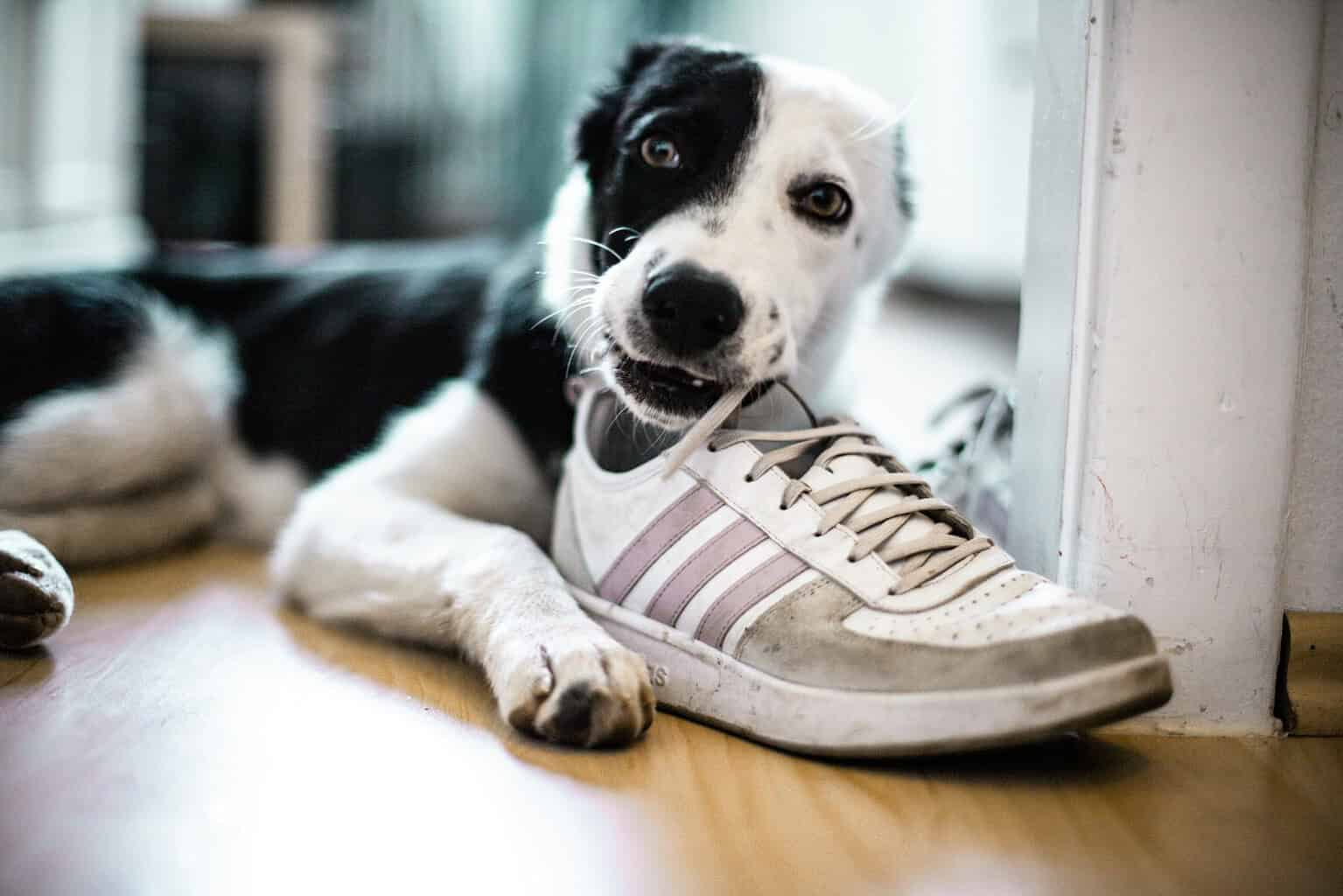
No hanging dog tag is truly chew-proof, and the ones that come closest can be hard enough to crack a tooth. Acrylic tags, including ours, can chip or snap and leave sharp edges, while silicone is gentle on teeth but can be chewed into pieces. For a chewer, the best setup is ID that does not dangle: a slide-on tag, a riveted nameplate or an embroidered collar, backed by a registered microchip and a tap-to-open profile in case the tag gets destroyed.
Last updated: October 2025
Is any dog tag really chew-proof?
Not in the way most pet parents hope. “Chew-proof” on a product page usually means the tag is made of a hard metal, such as stainless steel, that a dog cannot easily dent or bite through. That solves one problem and creates another. A material too hard for a dog to damage is also too hard for a dog’s teeth to bite safely.
Softer materials flip the trade-off. Acrylic and silicone are easier on teeth, but a determined chewer can crack, tear or shred them. Acrylic can break into hard pieces with sharp edges. Silicone can be gnawed into rubbery chunks. Either way, the tag stops doing its job, and a piece of it may end up inside your dog.
So the useful question is not “which tag can my dog not destroy?” It is:
- Which ID is hardest for my dog to get into its mouth in the first place?
- Which material is least likely to hurt a tooth if it does get chewed?
- What still identifies my dog after the tag is gone?
Answer those three and you end up with a setup that protects both your dog’s mouth and its ride home. The rest of this guide walks through each piece, starting with why dogs go after tags at all.

Why do dogs chew their tags, or each other’s?
Chewing is normal dog behavior. The ASPCA explains that for young dogs it relieves the pain of incoming teeth, and for older dogs it keeps jaws strong and teeth clean, combats boredom and can ease mild anxiety or frustration. A shiny, swinging tag right under the chin is an easy target for all of those urges.
Most tag chewing falls into one of three patterns:
- Teething puppies. Puppies lose their baby teeth and feel discomfort as adult teeth come in, and the ASPCA notes this intense chewing phase usually ends by about six months. The American Kennel Club adds that boredom can restart the habit later. Our guide to puppy ID tags covers sizing and timing for this stage.
- Bored or anxious adults. A dog left alone with nothing to do may mouth whatever is closest, including its own collar. If chewing is a household-wide problem, our fixes for a dog that chews everything go deeper on exercise and enrichment.
- Playmates. This is the one owners miss. Dogs that wrestle grab each other by the neck, and a tag is the first thing in reach. One dog chews the other’s tag, not its own.
Playmate chewing carries a second risk beyond the tag. VCA Animal Hospitals warns that dogs can be frightened or injured when a tooth or leg is caught in a playmate’s collar, and Whole Dog Journal has described a dog whose lower jaw twisted in a friend’s collar during play, choking the other dog until someone cut the collar off.
Which tag materials hold up best against chewing?
Every common tag type sits somewhere on a scale between “hard to destroy” and “kind to teeth.” The table below is our own rough rating on a 1 to 5 scale, based on how each material behaves, not on lab testing. A 5 for chew resistance means hardest to damage. A 5 for tooth risk means most likely to hurt a tooth if a dog bites down hard.
| ID type | Chew resistance (1–5) | Tooth risk (1–5) | Readability after chewing | Notes |
|---|---|---|---|---|
| Riveted or slide-on collar nameplate | 5 | 2 | Good | Sits flat, so there is little to grab. Metal, but hard to bite. |
| Engraved buckle plate | 5 | 2 | Good | Part of the collar hardware. Limited space for text. |
| Embroidered collar | 3 | 1 | Fair | Nothing dangles. Thread can fray and the collar itself can be chewed. |
| Hanging stainless steel tag | 5 | 5 | Good | Survives chewing best, which is exactly why teeth lose. |
| Hanging aluminum or brass tag | 3 | 4 | Poor to fair | Softer metals dent and bend, and bite marks wear engraving. |
| Hanging acrylic tag | 2 | 2 | Poor once cracked | Quiet and light. Can chip or snap and leave sharp edges. |
| Silicone tag or tag silencer | 1 | 1 | Poor once torn | Gentle on teeth, but easy to gnaw into swallowable pieces. |
Notice that nothing scores well on every column. The flat options win because they take the tag out of reach, not because their material is magic. For deeper side-by-sides, see our comparisons of acrylic vs metal dog tags and silicone vs acrylic pet tags.
Can chewing a hard tag break a dog’s tooth?
Yes. Veterinary dental sources list hard, non-toy objects among the usual causes of broken teeth. VCA Animal Hospitals says tooth fractures in dogs most often come from chewing hard things such as bones, crate bars, antlers, ice cubes, hooves and hard nylon toys. A veterinary dentist writing in Today’s Veterinary Practice names ceramic materials, cage bars and rocks among the non-toy objects behind fractured carnassial teeth. A small metal tag is in the same family: a hard object a dog can wrap its back teeth around.
The most common injury is called a slab fracture. VCA describes it as the cheek teeth biting down on a hard object at just the right angle so that a piece of the tooth surface breaks off, exposing sensitive dentin and sometimes the pulp. Once the pulp is exposed, bacteria can get in. That can lead to a dead tooth and a painful root abscess.
Broken teeth are easy to miss. Dogs rarely cry over them. VCA notes that a dog with an abscessed tooth may simply chew on one side, drop food, pull away when its head is touched or paw at its face.
Dr. Katherine Kling of the University of Illinois Veterinary Teaching Hospital explains that when a fracture exposes the pulp and there is no intervention, the tooth will die, so any broken tooth should be checked promptly.
What happens if a dog swallows a piece of its tag?
Sometimes nothing. VCA notes that some swallowed objects pass through the gut without a problem. But not all do, and a chewed tag can produce pieces with hard, sharp edges.
Cornell University’s College of Veterinary Medicine explains that an obstruction happens when a dog swallows a non-digestible object too large to move through the stomach or small intestine. It calls these obstructions emergencies that often need surgical removal. The American College of Veterinary Surgeons adds that what the object is made of matters, since some metals, such as older pennies or lead, can be toxic as well as blocking.
Watch for these signs, which Cornell, VCA and ACVS all list:
- Vomiting, especially repeated vomiting
- Loss of appetite
- Belly pain, or growling when picked up around the middle
- Diarrhea, straining or very little stool
- Lethargy or dehydration
The same goes for the split ring and S-hook that hold a tag on. Small metal hardware is easy to swallow once a tag has been chewed loose, so check the whole attachment, not just the tag.
How do you set up ID for a dog that chews?
Start by taking the tag out of the mouth zone. Most tag chewing happens because the tag hangs loose from a ring and swings right under the jaw, where the dog or a playmate can grab it. Anything that sits flat on the collar is harder to reach. A slide-on dog tag threads onto the collar strap itself, a riveted nameplate is fixed to the webbing, and an engraved buckle plate is part of the hardware. Embroidered collars put the phone number into the fabric so there is nothing extra at all. Each of these gives teeth very little to hold.
If you prefer a hanging tag, attach it so it moves as little as possible. Use a single ring directly on the collar’s D-ring rather than chaining an extra jump ring or stacking several charms. Every added link lets the tag swing lower and wider. Keep only the tags your dog needs on that ring, such as the ID tag and a rabies tag if your area requires one. Fewer pieces means less to grab, less to jingle and less to swallow. Our guide to quieting jingling dog tags uses the same idea, and it helps with chewers too.
Fit matters as well. A collar that sits loose lets the tag drop toward the chest, where a dog can tuck its chin and catch it. A snug fit, where you can slide two fingers under the collar, keeps the tag higher and steadier. Big dogs need extra care because their jaws reach farther and bite harder. Our ID guide for large dogs covers rings and snag-safe setups for bigger necks.
Next, think about when the collar is on. Many trainers and daycare operators remove collars for rough group play, and VCA recommends supervision whenever dogs wear collars or harnesses. If your dog crate-rests or naps unsupervised and is a known tag chewer, a flat-ID collar is the safer choice for those hours. Some owners use a breakaway collar indoors, but remember that a breakaway collar is not meant for leash walks because it is designed to release under pressure.
Then redirect the chewing itself. The ASPCA suggests plenty of appropriate chew toys rotated every couple of days, food puzzle toys and enough physical and mental exercise. A dog with a better option in its mouth is less likely to go looking for metal or plastic. Puppies in the teething window may need frozen toys or washcloths for relief, and should never be left alone with something they can chew into pieces.
Finally, build ID that does not depend on the tag surviving. A tag is the fastest way for a neighbor to call you, but it is also the piece most likely to be lost, chewed or broken. Two backups cover that gap. A registered microchip sits under the skin, so it cannot be chewed, and any shelter or vet can scan it. An NFC or QR profile that you control lets you update your number, add medical notes or post a reward without engraving anything new. Pair those with a flat or carefully attached tag, check the whole setup every week or two, and a chewing habit stops being a lost-pet risk. A dog can still mouth its collar now and then. What matters is that its way home never depends on one small object staying in one piece.
When should you replace a chewed dog tag?
Tags wear out slowly, so it is easy to keep using one past its useful life. A quick check every week or two catches problems early. Run your fingers over the edges and read the front in daylight.
Replace the tag right away if you find:
- Sharp edges or cracks. A chipped acrylic tag or a jagged metal one can cut gums and lips, and a crack is where the next break will start.
- Missing pieces. If a corner is gone and you cannot find it, consider whether your dog swallowed it and watch for the signs above.
- Unreadable engraving. If you cannot read the phone number from arm’s length, a stranger holding a nervous dog will not either. Bite marks, dents and worn paint all count.
- A bent or stretched ring. A ring that has been chewed open is one tug away from losing the tag entirely.
- A smart tag that no longer works. If a tag has a chip inside and has been chewed or cracked, tap it with your own phone. If the profile does not open, replace it.
Also replace a tag whenever your information changes. A move or a new number makes even a perfect tag useless, and updating your microchip registry should happen the same day.
ID that does more than one job
Our acrylic NFC smart tags are not chew-proof, but if yours ever needs replacing, the profile behind it is what a finder sees: your contacts, medical notes and a one-tap call.
How do microchips and NFC profiles back up a chewed tag?
A tag can only help while it is on the collar and readable. Backups keep your dog identifiable after a tag is chewed off, cracked or lost on a walk.
The microchip is the permanent layer. In a JAVMA study of more than 7,700 microchipped animals entering 53 shelters, shelters found owners for about three-quarters of the microchipped animals. The catch was registration. Of the animals for which shelters called a microchip registry, only 58.1% were actually registered, and the top reason owners could not be found was a wrong or disconnected phone number.
“It only takes a few minutes to verify and update your contact information, but it can make all the difference in bringing a lost pet back home.”
Dr. Sandra Faeh, president of the American Veterinary Medical Association, PR Newswire (2024)
A microchip has one limit. A finder needs a scanner, which usually means a trip to a shelter or vet. An NFC profile fills that gap. With a Shiloh’s House smart tag, a finder taps the tag with a phone, no app needed, and a live pet profile opens with call, text and directions buttons, voice notes, medical notes and multiple contacts. Because the profile lives online, you can update it any time without engraving a new tag. Our guide to microchips vs smart tags explains how the two work together.
Owners manage that profile in the free Lohji app, available as “Lohji: Cartoon Your Pet” on the App Store and “Lohji: Cartoon Pet Avatar” on Google Play. You can add up to three contacts, record a short voice message for whoever finds your dog, and choose whether the finder sees your pet’s photo or its cartoon Lohji character.
Even if a chewed tag needs replacing, a new tag can be synced to the same pet in the app, so the profile, contacts and notes carry over.
Frequently asked questions
Are there any truly chew-proof dog tags?
No hanging tag is fully chew-proof and safe at the same time. Hard metals like stainless steel resist chewing best, but they are hard enough to fracture teeth. Softer acrylic and silicone are easier on teeth but can crack or tear. Flat options, such as slide-on tags, riveted nameplates and embroidered collars, resist chewing best because there is little for a dog to grab.
Are acrylic dog tags safe for puppies that chew?
Acrylic is not chew-proof, including our own tags. A teething puppy can chip or snap it, and a broken piece may have sharp edges or be swallowed. For a puppy in the chewing phase, which usually eases around six months, a slide-on tag or embroidered collar is the safer daily option, along with supervision and plenty of proper chew toys.
Why does my dog chew the other dog’s tag?
Dogs that wrestle grab at each other’s necks, and a dangling tag is the first thing in reach. It is play, not aggression, but it can damage tags and teeth, and a jaw can catch in a collar. Remove collars and hanging tags for rough play, supervise closely, and use flat ID on dogs that live together and play often.
Can a dog break a tooth on a metal tag?
It can. Veterinary sources list hard objects, including metal like crate bars, among the common causes of tooth fractures, and a metal tag is a similar hard object. The large upper cheek tooth is often affected by slab fractures. Watch for one-sided chewing, dropping food or a visibly chipped tooth, and see your vet if you notice any of these.
What should I do if my dog swallowed part of its tag?
Call your vet right away, even if your dog seems fine. Some small objects pass on their own, but others cause a blockage, which vets treat as an emergency. Watch for vomiting, belly pain, loss of appetite, lethargy or straining to poop. Do not make your dog vomit unless your vet tells you to. For possible toxic material, call ASPCA Animal Poison Control at (888) 426-4435.
How does my dog stay identifiable if a tag gets chewed off?
Use backups that do not depend on the tag. A microchip cannot be chewed and can be scanned by any shelter or vet, but only if it is registered with your current phone number. An NFC smart tag profile can be updated from your phone at any time, and a replacement tag can be linked to the same profile. Check both after any move or number change.
Sources
- Characterization of animals with microchips entering animal shelters, Journal of the American Veterinary Medical Association (2009)
- On Check the Chip Day, the AVMA stresses importance of up-to-date microchip registration, American Veterinary Medical Association via PR Newswire (2024)
- Tooth Root Abscess in Dogs, VCA Animal Hospitals
- Diagnosis and Treatment of Fractured Teeth, Today’s Veterinary Practice (2022)
- Fractured Teeth Mean Pets Should See Vet, University of Illinois College of Veterinary Medicine (2017)
- Gastrointestinal foreign body obstruction in dogs, Cornell University College of Veterinary Medicine
- Gastrointestinal Foreign Bodies, American College of Veterinary Surgeons (2023)
- Ingestion of Foreign Bodies in Dogs, VCA Animal Hospitals
- Destructive Chewing, ASPCA
- How to Stop Your Dog From Chewing Everything You Own, American Kennel Club (2020)
- Collar and Harness Options for Dogs, VCA Animal Hospitals
- When Dog Collars Become Deadly, Whole Dog Journal (2013)