Can You Put a Dog ID Tag on a Harness? Yes, Here’s How
 Shiloh’s House Team
·
·
16 min read

Yes, you can put a dog ID tag on a harness, and for many dogs you should. Clip it to a sturdy metal D-ring with a split ring, not to a plastic buckle or the leash ring you use for walks. Because harnesses usually come off indoors, keep a second tag on a collar too. In a national ASPCA survey, only 61% of lost dogs had a personalized ID tag on when they went missing, so a second tag is cheap insurance.
Last updated: October 2026
Can you put a dog ID tag on a harness?
You can, and nothing about a harness makes it a worse place for ID than a collar. Almost every walking harness has at least one metal ring, and a standard tag ring fits through it the same way it fits through a collar D-ring. The finder who catches your dog does not care where the tag hangs. They care that it is there, that it is readable, and that the number on it still rings your phone.
Maybe your vet moved your dog to a harness for a sensitive neck, or your small breed never wore a collar. Both are good reasons to tag the harness. Neither is a reason to take ID off the collar, and we explain why below.
The data on lost pets makes the case for redundancy. When the ASPCA and Ohio State researchers surveyed 1,015 pet-owning households by phone, 14% of dogs had been lost at least once in the previous five years, and 51% of those lost dogs had gone missing more than once. Dogs that slip out once tend to try again. A harness tag is simply one more chance that a stranger can read your phone number before your dog ends up in a shelter.
If you are still picking a harness, our comparison of the best dog harnesses notes which models have a dedicated tag ring, which matters more than most product pages admit.
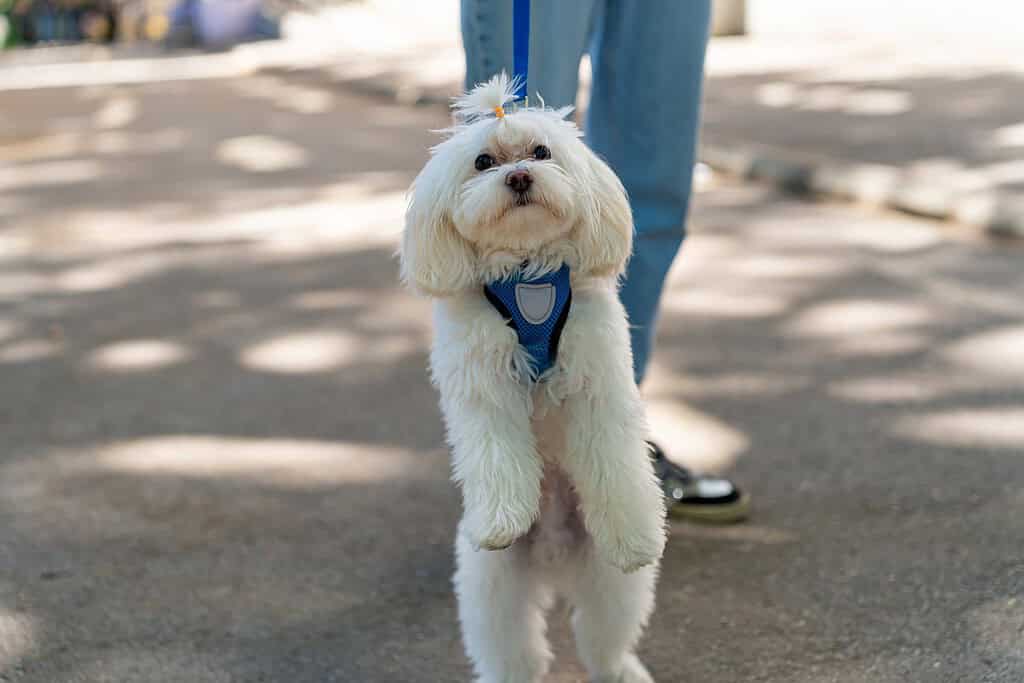
What were lost dogs actually wearing when they went missing?
The 2012 study in the journal Animals, led by Emily Weiss of the ASPCA with Margaret Slater and Ohio State veterinarian Linda Lord, is still the only nationally representative look at lost pets in the United States. It asked owners what their pet had on the most recent time it got lost. More than one answer was allowed.
| What the lost pet was wearing | Dogs | Cats |
|---|---|---|
| A collar | 90% | 43% |
| A rabies tag | 70% | 27% |
| A personalized ID tag with a phone number | 61% | 25% |
| A license tag | 58% | 21% |
| A microchip | 24% | 15% |
| No tag of any kind and no microchip | 11% | 56% |
Source: Weiss et al., Table 1, Animals, 2012. Two things jump out. Nine in ten lost dogs had a collar on, yet a third of those collars apparently carried no personal phone number. And among the dogs that were found, 15% got home because someone was contacted through a tag or microchip, the third most common route after owners searching the neighborhood (49%) and dogs coming back on their own (20%).
Which ring on the harness should the tag go on?
Look at your harness and count the metal rings. Most have two: a back ring between the shoulder blades and a front ring at the chest. Some add a small dedicated ID loop, often a fabric tab or a little D-ring near the buckle. Here is how we rank them for a tag.
- A dedicated ID ring. If your harness has one, use it. It was put there so the tag does not crowd the leash clip.
- The back D-ring. The next best spot on most step-in and overhead harnesses. The tag rides on top of the dog, stays dry in shallow puddles, and is the first thing a finder sees when they reach for the dog.
- A side or chest ring that you do not walk from. Fine, but a tag hanging at the chest swings into the front legs and bangs on water bowls.
- The ring you clip the leash to. Workable, but the leash clip grinds against the tag and its ring on every walk, which wears engraving and can pry a split ring open over time.
Avoid plastic hardware. Plastic side-release buckles and plastic sliders are not built to carry a swinging metal ring, and a tag hung from them can pop off. Webbing loops sewn into the strap are fine if the stitching is solid.
Tag size matters more on a harness than on a collar because the ring sits on a broad, flat surface where a big tag flips and flaps. We cover sizing by breed in how to choose the right size pet tag.
Split ring, S-hook, slide-on or riveted, which attachment works best on a harness?
The ring is where most tags are lost. A tag that looks fine in the morning can be gone by the afternoon if its ring bent open on a fence. The Oregon Veterinary Medical Association recommends “O” rings for that reason, because a closed ring is less likely to come loose than an open hook.
| Attachment | Fits a harness? | Security | Noise | Swap between gear |
|---|---|---|---|---|
| Split ring (keyring style) | Any metal D-ring | High | Medium | Slow, but doable |
| S-hook | Any metal D-ring | Low unless crimped shut | Medium | Not meant to be swapped |
| Quick-release tag clip | Any metal D-ring | Medium | Medium | Fast |
| Slide-on tag | Only flat straps of the right width | High | Silent | Hard |
| Riveted or embroidered plate | Built into the gear | Highest | Silent | No |
For most dogs we like a stainless split ring on the harness. It holds through rough play and does not need tools to remove, just a thumbnail and some patience. S-hooks come open when a dog scratches at them or snags them on brush, so if your license tag shipped with one, swap it for a ring. Slide-on tags are the quietest option, but they only fit a strap of the matching width, and many harness straps are padded or curved. Our guide to slide-on dog tags explains how to measure, and why dog tags fall off walks through every failure point we have seen.
Why should your dog wear ID on both the collar and the harness?

The honest answer is that a harness is a piece of walking gear, and walking gear comes off. Most of us take the harness off as soon as we get home, because it can rub, trap heat and snag on furniture when no one is watching. The collar is the item that stays on through the evening, the nap, the delivery driver at the door and the guest who leaves the gate open. If the only tag your dog owns lives on the harness, it will be hanging on a hook at the exact moment your dog slips out.
Emergency veterinarians see that pattern often enough to give the same advice. The collar is the full-time ID carrier, and the harness is the part-time one. The two jobs are different. On a walk, your dog is most likely to get loose because of a sudden scare, a backed-out harness or a dropped leash. At home, the risk is an open door. A tag on each piece of gear covers both.
There is a second, quieter reason for two tags. In the ASPCA study, lost dogs were far more likely than lost cats to be wearing some kind of ID, yet a third of the dogs wearing collars still had no personal phone number on them. A license tag gives a finder a county office and a serial number, not your cell phone, and the office may be closed on the Saturday night your dog goes missing. When you set up two pieces of gear, you have an easy moment to put a real, current phone number on both.
Two tags also protect you from the slow failure that ends most tags. Rings bend, engraving wears smooth and plastic tags crack. The odds that both tags fail on the same day are much lower than the odds of one tag quietly going missing in the yard. When one does, you still have the other while you order a replacement.
A microchip belongs underneath all of this. It is permanent and cannot fall off, and the Ohio State study of 7,704 microchipped animals in 53 shelters found that the median return-to-owner rate for stray dogs with microchips was 52.2%, compared with 21.9% for stray dogs overall. That gap is huge. But a chip only works after someone takes your dog to a scanner, and the most common reason shelters could not reach an owner was an incorrect or disconnected phone number, which accounted for 35.4% of failures. A tag lets a neighbor call you from the sidewalk within minutes, without a shelter visit at all. We compare the two in microchip vs. smart tag.
So the setup we recommend for most dogs looks like this. A flat collar that stays on whenever your dog is supervised at home, carrying a personal ID tag and any legally required tags. A harness for walks, carrying a second personal ID tag on its back ring or ID loop. A registered microchip with a phone number you have checked this year. If you are not sure what to engrave, our checklist on what to put on a dog ID tag keeps it to the lines a finder actually needs.
Do local laws let you put a license or rabies tag on a harness?
In most of the United States, yes. Dog licensing is handled by cities, counties and states, and many codes name the harness explicitly. Detroit’s ordinance says license tags “shall be attached to a substantial collar harness of durable material” and that a collar or harness with the license tag attached must be worn whenever the dog is on a street or in a public place. Sonoma, California, tells owners to secure the tag “to a collar, harness or similar device.” Long Beach requires a collar or harness with the tag securely fastened at all times.
A few points are worth checking in your own code:
- Whether the tag must be worn at home. Some codes, like Sonoma’s, exempt dogs confined to the owner’s property. Others, like Long Beach’s, say “at all times.” If yours says at all times and your dog wears the harness only on walks, the license tag belongs on the collar.
- Whether a rabies tag is required separately. Many states require proof of rabies vaccination on the dog, often as a tag. That tag is usually allowed on a harness too.
- Whether you are traveling abroad. In the United Kingdom, the Control of Dogs Order 1992 requires the owner’s name and address on the collar, and harness makers there point out that the law does not mention harnesses.
For a state-by-state overview, see are dog tags required by law.
What should your dog wear at home, in the crate and off leash?
The right gear changes through the day, and the tag plan should follow it. VCA Animal Hospitals warns that collars can become entangled in a crate, kennel, heat register or cabinet handle, and that harnesses are best removed when your dog is not directly supervised. That is the core of the problem: the gear that holds ID is also the gear that can catch.
“I usually recommend, even if you are using a harness, to also have a collar. The collar is a better place [to have] identification, contact information, rabies tags, and things like that. Harnesses tend to come off and on when you’re in the house, and the collars should always stay on.”
Erik Zager, DVM, DACVECC, Cohead of Critical Care, Philadelphia Animal Specialty and Emergency
Here is how we would split it:
- At home, supervised. Collar with ID on. Harness off.
- In the crate or left alone. Many trainers and vets suggest no gear at all, or a breakaway collar, so nothing can hang up on the wire. This is when the microchip carries the load.
- On leash walks. Collar and harness, both tagged. Clip the leash to the harness.
- Off leash at the park, on trails or at the beach. Both tagged. This is where dogs cover the most ground and meet the most strangers, so the extra tag earns its keep.
- Travel, boarding and moves. Both tagged, with a phone that will be answered during the trip.
If you are shopping for the collar half of this setup, our roundup of the best dog collars flags which ones come with a breakaway option.
How do you keep a harness from turning into an escape route?
A tag on a harness only helps if the harness stays on long enough to matter. VCA lists backing out as a main risk of both body harnesses and front-clip harnesses when they are not fitted correctly. Escape artists usually do it the same way: they plant their feet, lower their head and reverse until the chest strap slides over their shoulders.
A few fit checks cut that risk down:
- Two-finger rule. You should be able to slide two fingers under each strap, and no more.
- Chest strap behind the elbows, not on them. Too far forward and it pops over the shoulders; too far back and it rubs.
- Re-check after a bath or a haircut. A freshly groomed doodle can lose an inch of fluff and gain an escape route.
- Consider a third strap. For dogs who have already slipped a harness once, an escape-resistant design with a belly strap behind the ribs is worth the extra cost.
- Clip to both. VCA notes that attaching the lead to both chest and back clips gives extra control in urgent moments.
Even with a perfect fit, a determined dog can sometimes win. That is the best argument for the collar tag: if the harness ends up empty on the sidewalk, the collar and its ID are still on the dog.
A second tag that does more than a phone number
The Shiloh’s House Smart Tag clips onto any harness or collar D-ring with its ring, and any finder can tap it with a phone to see your dog’s profile and call you, no app needed. Each one is laser engraved, waterproof acrylic made in the USA.
What about cats and small dogs in harnesses?
Cats are where this question gets serious. In the ASPCA survey, only 43% of lost cats were wearing a collar and 56% had no tag or microchip at all. Lost cats were also less likely to come home: 75% were recovered, compared with 93% of dogs. Of the 18 cats that were never found, 15 had no personalized ID.
Many cats that walk on a harness never wear a collar indoors, so the harness tag is often their only visible ID. That makes it worth doing, but it should not be the whole plan. A randomized trial led by Linda Lord at Ohio State, with Cornell, Texas A&M and the University of Florida, fitted 538 cats with collars, and 72.7% wore them for the full six months. Owners were often surprised: 59.1% said their cat tolerated the collar better than they expected. A breakaway collar with a light tag, plus a microchip, gives an indoor cat ID that does not depend on a walk.
For toy dogs and cats, keep the harness tag small and light. A large tag hanging from the back ring of a four-pound dog can flip forward over the shoulders and annoy them enough to scratch at it. Slide-on tags and small round tags on a thin split ring work well here.
How does a smart tag on a harness help a finder?
An engraved tag holds a name and a phone number or two. With an NFC smart tag, the finder holds their phone near the tag on the back ring and a full profile opens in the browser, no app needed.
The Smart Tag profile is free in the Lohji app from Shiloh’s House. You can list up to three contacts with one-tap call, text, email and map buttons, add medical and behavior notes, list your dog’s rabies vaccine ID and vet, mention a reward, and record your dog’s name so a finder can say it the way your dog knows it. If you move or change numbers, you update the profile instead of re-engraving. The same app turns one clear photo of your pet into a 3D animated-movie-style character for wallpapers, watch faces and stickers. Get the Lohji app on the App Store or Google Play.
Frequently asked questions
Can a dog wear a tag on a harness instead of a collar?
Yes. Many US cities explicitly allow license tags on a collar or harness. The catch is that most dogs wear their harness only on walks. If your dog goes collarless at home, the harness tag is off exactly when an open door is most likely, so we suggest keeping a tagged collar on during supervised time indoors as well.
Which D-ring on a harness is best for an ID tag?
Use a dedicated ID ring if the harness has one. Otherwise, the back D-ring is usually best because it sits on top of the dog, stays visible and dry, and is easy for a finder to reach. Avoid the ring you clip the leash to, since the clip grinds on the tag and can pry its ring open.
Is a split ring or an S-hook better for a harness tag?
A stainless split ring is more secure. S-hooks bend open when dogs scratch at them or snag them on brush, which is one of the most common ways tags disappear. If your license tag arrived on an S-hook, move it to a split ring or crimp the hook fully closed with pliers.
Should a dog wear a harness in its crate?
Generally no. VCA Animal Hospitals advises removing harnesses when your dog is not directly supervised, because straps can catch on crate wire and cause injury. Collars carry a similar risk in crates. Many owners crate dogs bare or in a breakaway collar and rely on a registered microchip during that time.
Can I put a rabies tag on my dog’s harness?
In most places, yes, but check your local code. Some ordinances require the tag to be worn whenever the dog is in public, which a harness satisfies on walks. Others say at all times, which usually means the official tag belongs on a collar your dog wears indoors and out.
How do I stop my dog’s harness tag from jingling?
Wear one tag instead of a stack, add a silicone tag silencer, or switch to a slide-on tag if your harness has a flat strap of the right width. A smart tag can also replace several engraved tags, since contacts, vet and medical notes live on the profile rather than on extra metal.
Sources
- Frequency of Lost Dogs and Cats in the United States and the Methods Used to Locate Them, Animals (Weiss, Slater, Lord), 2012
- How Many Pets Are Lost? How Many Find Their Way Home? ASPCA Survey Has Answers, ASPCA, 2012
- Characterization of Animals With Microchips Entering Animal Shelters, Journal of the American Veterinary Medical Association, 2009
- Pet Owners, Shelters, and Clinics: Check the Chip, AVMA, 2017
- Evaluation of Collars and Microchips for Visual and Permanent Identification of Pet Cats, Journal of the American Veterinary Medical Association, 2010
- Navigating the World of Pet Safety Accessories, dvm360, 2022
- Collar and Harness Options for Dogs, VCA Animal Hospitals
- Pets Need ID: Collars, Tags, Microchips, Oregon Veterinary Medical Association
- Are ID Tags Enough? The Importance of Identifying Your Dog, American Kennel Club, 2021
- Sec. 6-2-5 License Tags, Detroit Code of Ordinances
- 8.10.070 Securing License Tag to Collar, Sonoma Municipal Code
- Pet Licensing, City of Long Beach Animal Care Services