Can Dogs Eat Tomatoes? Ripe vs Green, Tomatine and Safe Amounts
 Shiloh’s House Team
·
·
16 min read
Yes, dogs can eat ripe red tomato flesh in small amounts; the real danger is the green tomato, the leaves, the stems and the vines, which carry the nightshade alkaloids tomatine and solanine. A fully ripe tomato has roughly 100 times less tomatine than a small green one, so a few plain, bite-size pieces are a safe, 18-calorie-per-100-gram treat. Skip ketchup, sauce and soup, because their salt, garlic and onion are the problem, and call your vet if your dog has been grazing in the tomato patch.
Last updated: November 2026
Can dogs eat tomatoes safely?
Tomatoes confuse pet parents because the answer depends on which part of the plant is involved. The ripe red fruit that ends up on your sandwich is not toxic to dogs. The ASPCA Animal Poison Control Center lists the tomato plant as toxic to dogs, cats and horses, names solanine as the toxic principle, and then adds four words that settle the question: “ripe fruit is non-toxic.”
Every major veterinary source we opened lands in the same place. PetMD, Chewy, the AKC and the Pet Poison Helpline all say ripe tomatoes are fine in moderation and that leaves, stems, vines, flowers and unripe green fruit are the parts to keep away. Tomatoes do not appear on the list of foods that actually poison dogs, which we walk through in our guide to foods dogs cannot eat; the garlic and onion that so often get cooked with tomatoes do.
Tomatoes are also a food your dog does not need. A dog on a complete and balanced food already gets every vitamin and mineral in a tomato. What it offers is a juicy, low-calorie, low-sodium bite, and that is reason enough to share one, as long as it is red, plain and cut small.

Are tomatoes good for dogs?
A ripe tomato is mostly water with a respectable sprinkle of nutrients. Here is what USDA FoodData Central reports for raw red ripe tomatoes, year-round average (SR Legacy, FDC ID 170457), per 100 grams and per cup of cherry tomatoes (149 g).
| Nutrient (raw red ripe tomato) | Per 100 g | Per 1 cup cherry tomatoes (149 g) |
|---|---|---|
| Calories | 18 kcal | 27 kcal |
| Water | 94.5 g | 140.8 g |
| Total sugars | 2.63 g | 3.9 g |
| Dietary fiber | 1.2 g | 1.8 g |
| Potassium | 237 mg | 353 mg |
| Vitamin C | 13.7 mg | 20.4 mg |
| Lycopene | 2,573 mcg | 3,834 mcg |
| Sodium | 5 mg | 7 mg |
Three numbers matter. At 18 calories per 100 grams, tomato sits in the same featherweight class as cucumber and well below carrots, which is why Chewy’s veterinary reviewers describe a slice as roughly 4 calories and a sensible treat for overweight dogs. The 237 mg of potassium per 100 grams is real but modest, and it is the one line that matters for dogs with kidney trouble, which we cover below. And the lycopene, the red pigment behind the antioxidant reputation, is why tomato pomace shows up in so many dog foods.
The vitamin C is a nice line on the label and not much more. Dogs make their own vitamin C in the liver, so a tomato is not supplementing anything. Think of tomato as a hydrating, low-sugar bite with a little potassium and fiber, not a health food your dog is missing.
Why are green tomatoes and tomato plants dangerous for dogs?
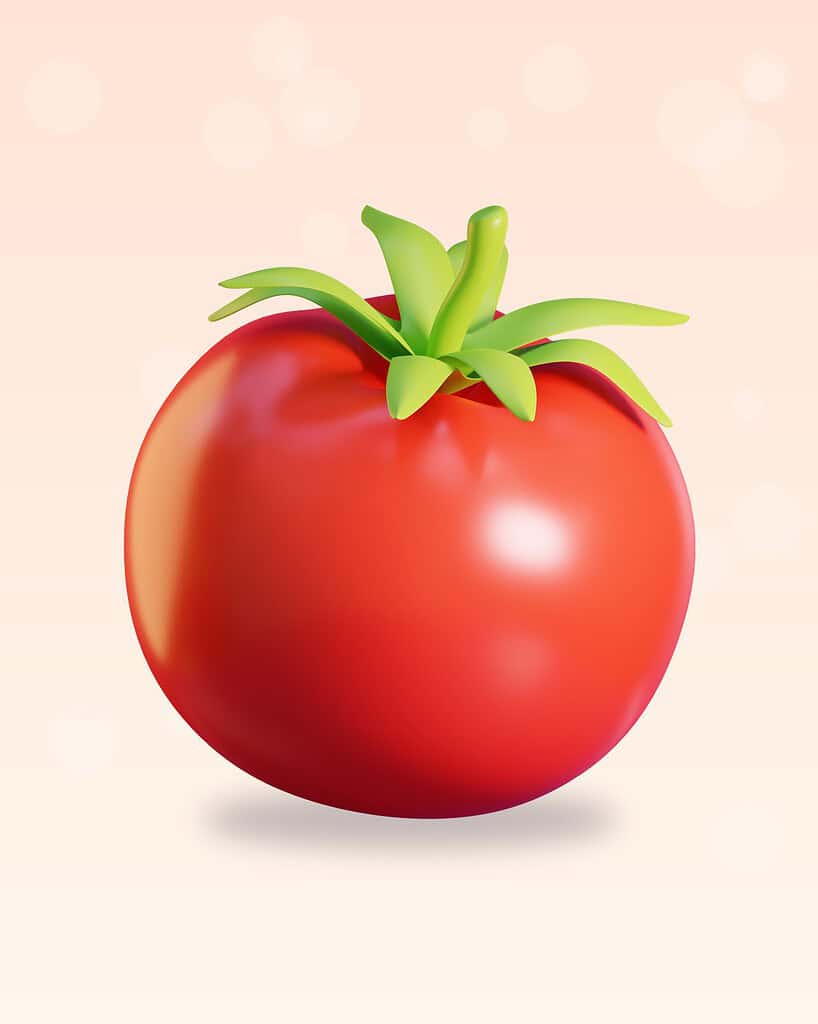
Tomatoes belong to the nightshade family, Solanaceae, alongside potatoes, eggplants and bell peppers. Nightshades defend themselves with steroidal glycoalkaloids, bitter compounds that discourage insects, fungi and grazing animals. In potatoes, the main one is solanine, which is why we warn about green or sprouting potatoes in our guide to potatoes for dogs. In tomatoes, the dominant glycoalkaloid is alpha-tomatine, with a smaller amount of a close relative called dehydrotomatine. Many veterinary references, including the ASPCA, use solanine as shorthand for the whole family, so you will see both names; the practical message is the same.
The reason ripe tomatoes are safe and green ones are not comes down to where the plant puts its chemical defenses. A 2023 analysis in the journal Molecules by Nobuyuki Kozukue, Mendel Friedman and colleagues puts immature green fruit at up to 500 milligrams of tomatine per kilogram of fresh weight and fresh red tomatoes at only about 5 milligrams per kilogram, because the plant enzymatically degrades tomatine as the fruit ripens. Friedman’s earlier survey of the whole plant is even more telling: small immature green fruit carried around 465 milligrams per kilogram, leaves about 975, small stems nearly 900, flowers 1,100, and dying leaves close to 4,900. The fruit you eat is the least defended part of the plant; the vine, the leaves and the green marbles that never ripened are the most defended, and that is exactly what a dog in a garden chews.
What tomatine does in a dog’s body explains the list of signs. Like solanine, it inhibits acetylcholinesterase, the enzyme that switches off a nerve signal, and it irritates the lining of the gut. The ASPCA lists hypersalivation, inappetence, severe gastrointestinal upset, depression, weakness, dilated pupils and a slow heart rate for tomato plant exposure. The Merck Veterinary Manual, in its table of plants poisonous to animals, describes the Solanum group as causing inflammation of the stomach and intestine, weakness, excess drooling, trembling and progressive paralysis in heavy exposures. The Pet Poison Helpline sorts the same picture by severity: vomiting, diarrhea, drooling, loss of appetite and lethargy at the mild end, then muscle weakness, tremors, loss of coordination and changes in heart rate after larger exposures.
The reassuring part is dose. Tomatine is poorly absorbed from the gut, which is why severe poisoning is uncommon and why every source we read calls fatal cases rare. A dog needs to eat a meaningful quantity of foliage, vine or unripe fruit to get into trouble, and a single nibble of a leaf is far more likely to produce an upset stomach than a cardiac problem. The dogs that do get sick are the ones left alone with a raised bed in August, the ones that work through a pile of pruned vines on the compost heap, and small dogs and puppies, whose body weight makes any given mouthful a larger dose.
One more wrinkle is the color of the fruit itself. Heirloom varieties ripen to yellow, orange, purple or striped green, and a ripe Green Zebra is not a green tomato in the toxic sense. The test is softness and the smell of a ripe tomato, not color alone. If you are not sure whether a fruit is ripe, your dog does not need it. Keep the plants fenced or caged, bag your prunings, and pick up windfall fruit before your dog beats you to it.
How much tomato can a dog eat?
Veterinary nutritionists use the same guardrail for every treat: all treats combined should stay under 10 percent of a dog’s daily calories. The American Animal Hospital Association’s 2021 nutrition guidelines give the formula for the rest: resting energy requirement is 70 times body weight in kilograms raised to the 0.75 power, multiplied by a life-stage factor of 1.4 to 1.6 for a neutered adult.
We ran that math for four weights using the 1.6 factor, took 10 percent as the treat budget, and converted it to ripe tomato at 18 calories per 100 grams. The result is our suggestion, not a prescription, and it is deliberately more conservative than the calorie math allows, because acidity and volume upset a stomach long before calories do. Chewy’s veterinary guidance tops out at about four cherry tomatoes for the biggest dogs, and ours sits nearby.
| Dog weight | Daily treat budget (10%) | Tomato if it were the only treat | Our suggested serving (a few times a week) |
|---|---|---|---|
| 10 lb (4.5 kg) | About 35 kcal | About 194 g | 1 to 2 half-inch cubes, or half a cherry tomato quartered |
| 25 lb (11.3 kg) | About 69 kcal | About 383 g | 2 to 3 cubes, or 1 cherry tomato quartered |
| 50 lb (22.7 kg) | About 116 kcal | About 644 g | 3 to 4 cubes, or 2 cherry tomatoes halved |
| 80 lb (36.3 kg) | About 166 kcal | About 922 g | 4 to 6 cubes, or 3 cherry tomatoes halved |
Look at the gap between the third and fourth columns. A 50-pound dog could in theory eat more than a pound of tomato before hitting its treat budget, and it would spend the next day with diarrhea. PetMD, Chewy and the Pet Poison Helpline all say the same thing in different words: even ripe tomatoes cause gas, loose stools or vomiting when a dog eats too many at once, and the natural acids are harder on sensitive stomachs. For a first taste, give one piece and check the yard the next morning.
Can dogs eat cooked tomatoes, ketchup or tomato sauce?
Plain cooked tomato is fine, and in one respect it is better than raw. A 2002 Cornell study in the Journal of Agricultural and Food Chemistry heated tomatoes to 88 degrees Celsius and found that absorbable trans-lycopene rose from about 2 to more than 5 milligrams per gram of dry weight after 30 minutes, while vitamin C fell by up to 29 percent. Since your dog makes its own vitamin C, cooking is a net win. A spoonful of roasted or simmered tomato with nothing added is a perfectly good kibble topper.
The trouble starts with everything we add to tomatoes. USDA FoodData Central puts ketchup (SR Legacy, FDC ID 168556) at 907 mg of sodium and 21.3 grams of sugar per 100 grams, so a single tablespoon (17 g) carries about 154 mg of sodium and 3.6 grams of sugar, against 5 mg of sodium in the same weight of fresh tomato. Most ketchups also list onion powder or garlic powder, both of which damage a dog’s red blood cells, and PetMD warns that some contain xylitol, which is toxic to dogs at tiny doses. A lick off a plate is not an emergency, but ketchup should never be a treat.
Pasta sauce, pizza sauce, salsa and tomato soup carry the same ingredients in larger amounts: garlic and onion in nearly every jar, salt throughout, and often chili or sugar. Canned tomatoes are a maybe; plain diced tomatoes in juice are fine in small amounts, but many cans add salt, calcium chloride and seasonings, so read the label.
Put your dog’s food rules where a finder, sitter or neighbor can see them
A Shiloh’s House Smart Tag pairs a laser-engraved name and number with a tap-to-open profile that lists your contacts, medications and feeding notes, so a well-meaning stranger does not share their sandwich with a dog on a kidney diet. $38 one-time, no subscription, no battery, made in the USA.
What should you do if your dog eats a tomato plant or ketchup?
A dog that has eaten tomato leaves, vines or green fruit needs a phone call, not a wait-and-see. Figure out what is missing: how many plants were chewed, whether green fruit is gone, roughly when it happened, and your dog’s weight. Then call your veterinarian, the Pet Poison Helpline at (855) 764-7661 or the ASPCA Animal Poison Control Center at (888) 426-4435. Both charge a consultation fee and are staffed around the clock by veterinary toxicologists. Do not induce vomiting at home unless they tell you to.
“[The tomato] plant and small green tomatoes contain tomatine, which can cause vomiting, weakness, and even heart issues. But as the fruit grows, the level of tomatine decreases dramatically, so ripe tomatoes make for safe, nontoxic treats.”
Tina Wismer, DVM, MS, DABVT, DABT, senior director at the ASPCA Animal Poison Control Center (Daily Paws, 2021)
If your dog is seen soon after eating a large amount of plant material, the vet may decontaminate to limit absorption. Otherwise treatment is supportive: fluids, anti-nausea medication and monitoring, with an ECG if the heart rate is off. The Pet Poison Helpline notes that most cases resolve without lasting harm when care is sought early, and the AKC says most dogs with tomatine poisoning recover fully. Signs to act on immediately are wobbliness, tremors, a very slow or irregular heartbeat, collapse or large dilated pupils.
A ketchup or sauce incident is a different calculation. Note the brand and read the ingredients to the vet, because garlic and onion content matters more than the tomato. A small dog that ate a bottle of ketchup also has a sugar and salt load and is likely to vomit; offer water and call. For either scenario, our step-by-step guide to what to do when your dog eats something it should not walks you through the first hour.
Which dogs should skip tomatoes or ask the vet first?
For a healthy adult dog, a few pieces of ripe tomato are an easy yes. These are the dogs for whom we would pause.
Dogs with acid reflux or a sensitive gut. Tomatoes are naturally acidic, and PetMD notes that high-acid foods can irritate the stomach lining and worsen reflux or chronic gastroenteritis. If your dog already lip-smacks and gulps in the morning or has a history of vomiting bile, choose cucumber instead.
Dogs with kidney disease. PetMD lists kidney disease among the conditions that make dogs more sensitive to tomato, and potassium is the reason people worry. Most therapeutic kidney diets are actually moderately higher in potassium, according to board-certified nutritionist Angela Witzel Rollins in Today’s Veterinary Practice, because low potassium is a common problem in CKD. A smaller group of dogs runs high and eats a potassium-restricted diet, and for them 237 mg per 100 grams is a number to avoid. Your vet knows which group your dog is in; ask before sharing.
Puppies. Chewy’s veterinary reviewers point out that puppies are more prone to stomach upset and, because they are small, more susceptible to tomatine if they eat the wrong part. A ripe sliver is fine once a puppy is fully on solid food, but a puppy loose in a vegetable garden is a real risk.
Dogs on prescription or elimination diets. PetMD’s standing rule applies: no treats outside the diet unless the vet approves. Tomato is also a common ingredient in dog food, so it can muddy an allergy trial.
Whatever the rule is for your dog, write it somewhere other people will see it. In the free Lohji app from Shiloh’s House, you can keep a pet profile with contacts, medical notes and voice notes that a Shiloh’s House NFC tag links to, so a sitter or finder who taps the tag reads “kidney diet, no people food” before anyone offers a snack, and a Share Profile card sends the same details to a dog walker. Get the app on the App Store or Google Play.
How do tomatoes compare with other vegetables for dogs?
Tomato is a lightweight. Here is how it stacks up against the other produce pet parents reach for, raw, per 100 grams, from USDA FoodData Central.
| Food (raw, per 100 g) | Calories | Sugars | Fiber | Potassium | USDA FDC ID |
|---|---|---|---|---|---|
| Cucumber, with peel | 15 kcal | 1.7 g | 0.5 g | 147 mg | 168409 |
| Tomato, red, ripe | 18 kcal | 2.6 g | 1.2 g | 237 mg | 170457 |
| Carrots | 41 kcal | 4.7 g | 2.8 g | 320 mg | 170393 |
| Sweet potato | 86 kcal | 4.2 g | 3.0 g | 337 mg | 168482 |
Cucumber edges out tomato on every line and has no acidity, which is why it is our first pick for a reflux-prone or dieting dog; see cucumbers for dogs. Carrots carry more than twice the calories and sugar, which adds up over a bag of baby carrots; our guide to carrots for dogs covers the choking rules. Sweet potato is nearly five times the calories of tomato and belongs in the meal, not the treat jar, as we explain in sweet potatoes for dogs. Tomato lands in the sweet spot: more flavor and potassium than cucumber, a fraction of the sugar of the root vegetables.
Frequently asked questions
Can dogs eat cherry tomatoes?
Yes, as long as they are fully ripe, washed and served plain with the stem and calyx removed. The one extra risk is size: a cherry or grape tomato is exactly the shape to lodge in a small dog’s throat, so halve them for medium dogs and quarter them for small breeds and gulpers. Two or three is plenty for a large dog.
Can dogs eat green tomatoes?
No. Unripe green tomatoes contain up to 500 mg of tomatine per kilogram, roughly 100 times the level in a ripe red tomato, and can cause drooling, vomiting, diarrhea, weakness and, in larger amounts, tremors and a slow heart rate. One small bite is unlikely to do serious harm, but a dog that eats several or chews on the vine should prompt a call to your vet.
Can dogs eat ketchup?
No. USDA data puts ketchup at 907 mg of sodium and 21 grams of sugar per 100 grams, and most brands include onion or garlic powder, which are toxic to dogs. A quick lick off a plate is not an emergency, but a small dog that gets into a bottle can vomit and become very thirsty, and any ketchup sweetened with xylitol is a poison-control call.
Can dogs eat tomato sauce or pasta sauce?
Not the jarred kind. Nearly every pasta, pizza and marinara sauce contains garlic and onion, which damage a dog’s red blood cells, plus salt and often sugar. Plain tomato puree or simmered tomatoes with nothing added are fine in small amounts and actually offer more absorbable lycopene than raw tomato. If a dog ate seasoned sauce, call your vet, because anemia from garlic can take a day or two to appear.
How much tomato can I give my dog?
Treats should stay under 10 percent of daily calories, but with tomato the acidity sets the limit first. Our suggestion: one or two half-inch cubes for a 10-pound dog, two or three for a 25-pound dog, three or four for a 50-pound dog and four to six for an 80-pound dog, a few times a week. Start with one piece and watch for loose stools over the next day.
Can puppies eat tomatoes?
A ripe sliver is fine once a puppy is fully weaned onto solid food, but keep it tiny and occasional. Puppies have sensitive stomachs and small bodies, so both tomato acidity and any accidental green parts hit harder than they would in an adult. The bigger concern is a puppy loose in a vegetable garden; fence the tomato bed before you worry about the treat.
Sources
- USDA Agricultural Research Service, “Tomatoes, red, ripe, raw, year round average (SR Legacy, FDC ID 170457)”, USDA FoodData Central, 2019 — https://fdc.nal.usda.gov/food-details/170457/nutrients
- USDA Agricultural Research Service, “Catsup (SR Legacy, FDC ID 168556)”, USDA FoodData Central, 2019 — https://fdc.nal.usda.gov/food-details/168556/nutrients
- USDA Agricultural Research Service, “Sweet potato, raw, unprepared (SR Legacy, FDC ID 168482)”, USDA FoodData Central, 2019 — https://fdc.nal.usda.gov/food-details/168482/nutrients
- ASPCA Animal Poison Control Center, “Toxic and Non-toxic Plants: Tomato Plant”, ASPCA, accessed 2026 — https://www.aspca.org/pet-care/aspca-poison-control/toxic-and-non-toxic-plants/tomato-plant
- Pet Poison Helpline, “Are Tomatoes Bad for Dogs? What’s Safe and What’s Toxic”, Pet Poison Helpline, accessed 2026 — https://www.petpoisonhelpline.com/uncategorized/are-tomatoes-poisonous-to-dogs/
- Cecil F. Brownie, DVM, PhD, DABVT, “Plants Poisonous to Animals”, Merck Veterinary Manual, 2026 — https://www.merckvetmanual.com/special-pet-topics/poisoning/plants-poisonous-to-animals
- April Saylor, reviewed by Sandra C. Mitchell, DVM, DABVP, “Can Dogs Eat Tomatoes?”, PetMD, 2025 — https://www.petmd.com/dog/nutrition/can-dogs-eat-tomatoes
- Lindsay Boyers, with Samuel Varon, DVM, and Michael Gerber-Weiss, DVM, “Can Dogs Eat Tomatoes?”, Chewy, 2025 — https://www.chewy.com/education/dog/food-and-nutrition/can-dogs-eat-tomatoes
- Sarah Gerrity, with Tina Wismer, DVM, MS, DABVT, DABT, “How to Safely Feed Your Dog Tomatoes”, Daily Paws, 2021 — https://www.dailypaws.com/dogs-puppies/dog-nutrition/what-can-dogs-eat/can-dogs-eat-tomatoes
- Nobuyuki Kozukue, Dong-Seok Kim, Suk-Hyun Choi, Masashi Mizuno and Mendel Friedman, “Isomers of the Tomato Glycoalkaloids α-Tomatine and Dehydrotomatine”, Molecules, 2023 — https://www.mdpi.com/1420-3049/28/8/3621
- Veronica Dewanto, Xianzhong Wu, Kafui K. Adom and Rui Hai Liu, “Thermal Processing Enhances the Nutritional Value of Tomatoes by Increasing Total Antioxidant Activity”, Journal of Agricultural and Food Chemistry, 2002 — https://pubs.acs.org/doi/10.1021/jf0115589
- American Animal Hospital Association, “Energy Requirement Calculations (2021 AAHA Nutrition and Weight Management Guidelines)”, AAHA, 2021 — https://www.aaha.org/wp-content/uploads/globalassets/02-guidelines/2021-nutrition-and-weight-management/resourcepdfs/nutritiongl_box1.pdf