Cat Primordial Pouch: Why Your Cat Has a Saggy Belly Flap
 Shiloh’s House Team
·
·
17 min read
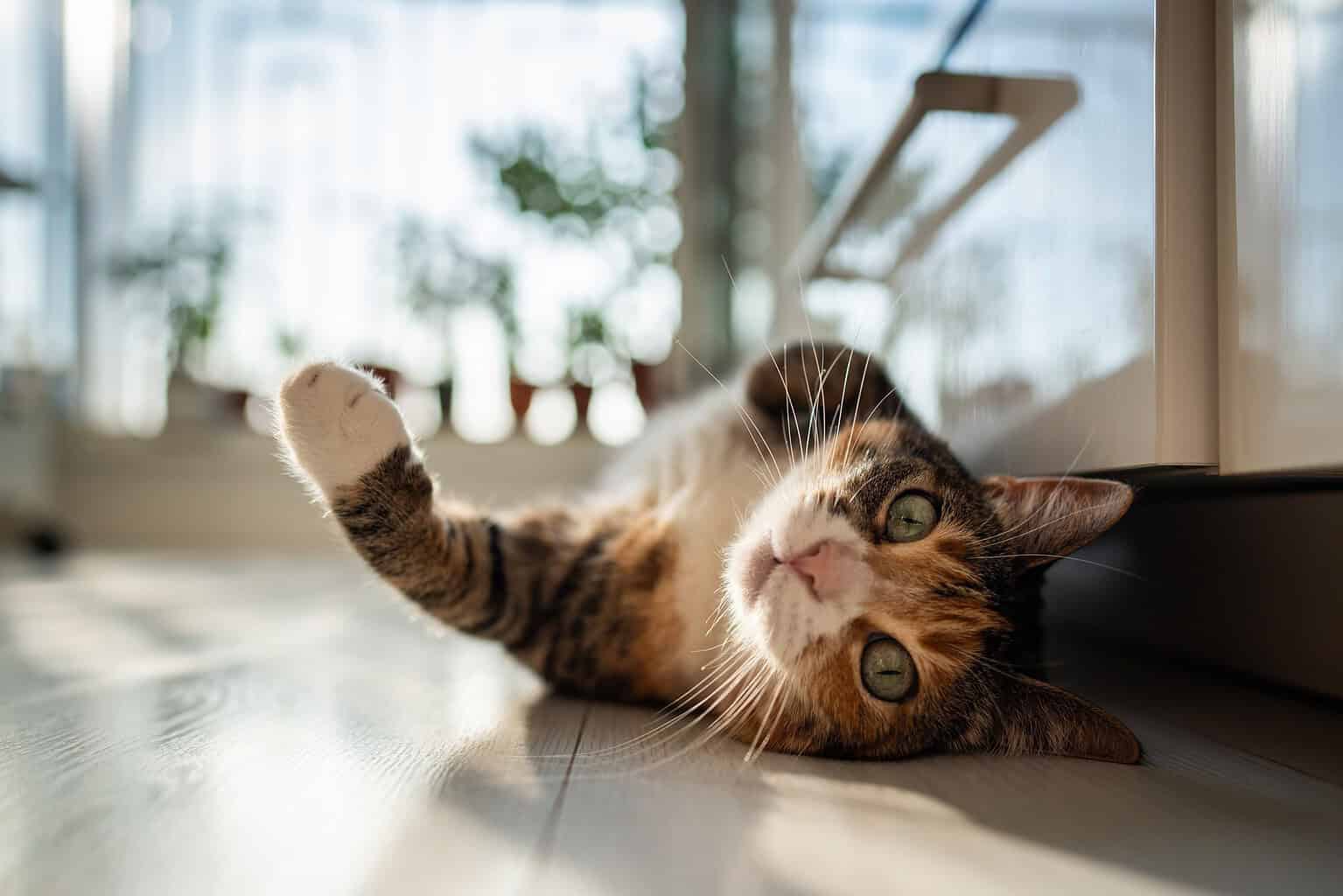
That saggy, swinging belly is almost always your cat’s primordial pouch, a normal flap of loose skin and fat that every cat has, from a lean Egyptian Mau to a lion, and it is not a sign of being overweight or of a spay gone wrong. The pouch hangs low near the back legs and feels like a floppy bag of skin; real fat is firmer, covers the ribs and erases the waist. A belly that swells quickly, feels hard or hurts needs a vet.
Last updated: September 2025
What is the primordial pouch on a cat?
Watch your cat trot across the kitchen and you will see it: a loose pad of skin and fur low on the belly that swings like a hammock. That is the primordial pouch. VCA Animal Hospitals describes it as the flap of skin that runs along the belly and is most pronounced near the back legs. It is skin, fur and some fat, attached loosely to the body wall, which is why it sways.
Every cat has one. Live Science asked José Arce, then president-elect of the American Veterinary Medical Association, about it in 2021, and he said the pouches are perfectly normal and healthy and that all cats have them, in sizes that vary enormously. Lions and tigers have them too.
Timing fools most pet parents. According to VCA and PetMD, the pouch becomes noticeable between six months and a year of age, which is also when most cats are spayed or neutered, so the surgery gets blamed. Hill’s is clear that spaying and neutering do not affect the pouch; what surgery can do is lower energy needs and nudge a cat toward overeating.
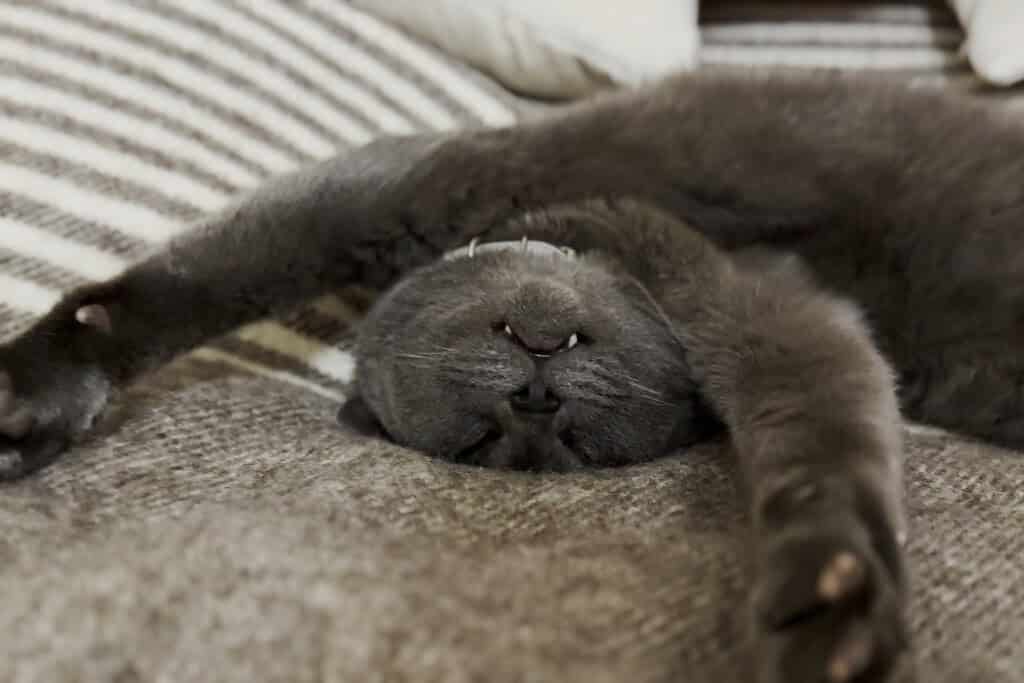
So a pronounced pouch does not mean a fat cat. VCA points out that a swinging pouch can be a sign of a healthy weight, because an overweight cat’s pouch disappears into the roundness of the belly. The pouch is also part of why a cat rolling over looks so exposed; we cover that in why your cat shows you her belly.
Why do cats have a primordial pouch?
Nobody knows for sure. Every veterinary source we opened says the pouch’s purpose is a matter of theory, and the same few ideas come up each time.
Protection in a fight. A cat’s belly has no rib cage over the liver and intestines. The leading theory, which Arce described to Live Science and which VCA, PetMD and Hill’s repeat, is that the pouch adds a layer of skin and fat between an opponent’s claws and the organs underneath. Hill’s points to the bunny kick, the two-footed rake with the hind claws that cats use on each other.
Room to stretch. Arce explained that the pouch stretches as a cat runs, giving extra flexibility and a longer reach with each bound. The International Cat Association’s Egyptian Mau page says the breed’s skin flap “lends the Mau an uncanny leaping ability” and bursts of speed.
A built-in reserve. Wild cats gorge when a hunt succeeds and may go hungry afterward. Arce suggested the pouch could be extra space for a full stomach, and VCA describes it as a place to store fat for energy when food is scarce. Hill’s quotes Pennsylvania SPCA animal advocate Carol Erickson comparing it to loose pants at a big dinner.
PetMD adds a fourth idea, temperature regulation, and Dr. Nicole Savageau, a veterinarian with the mobile practice The Vets, told PetMD that for a well-fed house cat the pouch may do nothing anymore and simply be a leftover from wild ancestors. What is not in doubt is that size is mostly inherited.
“There can be variations in the size of the primordial pouch among cats, with genetics playing a role.”
Nicole Savageau, DVM, veterinarian at The Vets, PetMD 2024
Two things change the look of a pouch over a lifetime. Hill’s and VCA both note that cats lose skin elasticity and muscle with age, so a senior’s pouch hangs lower. And a cat who slims down keeps the pouch, which often looks bigger against a leaner frame.
Is my cat’s saggy belly a pouch or fat?
You can answer most of this with your hands in two minutes. Dr. Savageau’s guidance in PetMD is the simplest: a pouch sits between the rear legs, feels loose and floppy, and belongs to a cat with a defined waist. Fat is spread around the whole body, feels firm or squishy, and comes with a rounded shape and no waist.
Arce gave Live Science three quick tells. Look down from above: you should see an indentation at the hips, the waist. Note where the belly starts: an obese cat’s belly begins high on the underside, while a pouch starts farther back, toward the hind legs. Press gently on the ribs: if you have to push hard to feel them, your cat is probably overweight.
A pouch is not the only thing that can make a belly look bigger. Here is how the possibilities compare, drawn from VCA’s guide to abdominal enlargement in cats, Hill’s and PetMD.
| What you are seeing | Where it sits | How it feels | Other clues | What to do |
|---|---|---|---|---|
| Primordial pouch | Low on the belly, toward the hind legs | Loose, floppy skin; swings when walking | Visible waist; ribs easy to feel | Nothing; it is normal |
| Body fat | Whole body: belly, ribs, back, face | Firm or squishy; does not swing | No waist; ribs hard to feel | Body condition score, then a vet-guided diet |
| Pregnancy | Whole abdomen, growing over weeks | Rounded, firm; mammary glands enlarge | Unspayed female; shows around week five | Vet visit to confirm |
| Fluid (ascites) or organ enlargement | Whole abdomen, often fast | Tight, distended | Lethargy, poor appetite, fast breathing | Same-day vet visit |
| Lump, mass or hernia | One spot, often in or near the pouch | Distinct firm or rubbery bump | Lipoma, mammary tumor or hernia | Vet visit soon; sooner if it grows |
The pattern is simple. A pouch is loose, low and symmetrical, and it leaves the rest of the cat looking lean. Everything else involves the whole abdomen, feels tight or firm, or shows up as a single bump.
How do you body condition score a cat at home?
Vets stopped trusting the scale alone long ago; a 10-pound Maine Coon kitten and a 10-pound obese shorthair are different animals. Instead they use body condition scoring, a hands-and-eyes estimate of body fat. The World Small Animal Veterinary Association publishes the nine-point chart most U.S. clinics use, where 5 is ideal. APOP’s 2022 report noted that scoring is harder in cats with prominent primordial pouches or long hair, which is why touch matters more than looks.
Three checks drive the score. Ribs: at an ideal weight you feel each rib under a slight layer of fat, like the knuckles on the back of your open hand, as PetMD puts it. Waist: look down from above for the inward curve behind the ribs. Abdominal tuck: from the side, the belly line should rise slightly toward the rear, with only a minimal fat pad, the pouch, below it.
Here is the WSAVA scale with its wording condensed, plus the approximate body fat the Association for Pet Obesity Prevention attaches to each score. Only a veterinarian can confirm a score.
| Score (of 9) | Category | Ribs | Waist and belly | Approx. body fat |
|---|---|---|---|---|
| 1 | Under ideal | Very easily seen | Severe tuck; no fat pads; bones easily seen | Under 5% |
| 2 | Under ideal | Easily seen | Pronounced tuck; no fat pads | 5 to 9% |
| 3 | Under ideal | Easily felt, minimal fat | Obvious waist; minimal fat pads | 10 to 14% |
| 4 | Under ideal | Felt, minimal fat | Noticeable waist; slight tuck | 15 to 19% |
| 5 | Ideal | Felt with slight fat covering | Waist seen, not pronounced; minimal fat pad | 20 to 24% |
| 6 | Over ideal | Felt with slight excess fat | Waist and fat pad present, not obvious; no tuck | 25 to 29% |
| 7 | Over ideal | Not easily felt, moderate fat | Waist not easily seen; moderate fat pad | 30 to 34% |
| 8 | Over ideal | Not felt, excess fat | No waist; prominent fat pad; fat over lower back | 35 to 39% |
| 9 | Over ideal | Not felt, heavy fat | Distended abdomen; heavy fat over back, face and limbs | 40 to 45% or more |
Notice how the chart treats the pouch. At a 5, the abdominal fat pad is minimal, not absent; the pouch is expected. Scores climb as the pad becomes moderate, then prominent, and as the ribs vanish and the waist goes. A footnote adds that a 6 may be acceptable in some older cats. APOP found that more than a quarter of cat owners rated their cat as normal when a veterinary professional scored it as overweight or obese, so ask for the number.
Put your cat’s weight, diet and medical notes where a finder or sitter can read them
A Shiloh’s House Smart Tag is a personalized NFC ID tag in premium acrylic, laser engraved on the front with a “Tap Phone Here” back. One tap opens your cat’s live profile with call and text buttons, medical notes and feeding instructions. $38 one-time, no subscription, no battery, made in the USA, 30-day returns.
Which cat breeds are known for a big primordial pouch?

If you want proof that the pouch is a feature rather than a flaw, read the breed standards. For a handful of breeds the belly flap is part of the registry’s written description of a perfect cat. Judges are told to look for it, and in one case to mark a cat down for not having it.
The Egyptian Mau is the clearest example. The International Cat Association’s Egyptian Mau standard, in the section on the torso, states that there is a loose skin flap, which the standard itself calls a belly flap. The Cat Fanciers’ Association standard for the same breed, revised in 2009, describes a loose skin flap extending from the flank to the knee of the hind leg, and the CFA breed page credits that flap with giving the Mau remarkable agility in twisting and jumping. TICA’s breed introduction lists the flap among five features that should be apparent at a glance, alongside the gooseberry-green eyes and the tiptoe stance. The only naturally spotted domestic breed is also the breed whose pouch is treated as an athletic asset.
The Pixiebob goes a step further. TICA’s Pixiebob standard, for a breed developed to resemble the North American bobcat, lists a primordial belly pouch as an element of the torso, alongside the deep flank, broad chest and prominent hips. The torso is worth 11 of the 39 body points, and under faults to penalize, the standard names a cat lacking the primordial belly pouch. PetMD adds the flip side: TICA’s standard for the Thai breed describes a mostly level underbelly with only a slight amount of loose skin, so the pouch can be bred smaller as well as larger.
The Bengal is often mentioned in the same breath, and it is worth being precise. The Adopt-a-Pet veterinary team, writing in early 2025, lists the Bengal, the Egyptian Mau and the Japanese Bobtail as breeds with more prominent pouches, and plenty of Bengal owners would agree. But the TICA Bengal standard we read does not mention the pouch at all; its torso section asks for a long, substantial, very muscular body, and its belly rules are about pattern, requiring the belly to be spotted. So the Bengal’s famous flap is a common trait rather than something a judge is told to reward. The same is true of nearly every domestic shorthair: the pouch is there, its size is inherited, and no registry is keeping score.
Coat changes how much pouch you notice without changing the pouch itself. Hill’s makes the point that the flap is far more evident on a hairless Sphynx than on a Maine Coon, because there is no fur to drape over it. A long-haired cat may carry a substantial pouch you never see until bath time, while a short-coated cat with a modest one looks as though it is swinging a purse.
Two more factors shape the pouch in any cat. Age lowers it: VCA and Hill’s both describe skin losing elasticity and muscle declining in older cats, so a 14-year-old’s pouch hangs lower than it did at 4 at the same weight. History stretches it: a cat who carried extra weight for years, or a female who has had litters, keeps skin that was once filled. None of this is a health problem. The only pouch that should worry you is one that changes quickly, feels different in one spot, or arrives with a cat who is not acting like herself.
When is a changing cat belly a reason to see the vet?
A pouch is stable. It grows slowly over a cat’s first year, hangs a little lower with age, and otherwise looks the same from month to month. A belly that changes on any other schedule deserves a phone call, because, as VCA puts it, a bigger belly can be a simple matter or a sign of serious disease.
VCA groups the causes usefully. The simple ones are intestinal worms, which give kittens a pot belly; obesity; and pregnancy. The illness-related ones are organ enlargement from infection, inflammation or tumors; pyometra, a pus-filled uterus that is an emergency; free fluid in the abdomen, which VCA says is always a cause for concern; abdominal cancers; heart failure; and feline infectious peritonitis, a viral disease that fills the belly with fluid.
Your job is to notice the pattern, not to diagnose. Call the vet the same day if the belly has swollen over hours or days rather than months; if it feels tight, hard or tender instead of loose; if you feel a distinct lump in or near the pouch; if the pouch is red, hot or sore; or if a bigger belly comes with weight loss along the spine and hips, a classic sign of fluid or a mass. Lethargy, hiding, faster breathing, vomiting and a cat who stops eating all raise the stakes; see our guides to why a cat stops eating and the signs vets look for when a cat is in pain.
At the clinic, VCA describes a straightforward workup: a history of how fast the change happened, a physical exam with careful palpation, blood work and urinalysis, then imaging if needed. A new belly paired with a cat drinking far more water than usual points toward diabetes or kidney and liver trouble and is worth mentioning up front.
How do you keep a pouchy cat at a healthy weight?
Once the pouch is ruled out, the real work is keeping the cat behind it lean. The Cornell Feline Health Center defines feline obesity as body weight 20 percent or more above normal. In Cornell’s follow-up of roughly 2,000 cats, overweight cats were four and a half times more likely to develop diabetes, obese cats were seven times more likely to need care for lameness, and obese cats were twice as likely to die in middle age, six to twelve years.
The fixes are unglamorous. Measure food instead of free-feeding; our cat feeding chart by weight gives a starting point your vet can adjust. Count treats and pick lower-calorie options from our guide to the best cat treats. Arce told Live Science that cats should get about 15 minutes of exercise a day; our play guide shows how. If a diet is needed, Cornell’s Dr. McDaniel warns that sudden starvation can trigger hepatic lipidosis and recommends losing one to two percent of body weight per week with a vet.
Keep a record as you go. The free Lohji app from Shiloh’s House gives your cat a live profile you can update with diet instructions, medical notes, contacts and a voice message, the same profile a finder sees when they tap a Shiloh’s House NFC tag. It also makes cartoon Lohji avatars, stickers and slideshows of your cat, pouch and all. Get it on the App Store or Google Play.
And because the cats most likely to carry extra weight are indoor cats, remember that an indoor cat who slips out a door is the one least prepared to be outside. A collar and tag matter even for a homebody, as we explain in do indoor cats need ID tags. A tag has no GPS, but it tells whoever finds her who to call.
Frequently asked questions
Why does my cat have a saggy belly after being spayed?
The timing is a coincidence. The pouch usually becomes noticeable between six months and a year of age, which is when most cats are spayed or neutered, so the surgery gets the blame. Hill’s veterinary team notes the procedures do not affect the pouch; what they can do is lower calorie needs and encourage overeating, so measure meals after surgery.
Does a big primordial pouch mean my cat is overweight?
No. VCA notes that a prominent pouch that swings when the cat walks can be a sign of a healthy weight, because an overweight cat’s pouch gets hidden in a round belly. Judge weight by whether you can feel the ribs easily, whether there is a waist from above and where your cat lands on the WSAVA chart.
Will my cat’s primordial pouch go away if she loses weight?
No. The pouch is skin and a little fat that every cat carries, and PetMD confirms weight loss will not shrink it. A slimmer cat often looks saggier, because the same skin now hangs against a leaner frame. If the belly swings more while the ribs are easier to feel, the diet is working.
Do all cats have a primordial pouch, even big cats?
Yes. José Arce, then president-elect of the American Veterinary Medical Association, told Live Science that all cats have primordial pouches, that lions and tigers have them for the same reasons, and that size varies enormously. In house cats the pouch starts developing around six months of age, and genetics largely decides how big it gets.
How can I tell a primordial pouch from a tumor or hernia?
A pouch is loose, floppy, symmetrical and the same from month to month; when you gently feel it you find only soft skin and a little fat. A hernia or mass is a distinct bump in one spot, often firm or rubbery, and it may grow. Hill’s notes that belly lumps in a female cat can be mammary tumors, so any new bump earns a vet visit.
What breeds have the biggest primordial pouch?
The Egyptian Mau and the Pixiebob are the two breeds whose registry standards describe the pouch. TICA’s Egyptian Mau standard calls for a loose skin flap, the CFA standard describes it running from flank to hind-leg knee, and TICA’s Pixiebob standard lists a primordial belly pouch and penalizes cats without one. Bengals and Japanese Bobtails are often noted for large pouches too.
Sources
- Janelle Leeson, reviewed by Barri J. Morrison, DVM, with Nicole Savageau, DVM, “What Is a Cat’s Primordial Pouch?”, PetMD, 2024 — https://www.petmd.com/cat/general-health/cat-primordial-pouch
- VCA Animal Hospitals, “What Is the Primordial Pouch in Cats?”, VCA, accessed 2025 — https://vcahospitals.com/pediatric/kitten/health-wellness/what-is-the-primordial-pouch
- Tyler Santora, with José Arce, DVM, AVMA president-elect, “Why do cats have belly ‘pouches’?”, Live Science, 2021 — https://www.livescience.com/cats-primordial-pouch.html
- Christine O’Brien, reviewed by Hill’s veterinary experts, “What Is a Cat’s Primordial Pouch?”, Hill’s Pet Nutrition, 2022 — https://www.hillspet.com/cat-care/behavior-appearance/primordial-pouch-in-cats
- Shelby Neely, DVM, reviewed by Heidi Cooley, DVM, “What Is a Cat’s Primordial Pouch?”, Adopt-a-Pet, 2025 — https://www.adoptapet.com/blog/health/cats-primordial-pouch
- Association for Pet Obesity Prevention, “2022 U.S. State of Pet Obesity Report”, APOP, 2022 — https://www.petobesityprevention.org/2022-state-of-pet-obesity-report-summary
- Ernie Ward, DVM, “2022 Survey Reveals Alarming Rates of Pet Obesity in the US”, Association for Pet Obesity Prevention, 2023 — https://www.petobesityprevention.org/articlesandnews/new-survey-reveals-alarming-rates-of-pet-obesity-in-the-us
- Tim Wall, “Cat obesity steady 2017-2022, but owners may misclassify”, Petfood Industry, 2023 — https://www.petfoodindustry.com/news-newsletters/pet-food-news/article/15469813/cat-obesity-steady-20172022-but-owners-may-misclassify
- WSAVA Global Nutrition Committee, “Body Condition Score: Cats” (9-point chart PDF), World Small Animal Veterinary Association, 2025 — https://wsava.org/wp-content/uploads/2025/06/WSAVA_BCSCat_BCSCat_Nutrition_250612.pdf
- Association for Pet Obesity Prevention, “Cat Body Condition Scoring & Chart”, APOP, accessed 2025 — https://www.petobesityprevention.org/catbcs
- The International Cat Association, “Egyptian Mau (EM) Breed Standard”, TICA, 2010 — https://tica.org/wp-content/uploads/2024/02/em.pdf
- The International Cat Association, “Pixiebob Breed Group (PB/PBL) Breed Standard”, TICA, 2009 — https://tica.org/wp-content/uploads/2024/02/pb.pdf
- The Cat Fanciers’ Association, “Egyptian Mau Show Standard (revised 2009)”, CFA, 2009 — https://www.cfa.org/wp-content/uploads/2024/03/egyptian-mau-standard.pdf
- Courtney Barnes, DVM, Krista Williams, DVM, Kristiina Ruotsalo, DVM, DVSc, and Margo S. Tant, DVM, DVSc, “Testing for Abdominal Enlargement in Cats”, VCA Animal Hospitals, accessed 2025 — https://vcahospitals.com/know-your-pet/testing-for-abdominal-enlargement-in-cats
- Cornell Feline Health Center, “Obesity”, Cornell University College of Veterinary Medicine, accessed 2025 — https://www.vet.cornell.edu/departments-centers-and-institutes/cornell-feline-health-center/health-information/feline-health-topics/obesity
- Roger Segelken, with Janet M. Scarlett, DVM, “Overweight cats risk disease and premature death, Cornell study finds”, Cornell Chronicle, 1997 — https://news.cornell.edu/stories/1997/03/overweight-cats-risk-disease-and-premature-death-cornell-study-finds