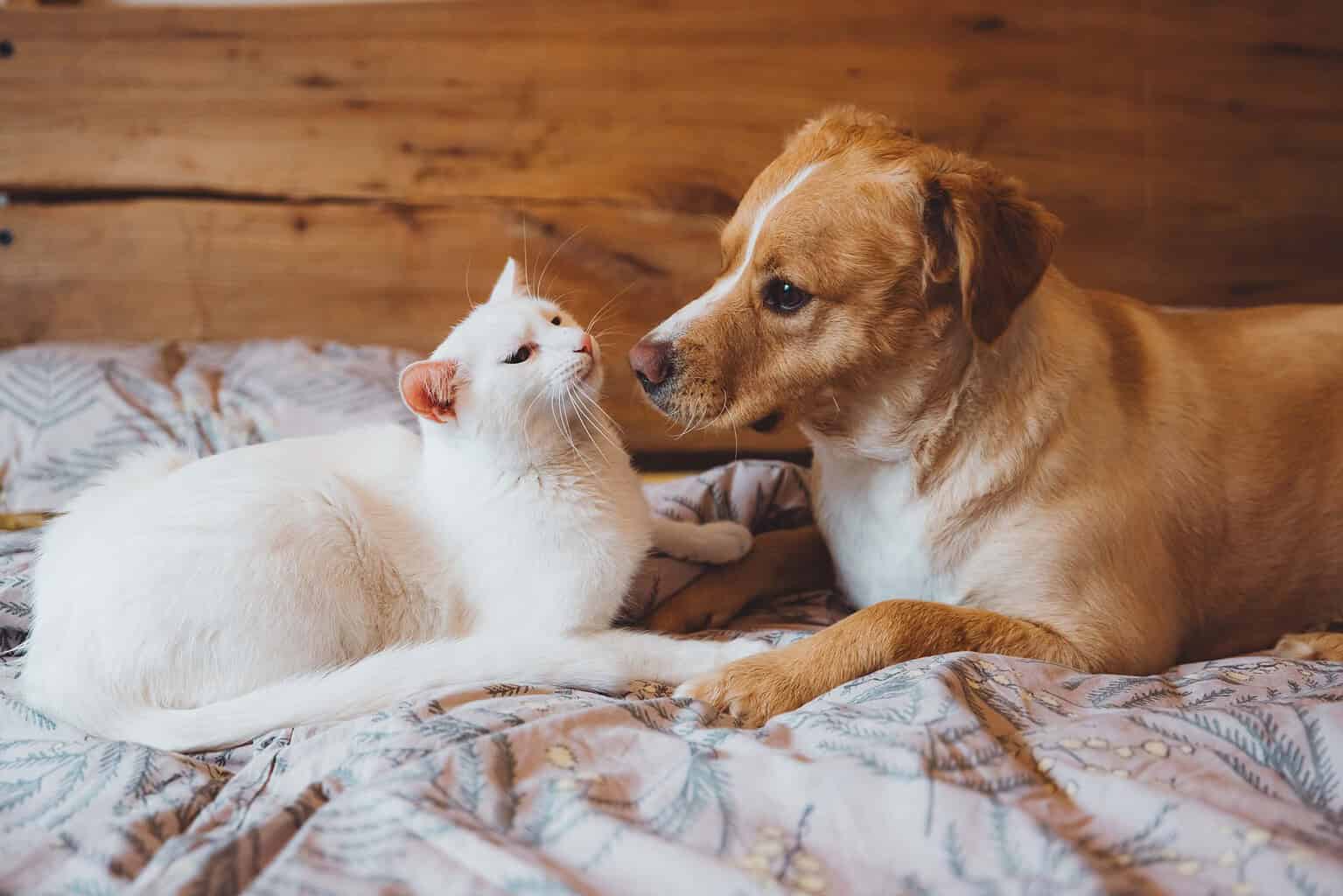
The secret to a calm multi-pet household is giving every animal its own setup and its own paperwork. Feed each pet at a separate station, follow the one-litter-box-per-cat-plus-one rule, keep beds and toys plentiful enough that nobody has to guard them, and track each pet’s vet visits and medications separately. Then give every pet its own ID tag and its own microchip registration, and count heads every time a door opens or an emergency hits.
Last updated: December 2025
How common are multi-pet households, and why are they harder to manage?
If you share your home with more than one animal, you are in the majority. The American Pet Products Association (APPA) reported that 66% of pet-owning households had multiple pets in 2022, and that the rise was driven almost entirely by younger owners: 71% of Gen Z and 73% of Millennial pet households had more than one pet.
More pets means more love, and also more moving parts. Two cats may need two different diets. A senior dog may be on daily medication while the puppy is not. One cat may be a confident door-dasher while the other hides under the bed during a thunderstorm. Small mix-ups that would never happen with one pet, like a dog eating the cat’s kidney diet or a tag engraved with the wrong name, become everyday risks.
The good news is that most multi-pet problems have simple fixes. They come down to three habits: give each animal its own resources, keep separate records for each animal, and make sure each animal can be identified and counted on its own. The sections below walk through each one, starting with the place most conflicts begin: the food bowl.

How should you set up feeding stations for several pets?
The simplest rule is one pet, one bowl, one spot. Veterinary feline experts are clear that just because cats will eat side by side does not mean they want to. The ISFM and AAFP consensus statement on feline feeding programs warns that forcing a cat to eat near another cat it would otherwise avoid “creates anxiety, stress and health problems,” and recommends multiple feeding stations that are visually separated. A cat who feels watched may eat too fast, walk away hungry, or quietly stop eating, which is easy to miss when the bowls are shared.
Dogs need the same courtesy. VCA Animal Hospitals behaviorists advise feeding dogs in separate rooms, because dogs may fight over food and separation lets each dog eat without worrying about the other. For dog-and-cat homes, the ASPCA suggests putting the cat’s food on a countertop, a wide windowsill or behind a baby gate the cat can hop, and reminds owners that cat food and dog food are not interchangeable.
Practical ways to keep meals separate:
- Feed at set mealtimes, then pick up the bowls, instead of leaving food out all day.
- Use different rooms with the door closed for any pet on a special diet.
- Put an agile cat’s bowl up high where a heavier or older pet cannot reach.
- Consider a microchip-activated feeder or pet door, which opens only for the registered pet.
- Keep water in several places, not just next to the food.
Separate feeding matters most when one pet eats a prescription food. Texas A&M veterinarians note that a kidney diet, for example, usually contains less than half the protein of regular cat food, and a healthy cat living on it can lose muscle mass.
“Prescription food must be fed like medicine and only administered as intended. These foods have a specific purpose and are meant to be fed only to cats with specific diseases.”
Dr. Debra Zoran, professor, Texas A&M College of Veterinary Medicine & Biomedical Sciences (Texas A&M Pet Talk)
An occasional stolen bite is not an emergency, Zoran adds, but a long-term swap is. Separate stations also help you notice early when one pet stops finishing meals, a change that can signal illness.
How many litter boxes, bowls and beds does a multi-pet home need?
For cats, the classic formula is “n+1”: one litter box per cat, plus one extra. The AAFP and ISFM guidelines on house-soiling call it the historical rule of thumb and add that it is not absolute. Cats who are close friends may share, while cats who are not socially bonded should have separate litter stations. Even a single cat should have two boxes in two different places. The guidelines also warn that boxes placed side by side count as one big box in a cat’s eyes, so spread them out, put one on every floor of a multilevel home, and keep them away from food and water.
The same thinking applies to everything a pet might compete over. VCA’s summary of the feline environmental needs guidelines says each cat in a multi-cat home should have access to its own resources, with at least two options for food, water, resting and toileting spots. Use the table below as a starting point.
| Household | Food bowls | Water stations | Litter boxes | Beds or resting spots | ID tags and chip registrations |
|---|---|---|---|---|---|
| 1 cat | 1 | 2 | 2 | 2 | 1 tag, 1 registration |
| 2 cats | 2 | 3 | 3 | 3 or more | 2 tags, 2 registrations |
| 1 dog and 1 cat | 2, in separate spots | 2 to 3 | 2, out of the dog’s reach | 3, with one up high for the cat | 2 tags, 2 registrations |
| 3 cats | 3 | 4 | 4 | 4 or more, at different heights | 3 tags, 3 registrations |
| 2 dogs and 1 cat | 3 | 3 to 4 | 2, out of the dogs’ reach | 4 | 3 tags, 3 registrations |
| 2 dogs and 3 cats | 5 | 5 to 6 | 4 | 6 or more | 5 tags, 5 registrations |
How do you prevent resource guarding between pets?
Resource guarding is when an animal protects something it values, such as food, a chew, a toy, a bed or even a favorite person. The ASPCA calls guarding possessions from humans or other animals normal behavior for dogs. It can range from a stiff body and a growl to snapping and biting, and some dogs guard only food while others guard resting spots, crates or stolen items.
In a multi-pet home, the easiest fix is to remove the reason to compete. The ASPCA notes that many owners of food-guarding dogs simply take reasonable precautions: they leave the dog alone while it eats, feed it in a separate room, in a crate or behind a barrier, and provide enough food that the dog feels less need to guard. A few other habits help:
- Give high-value chews only when pets are apart, and pick them up afterward.
- Offer more beds and toys than you have pets, as in the table above.
- Watch for quieter signs in cats, such as one cat sitting in a hallway that leads to the litter box or food. Cats tend to avoid conflict rather than fight it out, so blocking is often the only clue.
- Never reach in to take food or a stolen item from a guarding dog.
What are the basics of introducing a new pet?
Most multi-pet trouble starts in the first weeks, so go slowly. For dogs, the first meeting should happen on neutral ground, not inside the resident dog’s home. VCA behaviorists suggest starting outdoors or in the yard with both dogs leashed, rewarding calm behavior with praise and small treats, keeping early sessions short and separating the dogs at bedtime at first. Pick up food, toys and chews before the dogs share a room, since those are the items most likely to start a scuffle.
Cats need even more time. A new cat should start in its own room with its own food, water, litter box and hiding spot, then get to know the resident cat through scent and sound before the two ever see each other. Our step-by-step guide on how to introduce two cats covers the full process.
For dog-and-cat introductions, the ASPCA’s advice is to make sure the dog responds to “leave it,” “down” and “come,” keep the dog on a house leash early on, and use a sturdy baby gate so the cat always has a dog-free escape. Whatever the species, add the newcomer’s ID before the first day at home, not after things settle down. New pets do not know where home is yet, and the first weeks are when a startled animal is most likely to bolt.
Why does every pet need its own ID tag and microchip registration?

It is tempting to think one tag with your phone number is enough for a household, or that a microchip covers everyone. It is not. Each pet needs its own collar tag and its own microchip registration in its own name, because the person who finds a lost animal only has that one animal in front of them. A tag that reads “Max and Bella” tells a finder nothing about which dog is standing on their porch, and a chip registered under the wrong pet’s description can slow down a shelter’s search.
Losing a pet is more common than most people think. In a national telephone survey published in the journal Animals in 2012, Emily Weiss, Margaret Slater and Linda Lord found that about 14% of dogs and 15% of cats had been lost at least once in the previous five years. Owners got 93% of those dogs back, but only 75% of the cats. Fourteen percent of recovered dogs were found through an identification tag, and the researchers noted that cats were less likely than dogs to have any type of identification at all. In a multi-pet home, every extra animal is one more chance for a door to be left open.
Microchips make a big difference, but only when the registration is current. In a 2009 study in the Journal of the American Veterinary Medical Association, Linda Lord and colleagues followed more than 7,700 microchipped animals entering 53 shelters. The median return-to-owner rate for stray dogs was 21.9% overall, compared with 52.2% for microchipped dogs. For cats the gap was even wider: 1.8% overall versus 38.5% for chipped cats. Yet when shelters called a microchip registry, only 58.1% of the animals were actually registered, and the most common reason owners could not be found was an incorrect or disconnected phone number.
For multi-pet families, that means a short checklist for every animal, not just the newest one:
- Engrave or set up a separate tag for each pet with that pet’s name, your phone number and any urgent medical need.
- Look up each microchip number and confirm it is registered to the right pet, with the right species, color and description.
- Update every pet’s registration at once when you move or change numbers. It is easy to update the dog and forget the cat.
- Keep a breakaway collar and tag on indoor cats too, since an indoor cat that slips out has no street smarts.
- Store each pet’s chip number and a recent photo in one place you can reach fast.
Pets that look alike make this even more important. Two black cats or two yellow Labs can be hard to tell apart in a blurry photo, and a finder or shelter worker needs to be sure they are calling the right family about the right animal. Distinct tag designs or colors help you, too, because you can see at a glance who is wearing what. If you are not sure what to engrave, see our guides on what to put on a dog ID tag and cat ID tags. For how a tag and a chip work together, read microchip vs. smart tag, and compare styles in our roundup of the best pet tags.
How do you keep vet visits and medications straight for each pet?
When three pets are due for different vaccines, flea preventives and dental cleanings, it is easy to lose track of who got what. The fix is a separate record for every animal: its microchip number, vaccine dates, rabies tag number, current medications with dose and timing, diet, allergies and veterinarian. Disaster checklists from the ASPCA recommend keeping copies of medical records and a supply of each pet’s medicine ready to go, and that same file saves time at routine visits.
Labeling is where multi-pet homes most often slip. Pills for a 70-pound dog and a 9-pound cat can look alike, and a dose meant for one can be dangerous for another. A few habits help:
- Keep each pet’s medications in its own labeled bin or zip bag with the pet’s name in large letters.
- Write the dose and time on the bin, not just on the pharmacy label.
- Use a shared checklist on the fridge or in your phone so whoever gives a dose marks it off.
- Never give one pet’s prescription to another pet, even if they have the same symptoms.
- Book annual checkups for pets in the same month if your schedule allows, so preventives line up.
What is a good headcount routine for doors and emergencies?
With one pet, you notice right away when they are missing. With four, a cat can slip out behind a delivery and nobody realizes for hours. A simple headcount habit closes that gap:
- Before the door opens. Put dogs in a sit or behind a gate and know where each cat is before guests arrive, deliveries are dropped off or kids head outside.
- After the door closes. Count everyone by name. Saying names out loud helps the whole family learn the routine.
- At meals. A pet who does not come to its station is your first clue that someone is missing or unwell.
- Before bed and before you leave. One last count, including closets, garages and laundry rooms.
Emergencies make counting harder and more urgent. The ASPCA recommends a rescue alert sticker near your front door listing the types and number of pets inside, plus your veterinarian’s name and number, and writing “EVACUATED” across it if you leave with your pets. It also advises bringing pets indoors at the first sign of a storm, because pets can become disoriented and wander away, keeping a carrier for each pet and keeping recent photos of every animal in your emergency kit. Practice loading everyone at least once so you know how long it really takes.
One tag for every pet in the family
Shiloh’s House Smart Tags are laser-engraved premium acrylic, made in the USA, with 35 designs so each pet can wear its own look. A finder taps the tag with a phone, no app needed, and sees that pet’s live profile with one-tap Call, Text and Map.
How does the Lohji app help multi-pet families?
The free Lohji app from Shiloh’s House was built with full houses in mind. You can add unlimited pets to one account, and a pet switcher lets you jump between them anywhere in the app, so you are never digging through one shared profile to find the cat’s medication notes.
Each pet gets its own setup:
- Its own public profile. When a finder taps that pet’s Smart Tag, they see that pet’s photo or character, name, age and breed, with one-tap Call, Text, Email and Map buttons. You can choose from 21 profile themes, so Max’s page and Bella’s page look different at a glance.
- Up to 3 contacts each. List a primary guardian and two more people, such as a partner, a neighbor or your pet sitter, for every animal.
- Medical and behavior notes per pet. Record medical needs, behavior notes, the rabies vaccine ID and the veterinarian separately for each animal, plus voice messages from the family.
- Flexible tag syncing. Multiple tags can sync to one pet, for example a walking collar and a harness, or each pet can have its own tag and its own profile.
The fun side works per pet, too. From one clear photo, the app creates a Base Lohji, a 3D animated-movie-style character of that pet, and every creation is generated from it. That means each animal gets its own library of wallpapers, watch faces, stickers and collector cards, including seasonal New Year’s Eve stickers if you are planning a family photo for the holidays. New accounts start with 10 free coins.
Search for “Lohji: Cartoon Your Pet” on the App Store or “Lohji: Cartoon Pet Avatar” on Google Play. If you are new to tap-to-open tags, our explainer on how NFC pet tags work covers the basics.
Frequently asked questions
How many litter boxes do I need for multiple cats?
The usual rule is one litter box per cat plus one extra, so three cats need four boxes. The AAFP and ISFM call this a rule of thumb rather than an absolute. Bonded cats may share, while cats that are not friendly need separate stations. Spread boxes around the home, put at least one on every floor, and keep them away from food and water.
Should multiple pets eat from separate bowls?
Yes. Feline nutrition guidelines recommend separate, visually screened feeding stations because eating near a rival causes stress, and VCA advises feeding dogs in separate rooms to prevent fights over food. Separate bowls also keep prescription diets with the right pet and make it easy to notice when one animal stops eating, which can be an early sign of illness.
Does each pet need its own ID tag?
Yes. A finder only has one animal in front of them, so each pet should wear a tag with its own name, your phone number and any urgent medical need. Each microchip should also be registered to the right pet. In a 2009 study, only 58.1% of chipped shelter animals were found registered when shelters called a registry, so check every pet’s record.
How do I stop my dog from guarding food from my other pets?
Start with management. The ASPCA says many owners of food-guarding dogs simply feed them in a separate room, in a crate or behind a barrier, leave them alone while eating and never try to take food away. Give chews only when pets are apart. If guarding involves bites or children live in the home, work with your veterinarian or a qualified behavior professional.
How do I keep track of medications for several pets?
Give each pet its own labeled bin with its name in large letters, write the dose and time on the bin, and use a shared checklist so everyone marks off each dose. Never give one pet’s prescription to another. Keep a one-page record per pet with medications, diet, vet contact and microchip number, and update it after every vet visit.
What should a multi-pet emergency plan include?
The ASPCA recommends a rescue alert sticker by your front door listing the types and number of pets inside, a carrier for each pet, current ID tags and microchips, a two-week supply of each pet’s medicine and recent photos of every animal. Practice a full headcount and loading everyone into carriers so you know how long evacuation really takes.
Sources
- Pet Food Processing — APPA dives deep into pet industry trends, consumer behaviors in new report (2023)
- Animals — Weiss, Slater and Lord, Frequency of Lost Dogs and Cats in the United States and the Methods Used to Locate Them (2012)
- Journal of the American Veterinary Medical Association — Lord et al., Characterization of animals with microchips entering animal shelters (2009)
- Journal of Feline Medicine and Surgery — AAFP and ISFM Guidelines for Diagnosing and Solving House-Soiling Behavior in Cats (2014)
- Journal of Feline Medicine and Surgery — Feline feeding programs: Addressing behavioural needs to improve feline health and wellbeing (2018)
- VCA Animal Hospitals — Feline Environmental Needs Guidelines (n.d.)
- VCA Animal Hospitals — Introducing a New Dog to Your Family Dog (n.d.)
- ASPCA — Food Guarding (n.d.)
- Texas A&M Pet Talk — What To Know About Feeding Your Cat Prescription Food (2022)
- ASPCA — Disaster Preparedness (n.d.)