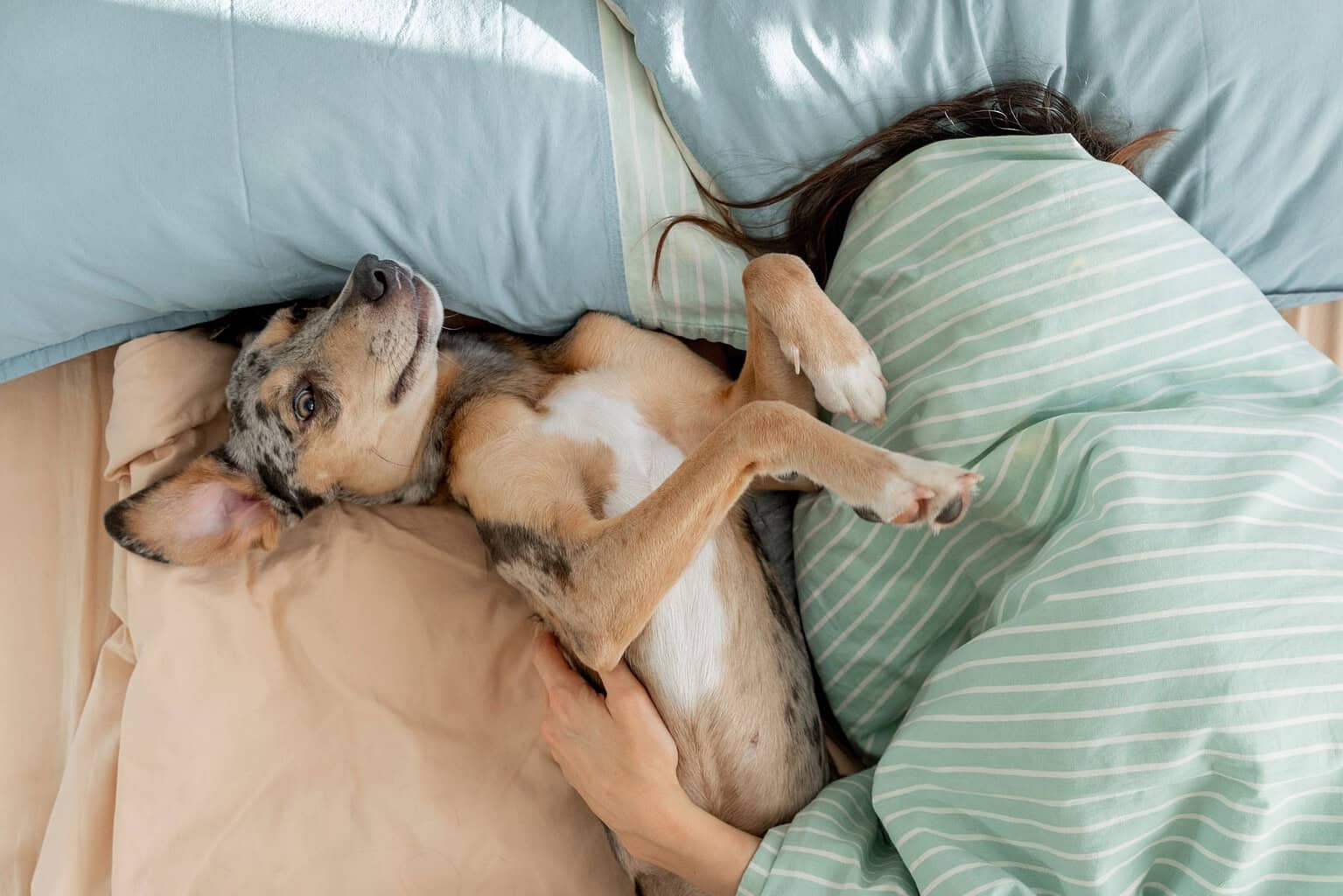
Yes, for most dogs it is safer and more comfortable to take the collar off at night, as long as your dog is microchipped and sleeps inside a secure home. Removing it eliminates the snag and strangulation risk in crates, gives the skin under the collar a chance to breathe, and stops tags from jingling every time your dog scratches. Keep the collar on, ideally a breakaway style with quiet tags, if your dog is an escape artist, a new rescue, or sleeping somewhere unfamiliar.
Last updated: December 2025
Should you take your dog’s collar off at night?
For a dog who sleeps indoors, in a closed house, with a registered microchip, taking the collar off at bedtime is the safer default. Vets who answer this question tend to land in the same place. The collar does its most important job, carrying ID and giving you something to clip a leash to, during the day. At night, behind a locked door, that job shrinks and the risks stay the same.
Dr. Barbara Hodges, a veterinary advisor with the Humane Society Veterinary Medical Association, told PetMD she recommends letting dogs sleep without a collar so the skin can air out. She paired that advice with a condition: make sure the dog is microchipped, so it can still be identified if something goes wrong while the collar is hanging by the door.
Dr. Carly Fox, senior veterinarian at the Schwarzman Animal Medical Center, took a slightly different angle in an Adopt a Pet interview. She said a correctly fitted collar carries “little risk” for full-time wear, but that you should feel free to remove it at home as long as your dog has backup ID such as a microchip.
So this is not a black-and-white rule. It is a trade-off between two kinds of risk:
- Collar on means instant ID if your dog slips out during a 2 a.m. potty break, a fire or a house guest leaving the door open.
- Collar off means zero chance of a tag catching in crate wire, a playmate’s jaw hooking under the collar, or a too-tight band rubbing the neck raw.
If your dog needs to stay collared, the answer is usually a better collar and quieter tags, not a different bedtime.

What are the real risks of leaving a collar on overnight?
The biggest risk is entanglement. A collar or a dangling tag catches on something, the dog panics and pulls, and the collar tightens. Most of the time the result is a scare or a scraped neck. Occasionally it is fatal, which is why vets and trainers take it seriously.
In a 2016 press release, PetSafe reported that more than half of the veterinarians, trainers and daycare professionals it surveyed had experienced a collar-related accident. The company also cited an estimate of up to 26,000 collar strangulation accidents a year. That second number comes from a manufacturer that sells breakaway collars and has not been independently verified, so treat it as a rough signal rather than a hard count. The pattern behind it is well documented, though.
PetSafe listed the most common hazards as crates and kennels, play with other dogs, fences, heating and cooling vents, and shrubs or branches. Dr. John Pacy, a mobile veterinarian in Palm Beach County, told PetMD that hanging tags can catch on crates and other objects and cause choking.
“I do think they seem to enjoy getting a break from it at night or anytime you are relaxing around the house together.”
Dr. Brian Collins, veterinarian, Cornell Riney Canine Health Center, Adopt a Pet
Play is the scenario that surprises most owners. When two dogs wrestle, one can get its lower jaw or teeth caught under the other’s collar. Both dogs twist to get free, and the collar becomes a noose. Dr. Collins described exactly this risk to Adopt a Pet. The AKC has published an owner’s account of a 5-month-old puppy who died after an older dog’s jaw caught in the puppy’s buckle collar during yard play.
Collar type matters too. Choke chains and other non-breakaway collars do not release under pressure, so they should never be left on an unsupervised dog. The AKC piece above ends with blunt advice from a longtime breeder: if in doubt, remove the collar.
Why do vets say a collar break helps your dog’s skin?
A collar sits on the same strip of skin and fur for 24 hours a day. Over weeks and months, that constant contact can cause friction, matting and hair loss, and it traps moisture against the skin. Taking the collar off for eight hours a night is the easiest way to give that area a rest.
Dr. Collins told Adopt a Pet that constant wear can lead to hair loss and, in some dogs, skin irritation and infection. He singled out long-haired dogs, dogs with lots of skin folds, dogs who swim often and dogs with allergies that affect the skin. Dr. Fox added that any dog with atopy or another skin disease can develop irritation under and around the collar.
Dr. Hodges told PetMD that even a “moderately tight” collar can irritate the skin and that areas with collar hair loss can be more prone to infection.
Fit is the other half of the equation. Dr. Fox’s guideline is simple: “Ideally, you should be able to fit two fingers under the collar when on.” Dr. Hodges uses a similar test. If she can slide her whole hand in, the collar is too loose. If she cannot wedge a finger in, it is too tight. She also pointed out that a collar that fits a standing dog can tighten when the dog lies down or rolls over, because skin and fat shift. That is exactly the position your dog spends the night in.
Signs the collar needs a break, a refit or a vet check include redness, thinning fur or a bald band, a sour smell under the collar, and frequent scratching or rubbing at the neck. If you see them, take the collar off overnight for a week and watch whether the skin improves.
For collar shopping, Dr. Fox recommends something light, flexible and quick-drying, since heavy, metal or rigid collars can be uncomfortable. Our guide to the best dog collars compares soft, breakaway and everyday options.
Should a collar ever stay on in the crate?
For most dogs, no. The crate is the single place where a collar is most likely to get caught, and it is also the place where your dog is alone and cannot be helped quickly. Wire crates are the main concern, because a dangling tag can slip between bars or hook on the door latch.
A 2024 Petful article ranked crate accidents as about as common as play-related strangulation, usually when ID tags get stuck between crate bars. Dr. Pacy described the same hazard to PetMD. A dog who is anxious, restless or still learning to settle in a crate moves around more, which raises the odds of a snag.
Puppies deserve extra care. They grow fast, they chew, and they spend a lot of their first months in a crate. A collar that fit at 10 weeks can be snug by 4 months. Many trainers take puppy collars off for every crate session and put them back on for potty trips and walks. If you crate-train at night, that habit takes about 10 seconds each time.
If you must keep a collar on in the crate, for example during travel in a strange place, use a breakaway collar designed to release under tension and swap any dangling tags for a slide-on tag that sits flat against the collar. Plastic or solid-sided travel crates reduce the risk compared with wire, but they do not remove it.
The simplest compromise is to keep ID next to the crate. Hang the collar on a hook by the crate door, so it goes back on your dog the moment the door opens.
When is it smarter to leave the collar on at night?

Taking the collar off is the right call for many dogs, but not for all of them. The strongest argument for leaving it on is simple. If your dog ever ends up outside at night without you, the collar and tag are the fastest way for a stranger to get them home. A microchip is excellent backup, but someone has to bring your dog to a vet or shelter with a scanner before it helps.
The research shows how much visible ID matters. In a national ASPCA survey of more than 1,000 households, published in 2012, about 14 percent of dogs had been lost at least once in the previous five years. Ninety percent of those dogs were wearing a collar the last time they went missing, and 15 percent of the dogs who were found got home because of a tag or microchip. Only 6 percent were found at a shelter. Most lost dogs are found close to home by neighbors and owners, and those neighbors do not carry chip scanners.
Here are the situations where many vets and trainers would keep a collar on overnight:
The first is the escape artist. If your dog has ever bolted through a door, dug under a fence or slipped out during a late potty break, the collar is doing real work at night. Night potty trips in the dark are a classic moment for a dog to chase a rabbit or a noise and disappear.
The second is the new rescue. A dog in the first few weeks of a new home does not know your street, your door or your routines. Fear can make a newly adopted dog run, and many shelters advise keeping ID on around the clock during that settling-in period.
The third is any unfamiliar place. Hotels, vacation rentals, campsites and relatives’ homes all come with doors you do not control. Guests come and go, gates get left open and a dog who is calm at home may be restless somewhere new.
The fourth is emergencies. In a house fire, a burst pipe or a storm evacuation, you may need to grab your dog and leave in seconds. A dog already wearing a collar with ID is one less thing to find in the dark, and firefighters or neighbors who end up handling your dog can read the tag right away.
The fifth is a dog who needs quick handling. Some dogs are easier to guide when you have a collar to hold, for example a senior dog who wobbles on stairs at night or a dog who needs help getting off the bed.
If your dog fits one of those categories, the goal is to make overnight wear as safe and comfortable as possible rather than to skip the collar. That usually means three changes. Use a breakaway or quick-release collar so a snag releases instead of tightening. Check the fit with the two-finger test while your dog is lying down, not standing. And replace a jingling bundle of metal tags with one lightweight, quiet tag that carries everything a finder needs.
Keep the sleeping area simple too. Move your dog’s bed away from heating vents, cabinet handles and furniture with gaps, and avoid letting two collared dogs wrestle unsupervised at bedtime. Those small adjustments remove most of the risk while keeping your dog identifiable all night.
Why are metal tags so loud at night, and do acrylic tags fix it?
If you share a bedroom with your dog, you already know the sound. A scratch, a shake or a drink of water sets off a clink of metal tags that can wake a light sleeper. Most dogs wear several tags on one ring, an ID tag, a rabies tag and often a license, so every movement is metal hitting metal.
Material makes the difference. Acrylic has a density of about 1.19 grams per cubic centimeter, compared with roughly 7.5 to 8 for stainless steel, 8.4 to 8.75 for brass and 2.7 for aluminum, according to Engineering ToolBox. Acrylic tags are cut thicker than metal ones, so the per-tag gap is smaller than those densities suggest, but they are still lighter. And plastic tapping plastic, or plastic tapping a metal rabies tag, makes a soft tick instead of a bright jingle.
| 1-inch round tag | Typical thickness | Material density (g/cm³) | Approx. weight (calculated) | Night noise |
|---|---|---|---|---|
| Stainless steel | 0.031 in (0.8 mm) | 7.5 to 8.0 | about 3.2 g | Loud, bright jingle |
| Brass | 0.036 in (0.9 mm) | 8.4 to 8.75 | about 3.9 g | Loud, bright jingle |
| Aluminum | 0.064 in (1.6 mm) | 2.7 | about 2.2 g | Softer clink |
| Acrylic | 1/8 in (3.2 mm) | 1.19 | about 1.9 g | Quiet tick |
| Slide-on plate | Sits flat on collar | Varies | Varies by material | Silent |
Metal thicknesses are standard tag gauges from National Band and Tag Company. Weights are our calculations for the tag body only, before split rings, so real tags vary with shape and hardware. The takeaway is less about grams and more about sound and bulk. Brands such as Em & Me and Kissamo market acrylic tags on that quiet, lightweight angle, and it holds up. For a deeper look, see our comparison of acrylic vs metal dog tags and our roundup of the best acrylic pet tags.
Which setup works best for a crate, a bed, a potty break or a multi-dog home?
There is no single right answer, because the risk changes with where and how your dog sleeps. Use this table as a starting point, then adjust for your dog’s personality and history.
| Situation | Collar at night? | Main risk | Best setup |
|---|---|---|---|
| Wire crate | Off | Tag or collar snagging on bars | Collar on a hook by the crate door, microchip registered |
| Your bed or dog bed | Off, or breakaway | Tag noise, skin friction | Collar off, or one quiet acrylic or slide-on tag |
| Outdoor potty break | On | Bolting in the dark | Clip collar on before the door opens, leash if the yard is unfenced |
| Multi-dog household | Off, or breakaway | Jaw caught in a playmate’s collar | No collars during unsupervised play or shared sleep |
| Travel or new rescue | On | Escape in an unfamiliar place | Breakaway collar, two-finger fit, current ID tag |
A few notes on the trickier rows. For potty breaks, make putting the collar back on part of the routine, the same way you grab your shoes. In multi-dog homes, the risk is highest when dogs play right before bed. If you prefer a harness for walks, you can also put an ID tag on a harness and take the whole thing off at night.
One quiet tag instead of a jingling bundle
Shiloh’s House Smart Tags are lightweight acrylic with an NFC back, so a finder can tap with any phone and reach you in one tap, without a midnight jingle.
How do you keep your dog identifiable without a collar at night?
If you take the collar off at bedtime, your dog’s backup ID has to be solid. That means a registered, up-to-date microchip, a collar that is easy to grab, and contact details a finder can actually use.
Start with the microchip. In a study of more than 7,700 microchipped animals entering 53 shelters, published in the Journal of the American Veterinary Medical Association in 2009, microchipped stray dogs went home 52.2 percent of the time, compared with 21.9 percent for stray dogs overall. The catch was registration. When owners could not be found, the most common reason was an incorrect or disconnected phone number. Ask your vet to scan the chip at the next checkup and confirm the registry has your current number.
Next, make the collar part of a habit. Keep it on a hook by the bedroom door, the back door or the crate, wherever your dog starts the day. The collar goes on before any door to the outside opens, every time.
Finally, put the right details on the tag. Your phone number matters most, followed by a backup contact and any medical needs. Our checklist on what to put on a dog ID tag covers the essentials.
A smart tag lets you go further without crowding a tiny tag. With a Shiloh’s House Smart Tag, a finder taps the tag with a phone, no app needed, and sees a live profile with one-tap call, text and directions. You set that profile up for free in the Lohji app (App Store or Google Play), with up to 3 emergency contacts, medical and behavioral notes, your vet and rabies vaccine ID, and up to 3 short voice messages. Changes show up immediately, so if you are traveling over the holidays you can add the hotel number before you leave.
Frequently asked questions
Should dogs sleep with their collars on?
Most indoor dogs with a registered microchip can sleep without a collar safely. Removing it prevents snags in crates and gives the skin under the collar a break. Keep it on overnight if your dog is an escape artist, a new rescue or sleeping somewhere unfamiliar, and choose a breakaway collar with a single quiet tag for those nights.
Is it safe to leave a collar on a dog in a crate?
It is safest to remove it. Crates, especially wire ones, are one of the most commonly reported places for collar and tag snags, and your dog is usually alone there. If a collar must stay on, use a breakaway style and a flat slide-on tag, and never leave a choke, prong or martingale collar on a crated dog.
Do dogs like having their collar taken off at night?
Dogs cannot tell us directly, but veterinarians think many enjoy the break. Dr. Brian Collins of Cornell’s Riney Canine Health Center told Adopt a Pet that dogs seem to enjoy time without a collar while relaxing at home. Some dogs shake, stretch or roll right after it comes off, which suggests it feels good.
How tight should my dog’s collar be?
Use the two-finger rule. You should be able to slide two fingers flat between the collar and your dog’s neck. Check the fit while your dog is lying down too, because skin and fat shift and a collar that fits a standing dog can feel tighter when they curl up to sleep.
How do I stop my dog’s tags from jingling at night?
Swap a bundle of metal tags for one lightweight acrylic tag or a slide-on tag that sits flat on the collar. Fewer tags means less clinking, and acrylic makes a soft tick rather than a metal jingle. Rubber tag silencers help, or simply take the collar off at bedtime if your dog sleeps indoors.
Is a microchip enough ID if my dog sleeps without a collar?
A registered microchip is excellent backup, but it only works after someone scans your dog at a vet or shelter. Most lost dogs are found nearby by neighbors without scanners, so put the collar and tag back on before any outdoor trip. Confirm your chip registration has your current phone number.
Sources
- PetSafe Brand — PetSafe Brand Educates Pet Owners about How to Prevent Strangulation and Injuries During Collar Safety Awareness Week (2016)
- Adopt a Pet — Do Dogs Want Their Collars Taken off When They Get Home? (2025)
- PetMD — 5 Ways Collars Can Harm Your Dog (2018)
- American Kennel Club — Could Your Dog’s Collar Endanger His Life? (2021)
- Petful — Essential Tips for Dog Collar Safety (2024)
- ASPCA — How Many Pets Are Lost? How Many Find Their Way Home? (2012)
- Animals journal — Frequency of Lost Dogs and Cats in the United States and the Methods Used to Locate Them (2012)
- JAVMA — Characterization of Animals with Microchips Entering Animal Shelters (2009)
- Engineering ToolBox — Solids Densities
- National Band and Tag Company — Dog and Cat Tags Material Comparison Chart (2022)