Can Cats Eat Strawberries? Sugar, Serving Size and What Cats Taste
 Shiloh’s House Team
·
·
16 min read
Yes, cats can eat strawberries; the fruit is non-toxic, but it is a treat with no nutritional job to do, so keep it to a few small pieces of one washed, hulled berry a couple of times a week. Cats cannot taste sweetness, so a cat that licks a strawberry is after the smell, the texture or your attention, not the sugar. Skip strawberries for diabetic or overweight cats, remove the leaves and stem, and keep strawberry jam, yogurt and ice cream on your side of the table.
Last updated: September 2025
Can cats eat strawberries safely?
Strawberries are one of the easier people foods to answer for. The ASPCA Animal Poison Control Center lists the strawberry plant, Fragaria species, as non-toxic to cats, dogs and horses, and PetMD, in an article by Sandra C. Mitchell, DVM, DABVP, says cats can eat fresh or frozen strawberries in moderation.
That is the good news. The rest of this post is about why “can” and “should” are different questions for a cat. Cats are obligate carnivores, built to run on animal protein and fat, and a strawberry is mostly water and sugar. It will not hurt a healthy cat in small amounts, but it does nothing for her either.
“The short answer is yes, cats can eat strawberries in small amounts. But while they aren’t toxic, they’re also not exactly a feline superfood. Like many human treats, strawberries fall into the category of ‘safe but not necessary,’ and there are a few things to keep in mind before sharing this fruit with your cat.”
Sandra C. Mitchell, DVM, DABVP, veterinarian, reviewed by Jennifer Coates, DVM (PetMD, 2025)
If your cat nibbles the strawberry plants on the patio rather than the fruit, that is a different habit, which we cover in why cats eat grass.
Why can’t cats taste strawberries?
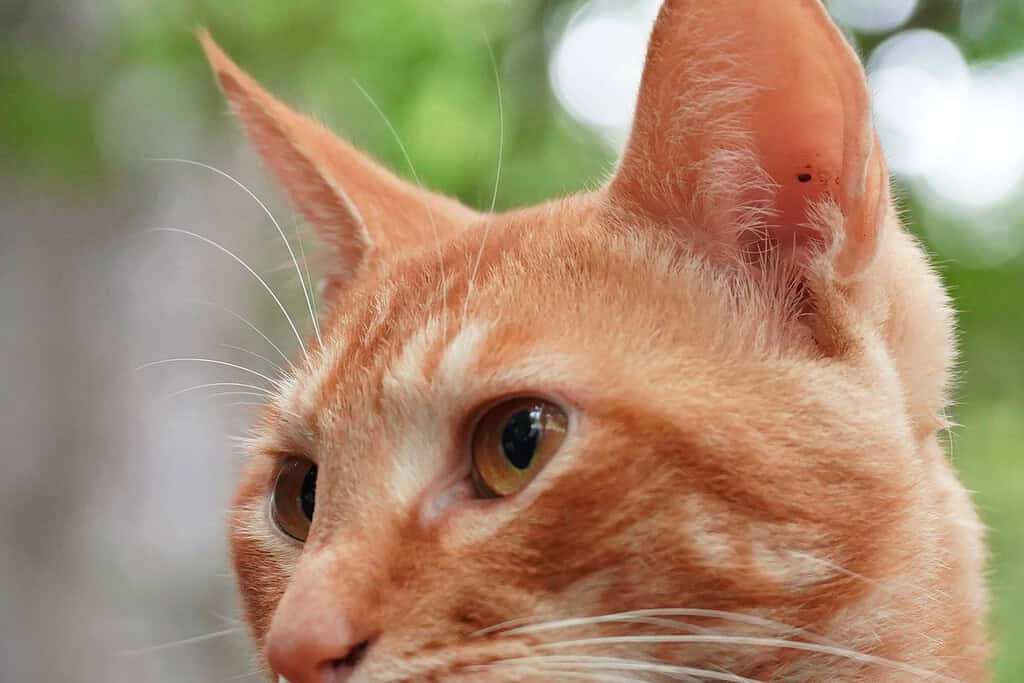
Most mammals taste sweetness through a receptor built from two proteins, T1R2 and T1R3, made by the genes Tas1r2 and Tas1r3. In 2005 a team led by Xia Li at the Monell Chemical Senses Center published the cat’s version of those genes in PLoS Genetics. Tas1r3 looked normal and was switched on in the taste buds. Tas1r2 carried a 247-base-pair deletion in exon 3 plus stop codons in exons 4 and 6, and no messenger RNA or protein from it turned up in cat taste tissue. Six more house cats, a tiger and a cheetah had the same deletion.
Without T1R2 the sweet receptor cannot assemble, so the authors concluded the cat “lacks the receptor likely necessary for detection of sweet stimuli.” The fructose and glucose in a strawberry are, to a cat, simply absent. Dogs have a working Tas1r2, which is one reason our guide to strawberries for dogs reads very differently from this one.
So why do some cats lick, bite or roll on strawberries? Honestly, nobody has studied it. Veterinary writers at PetMD and Chewy describe cats as curious about novel food, and the usual explanation is texture and juiciness rather than flavor. A ripe berry is cool, wet and soft, closer to prey than kibble is, and it is something you are eating. You will see claims online that strawberries contain a catnip-like compound; we found no study supporting that, so treat it as a guess.
Are strawberries good for cats?
A strawberry is about 91 percent water with a modest dose of sugar and a surprising amount of vitamin C. Here is what USDA FoodData Central reports for raw strawberries (SR Legacy, FDC ID 167762), per 100 grams and per medium berry, using USDA’s 12-gram weight for a medium strawberry.
| Nutrient (raw strawberries) | Per 100 g | Per medium berry (12 g) |
|---|---|---|
| Calories | 32 kcal | About 4 kcal |
| Water | 91.0 g | 10.9 g |
| Total sugars | 4.89 g | 0.59 g |
| Dietary fiber | 2.0 g | 0.24 g |
| Protein | 0.67 g | 0.08 g |
| Total fat | 0.30 g | 0.04 g |
| Vitamin C | 58.8 mg | 7.1 mg |
| Potassium | 153 mg | 18 mg |
Read the right-hand column, because that is what a cat will actually eat. A medium berry is about 4 calories and a little over half a gram of sugar, which is why one berry is harmless for a healthy cat and why the vitamins are a rounding error. PetMD points out that cats make their own vitamin C, and Chewy notes that the amounts a cat can safely eat are too small for the nutrients to matter.
The one line worth something is water. Many cats drink poorly, and PetMD lists hydration as a small genuine benefit. Canned food does the job far better, but a cold piece of strawberry on a hot day adds a few harmless drops.
What a strawberry lacks is the point: almost no protein and essentially no fat, the two things a cat’s body is designed to burn. Sarah Wooten, DVM, CVJ, told Chewy that cats “don’t need carbohydrates” and are meant to get their energy from meat.
How many strawberries can a cat eat?
Veterinary nutritionists use one guardrail for every treat: treats and table food combined should stay under 10 percent of the day’s calories. Lisa M. Freeman, DVM, PhD, DACVIM (Nutrition), of the Tufts Clinical Nutrition Service, puts it in plain numbers: a 10-pound cat typically needs just over 200 calories a day, so no more than 20 calories should come from treats. Her colleague Deborah E. Linder, DVM, MS, DACVIM (Nutrition), lists three medium strawberries, about 50 grams, at 16 calories.
For the table below we ran the Merck Veterinary Manual formula: resting energy requirement equals 70 times body weight in kilograms raised to the 0.75 power, times 1.2 for a neutered adult cat. We took 10 percent as the treat budget and converted it to strawberry at 32 calories per 100 grams. The table is our suggestion, not a prescription, and it runs higher than the Tufts estimate because the Merck factor assumes a moderately active cat; a sedentary indoor cat needs less.
| Cat weight | Daily calories (Merck, neutered adult) | Treat budget (10%) | Strawberry if it were the only treat | Our suggested serving (a few times a week) |
|---|---|---|---|---|
| 6 lb (2.7 kg) | About 180 kcal | About 18 kcal | About 55 g (4 medium berries) | 2 to 3 pea-sized pieces (about half a berry) |
| 10 lb (4.5 kg) | About 260 kcal | About 26 kcal | About 80 g (7 medium berries) | Half to one small berry, cut up |
| 14 lb (6.4 kg) | About 335 kcal | About 34 kcal | About 105 g (9 medium berries) | One small berry, cut up |
| 18 lb (8.2 kg) | About 405 kcal | About 41 kcal | About 125 g (10 medium berries) | One small berry, cut up |
Notice the gap between the last two columns. Calories alone would let a 10-pound cat eat seven strawberries a day, and that cat would reward you with diarrhea; the limit is the gut, not the math. PetMD’s guidance is one small strawberry, cut into pieces, or less per day, no more than a couple of times a week, and Chewy’s vets agree. As for the 18-pound row, unless yours is a Maine Coon at a healthy weight, 18 pounds usually means overweight, and a bigger budget on paper does not mean more fruit.
How should you prepare strawberries for a cat?
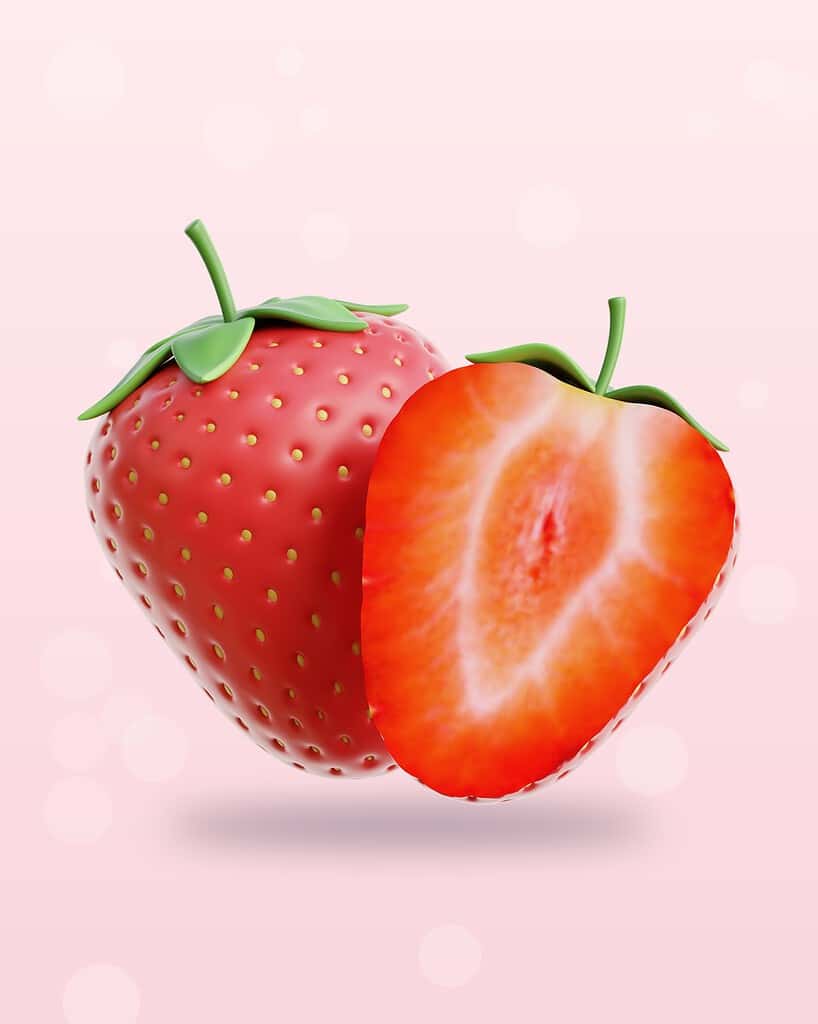
Start at the store or the garden. Strawberries sit near the top of the Environmental Working Group’s Dirty Dozen every year, and in the 2025 Shopper’s Guide they ranked second, behind spinach, for pesticide residue on conventionally grown produce. The USDA samples behind that ranking were washed for 15 to 20 seconds under running water before testing, and residues were still detected. That does not make a strawberry dangerous for a cat eating a few grams of it, but it is a good reason to rinse thoroughly, rub each berry gently under the tap and dry it before cutting. Organic berries remove most of the question.
Next, hull the berry. Pinch or slice off the green cap, the stem and any leaves attached to it. PetMD is clear that the leaves and stems are not toxic, but they are tough, fibrous and hard for a cat to chew and digest, and Chewy’s veterinarians add that the cap can be a choking hazard in a small mouth. Trim any white, unripe flesh and throw away any berry with soft brown spots or mold; a cat’s stomach is far less forgiving of spoiled fruit than ours.
Now cut it small. A whole strawberry is far too big for a cat to swallow safely, and cats do not chew fruit the way they shear meat. Slice the berry into pieces no bigger than a pea, about a quarter of an inch, so that even a cat who gulps cannot choke. For a kitten, go smaller still. If your cat has never had fruit, offer a single piece on a flat dish rather than from your fingers, so she can sniff and walk away without pressure. Most cats will lick it, bat it around and lose interest, which is a perfectly good outcome; no cat needs to like strawberries.
Frozen strawberries are fine, with two cautions. Thaw the piece partway so it is cool rather than rock hard, because a frozen chunk is a tooth and choking risk, and check that the only ingredient is strawberries, since many frozen blends are sweetened. Dried, candied, chocolate-covered and canned strawberries are all off the list: dried and candied fruit concentrates the sugar, chocolate is toxic to cats, and canned fruit comes in syrup.
Introduce the fruit slowly and watch. Give one piece the first day and nothing more, then watch the litter box for 24 hours. Soft stool, diarrhea, gas or vomiting means that cat does not tolerate strawberries, and both PetMD and Chewy say some cats simply do not. There is no reason to try again; a cat intolerant of fruit is not missing anything. If the first piece goes fine, you can offer a few pieces a couple of times a week, always counting it against the day’s treats and never in place of a meal. A cat who fills up on fruit and skips her food is eating an unbalanced diet, which is a bigger problem than the sugar.
Can cats eat strawberry jam, yogurt or ice cream?
Fresh fruit is the only form of strawberry we would share. Everything else adds the two things a cat handles worst: concentrated sugar and dairy.
Strawberry jam and preserves are mostly sugar by weight, and a cat cannot taste any of it. A lick off your toast is not an emergency, but there is no reason to offer it. One reassurance: xylitol, the sweetener so dangerous for dogs, does not appear to affect cats the same way. The Pet Poison Helpline’s feline safety guide says there is no published data to suggest cats are sensitive to it, and a 2018 study in the Journal of Veterinary Pharmacology and Therapeutics gave six cats doses lethal to a dog and found no toxic effects. A sugar-free product is still worth a call because of other ingredients, but the dog-level panic does not apply.
Strawberry yogurt and ice cream bring in dairy. Most adult cats lose much of the enzyme lactase after weaning, and PetMD’s Dr. Mitchell writes that most cats develop lactose intolerance as they mature. Undigested lactose pulls water into the gut and ferments, so the usual result is diarrhea and gas within about 12 hours. Add the sugar and fat in ice cream and you have a dessert designed to upset a cat. PetMD allows less than a teaspoon of strawberry yogurt for a cat known to tolerate dairy; we would rather you skip it.
Strawberry-flavored cat treats are a different product, formulated for cats with calories on the label. Strawberry-flavored human foods are not for cats.
Make sure whoever finds your cat knows her feeding rules
A Shiloh’s House Smart Tag pairs laser-engraved premium acrylic with a “Tap Phone Here” NFC back, so a finder, sitter or neighbor taps the tag with any phone and sees your contacts, medical notes and voice messages before anyone offers a strawberry to a diabetic cat. $38 one-time, no subscription, no battery, made in the USA, 30-day returns.
Which cats should skip strawberries?
For a healthy adult cat, a few pieces of strawberry are a harmless novelty. For these cats, we would pause.
Diabetic cats. PetMD says cats with diabetes should not have strawberries, and Dr. Wooten told Chewy that diabetic cats should steer clear because they process sugars differently. The Cornell Feline Health Center explains that a low-carbohydrate diet improves blood sugar regulation in diabetic cats, and a sugary treat between meals works against that.
Overweight cats. Cornell reports that obese cats are up to four times more likely to develop diabetes than cats at an ideal weight, and PetMD names overweight cats alongside diabetic ones. Spend the treat budget on play, or on a few pieces of plain cooked meat, which we cover in our guide to chicken for cats.
Cats with sensitive stomachs. Deborah Bayazit, DVM, told Chewy that some cats are inherently intolerant of strawberries and that sensitive-stomach cats are best left without them. Cats on a veterinary diet should get nothing outside it unless the vet agrees.
Kittens. Kittens can have a tiny amount of strawberry, and PetMD notes they are the cats most likely to investigate a new food. The real risk is choking, so cut pieces smaller than you think necessary and supervise.
Whatever the rule is for your cat, write it where other people will see it. In the free Lohji app from Shiloh’s House, you keep a live profile for your cat with up to three emergency contacts, medical notes, behavioral notes and voice messages, and a Shiloh’s House NFC Smart Tag opens that profile when anyone taps it with a phone, so a sitter or finder reads “diabetic, no treats” before offering a snack. The same app turns a photo of your cat into a cartoon Lohji character. Get it on the App Store or Google Play.
How do strawberries compare with blueberries, watermelon and banana?
Here is how strawberry compares with the other fruits cat owners ask about, raw, per 100 grams, from USDA FoodData Central’s SR Legacy records.
| Fruit (raw, per 100 g) | Calories | Sugars | Fiber | USDA FDC ID |
|---|---|---|---|---|
| Strawberries | 32 kcal | 4.9 g | 2.0 g | 167762 |
| Watermelon | 30 kcal | 6.2 g | 0.4 g | 167765 |
| Blueberries | 57 kcal | 10.0 g | 2.4 g | 171711 |
| Banana | 89 kcal | 12.2 g | 2.6 g | 173944 |
Strawberry is the lowest-sugar fruit of the four and nearly the lowest in calories, which is why Dr. Wooten calls it a better snack than most fruit. Watermelon has fewer calories but more sugar and no fiber to speak of. Blueberries carry twice the sugar, though a single blueberry is so small the portion controls itself. Banana is the outlier, with nearly three times the calories and two and a half times the sugar.
The real comparison is fruit versus meat. A tablespoon of boiled chicken breast, about 9 grams, runs 15 calories on the Tufts treat list and delivers the protein a cat is built for. If your cat truly likes berries, a few pieces do no harm. If she is indifferent, as most cats are, a flake of tuna or a shred of chicken is the better treat, and she can actually taste it.
One more thought for the cat who hunts strawberries off the counter: curious, food-motivated cats are also the cats who slip out an open door. Our guides to whether indoor cats need ID tags and the best smart cat tags explain why a lightweight tag on a breakaway collar is worth it.
Frequently asked questions
Are strawberries safe for cats?
Yes. The ASPCA lists the strawberry plant as non-toxic to cats, and PetMD says cats can eat fresh or frozen strawberries in moderation. Safe is not the same as beneficial, though. Strawberries are mostly water and sugar, cats cannot taste sweetness, and too much fruit causes vomiting or diarrhea. Treat a strawberry as a harmless novelty, not a health food.
How many strawberries can a cat eat?
PetMD suggests one small strawberry, cut into pieces, or less per day, no more than a couple of times a week, and Chewy’s veterinarians give the same ceiling. Our own suggestion is two or three pea-sized pieces for a small cat and up to one small cut-up berry for a 10-to-14-pound cat, within a daily treat budget of roughly 20 to 30 calories.
Can kittens eat strawberries?
Yes, in tiny amounts. PetMD says kittens can have a small piece of strawberry and notes that kittens are the cats most likely to try a new food out of curiosity. The main risk is choking, so cut pieces small enough that a kitten could swallow one whole without trouble. Keep it to a lick or two; a kitten’s calories should come from kitten food.
Why does my cat lick strawberries if cats cannot taste sweet?
Nobody has studied it directly. Cats lack a working Tas1r2 gene, so the sugar is invisible to them, but a ripe strawberry is cold, wet, soft and strongly scented, and it is something you are eating. Veterinary writers put the attraction down to curiosity, texture and moisture. Claims of a catnip-like compound in strawberries are common online, but we found no study supporting them.
Can cats eat strawberry yogurt or strawberry ice cream?
We would not offer either. Most adult cats are lactose intolerant, so dairy tends to cause diarrhea and gas within a day, and both products add sugar a cat cannot taste and does not need. PetMD allows less than a teaspoon of strawberry yogurt for a cat known to tolerate dairy, but overweight and diabetic cats should have none. Chocolate-covered strawberries are the real danger.
Can diabetic cats eat strawberries?
No. PetMD says cats with diabetes should not have strawberries, and veterinarians quoted by Chewy agree that diabetic cats should steer clear because of how they process sugar. The Cornell Feline Health Center notes that a low-carbohydrate diet improves blood sugar control in diabetic cats, and a sugary snack between meals undermines that. Stick to the treats your veterinarian approved for your cat’s insulin plan.
Sources
- USDA Agricultural Research Service, “Strawberries, raw (SR Legacy, FDC ID 167762)”, USDA FoodData Central, 2019 — https://fdc.nal.usda.gov/food-details/167762/nutrients
- USDA Agricultural Research Service, “Blueberries, raw (FDC ID 171711); Watermelon, raw (FDC ID 167765); Bananas, raw (FDC ID 173944) (SR Legacy)”, USDA FoodData Central, 2019 — https://fdc.nal.usda.gov/food-details/171711/nutrients
- Xia Li, Weihua Li, Hong Wang et al., “Pseudogenization of a Sweet-Receptor Gene Accounts for Cats’ Indifference toward Sugar”, PLoS Genetics, 2005 — https://journals.plos.org/plosgenetics/article?id=10.1371/journal.pgen.0010003
- Sandra C. Mitchell, DVM, DABVP, reviewed by Jennifer Coates, DVM, “Can Cats Eat Strawberries?”, PetMD, 2025 — https://www.petmd.com/cat/nutrition/can-cats-eat-strawberries
- Sandra C. Mitchell, DVM, DABVP, “Can Cats Drink Milk?”, PetMD, 2023 — https://www.petmd.com/cat/nutrition/can-cats-drink-milk
- Rebecca Geiger, with Sarah Wooten, DVM, CVJ, Rachel Barrack, DVM, and Deborah Bayazit, DVM, “Can Cats Eat Strawberries?”, Chewy, 2025 — https://www.chewy.com/education/cat/food-and-nutrition/can-cats-eat-strawberries
- Lisa M. Freeman, DVM, PhD, DACVIM (Nutrition), “The Most Popular Holiday Foods That Your Pet Should Avoid”, Tufts Petfoodology, 2023 — https://sites.tufts.edu/petfoodology/2023/12/08/the-most-popular-holiday-foodsthat-your-pet-should-avoid/
- Deborah E. Linder, DVM, MS, DACVIM (Nutrition), “Treat Options for Dogs and Cats Without Unbalancing Their Diet”, Tufts Petfoodology, 2021 — https://sites.tufts.edu/petfoodology/2021/10/21/treat-options-for-dogs-and-cats-without-unbalancing-their-diet/
- Sherry Lynn Sanderson, DVM, PhD, DACVIM, “Nutritional Requirements of Small Animals”, Merck Veterinary Manual, 2024 — https://www.merckvetmanual.com/management-and-nutrition/nutrition-small-animals/nutritional-requirements-of-small-animals
- ASPCA Animal Poison Control Center, “Toxic and Non-toxic Plants: Strawberry”, ASPCA, accessed 2025 — https://www.aspca.org/pet-care/aspca-poison-control/toxic-and-non-toxic-plants/strawberry
- Susan Shaw, CVT, “Feline Safety”, Pet Poison Helpline, 2019 — https://www.petpoisonhelpline.com/uncategorized/feline-safety/
- Á. Jerzsele et al., “Effects of p.o. administered xylitol in cats”, Journal of Veterinary Pharmacology and Therapeutics, 2018 — https://onlinelibrary.wiley.com/doi/10.1111/jvp.12479
- Cornell Feline Health Center, “Feline Diabetes”, Cornell University College of Veterinary Medicine, accessed 2025 — https://www.vet.cornell.edu/departments-centers-and-institutes/cornell-feline-health-center/health-information/feline-health-topics/feline-diabetes
- Environmental Working Group, “EWG’s 2025 Shopper’s Guide to Pesticides in Produce”, EWG, 2025 — https://www.ewg.org/news-insights/news-release/2025/06/ewgs-shoppers-guide-pesticides-producetm-almost-60-clean