Why Does My Dog Growl When Playing? Play Growls vs Warning Growls
 Shiloh’s House Team
·
·
17 min read
Most dogs that growl during play are not being aggressive; a play growl is a normal part of the game, and the rest of the body tells you so. Playful dogs stay loose and bouncy, offer play bows, take turns and come back for more, and research shows play growls are shorter and faster than warning growls. If the body goes stiff, the stare hardens, the lip curls or your dog is guarding food or a toy, the growl is a warning, so stop, give space and never punish it.
Last updated: September 2025
Why does my dog growl when playing?
Dogs growl in play for the same reason they bite and body-slam in play: the game rehearses serious behavior with the stakes turned off. Pat Miller, a certified behavior consultant writing for Whole Dog Journal, calls this pseudo-aggression and notes that it is usually wrapped in play bows and other body language that says it is all in fun.
Veterinary behaviorist Lore Haug, writing in Clinician’s Brief, explains the mechanism. In a serious encounter a growl is a distance-increasing signal meant to make the other party back off. In play, dogs add what she calls metasignals, such as a play bow, that tell the receiver the growl is not a threat. Same instrument, different meaning.
Here is the reassuring part. In a 2017 study in Royal Society Open Science, Tamás Faragó and colleagues at Eötvös Loránd University played recorded growls to 40 adults and asked them to guess the situation. People placed 63 percent correctly, well above the 33 percent expected by chance, and they were best at play growls, getting 81 percent right. Women and dog owners scored higher still. Your gut is working with real information, though sound alone is not the whole story.
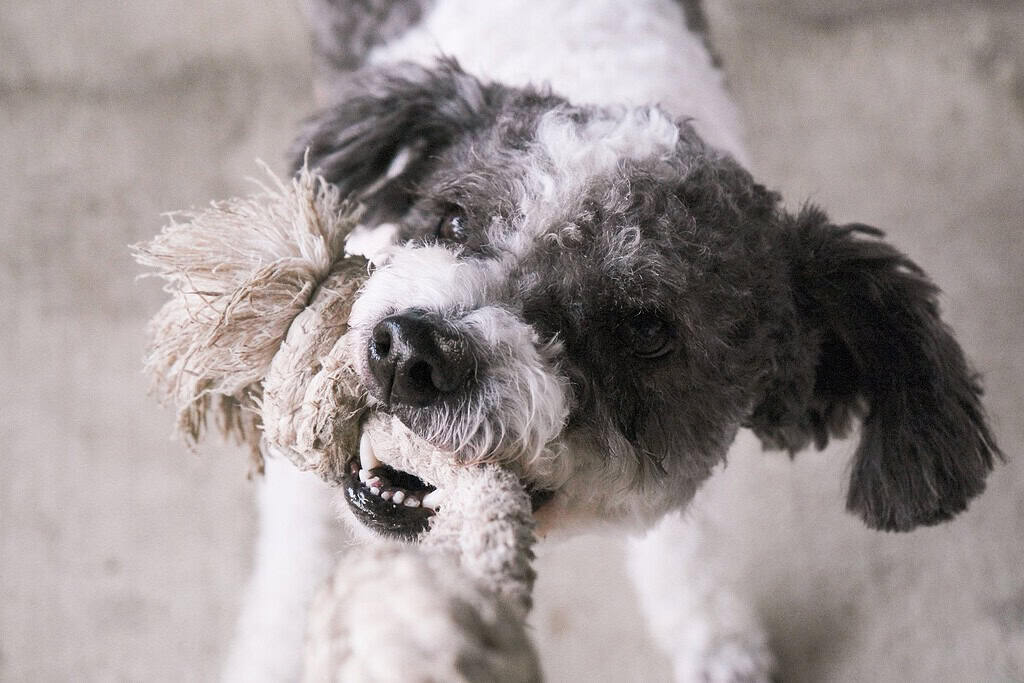
What does science say makes a play growl different?
Three research groups have put growls under the microphone, and they agree: a play growl is shorter, comes in rapid bursts and often makes the dog sound bigger, while a warning growl is longer and more widely spaced.
Anna Taylor, David Reby and Karen McComb at the University of Sussex recorded 204 growls from 32 pet dogs in a play context and an aggression context for a 2009 paper in Ethology. Pitch and formant frequencies, the resonances that reflect vocal tract length, did not differ between contexts. Timing did: aggressive growls were significantly longer, and the sequences had a different rhythm. Listeners could not tell single growls apart, but when the team synthesized sequences at the two typical rates, people labeled the fast ones playful and the slow ones aggressive.
Faragó’s group went further. Their 2010 Animal Behaviour paper, nicknamed “The bone is mine,” recorded growls during tug with the owner, while guarding a bone from another dog and while facing a threatening stranger. Play growls differed from both agonistic types mainly in pitch and formant dispersion. In the 2017 follow-up, play growls were shorter, more numerous and closer together, with the narrowest formant dispersion of the three, the acoustic signature of a bigger body. A dog playing tug often growls like a larger dog, and Taylor’s 2010 playback study showed dogs read body size straight off a growl. The table summarizes the research; the last row is our suggestion.
| Feature | Play growl | Warning growl |
|---|---|---|
| Growl length (Taylor 2009; Faragó 2017) | Shorter individual growls | Significantly longer growls |
| Rhythm (Taylor 2009; Faragó 2017) | More growls per bout, shorter pauses | Fewer, drawn-out growls with longer gaps |
| Apparent body size (Faragó 2010, 2017) | Narrow formant dispersion; dog sounds bigger than it is | Closer to true size; widest dispersion in food guarding |
| Humans guessing context (Faragó 2017) | 81 percent correct | 60 percent (food guarding), 50 percent (stranger) |
| Body (PetMD, Whole Dog Journal) | Loose, wiggly, bouncy; soft face; ears slightly to the side; tail neutral | Stiff and still; hard stare; closed mouth or curled lip; hunched over an object |
| Context | Tug, wrestling, chase; play bows; partner keeps re-engaging | Food, toys or bed approached; handling; cornered; pain; one dog trying to leave |
| What to do (our suggestion) | Keep playing; add short breaks if arousal climbs | Stop, back away, remove the stressor; never punish; call a professional if new or repeated |
How do dogs signal that growling is just play?
Because the actions in play are borrowed from fighting and hunting, a dog needs a way to tell its partner that none of it is meant seriously. The answer is a set of play signals, and the most famous is the play bow: front end down, rear end up, often with a wagging tail.
Marc Bekoff spent years filming domestic dogs, wolf pups and coyote pups at play, and in a 1995 paper in the journal Behaviour he asked whether bows show up randomly or cluster around the moments most likely to be misunderstood. He focused on the riskiest move in play, a bite with rapid side-to-side head shaking, which is exactly how a canid kills prey or fights. In the dogs he studied, 74 percent of all bows happened immediately before or after one of those bite-shakes. For wolves the figure was 79 percent and for coyotes 92 percent. Bekoff called this play signals as punctuation. The bow at the start says “I want to play,” and the bow in the middle of a rough sequence says, in his words, “I want to play despite what I am going to do or just did.” A growl sandwiched between two bows is about as safe as a growl gets.
Alexandra Horowitz added the next piece in a 2009 study in Animal Cognition. She filmed 39 bouts of rough-and-tumble play between pairs of dogs, 78 dogs in all, at an off-leash park in Leucadia, California. Of 397 play signals she recorded, 376 were aimed at a partner facing forward and able to see them. When a partner looked away, dogs did not waste a bow on the back of its head. They used an attention-getter first, a nudge, a paw or a bump, and only then signaled play. Play signals also piled up at pauses, with 41 percent occurring within a second of a break in the action, the moment a partner might wonder whether the game is still a game.
Two more signals round out the picture. The first is self-handicapping, a term Bekoff uses for a dog deliberately playing below its ability. A big dog lets a small dog pin it. A fast dog lets itself be caught. The second is role reversal, the pattern of taking turns: the chaser becomes the chased, the dog on top rolls over, the one with the toy drops it. Pat Miller describes healthy play as a negotiation in which Dog B signals discomfort when Dog A gets too intense, and Dog A tones it down before the two resume. Neither dog is trying to win.
Put the pieces together and you have a checklist. Is the body loose and bouncy rather than stiff and efficient? Are there bows around the roughest bits? Is the growling dog taking turns and going easy on a smaller partner? When one dog pauses, does the other re-invite rather than press on? Does the quieter dog come back for more on its own? If the answers are yes, the growl is part of the conversation. If a dog keeps pushing after its partner has checked out, the play style is the problem, and that is your cue to step in cheerfully.
One last clue is the sneeze. Many dogs punctuate play with quick, snorty sneezes that seem to serve the same purpose as a bow, as we explain in our guide to why dogs sneeze when playing. A dog producing growls, sneezes and bows together is having a very good time.
When is a growl not play?
The growl you should take seriously announces itself with the rest of the body. Wailani Sung, a board-certified veterinary behaviorist writing for PetMD, describes a play growl as coming with loose body language, a soft face, a neutral tail and ears slightly to the side. The warning version is a stiff body, hard stare, ears forward or pinned, and a closed mouth or lifted lip.
Resource guarding is the most common serious context. Sung describes a dog that growls while making direct eye contact, baring its teeth, with the front half of its body hunched over a toy or treat. VCA Animal Hospitals’ behavior team notes that a dog may stare, freeze, put a chin or paw on an object, or growl to say “do not approach,” and that trouble starts when those signals are ignored and the dog switches to a lunge or bite.
“Growling is a valuable warning sign that allows us to decipher a dog’s tolerance level for a certain situation or action without direct injury. Growling should be addressed by determining and treating the underlying reason for the animal’s behavior (eg, fear or anxiety), not by punishing or correcting the growling itself.”
Lore I. Haug, DVM, MS, DACVB, Texas Veterinary Behavior Services (Clinician’s Brief, 2015)
Pain is the context people miss. Sung’s advice is blunt: if a friendly dog suddenly starts growling at other dogs or people, see a veterinarian first, because pain and medical conditions contribute heavily to sudden behavior changes. A dog that now growls when a playmate lands on its hips may have a sore back, not a bad attitude.
Is it okay for my dog to growl during tug-of-war?
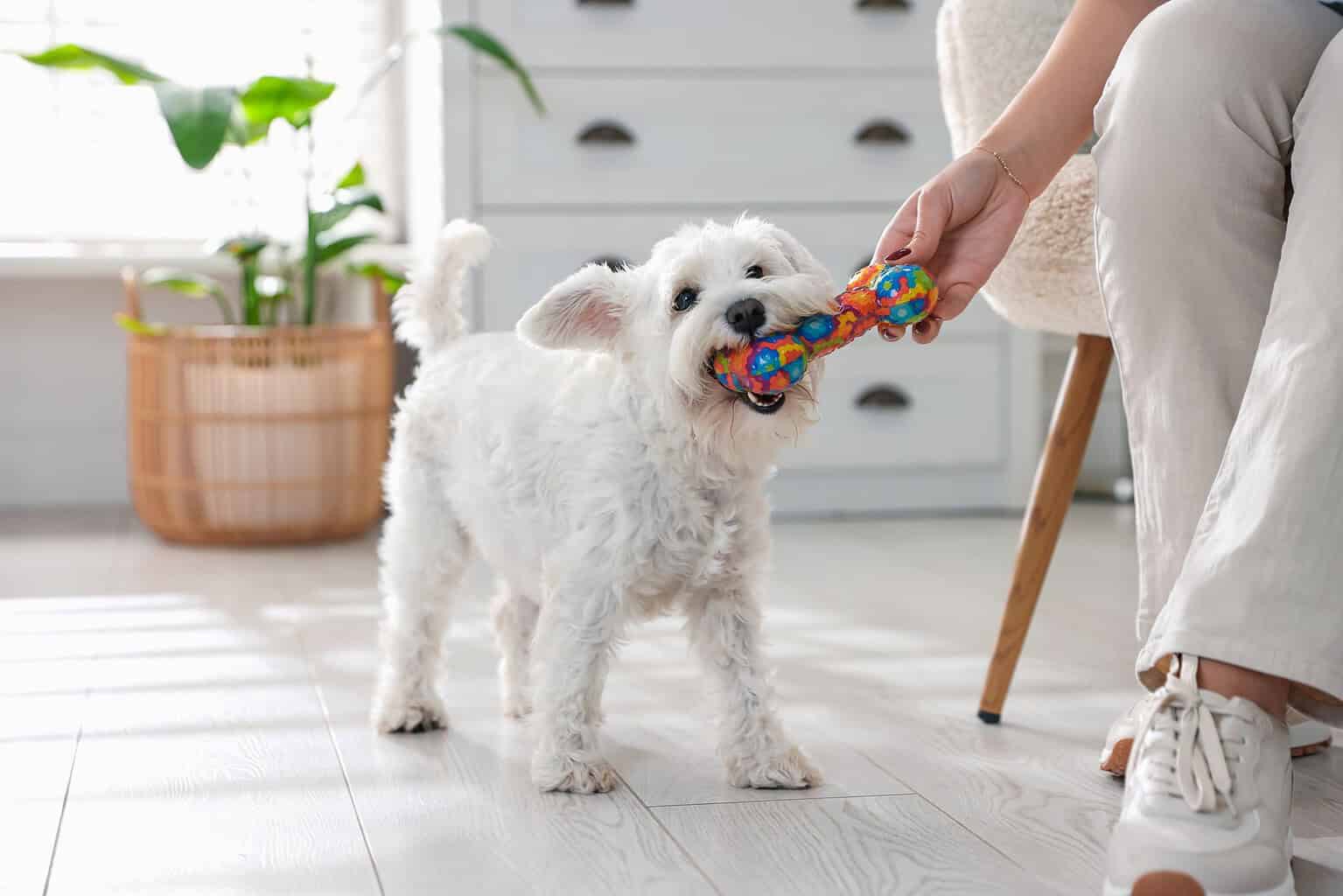
Yes, for most dogs. Tug is the most common place owners hear growling, because the game is a mock contest over a possession. Miller writes that the old advice to avoid tug because it “encourages aggression, as evidenced by the dog’s growls” is a myth, and that dog-human tug is good exercise, a strong reinforcer and a bond-builder. Faragó’s team used tug with the owner as their play context, and those were the growls people recognized 81 percent of the time.
The veterinary behaviorists at VCA agree, with a caveat. Ellen Lindell, Debra Horwitz and Gary Landsberg write that many dogs growl playfully during tug, but if there is any concern the growling is aggressive, stop tug until you have consulted a behavior professional. They suggest keeping tug gentle, taking breaks by announcing “all done,” and watching for overstimulation such as jumping up, excessive barking or nipping at your clothes.
The rules are simple. You start the game and you end it. Teeth on skin or clothing ends the round. Teach a reliable “drop it,” trading the toy for a treat at first. Use a toy long enough to keep hands and teeth apart; our roundup of the best tug toys for dogs covers sturdy options. If your puppy’s growls come with needle teeth on your fingers, see our guide to how to stop a puppy from biting.
Watch for the one tug growl that is not play. If your dog stiffens, stops pulling and stares at you while gripping the toy, or growls when you reach for a toy after the game ends, that is possessive behavior; pause the game and get help.
Let the person who finds your dog know the growl is just talk
A rowdy, growly player can scare off a well-meaning stranger. A Shiloh’s House Smart Tag is laser-engraved acrylic with a “Tap Phone Here” NFC back: a finder taps it with any modern phone and sees your live profile with call, text and directions, plus notes like “growls when playing, friendly.” About $38 one-time, no battery, no subscription, waterproof, made in the USA.
Why does my dog growl at other dogs at the dog park?
Dog-park growling comes in two flavors, and the sorting rule is the same one you use at home: watch the body, not the volume. Horowitz’s park study is a reminder that normal dog play is loud, physical and full of signals most people never notice, with hundreds of bows, chase-me invitations and play slaps mixed into the wrestling and growling.
Playful park growling looks like this: both dogs are loose, they trade roles, they pause and re-invite, and the dog that gets pinned comes back for more. Miller’s Dog A and Dog B test is the quickest check. When one dog signals discomfort, does the other ease off? If yes, let them play. If Dog A keeps pursuing a Dog B who is trying to get away, intervene before Dog B feels forced to defend itself; Dog B is not the problem even if it growls loudest.
Warning growls at the park usually come from three places: a greeting that goes on too long, which Sung notes simply means the dog wants space; guarding a ball, a stick or an owner; or a dog that does not want to be there, stiff, tucked and growling at any approach. That dog is asking to leave.
A consent test settles most arguments. Gently hold the more intense dog for a few seconds. If the other bounces right back in, it was play. If it shakes off or walks away, it was done. Well-exercised dogs arrive with less to burn off; see our guide to how often you should walk your dog.
What should I do, and not do, when my dog growls?
If the growl is play, do nothing special. Let the game continue, watch arousal and build in breaks. If the growl is a warning, stop whatever is happening and give the dog space. Haug frames growling as a clinical sign, like scratching: treat the cause, not the symptom. Identify what happened right before the growl, then change that situation.
What you must not do is punish the growl. The American Veterinary Society of Animal Behavior’s 2021 position statement recommends only reward-based methods for all dog training and behavior modification, and says aversive methods, which rely on force, pain or discomfort, should not be used. It notes that survey studies associate aversive methods with aggression toward people and other dogs, and it names choke, prong and shock collars, squirt bottles, shaker cans, shouting and alpha rolls as things to avoid.
The reason is specific to growling. Haug explains that a dog can be conditioned to skip the growl and go straight to biting, most likely when it is punished for growling while someone keeps doing the thing that worried it. Sung adds that punishing a growl can confirm to the dog that strangers are bad news. A dog that no longer growls has not stopped being afraid; it has stopped telling you.
The constructive alternative is redirection and counterconditioning. Sung suggests interrupting a warning growl with a neutral sound, asking for a known cue like “look,” and paying well, so the dog learns to check in with you when uneasy. If the growling is over toys or food, manage first: pick up chews and feed behind a gate.
It also helps to keep good notes. In the free Lohji app from Shiloh’s House, you keep a live pet profile with contacts, medical notes and voice messages that a Shiloh’s House NFC tag links to, so a sitter or finder who taps the tag reads “growls when playing tug, friendly” or “guards food” before learning it the hard way. The app also makes cartoon Lohji avatars, stickers and slideshows of your pet. Get it on the App Store or Google Play.
When should I see a vet or a behaviorist about growling?
Play growling by itself never needs a professional. Call your veterinarian when the growling is new, when a formerly easygoing dog starts growling at playmates or people, or when growling comes with avoiding touch, limping or flinching. Sung’s rule is to rule out pain first; a senior dog that growls when a puppy barrels into it deserves an exam before a training plan.
Once the dog is healthy, get help if the growling is tied to food, toys, resting spots or handling, or has ever escalated to a snap or bite. AVSAB advises that aggression, anxiety and fear need a plan with management, behavior modification and sometimes medication, and that a struggling trainer should refer to a veterinarian, a board-certified veterinary behaviorist or a certified applied animal behaviorist. Sung recommends a reward-based trainer and avoiding anyone who promises to correct the growl. Repetitive behaviors that look like play, such as spinning and growling at a tail, can have medical roots; our guide to why dogs chase their tails covers the red flags.
The tail tells the same story as the growl. Our guide to why dogs wag their tails explains how height, speed, sweep and left-right bias separate a play wag from a warning.
Frequently asked questions
Is it normal for dogs to growl when they play?
Yes. Growling is a standard part of dog play, especially tug and wrestling, because play borrows actions from fighting and hunting. Trainers call it pseudo-aggression; dogs surround the growls with play bows and loose, bouncy movement so partners know it is a game. In a 2017 study, people correctly identified 81 percent of play growls from sound alone.
How can I tell a play growl from an aggressive growl?
Look at the body first. Play growls come with a loose, wiggly body, a soft open face, play bows and turn-taking, and the quieter dog keeps coming back. Warning growls come with a stiff body, hard stare, closed mouth or curled lip, and a context such as food, a toy or handling. Research also finds warning growls are longer and more spaced out.
Should I stop playing tug if my dog growls?
Not if the growling is playful. Certified trainers and the veterinary behaviorists at VCA say many dogs growl happily during tug. Keep the game gentle, start and end it yourself, stop if teeth touch skin, and teach a reliable “drop it.” Stop tug and consult a professional if your dog stiffens, stares or growls when you reach for the toy afterward.
Why does my dog growl at other dogs at the dog park?
Often it is play: loud growls, wrestling and chasing are normal as long as both dogs stay loose, trade roles and re-engage after pauses. Warning growls usually come from a greeting that goes on too long, guarding a ball or person, or a dog that wants to leave. Hold the more intense dog briefly and see whether the other comes back.
Should I punish my dog for growling?
No. The American Veterinary Society of Animal Behavior recommends only reward-based methods and advises against aversive tools and corrections. Veterinary behaviorists warn that punishing a growl can teach a dog to skip the warning and bite without notice, while leaving the fear in place. Instead, stop what triggered the growl, give space and work on changing how your dog feels about the trigger.
When should I worry about my dog growling during play?
Worry when the growling is new, when an easygoing dog starts growling at playmates, or when the body goes stiff and the mouth closes mid-game. Sudden growling can signal pain, so see your veterinarian first. If growling is tied to toys, food or handling, or has escalated to a snap, ask for a referral to a veterinary behaviorist.
Sources
- Tamás Faragó, Nikolett Takács, Ádám Miklósi and Péter Pongrácz, “Dog growls express various contextual and affective content for human listeners”, Royal Society Open Science, 2017 — https://royalsocietypublishing.org/doi/full/10.1098/rsos.170134
- Tamás Faragó, Péter Pongrácz, Friederike Range, Zsófia Virányi and Ádám Miklósi, “‘The bone is mine’: affective and referential aspects of dog growls”, Animal Behaviour, 2010 — https://www.sciencedirect.com/science/article/pii/S0003347210000102
- Anna M. Taylor, David Reby and Karen McComb, “Context-Related Variation in the Vocal Growling Behaviour of the Domestic Dog (Canis familiaris)”, Ethology, 2009 — https://doi.org/10.1111/j.1439-0310.2009.01681.x
- Anna M. Taylor, David Reby and Karen McComb, “Size communication in domestic dog, Canis familiaris, growls”, Animal Behaviour, 2010 — https://www.sciencedirect.com/science/article/abs/pii/S0003347209005016
- Marc Bekoff, “Play Signals as Punctuation: The Structure of Social Play in Canids”, Behaviour, 1995 — https://www.wellbeingintlstudiesrepository.org/cgi/viewcontent.cgi?article=1029&context=acwp_ena
- Alexandra Horowitz, “Attention to attention in domestic dog (Canis familiaris) dyadic play”, Animal Cognition, 2009 — https://barnard.edu/sites/default/files/inline-files/Attention%20to%20Attention.pdf
- Lore I. Haug, DVM, MS, DACVB, “Growling in Dogs”, Clinician’s Brief, 2015 — https://www.cliniciansbrief.com/article/growling-dogs
- Wailani Sung, MS, PhD, DVM, DACVB, reviewed by Tiffany Tupler, DVM, CBCC-KA, “What Dog Growling Means and What To Do”, PetMD, 2025 — https://www.petmd.com/dog/behavior/why-do-dogs-growl
- Pat Miller, CBCC-KA, CPDT-KA, “Dog Growling is a Good Thing!”, Whole Dog Journal, 2016 — https://www.whole-dog-journal.com/behavior/dog-growling-is-a-good-thing/
- Ellen Lindell, VMD, DACVB, Monique Feyrecilde, Debra Horwitz, DVM, DACVB, and Gary Landsberg, DVM, DACVB, “Dog Behavior and Training: Play and Exercise”, VCA Animal Hospitals, accessed 2025 — https://vcahospitals.com/know-your-pet/dog-behavior-and-training—play-and-exercise
- Ellen Lindell, VMD, DACVB, et al., “Food Bowl Aggression in Dogs”, VCA Animal Hospitals, accessed 2025 — https://vcahospitals.com/know-your-pet/food-bowl-aggression-in-dogs
- American Veterinary Society of Animal Behavior, “Position Statement on Humane Dog Training”, AVSAB, 2021 — https://www.avsab.org/wp-content/uploads/2021/08/AVSAB-Humane-Dog-Training-Position-Statement-2021.pdf