The Best Tug Toys for Dogs (and How to Play Tug the Right Way)
 Shiloh’s House Team
·
·
17 min read
The best tug toy for most dogs is the West Paw Bumi, a stretchy, dishwasher-safe S-shaped tug that is gentle on gums and backed by a lifetime guarantee. Big, strong tuggers do better with the solid-rubber Goughnuts Tug, puppies with the KONG Wubba, and dogs who like something soft with the Tuffy Ultimate Ring. Rope toys are fine for supervised tug if you retire them the moment they fray, because swallowed strands can cause a dangerous intestinal blockage. Whatever you pick, play side to side, keep rounds short, and teach a “drop” cue before you start.
Why tug is the perfect January game
When it is dark by five and the sidewalks are salted, a lot of dogs are getting less exercise than they need. Tug is the quickest fix we know. Ten minutes of tug in the hallway works a dog’s whole body, taps into the grab-and-shake instinct that most breeds share, and, unlike fetch, does not need a long room or a yard. We use it on the nights when a proper walk is not happening, and it pairs well with the games in our guide to indoor exercise for dogs in winter.
The old warning that tug makes dogs dominant or aggressive has been tested and did not hold up. In a 2002 study in Applied Animal Behaviour Science, researchers at the University of Southampton had fourteen Golden Retrievers play twenty games of tug they were allowed to win and twenty they lost. The dogs’ confidence scores, the measure closest to what people call dominance, were unaffected by whether they won or lost, and the dogs were actually more attentive and obedient after play sessions regardless of the outcome.
A follow-up study of fifty dog-owner pairs, published in the Journal of Applied Animal Welfare Science in 2003, found the same thing: winning or losing tug and fetch had no consistent effect on the dogs. The only warning sign in that data was who started the games. Dogs that initiated most of the play were less amenable and more likely to show aggression, which is why every trainer we read says the human should start and end the game.
How we chose these tug toys
We looked for toys that do three things well. First, they give you a safe hold, with enough length or a dedicated handle that a dog re-gripping mid-game cannot catch your fingers. The AKC’s expert on tug, trainer Dianna L. Santos, makes exactly this point: pick something with some length to it, in a material that is easy on teeth and gums. Second, they survive real tugging. Third, they do not shed pieces a dog can swallow.
That last point is why rope toys sit near the bottom of this list. The Spruce Pets left rope out of its tug roundup entirely because veterinarians recommend avoiding it, and when Canine Journal tested more than two dozen tug toys, every knotted rope frayed. We still include one rope pick, because many dogs love the texture and the price is hard to beat, but only with rules attached.
West Paw Bumi Best overall
The Bumi is an S-shaped tug made from West Paw’s Zogoflex, a soft, pliable material that stretches to twice its length when you and your dog pull in opposite directions. That stretch is the whole point. It absorbs the head-shaking that makes most tug games hard on your shoulder, and it gives smaller dogs a fighting chance against a human. Each end is a loop, so your hand stays well clear of the teeth.
It comes in two sizes, 8 inches and 9.5 inches, floats, goes in the dishwasher, and is made in Bozeman, Montana, with a “Love It” guarantee that replaces the toy if your dog ruins it. Both The Spruce Pets and Canine Journal picked it as their favorite tug toy, and the stretchy version was the one our small-dog friends kept coming back to. The one caveat is that West Paw labels it for gentle chewers: it is a tug toy for games with you, not a chew to leave on the floor. Expect to pay about $18.
Buy this one if you have a small-to-medium dog, or any dog that shakes hard mid-tug, and you want a toy that is easy on their mouth and your arm.
Goughnuts Tug Best for big, strong dogs
If your dog is the kind that drags you across the kitchen, you want the Goughnuts Tug. It is two thick rings of solid natural rubber fused into a figure eight, designed by a rubber chemist and made in Modesto, California. There are no seams, no stitching and no weak points, and the 1.4-inch cross-section is wide enough that a big dog cannot fully close its bite on it. You hold one ring, your dog takes the other, and your fingers stay a safe distance from the action.
In Canine Journal’s testing it was the only tug toy the reviewers felt confident would hold up to a German Shepherd or a Pit Bull, and The Spruce Pets found hardly any wear after sessions with an energetic eleven-month-old Golden Retriever. Goughnuts covers it with a lifetime guarantee. Two things to know: it is heavy and too thick for small dogs, and Goughnuts says plainly that the tug is for supervised play, not for chewing. The medium fits dogs of 30 to 70 pounds for about $28; the large MaXX fits 60 to 120 pounds for about $40.
Buy this one if your dog has destroyed every “indestructible” toy you have owned and you want a tug that is built like a tire.
KONG Wubba Best for puppies
The Wubba is a tennis-ball-sized squeaker wrapped in reinforced nylon with a cluster of long, floppy tails hanging off the back. Puppies grab the tails, you hold the ball end, and you can keep the pull as light as you like, which is exactly what you want with a dog whose adult teeth are still coming in. It is light enough to toss down a hallway for a round of fetch between tugs, and the squeak keeps a distracted puppy interested.
KONG makes it in small for dogs up to 20 pounds, large for 30 to 65 pounds and extra-large for 60 to 90 pounds, plus a puppy version, usually for $10 to $13. The Spruce Pets named it the best tug toy for puppies and we agree, with the same warning they give: it is not a chew toy. The nylon tails will unravel if a dog is left to work on them alone, so it lives in the toy drawer between games.
Buy this one if you are starting tug with a puppy or a soft-mouthed small dog and you want something that doubles as a fetch toy.
Tuffy Ultimate Ring Best soft tug
Some dogs refuse to put their mouth on rubber. For them, the Tuffy Ultimate Ring is the toughest soft option we have found. It is a fabric ring built from four layers, an outer layer of fleece over industrial luggage material and a plastic-coated layer, cross-stitched with up to seven rows of thread and finished with webbing around the edges. Tuffy rates it a 9 out of 10 on its own durability scale, and the four squeakers sit in sewn-in safety pockets so a dog that gets through the fabric cannot swallow one straight away.
The regular ring is 11 inches across, which keeps your hand away from the teeth and leaves room for two dogs to tug together; the junior size is 7 inches. It floats, it goes in the washing machine, and it costs about $15 to $18. Like every soft toy, it is for interactive play only; Tuffy says to pull it if a dog reaches the white core.
Buy this one if your dog likes plush and fabric textures but shreds ordinary stuffed toys, or you have two dogs that like to tug with each other.
Mammoth Flossy Chews 3-Knot Best rope, with rules
If your dog is a rope dog, this is the rope to buy. Mammoth has made these cotton-blend knotted tugs since 1995, and in Canine Journal’s test of more than fifty rope toys the 3-Knot was the only classic rope that stayed intact through weeks of tug sessions with Labradors and power-chewing mixes, showing only light fuzzing where cheaper ropes split. It comes in five lengths, from a 10-inch mini to a 36-inch extra-large, so you can match the rope to the dog and keep your hands clear, and most sizes cost between $6 and $12.
Now the rules. A rope is a tug toy, not a chew toy, so it comes out for the game and goes away afterwards. Check it before every session and throw it out as soon as strands start to pull loose. Watch your dog’s gums the first few times; coarse cotton can rub sore spots on dogs with sensitive mouths. And if the rope ever goes missing, do not wait and see. Loose fibers are the exact thing the surgeons quoted above are describing.
Skip this one if your dog shreds and swallows fabric or you cannot supervise every tug session. Pick the Bumi or the Goughnuts instead.
Outward Hound Invincibles Snake Best for squeaker fans
The Invincibles Snake is a long, flat fabric snake with no stuffing, two layers of tough fabric, reinforced seams and a row of squeakers that keep squeaking even after they are punctured. The length is what makes it a good tug toy: the large is just over two feet long with three squeakers, the extra-large is 40 inches with six, and the “ginormous” is almost six feet with a dozen, so there is always a stretch of snake between your hand and the teeth.
Because there is no stuffing, a dog that chews through the fabric does not leave a snowdrift of fluff on the rug, which is the usual end of a plush toy. It will not survive a determined shredder, and The Spruce Pets notes that some owners with powerful dogs have torn theirs apart, so treat it as a supervised tug and squeak toy rather than a chew. Prices run about $12 to $25 depending on size.
Buy this one if your dog is squeaker-obsessed and plays rough with soft toys but does not try to eat them.
Tug toys compared
| Toy | Best for | Material | Sizes | Approx. price |
|---|---|---|---|---|
| West Paw Bumi | Most dogs, small to medium | Zogoflex (stretchy, dishwasher safe) | 8 in, 9.5 in | $18 |
| Goughnuts Tug | Big, powerful tuggers | Solid natural rubber | Medium 30–70 lb, MaXX 60–120 lb | $28–$40 |
| KONG Wubba | Puppies, tug-and-fetch | Reinforced nylon over a squeaker ball | Puppy, S, L, XL | $10–$13 |
| Tuffy Ultimate Ring | Soft-toy dogs, two-dog tug | 4-layer fabric, squeakers in pockets | 7 in, 11 in | $15–$18 |
| Mammoth Flossy Chews 3-Knot | Rope lovers, supervised only | Cotton-blend rope | 10 in to 36 in | $6–$12 |
| Outward Hound Invincibles Snake | Squeaker fans | Two-layer fabric, no stuffing | 24.5 in, 40 in, 70 in | $12–$25 |
How to play tug the right way
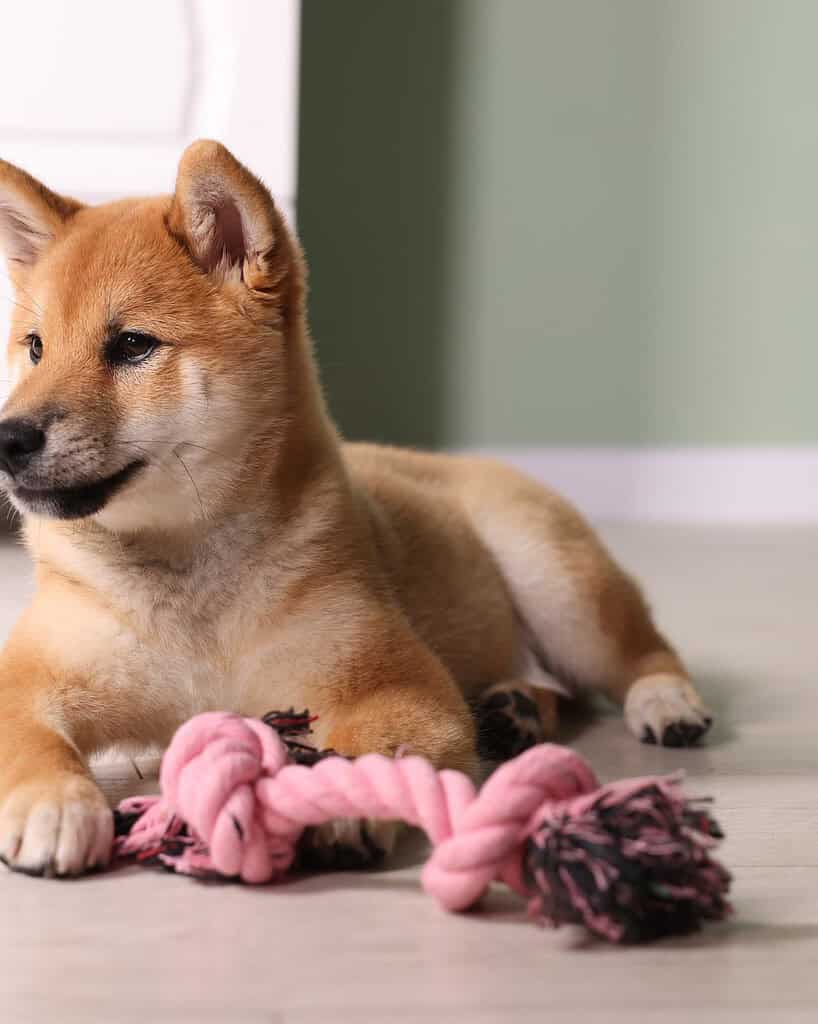
A good tug toy is only half of it. The trainers and vets we read all describe the same handful of habits, and they matter more in winter, when the game is happening on a hallway floor instead of a lawn. Start with the direction of the pull. Preventive Vet’s trainer Cathy Madson is blunt about this: tug side to side only, never up and down, and never lift the toy high enough that your dog is hanging from it, because that is how necks and spines get hurt. Dr. Erica Boling, a certified canine fitness trainer quoted by the AKC, puts it as “neutral spine”: keep your dog’s feet on the ground and its head and back in a straight line, and let the dog do most of the pulling while you mostly hold on.
Match the pressure to the dog. With a puppy, a senior or a small dog you should barely feel like you are tugging at all. Boling says she only uses light resistance with young puppies and older dogs, and Madson adds a step most people skip: before tug with a puppy, look in its mouth for loose teeth, since a wobbly canine tooth can be yanked out before it is ready and turn the dog off the game for good. Pat Miller, writing in Whole Dog Journal, draws the same line between healthy adults, who can tug hard, and pups and seniors, who cannot.
Keep rounds short. Santos recommends tug bursts of ten to fifteen seconds, two or three per session, in a rhythm she describes as tug, trade, tug, win, tug, trade. Then cap the session by asking for something that makes the dog think, a sit or a down or a hand touch, reward it, and put the toy away. She calls this interval training: you let the dog get wound up and then bring it back down, which is a skill every dog needs in daily life. A pocket of training treats makes the trade easy.
Teach two cues before the first real game. One starts it, something like “take it,” and one ends it, “drop” or “out.” The Nebraska Humane Society suggests teaching the release on several different objects before you ever bring out the tug toy, so you are not trying to train it in the middle of the most exciting thing in the dog’s week. Blue Cross describes the simplest way to build a drop: after about thirty seconds of tug, freeze. Hold the toy still against your body and say nothing. The moment your dog lets go, say “yes” and immediately start the game again. The dog learns that a still toy is boring and that releasing it is what restarts the fun. Once that is reliable, add the word.
Make the rules yours. You start the game and you end it, and the toy lives out of reach in between, which is the Nebraska Humane Society’s first rule and one Madson repeats. Teeth on skin or clothing pauses the game instantly, even by accident, and if it happens two or three times in a row the game is over for the day. If your dog runs off with the toy, do not chase; Boling warns that chasing teaches the dog to keep away from you, and the game simply stops until the toy comes back. Dogs that get over-aroused and jump or grab can play through a baby gate or exercise pen, Miller suggests, so there is a barrier between the two of you while the dog learns the rules.
And let your dog win. This is the part the old advice got backwards. Blue Cross says to let your dog win the toy regularly, because a dog that never wins loses interest in playing with you. Santos’s version, “shared holding,” is the one we like best: letting the dog win means it gets to celebrate with its prize, and then it gets to choose to bring the toy back for more. If you are waiting with a happy voice and another round, most dogs will.
Does letting your dog win make them dominant?
No. The Southampton researchers set out to test this exact claim, which was common in training books of the 1990s, and found no support for it. Fourteen retrievers, forty tug sessions each, and the dogs that won were no more “dominant” afterwards than when they lost. What changed was attention: the dogs were more obedient and attentive after playing, win or lose, and the most playful dogs were keener to engage with their human after a win.
The 2003 follow-up with fifty pet dogs found the same lack of effect from winning or losing, and added the useful detail that dogs who played tug and fetch scored high on “confident interactivity,” which is a good thing. The only pattern tied to aggression was dogs starting most of the games themselves, which is a reason to control the start of the game, not to avoid it.
I love the description of ‘shared holding’ when it comes to tug. Allowing a dog to win means they can celebrate with their prize, but it also presents them with a wonderful opportunity: to choose to bring the toy back to you on their own.
Dianna L. Santos, KPA-CTP, CPDT-KA, Dog Sport University, quoted by the American Kennel Club
When to skip tug
Tug is not for every dog. Madson’s list of dogs who should not play it is short and clear: a dog that is already aggressive, a dog that guards food or toys, or a dog showing early signs of either. Tug will not create those problems, but it can intensify a pattern that is already there. Dogs with neck or back trouble are the other group. Madson specifically names intervertebral disc disease and arthritis, and Boling notes that dogs in hard-impact sports can have neck and spine issues nobody has noticed, because dogs hide pain well. If your dog has ever had a sore neck, is limping, or is on joint supplements for a reason, ask your vet before you start.
Children and tug need a referee. Miller’s rule is that kids only play tug, under direct supervision, with a dog that already knows and respects the rules, and that nobody who will not follow your rules gets to tug with your dog at all. If the game is too much for your household right now, the same energy can go into a puzzle toy or a snuffle mat, which we cover in our best dog toys guide.
Not tagged yet?
The best tug session of the week is also the one where a dog bolts out a door someone left open. A Shiloh’s House smart tag puts your phone number and your dog’s profile one tap away for whoever finds them, with your number laser-engraved on the back as a backup. No battery, no subscription, and the finder does not need an app.
Tug is only half of most dogs’ toy box. For solo chewing between games, see our guide to the best dog chew toys, including which chews vets say are too hard for teeth.
Frequently asked questions
Is tug of war bad for dogs?
Not when it is played with rules. Two University of Southampton studies found that winning or losing tug had no effect on dominance-related behavior, and the AKC, Preventive Vet, Blue Cross and Whole Dog Journal all recommend it as exercise and training. Play side to side, keep rounds short, teach a drop cue, and skip it for dogs with neck or back problems or existing aggression.
Should I let my dog win at tug of war?
Yes, regularly. Blue Cross notes that a dog that never wins loses interest in playing with you, and the research found no downside to letting dogs win. Let your dog take the toy, celebrate, and then invite it back for another round.
Are rope toys safe for dogs?
For supervised tug, with care. Strands that pull loose and get swallowed can cause a linear foreign body, which veterinary surgeons say often needs surgery. Only use rope during games you are part of, check it for fraying before each session, replace it as soon as it starts to unravel, and never leave it with a dog that shreds and swallows fabric.
Can puppies play tug?
Gently. Use very light resistance, keep the pull level with the floor, and check for loose baby teeth first; pulling on a wobbly tooth can hurt and put a puppy off the game. A soft, light toy like the KONG Wubba is a good first tug toy. If your puppy is grabbing hands instead of toys, see our guide to stopping puppy biting.
How long should a game of tug last?
Trainer Dianna L. Santos recommends bursts of ten to fifteen seconds, two or three per session, ending with a calm cue such as a sit and a treat before the toy is put away. Several short sessions a day beat one long one, especially for puppies and seniors.
What is the most durable tug toy?
For big, powerful dogs, the Goughnuts Tug. It is solid natural rubber with no seams or weak points, and it was the one tug toy in Canine Journal’s testing that held up to rough play with large breeds. It is also guaranteed for life. It is too heavy for small dogs, who do better with the West Paw Bumi.
Sources
- Rooney NJ, Bradshaw JWS. An experimental study of the effects of play upon the dog–human relationship. Applied Animal Behaviour Science, 2002;75(2):161–176
- Rooney NJ, Bradshaw JWS. Links between play and dominance and attachment dimensions of dog-human relationships. Journal of Applied Animal Welfare Science, 2003
- American Kennel Club — Should You Play Tug-of-War With Your Dog? (Gemma Johnstone, with Dianna L. Santos and Dr. Erica C. Boling)
- Preventive Vet — Play Tug of War Without Encouraging Aggression (Cathy Madson, CBCC-KA, CPDT-KA)
- Whole Dog Journal — Eight Rules for Playing Tug of War With Your Dog (Pat Miller, CBCC-KA, CPDT-KA)
- Blue Cross — How to Play with Your Dog
- Nebraska Humane Society — Tug-of-War
- Texas A&M School of Veterinary Medicine — Tips for Buying Dog Toys (Dr. Mark Stickney)
- American College of Veterinary Surgeons — Gastrointestinal Foreign Bodies
- American Kennel Club — Intestinal Blockage in Dogs (Caroline Coile, PhD, with Dr. Jerry Klein)
- The Spruce Pets — The Best Dog Tug Toys, Tested (Mary Jo DiLonardo)
- Canine Journal — Best Tug Toys To Play Tug-Of-War With Your Dog (28+ Tested)
- Canine Journal — Best Rope Toys For Dogs (50+ Tested)
- West Paw — Bumi Tug Toy
- Goughnuts — Tugs
- KONG Company — Wubba
- Tuffy — Ultimate Ring