Why Does My Dog Hide? Fear, Noise, Pain and What to Do About It
 Shiloh’s House Team
·
·
17 min read

Dogs hide for four main reasons: fear (thunder, fireworks, the doorbell, visitors), pain or illness, a simple wish for a quiet den, or stress from a change at home. The big surveys say fear is the most common driver, with roughly a third of dogs afraid of at least one loud noise. The rule that matters most is this: a dog that has suddenly started hiding, especially alongside a lost appetite, limping, lethargy or flinching when touched, needs a veterinarian, not a wait-and-see.
Last updated: September 2025
Why do dogs hide in the first place?
Hiding is what a dog does when it wants distance from something, and the “something” can be a sound, a stranger, a sore hip, a houseful of guests or nothing beyond a preference for a snug, dark spot. Veterinary behaviorists at VCA Animal Hospitals list “attempt to hide or flee” among the classic signs of fear in dogs, alongside pacing, freezing, tucking the tail and lip licking. So the real question is never “why is my dog hiding” but “what is my dog hiding from, and is this new?”
The numbers set expectations. In the 2020 University of Helsinki study of 13,715 dogs across 264 breeds, 32% were highly fearful of at least one noise and 29% showed fear of strangers, other dogs or new situations.
Pain is the reason owners miss. In a 2020 paper in the journal Animals, Daniel Mills and colleagues reviewed the last 100 dog cases from each of six behavior referral clinics and found a painful condition was suspected in 28% to 82% of them. Their advice was blunt: treat suspected pain first. That is why this guide sorts hiding by pattern. A dog that vanishes only when the sky rumbles is telling you something different from a dog that has quietly moved into the closet this week.

Is my dog hiding because of noise or fear?
If the hiding lines up with a trigger you can name, fear is the likely answer, and noise is the most common fear by a wide margin. In the 2013 University of Bristol study by Emily Blackwell, John Bradshaw and Rachel Casey, 25% of 3,897 owners surveyed by post said their dog was “fearful” of noises. But when the researchers interviewed 383 of those owners about specific behaviors, 49% described at least one fear sign during loud noises, and the university’s release names hiding among the most commonly reported signs. Half the dogs showing fear had owners who did not call it fear, and fewer than a third had asked anyone for help.
The fears cluster. Katriina Tiira, Sini Sulkama and Hannes Lohi, in a 2016 study of 3,284 dogs, found that 93% of dogs afraid of thunder also feared fireworks, and put the median onset of noise fear at 2 years with a range from 8 weeks to 10 years. One bad Fourth of July can start it in an adult dog; our piece on why so many pets go missing around July 5th explains what happens when that fear meets an open gate.
Fear of people is the other big category. VCA’s behaviorists Ellen Lindell, Kenneth Martin, Debra Horwitz and Gary Landsberg describe a dog meeting a stranger who may “cower, roll onto her back, look away, tuck her tail, lick her lips, tremble, pant, or try to hide behind you.” Our guide to Halloween doorbell anxiety in dogs covers the setup that keeps a hider from becoming a bolter.
Here is how the major studies compare. All relied on owner questionnaires, so the percentages describe what owners noticed, not diagnoses.
| Study | Sample | Key figures |
|---|---|---|
| Blackwell, Bradshaw and Casey, 2013 | 3,897 UK owners by post; 383 interviewed | 25% called their dog fearful of noises; 49% of interviewed owners reported a fear sign; under a third sought advice |
| Tiira, Sulkama and Lohi, 2016 | 3,284 Finnish dogs, 192 breeds | 39.2% noise sensitivity; 26.2% fearfulness; 17.2% separation anxiety; median onset 2 years |
| Salonen et al., 2020 | 13,715 Finnish dogs, 264 breeds | 32% noise sensitivity (26% fireworks, 17% thunder, 13% gunshot); 29% fear |
| Mills et al., 2020 | 100 recent dog cases from each of 6 referral clinics | Pain suspected in 28% to 82% of cases |
| Dreschel, 2010 | Owners of 721 deceased dogs | Fear of strangers linked to a significantly shorter lifespan (correlational) |
VCA warns that noise aversions “frequently worsen when left untreated,” so a hiding dog’s fear is a welfare issue, not a quirk.
Could my dog be hiding because of pain or illness?
Yes, and this is the reason to rule out first. VCA’s behaviorists put it plainly: “Medical conditions such as pain (i.e., ear infection or arthritis) can also contribute to noise sensitivity in dogs,” and they recommend that any dog eight or older who develops a new fear of noises be examined for a medical condition. Even hiding that looks like a textbook storm fear can have a sore joint or a painful ear underneath it.
A dog whose hips ache after a long walk goes somewhere it will not be bumped or invited to play. A dog with an ear infection may hide from the vacuum it used to ignore because the sound now hurts. The hiding is the dog’s solution to a problem you cannot see.
VCA’s handout on fears and phobias says that if a fear “is extreme or has started recently, it is important to consult with your veterinarian,” because an exam and lab work will uncover conditions “that could cause or contribute to the fear.” If the hiding came with a change in eating, read our guide on why a dog stops eating and call the clinic the same day.
How can I tell fear-hiding from pain-hiding?
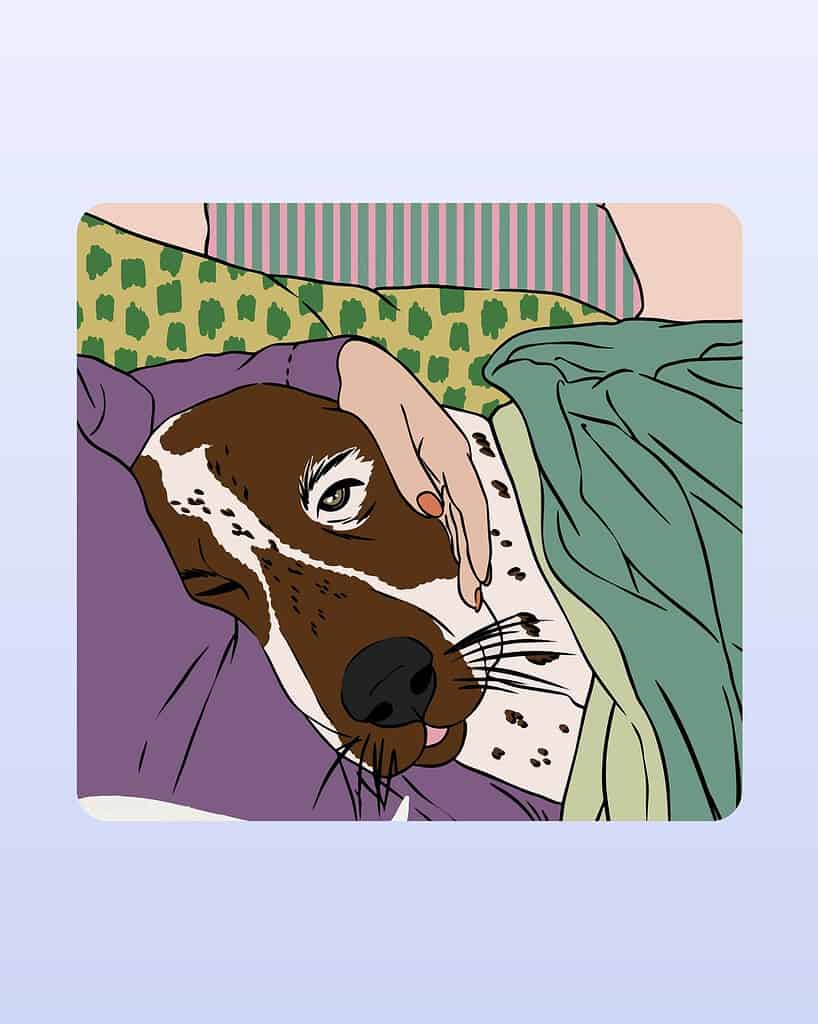
Start with timing, because timing is the clearest tell you have. Fear-hiding has a trigger and a release. The dog disappears when the first firework pops or the doorbell rings, and it reappears within minutes to an hour after the trigger stops, often asking for dinner as if nothing happened. Pain-hiding has no trigger you can point to. It creeps in over days or weeks, tends to be worse at predictable times such as first thing in the morning or after a long walk, and the dog does not bounce back when the house goes quiet. If you cannot name what your dog is hiding from, treat that as a clue in itself.
Next, look at the body in the hiding spot. A frightened dog is tense and busy. It pants with a tight mouth, trembles, flattens its ears, tucks its tail, licks its lips and scans the room with wide eyes. It may refuse a treat it would normally take, which the VCA behaviorists call a sign the dog is too afraid to eat. A dog in pain is more often still and dull. It lies in an odd position, shifts its weight off one leg, holds its head low or arches its back, and may pant at rest without trembling. It will often accept a treat, then go back to lying down. Touch is the other difference: a fearful dog usually relaxes once the trigger passes and you stroke it, while a painful dog may stiffen, flinch or growl when you reach for a hip, an ear or its belly.
Then count the other signs. Fear tends to travel alone. Outside the scary moment, the dog eats, plays, climbs stairs and greets you at the door as it always has. Pain and illness travel in a group. The classic companions are a smaller appetite, slower stairs, hesitation before jumping, a stiff gait that loosens after a few minutes, licking one paw or joint, sleeping more, and a new dislike of being brushed or picked up. One of those alongside new hiding is enough to make the call. Two or three means do not wait for the weekend.
Age shifts the odds. A young adult that starts hiding during storms is most likely showing the noise fear that the Finnish surveys say typically begins around two years old. A dog past eight that starts hiding for the first time is a different animal, because arthritis, dental disease, ear infections, failing hearing or sight and cognitive decline all become common at that age. In an older dog, assume a medical cause until a vet says otherwise.
Finally, know what the clinic will do. The veterinarian will take a history, so write down when the hiding started, where the dog goes, what else changed in the house and any of the signs above. Bring a short video of the dog getting up from rest and walking, since many dogs stop limping the moment they enter an exam room. The exam covers flexing each joint, pressing along the spine, looking in the ears and mouth, feeling the belly and checking the eyes, and the vet may suggest blood work, X-rays or a two-week trial of pain medication to see whether the hiding stops. If everything comes back clean, you have your answer: this is fear or stress, and the plan moves to behavior work. If something is found, you caught it early, which is the whole point.
Does my dog just want a den?
Sometimes the answer is boring. VCA’s crate-training guide by Debra Horwitz and Gary Landsberg observes that “most dogs quickly choose a small area, such as a corner of a room, in a dog bed, or on or under a couch, where they go to relax.” A dog that naps under the dining table every afternoon, comes out wagging when called and eats well is not hiding. It has a den, and the kindest thing you can do is leave it alone there.
The den instinct is also your best tool for a dog that hides from fear. The VCA behaviorists recommend creating “a haven where your dog can go when afraid,” ideally an interior room away from windows, with treats given there when the dog is calm. Christine Calder, a board-certified veterinary behaviorist writing for the Veterinary Information Network, puts it directly.
“The first step in managing and treating all types of noise phobia in dogs is to give them a safe place to hide. This safe haven can be a windowless basement, closet, crate, or bathroom.”
Christine Calder, DVM, DACVB (Veterinary Partner, VIN, 2021)
One caution: VCA’s storm-and-fireworks handout warns that “many dogs panic and could seriously injure themselves if confined during loud noises,” so if you cannot watch the dog, leave the crate open. A draped bed in a quiet corner often works better; our roundup of the best dog beds includes the covered styles hiders pick.
A frightened dog hides first and runs second
A Shiloh’s House Smart Tag is laser-engraved acrylic with a “Tap Phone Here” NFC back. A finder taps it with any modern phone, no app needed, and sees your contacts with one-tap call and text, your dog’s behavior notes and the reward you are offering, so a shy dog that slipped the gate during a storm gets home the same night. About $38 one-time, no subscription, no battery, waterproof, made in the USA, 30-day returns.
Is a change at home making my dog hide?
Dogs are creatures of routine, and a change you barely noticed can be the whole story. A move, a new baby, a new puppy or cat, a renovation, a schedule that shifted when school started: any of these can send a dog under the bed for a stretch. The VCA behaviorists note that fear responses “can occur from just one exposure to a trigger or may gradually increase with continued exposures.”
The pattern is that the hiding tracks the change and eases as the dog adjusts, usually within a couple of weeks if you help. Keep walks, meals and bedtime on their old clock. Give the dog a room or bed that guests and toddlers do not enter. Let it retreat from visitors rather than pulling it out to say hello; VCA warns that “fear-based responses can escalate quickly if dogs do not experience relief.” Stress also compounds: the Tiira study found that among dogs fearful of strangers and new situations, 56% also feared loud noises, against 29% of non-fearful dogs. A nervous dog reacts harder to change.
Is my senior dog hiding because of cognitive decline?
If your dog is past eight and the hiding is new, two things are on the table besides pain. The first is sensory change: VCA’s behaviorists note that senior dogs “may experience partial hearing loss that can change their perception of sounds and contribute to a fear response,” and a dog losing its sight may retreat because the house has become confusing after dark.
The second is canine cognitive dysfunction, the dog version of age-related dementia. Hannah Salvin and colleagues at the University of Sydney surveyed the owners of 497 dogs aged eight to nearly twenty in 2010 and estimated that 14.2% met criteria for cognitive dysfunction, while only 1.9% had ever been diagnosed. Lynne Seibert, a board-certified veterinary behaviorist writing in Today’s Veterinary Practice, summarizes the signs as DISHA: disorientation, changes in social interaction, altered sleep-wake cycles, house soiling and changes in activity, with anxiety common. A senior dog that hides in odd places, paces at night and avoids the family is showing several at once.
Cognitive dysfunction is a diagnosis of exclusion, so the veterinarian rules out pain, organ disease and sensory loss first. Seibert’s point that it is underdiagnosed because caregivers “may assume behavior changes are a result of normal aging” is the lesson. An old dog that has taken to hiding is not just old. Book the exam and ask about pain, hearing, vision and cognition.
What should I do when my dog hides?
Match the response to the pattern. This table is our suggestion, built from the VCA, Riemer and Mills sources above; the urgency column is our own call, and a phone call to your clinic costs nothing.
| Hiding pattern | Likely cause | What to do | Urgency (our suggestion) |
|---|---|---|---|
| Naps under a bed or table daily, comes out happily, eats and plays normally | Den preference | Leave the dog alone there; keep children out of the spot | None |
| Hides only during storms, fireworks or loud events, recovers within an hour | Noise fear | Haven away from windows; white noise; treats during the noise if the dog will eat; counterconditioning off-season; ask about event medication | Low to medium; vet if the dog injures itself or tries to escape |
| Hides when visitors or strangers arrive | Social fear | Let the dog retreat; never force greetings | Low; behaviorist if growling appears |
| Began after a move, new baby, new pet or schedule change | Stress from change | Hold routine steady; guest-free room; patience | Medium; vet if no better in two weeks |
| New hiding with no clear trigger plus reduced appetite, stiffness, limping, lethargy or flinching | Pain or illness | Book an exam; bring a video of the dog walking | High; within 24 to 48 hours |
| Sudden hiding with vomiting, a hard belly, labored breathing, pale gums or collapse | Emergency | Emergency clinic now | Immediate |
| Dog over 8 hiding in odd places, confused, pacing at night | Pain, sensory loss or cognitive decline | Full senior exam; ask about cognitive dysfunction | Medium to high; within the week |
For the fear cases, the evidence on what works is better than most owners realize. In Stefanie Riemer’s 2020 survey of 1,225 owners, the strategies rated most effective were counterconditioning, meaning treats or play right after each bang (70.8%), relaxation training (69.3%) and prescription medication (68.9%). Pressure vests landed at 44%. Pheromones, herbal, nutraceutical and homeopathic products sat between 27% and 35%, which Riemer notes is no better than a placebo effect. Our guide to the best dog calming aids is honest about which have evidence. For predictable nights, have the haven ready before dark, check the gates, and give any medication before the noise starts.
Write the fear down where a stranger can read it. In the free Lohji app from Shiloh’s House, your dog’s Smart Tag profile has a behavioral notes field where you can enter “shy, hides when scared, do not chase,” plus up to three voice messages a finder can play. Frightened dogs bolt, and a chased dog runs farther, so the note matters as much as the phone number. Get the Lohji app on the App Store or Google Play; the Smart Tag profile is always free. If a cat has also gone under the bed, our piece on why cats hide explains how the feline version differs.
Frequently asked questions
Why does my dog suddenly hide under the bed?
Sudden hiding usually means a new fear trigger such as fireworks, a storm or a houseguest, or a medical problem such as pain, an ear infection or nausea. If you can name the trigger and the dog recovers quickly, it is fear. If you cannot, or if appetite, movement or energy has also changed, book a veterinary exam within a day or two.
Is hiding a sign my dog is sick?
It can be. Dogs withdraw when they hurt, and the 2020 Mills review found a painful condition suspected in 28% to 82% of dogs referred for behavior problems. Hiding alongside reduced appetite, limping, stiffness, lethargy or flinching when touched calls for a veterinarian, and hiding with vomiting, a hard belly or trouble breathing is an emergency.
Should I pull my dog out of its hiding spot?
No. Veterinary behaviorists advise letting a frightened dog retreat, because blocking escape is how hiding escalates into growling. Make the spot safe, keep children away, and offer a treat or quiet company only if the dog wants it. The exception is a dog that needs emergency care; then move it gently in a blanket.
How do I help a dog that hides during thunderstorms or fireworks?
Give the dog a haven in an interior room with white noise and closed blinds, and reward it there on calm days. During the noise, offer treats or play if the dog will take them. Between seasons, work on counterconditioning with recordings at low volume, and ask your veterinarian about event medication, which owners in a 2020 survey rated effective 69% of the time.
Why is my old dog hiding more than it used to?
In dogs past eight, new hiding often points to arthritis or other pain, hearing or vision loss, or cognitive dysfunction. A 2010 survey estimated 14.2% of dogs over eight met criteria for cognitive dysfunction while only 1.9% had been diagnosed. Ask for a full senior exam covering joints, ears, eyes, blood work and cognition before assuming it is just age.
Do calming products stop a dog from hiding?
Only some. In a 2020 survey of 1,225 owners, counterconditioning, relaxation training and prescription medication were rated effective 69% to 71% of the time, pressure vests 44%, and pheromones, herbal and homeopathic products 27% to 35%, which is placebo territory. A safe haven, training and a veterinary plan do the real work.
Sources
- Milla Salonen, Sini Sulkama, Salla Mikkola, Jenni Puurunen, Emma Hakanen, Katriina Tiira, César Araujo and Hannes Lohi, “Prevalence, comorbidity, and breed differences in canine anxiety in 13,700 Finnish pet dogs”, Scientific Reports, 2020 — https://www.nature.com/articles/s41598-020-59837-z
- Emily J. Blackwell, John W. S. Bradshaw and Rachel A. Casey, “Fear responses to noises in domestic dogs: Prevalence, risk factors and co-occurrence with other fear related behaviour”, Applied Animal Behaviour Science, 2013 — https://research-information.bris.ac.uk/en/publications/fear-responses-to-noises-in-domestic-dogs-prevalence-risk-factors/
- University of Bristol, “Fear of noises in dogs is a common problem, study finds” (press release), 2013 — https://www.bristol.ac.uk/news/2013/9152.html
- Katriina Tiira, Sini Sulkama and Hannes Lohi, “Prevalence, comorbidity, and behavioral variation in canine anxiety”, Journal of Veterinary Behavior, 2016 — https://www.sciencedirect.com/science/article/pii/S1558787816300569
- Nancy A. Dreschel, “The effects of fear and anxiety on health and lifespan in pet dogs”, Applied Animal Behaviour Science, 2010 — https://www.sciencedirect.com/science/article/pii/S0168159110001243
- Daniel S. Mills, Isabelle Demontigny-Bédard, Margaret Gruen, Mary P. Klinck, Kevin J. McPeake et al., “Pain and Problem Behavior in Cats and Dogs”, Animals, 2020 — https://pmc.ncbi.nlm.nih.gov/articles/PMC7071134/
- Stefanie Riemer, “Effectiveness of treatments for firework fears in dogs”, Journal of Veterinary Behavior, 2020 — https://www.sciencedirect.com/science/article/pii/S155878782030037X
- Lynne Seibert, DVM, MS, PhD, DACVB, “Management of Dogs and Cats With Cognitive Dysfunction”, Today’s Veterinary Practice, 2017 — https://todaysveterinarypractice.com/neurology/management-of-dogs-and-cats-with-cognitive-dysfunction/
- Ellen Lindell, VMD, DACVB; Kenneth Martin, DVM, DACVB; Debra Horwitz, DVM, DACVB; Gary Landsberg, DVM, DACVB, DECAWBM, “Fear of Noises in Dogs”, VCA Animal Hospitals, accessed 2025 — https://vcahospitals.com/know-your-pet/fear-of-noises-and-places-in-dogs
- Ellen Lindell, VMD, DACVB; Kenneth Martin, DVM, DACVB; Debra Horwitz, DVM, DACVB; Gary Landsberg, DVM, DACVB, DECAWBM, “Fears, Phobias, and Anxiety in Cats and Dogs”, VCA Animal Hospitals, accessed 2025 — https://vcahospitals.com/know-your-pet/fears-phobias-and-anxiety
- Ellen Lindell, VMD, DACVB; Kenneth Martin, DVM, DACVB; Debra Horwitz, DVM, DACVB; Gary Landsberg, DVM, DACVB, DECAWBM, “Fears and Phobias in Dogs – Animals and People”, VCA Animal Hospitals, accessed 2025 — https://vcahospitals.com/know-your-pet/fears-and-phobias-in-dogs—animals-and-people
- Ellen Lindell, VMD, DACVB; Debra Horwitz, DVM, DACVB; Gary Landsberg, DVM, DACVB, DECAWBM, “Treating Fear of Storms and Fireworks in Dogs”, VCA Animal Hospitals, accessed 2025 — https://vcahospitals.com/know-your-pet/treating-fear-of-storms-and-fireworks-in-dogs
- Debra Horwitz, DVM, DACVB and Gary Landsberg, DVM, DACVB, DECAWBM, “How to Crate Train Your Dog”, VCA Animal Hospitals, accessed 2025 — https://vcahospitals.com/know-your-pet/how-to-crate-train-your-dog
- Christine Calder, DVM, DACVB, “Storm and Other Noise Phobias in Dogs”, Veterinary Partner (Veterinary Information Network), 2021 — https://veterinarypartner.vin.com/default.aspx?id=10250201&pid=19239
- American Veterinary Society of Animal Behavior, “Position Statement on Humane Dog Training”, AVSAB, 2021 — https://www.avsab.org/wp-content/uploads/2021/08/AVSAB-Humane-Dog-Training-Position-Statement-2021.pdf