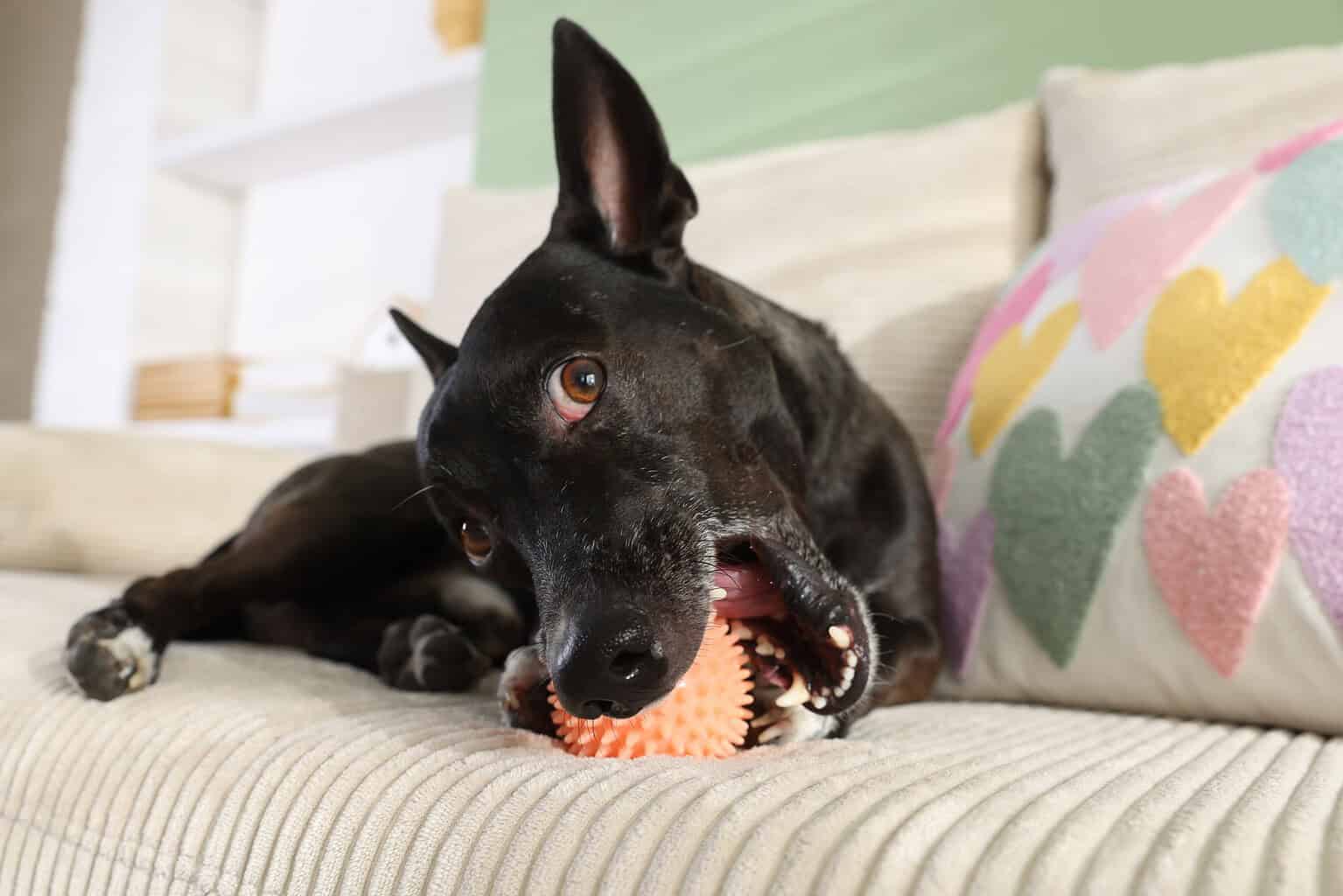
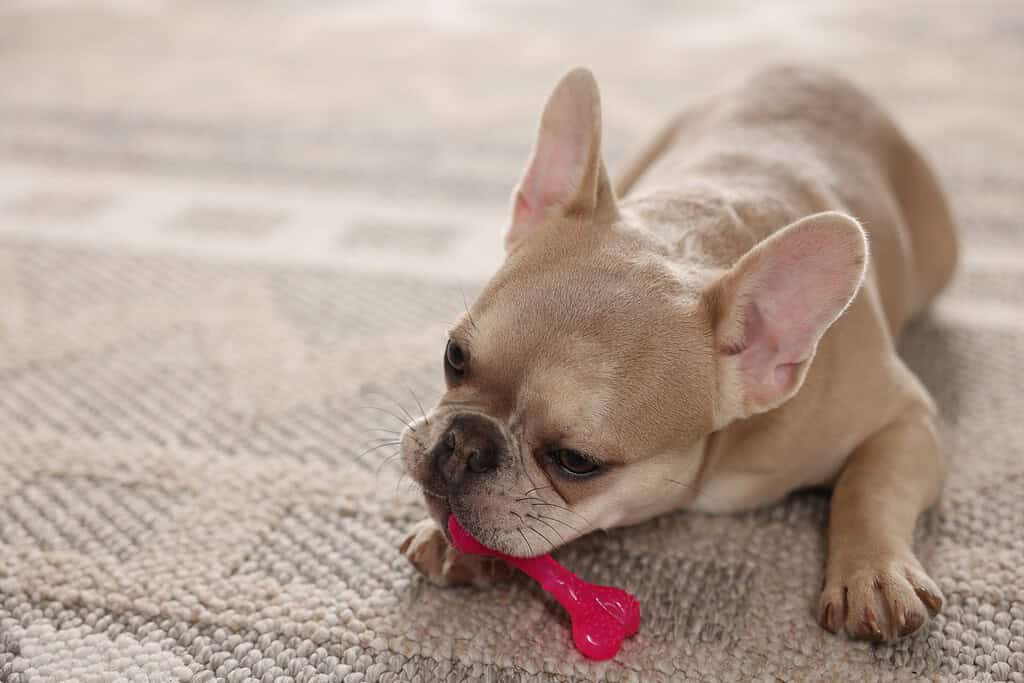
The best chew toy is one your dog cannot break into swallowable pieces and that is still soft enough to dent with your fingernail. For most dogs that means a properly sized natural-rubber toy such as the KONG Extreme, with a Goughnuts ring for the hardest chewers and softer puppy or senior rubber at either end of life. Skip anything harder than a tooth: real bones, antlers, hooves and rock-hard nylon.
Last updated: October 2026
How to choose a safe chew toy
Chewing is normal dog behaviour, and most owners lean into it. In a 2021 survey of 1,439 dog owners published in Applied Animal Behaviour Science, 83% gave their dogs inedible chew toys and 51% offered hard chewing material such as wood or antlers. Two out of three said their dog had never had a problem with a chew, but 3.6% reported a vet visit caused by one. The toy you pick decides which group your dog lands in.
Tooth injuries are the bigger hidden cost. When the University of Wisconsin–Madison reviewed nine years of its dentistry service records, 26.2% of the patients had a traumatic injury to a tooth, most often a canine. A summary from the British Veterinary Dental Association adds that about half of owners whose dogs had fractured teeth had not noticed the break.
Size matters as much as hardness. AAHA advises that a chew should be bigger than your dog’s snout and slightly wider than the mouth, and that power chewers should go one size above their recommended range. VCA adds two more rules: no ribbons, eyes or other parts that can come off, and supervise chewing so you can take the toy away the moment chunks start breaking off.
Finally, think about how your dog chews. AAHA sorts dogs into passive chewers who carry a favourite plush, moderate chewers who shred soft toys but leave hard rubber alone, and power chewers who destroy toys in minutes and gulp treats whole. The picks below are organised around those styles. If your dog is chewing the house rather than the toys, start with our guide on how to stop a dog chewing everything.
Our six picks at a glance
| Toy | Best for | Material | From (maker’s price) |
|---|---|---|---|
| KONG Extreme | Most power chewers | Black natural rubber, hollow | $8.99 |
| Goughnuts Ring | The toughest chewers | Two-layer natural rubber | $21.68 |
| West Paw Hurley | Chew plus fetch | Zogoflex (recyclable) | $12.95 |
| West Paw Qwizl | Treat-motivated chewers | Zogoflex, treat slot | Varies by size |
| KONG Puppy | Teething puppies | Softest KONG rubber | Varies by size |
| KONG Senior | Older dogs | Softer purple rubber | Varies by size |
Prices are the makers’ list prices in October 2026 for the smallest size; retailers often charge less. Every toy here is rubber or rubber-like on purpose. The nylon bones you see in most roundups are covered further down, with the reasons vets are wary of them.
KONG Extreme Best overall
The KONG Extreme is the black version of the familiar snowman-shaped KONG, made from what the company calls its most durable natural rubber. It comes in five sizes, from Small for dogs up to 20 lb to XX-Large for dogs over 85 lb, and KONG’s own pages tell power chewers to size up one or even two weight groups so the toy is bigger than the back of the mouth.
The hollow centre is what makes it the best all-rounder. Stuffed with part of a meal and frozen, it turns a few minutes of gnawing into a long licking-and-chewing job, which is also why it shows up in our guides to lick mats and leaving a dog home alone. The rubber gives under the teeth instead of fighting them, so it passes the thumbnail test. The Spruce Pets tested it with a one-year-old Labrador who destroyed toys labelled indestructible, and it held up through the trial.
Buy this one if you want one toy that handles chewing, stuffing and fetch. Retire it when the rim starts to tear.
Goughnuts Ring Best for the toughest chewers
Goughnuts makes its rings in Modesto, California, from carbon-reinforced natural rubber designed by a rubber chemist. The clever part is the safety indicator. The green, orange and yellow rings have a red inner core, so you can see at a glance when a dog has chewed too deep. Goughnuts says to take the toy away at that point and send it back for a replacement under its lifetime guarantee.
Sizing is unusually specific. The small ring suits dogs of 10 to 40 lb, the medium 30 to 70 lb, and the large Maxx rings 60 to 100 lb. The company’s guarantee page explains why width matters: a wider cross-section makes it harder for a big dog to close its bite and shear off the scissor-like chunks that cause intestinal blockages. The black Heavy Duty rings are tougher still but have no red layer, so you have to inspect them yourself.
Pick this one if your dog has already beaten a KONG Extreme. It is heavy and does not squeak, so it is a chew, not a fetch toy for long sessions.
West Paw Hurley Best for fetch and chew
The Hurley is a dog-bone shape made in Bozeman, Montana, from West Paw’s Zogoflex material, which the company says contains no latex, silicone, BPA or phthalates. It floats, it bounces, and it comes in three lengths: 4.5, 6 and 8.25 inches. West Paw replaces it once if your dog destroys it, and worn toys can be mailed back for recycling.
It is firmer than soft rubber but has much more give than nylon, which makes it a good bridge for dogs who like the shape of a bone. West Paw’s own safety note is worth repeating: no dog toy is indestructible, and you should stop using it as soon as it is damaged. For a dog who also loves pulling games, pair it with one of our tug toy picks.
Choose this one if your dog wants to carry, fetch and chew the same toy, especially near water.
West Paw Qwizl Best stuffable alternative
The Qwizl is a Zogoflex tube with a slot for a bully stick or long treat. The Spruce Pets gave it to a four-year-old Yorkie-poodle mix who spent several sessions working treats out of it, and it came through unscathed. It floats, it is dishwasher safe and it comes in two sizes. The testers noted it picks up lint and holds less interest without a treat inside.
A puzzle like this suits the dog who swallows chews too fast, because the treat comes out a little at a time. It is not a replacement for the solid toys above if your dog is a grinder who works on a toy for an hour. More food-dispensing ideas are in our dog puzzle toy guide.
Get this one if your dog chews harder when food is involved.
KONG Puppy Best for teething puppies
KONG makes its puppy toys in pink and blue from its softest rubber, and the company explains why: puppy teeth are sensitive, and a softer rubber avoids knocking baby teeth out early. KONG recommends the puppy line for dogs under nine months, then moving up to the red Classic for average chewers or the black Extreme for power chewers once the adult canines are fully in.
Puppies are also the group most likely to swallow things. A study of 252,414 insured dogs in Japan found that 4.4% of puppies under a year old had a claim for swallowing a foreign object in one year, compared with an average of 1.7% across all ages. That is a good reason to give a teething puppy one sturdy, well-sized toy rather than a basket of small ones. Our new puppy checklist and puppy biting guide cover the rest of the teething months.
Buy this one if you have a puppy under about nine months. Freeze it with a little wet food for sore gums.
KONG Senior Best for older mouths
The purple KONG Senior uses a softer rubber than the Classic for older dogs whose teeth and gums have become sensitive. It keeps the same stuffable shape, so an older dog still gets the licking and gentle chewing that keep them busy without hard pressure on worn or repaired teeth.
If your senior dog suddenly stops chewing, chews on one side or drops toys, that can be a sign of mouth pain rather than lost interest. A dental check is worth booking before you change toys, and our guide to dog bad breath lists other signs of a sore mouth.
Choose this one if your dog is older or has had dental work.
Chews vets warn about, and why
The products that break the most teeth are often the ones sold as the most natural. Real bones, antlers, cow hooves and rocks are all harder than teeth. AAHA lists bones, sticks, antlers, rawhide and yak milk chews among the hard chews that can damage or fracture teeth, and Texas A&M notes that the U.S. Food and Drug Administration warns owners against giving bones because they can cut the mouth and fracture teeth.
The physics backs that up. In a 2019 University of Pennsylvania study, dog carnassial teeth fractured at an average force of 1,281 newtons, a load within the chewing ability of an ordinary dog. The authors concluded that dogs who routinely chew hard treats and toys that do not give way below that point may be at higher risk of breaking those big cheek teeth. Board-certified veterinary dentist Dr. John Lewis has said the usual culprits he hears about are real bones, nylon bones, antlers, cow hooves, rocks and ice cubes.
There is no such thing as an indestructible toy.
Dr. John Lewis, VMD, FAVD, Dipl. AVDC, in Veterinary Practice News
Nylon is the grey area. Benebone and Nylabone are durable and many dogs love the flavour, but they do not pass the thumbnail test. The ASPCA’s position statement says that dogs slowly wear nylon chews down to thin sections that can snap off and be swallowed, and that owners should throw them away before they get that worn. If you use one, treat it as a short, supervised chew rather than an all-day toy, and skip it for dogs with dental work.
Edible chews carry a different risk. The ASPCA warns that overly aggressive chewers can swallow large chunks of compressed dental chews, leading to blockages that need surgery. A JAVMA case series of 31 dogs with a dental chew stuck in the oesophagus found that 84% were small dogs, and a quarter of them died. Rawhide can help with plaque, Dr. Teller says, but some dogs get stomach upset from it or bite off pieces large enough to choke on. Pig ears and bully sticks are often contaminated with bacteria such as Salmonella, according to both AAHA and Texas A&M. Tennis balls are a softer problem: VCA notes that their sandpaper-like surface wears teeth down with obsessive chewing.
Canadian veterinary dentist Dr. Fraser Hale gives owners a memorable test, as Dr. Lewis describes it: if a toy or treat looks like something you would not want to be hit on the kneecap with, do not give it to your dog. If you want an edible chew with proven dental benefit, look for the Veterinary Oral Health Council seal, which is awarded to products that submit data showing they reduce plaque or tartar.
When to retire a chew toy
Every toy here will eventually wear out. VCA’s rule is simple: once stuffing is showing, rope is frayed or rubber is broken, throw the toy away. Goughnuts makes it visual with its red core, and KONG and West Paw both say to stop using a toy as soon as it is damaged.
Check toys after each session for the first week or two, then weekly. Rotate two or three toys so no single one takes all the wear, and size up again if your dog grows into the top of a weight range. A dog who is getting a good daily walk also tends to chew less out of boredom; our guide to how often to walk your dog covers how much is enough. For softer play ideas, see our roundup of the best dog toys.
Not tagged yet?
Power chewers are hard on collars too. A Shiloh’s House smart tag puts your contact details one phone tap away if a chewed-through collar ever slips and your dog goes exploring.
Frequently asked questions
What is the safest chew toy for a dog?
A natural-rubber toy that is bigger than your dog’s mouth, has no removable parts and dents when you press it with your thumbnail. The KONG Extreme and Goughnuts rings both meet those rules for strong chewers.
Are Nylabones and Benebones safe?
They are durable, but they are hard enough that you cannot dent them with a fingernail, which vets use as the warning sign for tooth fractures. If you use them, supervise, keep sessions short and throw them away once the ends wear thin, as the ASPCA advises.
Are antlers good for dogs to chew?
Most vets advise against them. Texas A&M’s Dr. Lori Teller says veterinary dentists saw more fractured teeth when antlers became popular, and AAHA lists antlers among chews that can break teeth.
What size chew toy should I buy?
Go bigger than you think. AAHA says a chew should be bigger than your dog’s snout and slightly wider than the mouth, and KONG tells power chewers to size up one or two weight groups.
How often should I replace my dog’s chew toy?
Whenever it is damaged: torn rubber, frayed rope, visible stuffing or, on a Goughnuts ring, any red showing. Inspect toys after each session at first, then weekly.
What should I do if my dog swallows part of a toy?
Call your vet straight away, even if your dog seems fine. Swallowed pieces can block the gut, and the ASPCA recommends contacting a vet immediately if a dog eats a chunk of chew material.
Sources
- American Animal Hospital Association (AAHA), “Don’t Chew on This!” (2024).
- VCA Animal Hospitals, “How to Choose the Best Chew Toy for Your Dog.”
- Texas A&M School of Veterinary Medicine & Biomedical Sciences, “How to ‘Chews’ the Best Dog Chew Toys,” Pet Talk with Dr. Lori Teller (2019).
- Lewis J., “Why you need to choose chew toys wisely,” Veterinary Practice News (2017).
- ASPCA, “Position Statement on Dog Chews/Treats.”
- American Kennel Club, “Damaging Chews” (2015).
- Animal Emergency & Referral Center of Minnesota, “Chew Toys Guide for Dogs” (2023).
- Arhant C., Winkelmann R., Troxler J., “Chewing behaviour in dogs: a survey-based exploratory study,” Applied Animal Behaviour Science (2021).
- Soukup J.W., Hetzel S., Paul A., “Classification and epidemiology of traumatic dentoalveolar injuries in dogs and cats: 959 injuries in 660 patient visits (2004–2012),” Journal of Veterinary Dentistry (2015).
- Soltero-Rivera M. et al., “Fracture limits of maxillary fourth premolar teeth in domestic dogs under applied forces,” Frontiers in Veterinary Science (2019).
- British Veterinary Dental Association, “Defining a new standard for assessing dog chew products for textural safety” (research summary).
- “A research on foreign body ingestion in dogs,” Journal of Veterinary Epidemiology 16(1) (2011), Anicom insurance claims data.
- “Esophageal foreign body obstruction caused by a dental chew treat in 31 dogs (2000–2006),” Journal of the American Veterinary Medical Association 232(7) (2008).
- Veterinary Oral Health Council, vohc.org.
- KONG Company, KONG Extreme product page, Super Chewer collection and FAQ.
- Goughnuts, Rings product pages and Safety Guarantee policy.
- West Paw, Hurley product page.
- The Spruce Pets, “The Best Dog Toys for Tough Chewers,” tested reviews (2023).