Can Dogs Eat Avocado? Persin, the Pit, Guacamole and What Is Actually Safe
 Shiloh’s House Team
·
·
16 min read
A bite or two of plain, ripe avocado flesh is unlikely to hurt most dogs, but avocado is not a treat worth making a habit of. Dogs are far less sensitive to persin, the avocado toxin, than birds, horses, rabbits and goats, and the Merck Veterinary Manual and Pet Poison Helpline both say so. The real dangers are the pit, which can choke a dog or block the gut, the skin and leaves, which hold the most persin, the fat, which can trigger pancreatitis, and guacamole’s onion, garlic and salt.
Last updated: September 2025
Can dogs eat avocado safely?
Avocado shows up on almost every list of foods dogs should not eat, yet the toxicology sources are surprisingly relaxed about the flesh. The Merck Veterinary Manual, in an entry reviewed in September 2024 by Cristine Hayes, DVM, of the ASPCA Animal Poison Control Center, says dogs seem relatively resistant to avocado compared with other species. Pet Poison Helpline goes further and states that avocado is non-toxic to dogs and cats, flagging only the pit, which can cause an intestinal obstruction.
PetMD, in an article by Sandra C. Mitchell, DVM, DABVP, updated in February 2025, says avocado flesh is not toxic to dogs and that a dog who steals a piece off the cutting board will probably be fine. The ASPCA Animal Poison Control Center is a touch more cautious, noting that persin can cause vomiting and diarrhea in dogs, while the serious effects are reserved for birds, horses, rodents and ruminants.
So why the warning lists? Because avocado has four separate problems that have nothing to do with being poisonous. The pit is a choking and blockage hazard. The skin and leaves carry the most persin. The flesh is one of the fattiest fruits in the produce drawer, and fat is what sends dogs to the emergency clinic with pancreatitis. And the avocado most dogs actually meet is guacamole, a different food entirely. Our full list of foods dogs cannot eat keeps avocado in the caution tier rather than the toxic tier for this reason. If your dog snatched a slice of ripe avocado, watch and relax. If you are deciding whether to share on purpose, there are easier fruits.
Which parts of an avocado are dangerous for dogs?
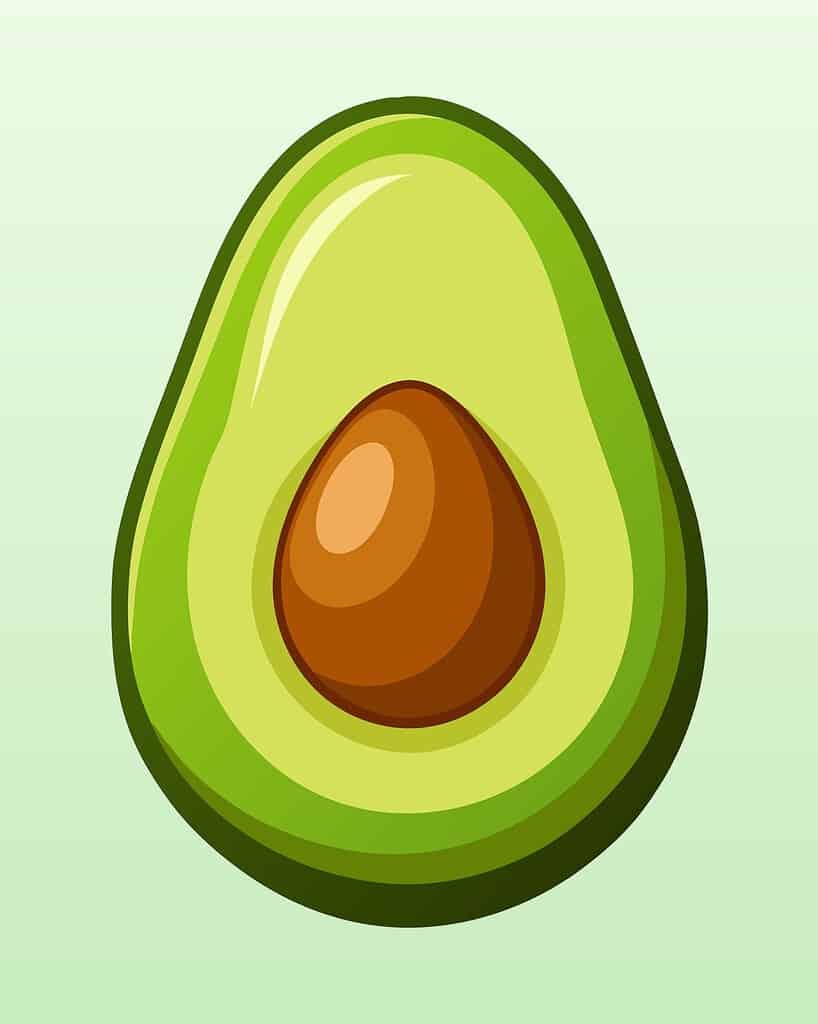
An avocado is really four foods: the buttery flesh, the hard pit, the skin and leaves, and whatever you mix it into. The Merck Veterinary Manual says the leaves are the most toxic part of the plant, and that Guatemalan varieties have most often been linked with poisoning. PetMD says a dog would have to eat a lot of leaves, bark or peel to show persin symptoms, and that the pit is the part that ends in surgery. The table below sorts the common forms by what the toxicology sources say; the verdicts are ours.
| Form of avocado | Main risk for dogs | What the sources say | Our verdict |
|---|---|---|---|
| Ripe flesh, plain | Fat (14.7 g per 100 g); GI upset in large amounts | Non-toxic to dogs (Pet Poison Helpline); vomiting and diarrhea possible (ASPCA) | A bite or two, rarely |
| Pit (seed) | Choking; stomach or intestinal obstruction | Foreign body obstruction (Merck); may need surgery (PetMD) | Never; call the vet if swallowed |
| Skin and leaves | Highest persin content; hard to digest | Leaves are the most toxic part (Merck) | Never; keep compost and trees fenced |
| Guacamole | Onion, garlic, salt, lime, chiles | Onion and garlic are dangerous for dogs and salt is not healthy (PetMD) | No |
| Avocado oil | Pure fat; pancreatitis in susceptible dogs | Contains no persin but is very high in fat (PetMD) | A lick is fine; do not add it to meals |
| Dog food with avocado meal or oil | None specific; it is a formulated diet | Made from flesh and oil only, not leaves, skin or pit (AvoDerm) | Fine as a complete diet |
Notice that the most dangerous form, the pit, is not dangerous because of persin at all. PetMD is blunt: the pit does not digest, it gets stuck partway through the intestinal tract, and the only treatment is to remove it surgically, as if it were a rock or a rubber ball.
What is persin and why does it hurt birds and horses but mostly spare dogs?
Persin is the reason avocado ended up on the toxic lists, and the story of how it got there explains why dogs mostly get a pass. For most of the twentieth century, farmers and veterinarians knew that livestock grazing under avocado trees could get sick in two distinct ways. Lactating animals developed a sudden, non-infectious mastitis: the udder went hard and swollen, milk production collapsed, and what milk remained came out watery and curdled. Animals that ate larger amounts, or kept eating for days, developed heart failure instead, with fluid in the chest, swelling under the skin and sometimes sudden death. The Merck Veterinary Manual still describes both syndromes in those terms, and lists cattle, goats, horses, sheep, rabbits, rodents, caged birds, poultry and even fish as susceptible.
Nobody knew what in the avocado was responsible until an Australian team isolated it. In 1995, Peter Oelrichs and colleagues at the National Research Centre for Environmental Toxicology in Brisbane fed freeze-dried avocado leaf to lactating mice, reproduced the mammary damage seen in livestock, and used that mouse model to purify the active compound. They named it persin, after the avocado’s genus Persea, and identified it as a long-chain fatty-acid-like molecule that the plant makes as a natural fungicide. At 60 to 100 milligrams per kilogram of body weight, purified persin caused the same mammary necrosis in mice that the leaves did; above 100 milligrams per kilogram, it began to kill heart muscle fibers. The team wrote that the mechanism remained unresolved, and thirty years later that is still largely true.
The doses tell the species story. Merck reports that goats develop severe mastitis after eating about 20 grams of leaves per kilogram of body weight and heart injury at around 30 grams per kilogram, and that sheep went into chronic heart failure on as little as 2.5 grams of leaves per kilogram a day for 32 days. Budgerigars are the extreme case: Merck notes that a single gram of avocado fruit produced agitation and feather pulling, and 8.7 grams of mashed avocado killed a budgie within 48 hours. That is why the ASPCA’s plant database lists avocado as toxic to horses and why bird owners are told to treat it as off limits entirely.
Dogs sit near the resistant end of the scale. The veterinary literature contains one case report of avocado heart damage in dogs, published in 1994 by Buoro and colleagues at the University of Nairobi. Two farm dogs with a known taste for Fuerte avocados developed congestive heart failure with fluid in the abdomen, chest and sac around the heart, and one showed damage to heart muscle cells on microscopy. The authors called the link putative, meaning suspected but unproven, because no toxin was measured. Merck cites that single report and in the same sentence says dogs seem relatively resistant compared with other species. Pet Poison Helpline simply lists avocado as non-toxic to dogs.
Why the difference? Nobody has a complete answer, and we would rather say so than invent one. Persin concentrates in the leaves, bark, skin and pit rather than the flesh, dogs are not grazing animals and rarely eat those parts in bulk, and whatever the compound does to mammary and heart tissue seems to require far higher exposure in dogs than in a 40-gram parakeet or a goat eating a tree’s worth of leaves. That is reassurance about a stolen slice. It is not a license for a daily avocado habit, and it says nothing about the pit.
How much avocado can a dog eat?
The World Small Animal Veterinary Association’s Global Nutrition Committee says treats should make up no more than about 10 percent of a pet’s daily calories. To turn that into avocado, we used the American Animal Hospital Association’s 2021 nutrition guidelines, which set resting energy requirement at 70 times body weight in kilograms raised to the 0.75 power, multiplied by a life-stage factor of 1.4 to 1.6 for a neutered adult dog.
Here is the math for one weight. A 25-pound dog weighs 11.3 kilograms; 11.3 to the 0.75 power is about 6.2, times 70 gives a resting requirement of about 433 calories; times 1.6 gives a daily need of about 692 calories; 10 percent of that is a treat budget of 69 calories. Avocado runs 160 calories per 100 grams, so 69 calories buys about 43 grams, roughly three tablespoons mashed. The table is our suggestion, not a prescription, and the last column is what we would actually feed. A tablespoon of mashed avocado weighs about 14 grams and carries about 23 calories and 2 grams of fat; a teaspoon is about 5 grams and 8 calories.
| Dog weight | Daily treat budget (10%) | Avocado if it were the only treat | Our suggested serving (occasional, not daily) |
|---|---|---|---|
| 10 lb (4.5 kg) | About 35 kcal | About 22 g (1 1/2 tbsp, 3.2 g fat) | 1 teaspoon mashed |
| 25 lb (11.3 kg) | About 69 kcal | About 43 g (3 tbsp, 6.4 g fat) | 2 teaspoons mashed |
| 50 lb (22.7 kg) | About 116 kcal | About 73 g (5 tbsp, 10.7 g fat) | 1 to 1 1/2 tablespoons |
| 80 lb (36.3 kg) | About 166 kcal | About 103 g (7 tbsp, 15.2 g fat) | 2 to 2 1/2 tablespoons |
Our suggested servings follow PetMD’s guide of no more than 1 teaspoon of avocado per 10 pounds of body weight. Look at the gap between the two right-hand columns. For avocado, the calorie budget is used up by a few spoonfuls, and the fat in those spoonfuls is the whole concern. A whole medium avocado, about 201 grams of flesh by USDA’s measure, carries roughly 320 calories and nearly 30 grams of fat, close to half of a 25-pound dog’s daily calorie need.
That is why we would not feed the full budget. PetMD warns that some dogs can develop pancreatitis even after a small amount of avocado pulp, and that it often starts with mild vomiting. Our dog feeding chart by weight shows how the main meals fit around that shared 10 percent treat budget; a spoonful of avocado comes out of it, not on top of it.
Put “no fatty foods” where the dog sitter will actually read it
A Shiloh’s House Smart Tag is laser-engraved acrylic with a “Tap Phone Here” NFC back. A sitter or finder taps it with any modern phone and sees your contacts, medical notes and feeding rules, so “history of pancreatitis, no table food” travels with the dog. About $38 one-time, no subscription, no battery, waterproof, made in the USA, 30-day returns.
What happens if a dog swallows an avocado pit?
This is the avocado emergency, and it has nothing to do with poison. An avocado pit is a smooth, slippery sphere about the size of a golf ball, and Hill’s warns that larger dogs may see it as a toy and choke on it. If it goes down whole, it is too hard to digest, so it travels until the gut narrows and then stops. The Merck Veterinary Manual states plainly that dogs eating the intact pit can develop a foreign body obstruction of the GI tract. The ASPCA’s senior director of toxicology said the same thing in fewer words.
“The pit, if ingested, can cause an obstruction, and may need surgical removal.”
Tina Wismer, DVM, senior director of toxicology, ASPCA Animal Poison Control Center (The Healthy, 2021)
Signs of a blockage can take a day or more to show. Watch for repeated vomiting or retching, a swollen or painful belly, straining to pass stool or passing none, refusing food, and lethargy that gets worse rather than better. PetMD treats a swallowed pit, or a dog choking on part of one, as an emergency that belongs at an emergency facility as quickly as possible. Do not wait to see whether it passes, and do not try to make your dog vomit at home. Our guide to what to do when your dog ate something it should not have walks through the first hour.
The fix is boring and effective. Pits and skins go straight into a lidded trash can or a dog-proof compost bin, and an avocado tree gets fenced or raked under, because fallen fruit is how the Nairobi farm dogs got theirs.
Can dogs eat guacamole, avocado oil or avocado dog food?
Guacamole is a no, and it is a no because of the other ingredients. PetMD’s Dr. Mitchell points out that the additions that make it taste good to us, onion, garlic and salt, are the problem: garlic and onion are dangerous for dogs and salt is not healthy for them. The ASPCA lists onion, garlic and chives among the foods pets should never eat because they damage red blood cells. A dog that licks a chip is fine. A dog that cleans out the bowl needs a call to the vet, recipe in hand, because the onion dose matters more than the avocado dose.
Avocado oil is a different case. PetMD says it contains no persin, so it is not toxic, but that it is very high in fat, can trigger pancreatitis in susceptible dogs, and is safest not given on purpose. A lick from a salad plate will not hurt a healthy dog. Drizzling it over dinner for a shiny coat is where we part ways with the internet; if your dog’s coat needs help, ask your vet.
Then there is the kibble aisle. Several commercial dog foods include avocado meal or avocado oil as named ingredients, and AvoDerm has built a brand on it since 1982. Its website says the avocado and avocado oil in its products come from the meat of the fruit and do not contain the leaves, bark, skin or pit, and it acknowledges that persin is harmful to birds, rabbits, horses and goats. That is consistent with the toxicology sources. A complete diet formulated with a measured amount of avocado flesh or oil is not the same as a dog eating half an avocado off your plate, and we found no veterinary source that flags those foods as unsafe. Whether they beat other brands is a nutrition question, not a toxicity one.
Compare that with peanut butter, where the ingredient to hunt for is xylitol, a sweetener that is genuinely toxic. Avocado has no equivalent hidden poison for dogs. Its risks are mechanical and caloric.
Which dogs should skip avocado and what should they eat instead?
For a healthy adult dog, a teaspoon of plain avocado now and then is a shrug. For these dogs, we would skip it entirely. Dogs with a history of pancreatitis, or any dog on a low-fat prescription diet, should get no avocado at all; PetMD’s warning that a small amount of pulp can set off pancreatitis is aimed squarely at them. Overweight dogs do not need 160 calories per 100 grams from a treat, and Hill’s warns that avocado can put weight on a pet more quickly than expected. Dogs with a history of foreign body surgery need extra care around the pit and skin, and puppies, with their small throats and curious mouths, are the dogs most likely to choke on one.
If you want a fruit to share, pick one where the calorie budget is not spent on fat. Bananas are soft, sweet and carry almost no fat. Mango is fine once the pit and skin are gone, and pineapple is a bright, low-fat option in small cubes. PetMD’s list of better fruits starts with apples, bananas, blueberries and cantaloupe; Hill’s suggests plain turkey, chicken or watermelon.
Write your dog’s rule where other people will see it. In the free Lohji app from Shiloh’s House, you keep a live safety profile with up to three contacts, medical notes and voice messages that a Shiloh’s House NFC Smart Tag links to, so a sitter who taps the tag reads “history of pancreatitis, no fatty foods” before the guacamole comes out. The app also turns a photo of your pet into cartoon Lohji avatars, stickers and wallpapers. Get it on the App Store or Google Play.
Frequently asked questions
Is avocado toxic to dogs?
Not in any practical sense. Pet Poison Helpline lists avocado as non-toxic to dogs and cats, and the Merck Veterinary Manual says dogs seem relatively resistant compared with birds, horses, rabbits and ruminants. The ASPCA notes that avocado can cause vomiting and diarrhea in dogs. The serious risks are the pit, the fat and the onion and garlic in guacamole.
What is persin and does it affect dogs?
Persin is a natural fungicide in avocado leaves, bark, skin, pit and, in smaller amounts, flesh, identified by Oelrichs and colleagues in 1995. In birds, horses, rabbits and ruminants it damages the heart and, in lactating animals, the mammary glands. Dogs are far less sensitive; the literature holds one suspected case report of heart damage in two farm dogs, from 1994.
My dog ate a whole avocado, what should I do?
First find out whether the pit is missing. If your dog swallowed it, call your vet or an emergency clinic right away, because it can block the stomach or intestines and may need surgery. If only the flesh and skin are gone, PetMD advises watching for 24 to 48 hours for vomiting, diarrhea or belly pain and calling the vet if any appear, since the fat can trigger pancreatitis.
Can dogs eat guacamole?
No. Guacamole usually contains onion and garlic, which the ASPCA says damage dogs’ red blood cells, plus salt, lime and chiles that upset the stomach. PetMD says the additions that make guacamole tasty are exactly why it should stay off limits. A lick from a chip is not a crisis, but a dog that eats a bowlful needs a call to the vet with the recipe in hand.
How much avocado can I give my dog?
PetMD suggests no more than 1 teaspoon of avocado flesh per 10 pounds of body weight, and we would keep it to once or twice a week at most. That is a teaspoon for a 10-pound dog and 2 to 2 1/2 tablespoons for an 80-pound dog, mashed or diced small, with no skin, pit or seasoning. Dogs with pancreatitis or weight problems should skip it.
Is avocado oil or avocado dog food safe for dogs?
Avocado oil contains no persin, but PetMD says it is so high in fat that it can trigger pancreatitis and is best not given on purpose. Commercial dog foods that use avocado meal or oil, such as AvoDerm, are made from the flesh and oil only, not the leaves, skin or pit, and we found no veterinary source that calls them unsafe as a complete, formulated diet.
Sources
- Cristine Hayes, DVM, “Avocado (Persea spp) Toxicosis in Animals”, Merck Veterinary Manual, 2024 — https://www.merckvetmanual.com/toxicology/food-hazards/avocado-persea-spp-toxicosis-in-animals
- ASPCA Animal Poison Control Center, “The Scoop on Avocado and Your Pets”, ASPCA, 2019 — https://www.aspca.org/news/scoop-avocado-and-your-pets
- ASPCA Animal Poison Control Center, “Toxic and Non-toxic Plants: Avocado”, ASPCA, accessed 2025 — https://www.aspca.org/pet-care/aspca-poison-control/toxic-and-non-toxic-plants/avocado
- ASPCA Animal Poison Control Center, “People Foods to Avoid Feeding Your Pets”, ASPCA, accessed 2025 — https://www.aspca.org/pet-care/aspca-poison-control/people-foods-avoid-feeding-your-pets
- Pet Poison Helpline, “Avocado”, Pet Poison Helpline, accessed 2025 — https://www.petpoisonhelpline.com/poison/avocado/
- USDA Agricultural Research Service, “Avocados, raw, all commercial varieties (SR Legacy, FDC ID 171705)”, USDA FoodData Central, 2019 — https://fdc.nal.usda.gov/food-details/171705/nutrients
- Sandra C. Mitchell, DVM, DABVP, “Can Dogs Eat Avocado?”, PetMD, 2025 — https://www.petmd.com/dog/nutrition/can-dogs-eat-avocado
- P. B. Oelrichs, J. C. Ng, A. A. Seawright et al., “Isolation and identification of a compound from avocado (Persea americana) leaves which causes necrosis of the acinar epithelium of the lactating mammary gland and the myocardium”, Natural Toxins, 1995 — https://pubmed.ncbi.nlm.nih.gov/8581318/
- I. B. J. Buoro, S. B. Nyamwange, D. Chai and S. M. Munyua, “Putative avocado toxicity in two dogs”, Onderstepoort Journal of Veterinary Research, 1994 — https://pubmed.ncbi.nlm.nih.gov/7898892/
- Jennifer Huizen, MS, with Tina Wismer, DVM, and Jerry Klein, DVM, “Can Dogs Eat Avocado? Veterinarians Explain”, The Healthy, 2021 — https://www.thehealthy.com/nutrition/can-dogs-eat-avocado/
- Erin Ollila, reviewed by Hill’s veterinary experts, “Can Dogs & Cats Eat Avocados? (& Are They Safe?)”, Hill’s Pet Nutrition, 2021 — https://www.hillspet.com/pet-care/nutrition-feeding/can-dogs-and-cats-eat-avocados
- AvoDerm Natural (Breeder’s Choice Pet Foods), “Why Avocados?”, AvoDerm, 2020 — https://avodermnatural.com/why-avocados/
- American Animal Hospital Association, “Energy Requirement Calculations (2021 AAHA Nutrition and Weight Management Guidelines)”, AAHA, 2021 — https://www.aaha.org/wp-content/uploads/globalassets/02-guidelines/2021-nutrition-and-weight-management/resourcepdfs/nutritiongl_box1.pdf
- WSAVA Global Nutrition Committee, “Frequently Asked Questions & Myths”, World Small Animal Veterinary Association, 2018 — https://wsava.org/wp-content/uploads/2020/01/Frequently-Asked-Questions-and-Myths.pdf