Can Dogs Eat Pineapple? Fresh, Canned, Dried and How Much Is Safe
 Shiloh’s House Team
·
·
16 min read

Yes, dogs can eat pineapple in small amounts, as long as you serve only the fresh, ripe flesh cut into bite-size pieces. A chunk or two is a sweet, juicy treat for most healthy dogs. The hard core, the spiky skin and the leafy crown are the problem parts, because dogs cannot break them down and they can cause choking or an intestinal blockage. Skip pineapple canned in syrup, go easy on dried pineapple and juice, and ask your vet first if your dog is diabetic or overweight.
Last updated: October 2025
Can dogs eat pineapple safely?
Yes. The American Kennel Club calls raw pineapple, in small amounts, an excellent snack for dogs, and Hill’s Pet Nutrition and the specialty hospital group MedVet agree that the fleshy part of the fruit is fine in moderation. Pineapple is not on any toxic food list. The risks come from the wrong parts of the fruit, the wrong forms of it and simply eating too much.
The “yes” holds when three conditions are met:
- Only the flesh. The core, the rind and the crown of leaves stay out of the bowl.
- Only fresh or plain frozen fruit. Pineapple canned in syrup, sweetened juice, candied or store-bought dried pineapple and pineapple desserts bring extra sugar your dog does not need.
- Only a little. Pineapple is high in natural sugar, has a fair amount of fiber and is quite acidic. Too much at once is the most common reason a dog ends up with diarrhea or an upset stomach after eating it.
If your dog is a fruit fan, pineapple can sit in the rotation beside other safe options we have covered, like apples and watermelon.

What nutrients does pineapple give a dog?
Pineapple is mostly water and natural sugar, with some fiber, a good dose of vitamin C and a surprising amount of the mineral manganese. It has almost no fat or protein. The figures below come from USDA FoodData Central for pineapple, raw, all varieties (FDC ID 169124). USDA gives the weight of one cup of chunks as 165 grams. USDA does not list a single chunk, so we assumed a bite-size 1-inch chunk weighs about 10 grams. Both right-hand columns are our own scaling of the per-100-gram values, rounded.
| Nutrient | Per 100 g raw pineapple | Per 1 cup chunks (165 g) | Per 1 chunk (about 10 g) |
|---|---|---|---|
| Calories | 50 kcal | 82 kcal | 5 kcal |
| Water | 86.0 g | 142 g | 8.6 g |
| Total carbohydrate | 13.1 g | 21.6 g | 1.3 g |
| Total sugars | 9.85 g | 16.3 g | 1.0 g |
| Dietary fiber | 1.4 g | 2.3 g | 0.14 g |
| Protein | 0.54 g | 0.89 g | 0.05 g |
| Fat | 0.12 g | 0.20 g | 0.01 g |
| Vitamin C | 47.8 mg | 78.9 mg | 4.8 mg |
| Manganese | 0.93 mg | 1.53 mg | 0.09 mg |
| Potassium | 109 mg | 180 mg | 11 mg |
The vitamin list sounds impressive. The AKC notes that ripe pineapple contains vitamin C, several B vitamins and minerals such as manganese, copper, potassium and magnesium. But a dog eating a complete and balanced food already gets the nutrients it needs, and dogs make their own vitamin C. A chunk of pineapple is a pleasant extra, not a supplement.
Why are pineapple core, skin and crown dangerous for dogs?
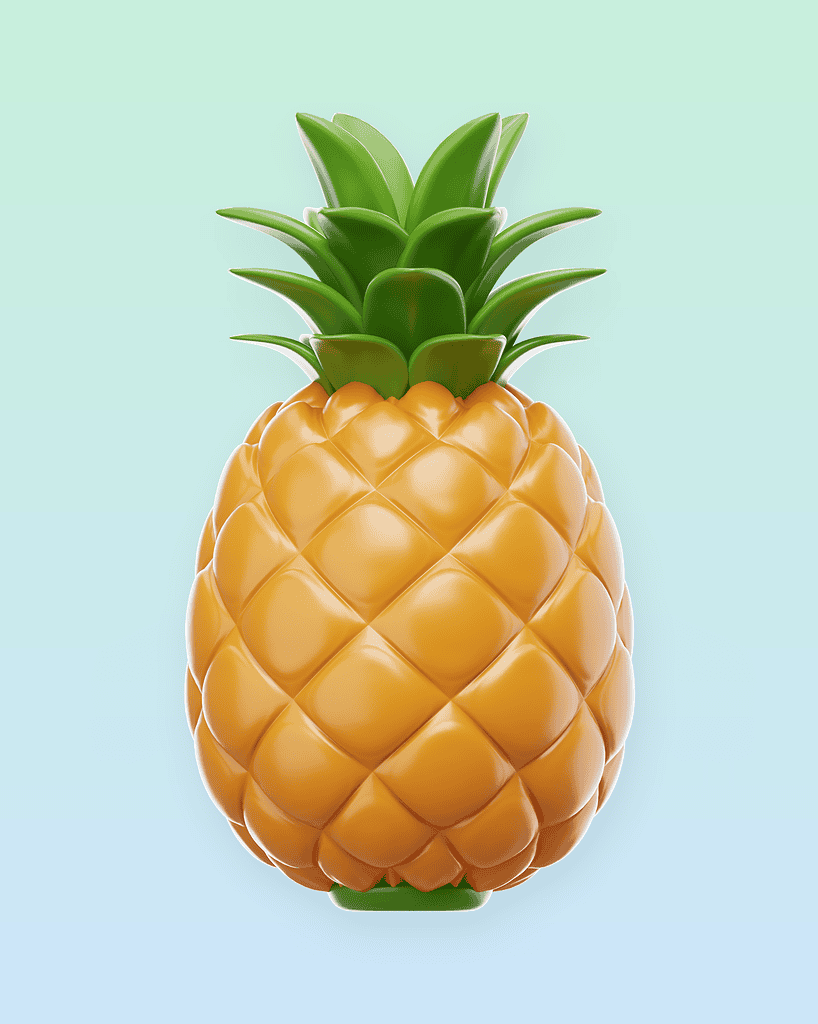
This is the part of the fruit question that sends dogs to the vet, so it deserves the most attention. The flesh is soft and breaks down easily. The other three parts of a pineapple do not, and each one causes trouble in its own way.
The core
The core is the pale, woody cylinder that runs through the middle of the fruit. It is edible for people in the sense that it will not poison you, but it is dense, fibrous and tough. The AKC warns that the tough central core has the potential to cause obstructions, and a vet-reviewed guide from MetLife Pet Insurance says the core and skin are far too dense for a dog’s digestive system to break down. Dogs that steal a core tend to gulp large pieces without chewing, which makes a blockage more likely. Small dogs are at higher risk simply because their intestines are narrower.
The skin
Pineapple rind is thick, waxy and covered in hard, pointed “eyes.” The AKC lists the spiny skin alongside the core as a possible cause of obstruction, and Dr. Alex Schechter, a veterinarian interviewed by The Dodo, explained that the core and spiky skin are hard for dogs to chew, which can cause choking or intestinal blockages. The rough texture can also scrape the mouth and gums.
The crown
The crown is the tuft of stiff, spiky leaves on top. MedVet specifically tells owners to dispose of the crown along with the skin and core. The leaves are fibrous and sharp at the tips, and a dog that shreds and swallows a crown can end up with the same kind of mechanical problem as one that eats a core. Pineapple crowns often end up in compost piles or on the counter while you cut the fruit, so they are easy for a curious dog to grab.
Why a blockage is serious
The Merck Veterinary Manual explains that intestinal obstruction can be partial or complete, and that foreign objects are a common cause. Signs usually include lethargy, loss of appetite and vomiting, and can progress to abdominal pain, swelling, dehydration and shock. A dog with a complete blockage may be unable to stop vomiting. Merck adds that dogs with an obstruction caused by something they ate tend to do well when it is diagnosed and treated quickly, which is the reason to call your vet early rather than wait.
How to prepare pineapple the safe way
- Wash the outside of the fruit, then slice off the crown and the base.
- Stand the pineapple up and cut away the rind from top to bottom, then trim out any brown eyes left in the flesh.
- Cut the fruit into quarters lengthwise and slice the core off each quarter.
- Cut the flesh into bite-size chunks for large dogs and smaller dice for small dogs. Hill’s recommends dicing it into small pieces for small breeds.
- Put the core, rind and crown straight into a lidded bin or a sealed bag. Hill’s advises discarding the peel and core in a place that is out of your dog’s reach.
That last step is the one most people skip. A dog will rarely be handed a pineapple core on purpose. Most core and rind incidents start in the kitchen trash or the backyard compost after a party or a fruit salad.
Can dogs eat canned, dried or frozen pineapple, or drink pineapple juice?
Fresh chunks are the best form to offer. The processed versions are not toxic, but most of them pack in more sugar per serving. The USDA figures below compare one cup of each, using the cup weights USDA gives for each record. Note that a cup of canned fruit includes the liquid, which is where much of the extra sugar sits.
| Form (1 cup, USDA) | Weight | Calories | Total sugars | Fiber |
|---|---|---|---|---|
| Raw chunks (FDC 169124) | 165 g | 82 kcal | 16.3 g | 2.3 g |
| Canned, juice pack, with liquid (FDC 169126) | 249 g | 149 kcal | 36.0 g | 2.0 g |
| Canned, heavy syrup, with liquid (FDC 169944) | 254 g | 198 kcal | 42.9 g | 2.0 g |
| Juice, canned or bottled, unsweetened (FDC 169947) | 250 g | 133 kcal | 24.9 g | 0.5 g |
Canned pineapple. Gram for gram, pineapple in heavy syrup has about 70% more sugar than raw pineapple (16.9 versus 9.85 grams per 100 grams), and the juice-pack version is not far behind at 14.4 grams. The AKC says canned pineapple should be avoided because the syrup contains too much sugar for most dogs’ digestive tracts to handle.
“It is better to avoid canned versions of the food, as the syrup keeping the pineapple chunks fresh is usually high in sugar, leading to digestive issues.”
Dr. Alex Schechter, veterinarian and founder of Burrwood Veterinary (The Dodo, 2022)
Pineapple juice. Even unsweetened juice has about 25 grams of sugar per cup and almost no fiber. A lick from a spilled glass is fine. Juice should not go in the water bowl.
Dried pineapple. Drying removes water, not sugar. Dr. Schechter told The Dodo that dried pineapple has more sugar per portion than raw. Raw pineapple is 86% water, so by our rough math, drying it down to typical dried-fruit moisture concentrates the sugar about five to six times per gram. MetLife’s vet-reviewed guide says homemade dried pineapple is fine occasionally in small amounts, while store-bought versions, which often have additives, should be avoided.
Frozen pineapple. Plain frozen chunks of fresh pineapple are a great summer treat, and the AKC recommends them. Let them soften for a minute so they are easier on teeth, and cut them small for small dogs.
Does pineapple stop dogs from eating poop?
This is one of the most repeated tips online. The idea is that bromelain, a group of protein-digesting enzymes in pineapple, changes how stool tastes so a dog stops eating it. The evidence for that is thin.
We could not find a published study testing pineapple as a coprophagia treatment in dogs. The best data on stool-eating remedies comes from a 2018 study in Veterinary Medicine and Science by researchers at UC Davis, which surveyed owners of more than 1,400 coprophagic dogs. Owners reported success rates of 0 to 2% for 11 commercial food additives and tablets sold to stop stool eating, and 1 to 4% for behavior approaches. Pineapple was not one of the products studied, but the result shows how hard this habit is to change with something added to the bowl.
Veterinary behaviorist Dr. Nicholas Dodman, professor emeritus at Tufts University, told Live Science in 2023 that you will probably find someone who thinks pineapple worked for their dog, but that it is not a strategy you can rely on.
There are other reasons to doubt it. Food science studies show that fruit bromelain loses its activity when heated, which is why it is inactivated during canning, and that it is unstable in acid and in the presence of stomach enzymes. Most commercial bromelain is extracted from the pineapple stem, not the fruit you would feed. MedVet says bromelain helps dogs absorb proteins more easily, but we found no canine study showing that a few chunks of fruit change digestion in a measurable way.
What does help is picking up stool quickly, supervising yard time and talking to your vet about diet and parasites. Our guide to why dogs eat poop walks through the causes and the fixes that have better support.
How much pineapple can a dog eat?
Veterinary nutritionists at Tufts University recommend that treats of every kind make up no more than 10% of a dog’s daily calories, with the rest coming from a complete and balanced dog food. Tufts gives two reference points: an average 10-pound dog needs about 300 calories a day, and an average 75-pound dog about 1,400. Hill’s suggests no more than two or three small bites of pineapple a day, and MetLife’s guide suggests starting with two to three small pieces.
The table below is our own suggestion, not a veterinary prescription. We estimated daily calories for each size from the Tufts reference points, took 10% as the full treat allowance, and converted it to pineapple using the USDA figure of 50 calories per 100 grams and our assumed 10-gram chunk (about 5 calories and 1 gram of sugar). The last column stays well below the full allowance because of the sugar, fiber and acidity, and because most dogs get other treats too.
| Dog weight | Est. daily calories | Full 10% treat allowance | Pineapple that would use all of it | Our suggested pineapple serving |
|---|---|---|---|---|
| 5 lb | About 180 | 18 kcal | About 36 g (3 to 4 chunks) | 1 small chunk, diced (about 10 g, 5 kcal) |
| 10 lb | About 300 | 30 kcal | About 60 g (6 chunks) | 1 to 2 chunks (10 to 20 g, 5 to 10 kcal) |
| 25 lb | About 600 | 60 kcal | About 120 g (three quarters of a cup) | 2 to 3 chunks (20 to 30 g, 10 to 15 kcal) |
| 50 lb | About 1,000 | 100 kcal | About 200 g (1.2 cups) | 3 to 4 chunks (30 to 40 g, 15 to 20 kcal) |
| 75 lb | About 1,400 | 140 kcal | About 280 g (1.7 cups) | 4 to 5 chunks (40 to 50 g, 20 to 25 kcal) |
| 100 lb | About 1,700 | 170 kcal | About 340 g (2 cups) | 5 to 6 chunks (50 to 60 g, 25 to 30 kcal) |
For large dogs our numbers are a little more generous than Hill’s “two or three small bites,” because a bite for a Labrador is bigger than a bite for a Chihuahua. If in doubt, use the lower figure. Rotating in other fruits, like bananas, also keeps any one sugar source in check. Real calorie needs also vary with age, activity and body condition, and our dog feeding chart by weight explains how to estimate your own dog’s number.
Which dogs should skip pineapple or eat less?
For most healthy adult dogs, a chunk or two is a non-event. A few groups need more care.
Dogs with diabetes. Hill’s notes that the natural sugar in pineapple could pose a risk to dogs with diabetes or at risk of developing it, and Dr. Schechter told The Dodo that dogs who already have diabetes shouldn’t have pineapple. Any treat change can affect a diabetic dog’s insulin plan. Our guide to diabetes in dogs explains why consistent meals matter so much.
Overweight dogs. One chunk is only about 5 calories, but sweet treats tend to multiply. If your dog is on a weight-loss plan, low-calorie vegetables are usually a better swap, and any treat should replace another rather than be added on top.
Dogs with sensitive stomachs. Hill’s says that for dogs with sensitive stomachs, even a small amount of pineapple might lead to tummy trouble. The mix of sugar, fiber and acid can cause gas, loose stools or vomiting.
Dogs with dental disease. Hill’s also points out that pineapple’s acid could wear down tooth enamel. If your dog already has dental problems, keep fruit rare.
Puppies and dogs on prescription diets. Puppies can have a tiny piece once they are eating solid food, but their stomachs are easily upset. Dogs on a therapeutic diet should not get extras unless their vet approves.
What should you do if your dog ate pineapple core or crown?
A dog that ate a lot of pineapple flesh will most likely have a day of soft stool or gas. A dog that swallowed a core, a strip of rind or a chewed-up crown needs a closer look.
Hill’s advises calling your veterinarian if your dog raids the garbage and eats the skin or core, because the vet can tell you whether to bring your dog in for an exam or watch at home. Do not try to make your dog vomit unless your vet tells you to. A sharp or bulky piece of rind coming back up can cause its own damage.
While you wait, watch for the signs the Merck Veterinary Manual links to obstruction: vomiting, loss of appetite, lethargy, belly pain or swelling and, in some dogs, diarrhea. Straining to poop with little result is another warning sign. Any of these after a core or crown incident is a reason to see a vet the same day. Our step-by-step guide for when your dog ate something it shouldn’t covers what to have ready when you call.
Having your dog’s details in one place makes those calls faster. In Lohji, the free Shiloh’s House app for pet parents, you keep the pet profile that a Shiloh’s House smart tag opens when someone taps it with a phone, including contacts and medical notes such as “diabetic, no fruit treats.” The same app turns your dog’s photo into a cartoon character, a Lohji, for stickers, wallpapers and collector cards. Get it on the App Store or Google Play.
Let a finder see your dog’s diet and health notes
Shiloh’s House smart tags are laser-engraved premium acrylic with a “Tap Phone Here” NFC back. A finder taps with a phone and sees a live profile with one-tap call, text and directions, voice messages, medical notes and multiple contacts. Waterproof, scratch-resistant and UV-stable, made in the USA in 35 designs for $38 with no subscription and 30-day returns.
Another tropical fruit with a pit problem? Our guide to whether dogs can eat mango covers the skin, the slippery pit, dried mango and safe amounts by weight.
Pineapple’s tropical neighbor is a different story. Coconut is not toxic either, but it is one of the fattiest treats you can hand a dog, so servings are measured in teaspoons; our guide to whether dogs can eat coconut covers the meat, oil, water and milk.
Frequently asked questions
Is pineapple toxic to dogs?
No. Pineapple flesh is not toxic to dogs, and the AKC, Hill’s and MedVet all describe fresh pineapple as a safe treat in moderation. The risks are the core, skin and crown, which can cause choking or a blockage, and eating too much flesh, which can upset the stomach.
Can dogs eat the pineapple core?
No. The core is dense and woody, and the AKC warns it has the potential to cause obstructions. A vet-reviewed MetLife guide says it is too dense for a dog’s digestive system to break down. If your dog swallows a core, call your vet for advice and watch for vomiting, loss of appetite, lethargy or belly pain over the next few days.
How many pineapple chunks can a dog have?
Hill’s suggests no more than two or three small bites a day. Our own suggestion, based on the 10% treat rule and USDA calorie data, runs from one small diced chunk for a 5-pound dog to five or six bite-size chunks for a 100-pound dog. Start smaller and offer it a few times a week.
Can dogs eat canned pineapple in juice?
It is better to skip it. Canned pineapple in juice is not toxic, but USDA data shows a cup with its liquid has about 36 grams of sugar, more than double a cup of fresh chunks. Pineapple in heavy syrup is even sweeter. A stolen piece usually means a mild stomach upset at most.
Can pineapple give dogs diarrhea?
Yes. The AKC notes that pineapple is high in fiber and natural sugar and can upset the digestive system if fed in large amounts, and Hill’s says too much fiber can cause diarrhea or constipation. Cut back or stop if you see loose stools, and call your vet if diarrhea lasts more than a day or comes with vomiting or lethargy.
Does pineapple really stop dogs from eating poop?
There is no good evidence that it does. No published study has tested pineapple for this, and a 2018 UC Davis survey found that even products sold specifically to stop stool eating had owner-reported success rates of only 0 to 2%. Prompt cleanup and a vet check work better.
Sources
- Pineapple, raw, all varieties (FDC ID 169124), USDA FoodData Central (2019)
- Pineapple, canned, juice pack, solids and liquids (FDC ID 169126), USDA FoodData Central (2019)
- Pineapple, canned, heavy syrup pack, solids and liquids (FDC ID 169944), USDA FoodData Central (2019)
- Pineapple juice, canned or bottled, unsweetened (FDC ID 169947), USDA FoodData Central (2019)
- Can Dogs Eat Pineapple?, American Kennel Club (2022)
- Is Pineapple Safe for Dogs?, Hill’s Pet Nutrition (2021)
- Which Fruits Are Safe for Your Dog to Eat?, MedVet (2025)
- Can Dogs Eat Pineapple? What Vets Want You to Know, MetLife Pet Insurance, medically reviewed (2023)
- Can Dogs Eat Pineapple? And What Amount Is Safe?, The Dodo (2022)
- Treat Options for Dogs and Cats Without Unbalancing Their Diet, Tufts Cummings School of Veterinary Medicine, Petfoodology (2021)
- The paradox of canine conspecific coprophagy, Hart et al., Veterinary Medicine and Science (2018)
- Why do dogs eat poop?, Live Science (2023)
- Effect of Temperature on the Stability of Fruit Bromelain from Smooth Cayenne Pineapple, Kasetsart Journal (Natural Science) (2010)
- Thermal Inactivation Kinetics of Bromelain in Pineapple Juice, Transactions of the ASAE (2000)
- Thermal stability of free bromelain and bromelain-polyphenol complex in pineapple juice, International Food Research Journal (2011)
- Disorders of the Stomach and Intestines in Dogs, Merck Veterinary Manual (2018)