Can Dogs Eat Kiwi? Skin, Whole Fruit Risks and How Much Is Safe
 Shiloh’s House Team
·
·
16 min read

Yes, dogs can eat kiwi, as long as you peel it, cut the flesh into small pieces and keep the portion to a few bites. Kiwi is not toxic to dogs, but the fuzzy skin is tough roughage that can upset a stomach, and a whole kiwi is the right size to choke a dog or block the gut. It is also sugary, so dogs with diabetes or a sensitive stomach should skip it, and dried kiwi, kiwi juice and anything labeled sugar-free stay off the menu.
Last updated: September 2025
Can dogs eat kiwi safely?
Kiwi is one of the easy ones. PetMD, in an article reviewed by Sandra C. Mitchell, DVM, DABVP, says dogs can have peeled, diced kiwi in small amounts and that the fruit is not considered toxic to dogs. Rover’s guide quotes Dan Su, DVM, a board-certified veterinary nutritionist, who says no part of the kiwi is toxic to dogs. The precautions are about texture, size and sugar, not poison.
That puts kiwi in a different category from the fruits that genuinely hurt dogs, which we cover in our guide to foods dogs cannot eat. Kiwi is not on it. Green kiwi, gold kiwi and the small, smooth-skinned kiwiberries are all fine to share, according to Rover’s veterinary sources.
What vets do ask you to respect is the prep. PetMD says to always peel the kiwi, cut it into small bites and never let a dog eat one whole, because a swallowed kiwi can choke a dog or create an intestinal blockage. Rover’s Dr. Su adds that an excited dog may gulp the fruit instead of chewing it. Follow those two rules, peel and dice, and most healthy adult dogs can enjoy kiwi as an occasional treat. Rover also notes that a complete dog food already supplies every nutrient a dog needs, so kiwi is a treat, not a supplement.

Is kiwi good for dogs?
Here is what USDA FoodData Central reports for raw green kiwifruit (SR Legacy, FDC ID 168153), per 100 grams and per USDA’s standard two-inch fruit, which weighs 69 grams.
| Nutrient (raw green kiwifruit) | Per 100 g | Per medium kiwi (69 g) |
|---|---|---|
| Calories | 61 kcal | 42 kcal |
| Water | 83.1 g | 57.3 g |
| Total sugars | 8.99 g | 6.2 g |
| Dietary fiber | 3.0 g | 2.1 g |
| Total fat | 0.52 g | 0.36 g |
| Protein | 1.14 g | 0.79 g |
| Potassium | 312 mg | 215 mg |
| Vitamin C | 92.7 mg | 64 mg |
| Vitamin K | 40.3 mcg | 27.8 mcg |
| Vitamin E | 1.46 mg | 1.01 mg |
| Sodium | 3 mg | 2 mg |
Three lines tell the story for dogs. The first is fiber: 3 grams per 100 grams is more than an apple or a banana carries, and PetMD notes that the fiber and water together are why kiwi is recommended for constipation in people. In a dog, too much of that combination ends in loose stools.
The second is sugar. Nearly 9 grams per 100 grams puts kiwi in the same range as apples, and PetMD warns that the sugar can be a risk for dogs with diabetes. The third is fat, which is essentially zero, so kiwi is a gentler pick than peanut butter or cheese for a dog watching calories.
Then there is the headline nutrient. Kiwi is famous for vitamin C, and 92.7 milligrams per 100 grams is a lot. It just does not matter much to a dog. According to the Canadian Veterinary Medical Association, in a piece by Matthew Kornya, DVM, dogs produce vitamin C in the liver, so it is not an essential nutrient for them, and scurvy is not recognized in dogs or cats.
Why should you peel kiwi and never give it whole?
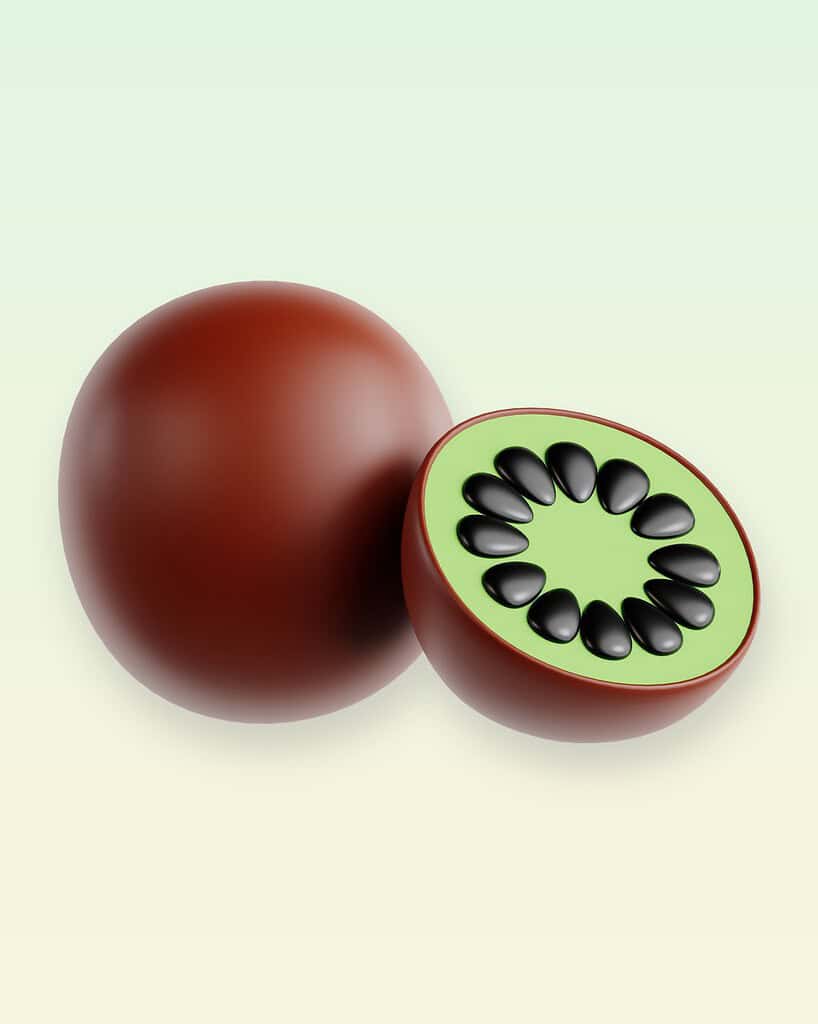
Every veterinary source we read lands on the same two instructions, so it is worth understanding why. The reasons are different for the skin and for the whole fruit.
Start with the skin. Kiwi skin is not toxic, and plenty of people eat it. PetMD explains that it is considered roughage, tough insoluble fiber that a dog’s digestive tract handles poorly, and that it may cause gas or other digestive discomfort. Rover’s Dr. Wayne Johnson, VMD, gives the same advice, saying kiwi skin can be tough and hard for dogs to digest, so always peel it first. The fuzz is also where dirt and sprays collect, which is why PetMD says to wash the fruit before you peel it. A dog that licks a slice of unpeeled kiwi off the floor is not in danger. A small dog that eats a whole unpeeled kiwi may have a rough night.
The whole fruit is the bigger concern, and it has nothing to do with chemistry. A green kiwi is about two inches long, firm, slick when peeled and almost exactly the size of a dog’s throat. PetMD states plainly that swallowing a whole kiwi could cause a dog to choke or even create an intestinal blockage. Rover’s Dr. Su points out that an excited dog may swallow the fruit whole rather than chewing it, which is exactly how retrievers and other food-motivated dogs eat. A large dog can inhale a kiwi in one motion; a small dog cannot fit one in its mouth but can get a half wedged where it should not be. Cutting the flesh into pieces no bigger than a sugar cube removes that risk, and it costs you ten seconds.
The seeds, by contrast, are a non-issue. PetMD says the tiny black seeds are not toxic and are too small to cause choking or a blockage, so there is no need to scrape them out. They pass through a dog the way they pass through you.
There is one more thing inside a kiwi that explains why some dogs lick their lips or paw at their mouth after a bite. Kiwi flesh contains needle-shaped crystals of calcium oxalate called raphides, along with a protein-digesting enzyme called actinidin. A 2013 study in the journal Foods by Nguyen and Savage measured about 19 milligrams of total oxalate per 100 grams in the pulp of ripe green kiwi, with much higher levels in the skin and seeds, and noted that the insoluble crystals cause the irritant factor food scientists call the catch, a prickling of the mouth’s mucous membranes. Earlier work by Perera and Hallett in New Zealand found that in fresh ripe fruit the crystals stay wrapped in mucilage and cause little or no irritation, but that juicing and drying expose their sharp ends and make the sting stronger. Actinidin, meanwhile, was identified in a 1998 study in the Journal of Allergy and Clinical Immunology as the major kiwi allergen in people. Neither has been studied as a hazard in dogs, and nothing suggests ripe kiwi flesh harms them, but the biology is a good reason to serve fresh fruit, not processed kiwi, and to start with a single piece.
Finally, the oxalate numbers matter for one group in particular. PetMD lists bladder stones among the conditions where fruit should be cleared with a veterinarian first, and calcium oxalate stones are a common type in dogs. If your dog has ever passed a stone, ask before you share kiwi.
How much kiwi can a dog eat?
PetMD and Rover both say that treats, fruit included, should make up no more than 10 percent of a dog’s daily calories. The American Animal Hospital Association’s 2021 nutrition guidelines supply the rest of the math: resting energy requirement is 70 times body weight in kilograms raised to the 0.75 power, multiplied by a life-stage factor of 1.4 to 1.6 for a neutered adult.
We ran that calculation for four weights using the 1.6 factor, took 10 percent as the treat budget, and converted it to raw kiwi at 61 calories per 100 grams. The table is our suggestion, not a prescription, and the right-hand column sits well below what the calories allow, because kiwi’s fiber and sugar upset a stomach long before the calories add up. A teaspoon-sized piece weighs about 5 grams and carries about 3 calories; a medium kiwi weighs 69 grams.
| Dog weight | Daily treat budget (10%) | Kiwi if it were the only treat | Our suggested serving (a few times a week) |
|---|---|---|---|
| 10 lb (4.5 kg) | About 35 kcal | About 57 g | 1 to 2 teaspoon-sized pieces |
| 25 lb (11.3 kg) | About 69 kcal | About 113 g | 2 to 4 pieces, about a quarter kiwi |
| 50 lb (22.7 kg) | About 116 kcal | About 191 g | 4 to 6 pieces, about half a kiwi |
| 80 lb (36.3 kg) | About 166 kcal | About 272 g | 6 to 8 pieces, up to one small kiwi |
Our numbers line up with the published vet guidance. PetMD suggests one or two small pieces for dogs under 20 pounds, up to six teaspoon-sized pieces for a medium dog and up to eight for a large dog, and Rover’s Dr. Johnson lands in the same place. The first serving should be smaller still: PetMD advises a single small bite, then watching for digestive upset before offering more.
Can dogs eat dried kiwi, kiwi juice or kiwi yogurt?
Fresh is the only form we would share. Dried kiwi concentrates the fruit’s sugar into a chewy piece a fraction of the size, and most commercial dried kiwi is sweetened on top of that. Rover’s Dr. Johnson says to give dogs only plain kiwifruit without added sugars or artificial ingredients and to avoid dried kiwi and kiwi-flavored products. Drying also, according to Perera and Hallett’s research, exposes the sharp oxalate crystals that ripe fresh fruit keeps wrapped, which is why dried kiwi stings the mouth more than a fresh slice.
Kiwi juice and kiwi-strawberry drinks are sugar water with the fiber removed, and the same researchers found that juicing breaks open the cells that hold those crystals. PetMD’s fruit guide says canned fruit in syrup should never be given to dogs because of the sugar, and the same logic applies to nectars, smoothies, sorbet and the sweetened fruit layer in flavored yogurt.
The real danger in this aisle is not sugar but what replaces it. The U.S. Food and Drug Administration warns that xylitol, a sweetener also labeled birch sugar or wood sugar, triggers a rapid insulin release in dogs that can drop blood sugar to dangerous levels within 10 to 60 minutes. The FDA lists sugar-free desserts, baked goods and some nut butters among products that have poisoned dogs. A sugar-free kiwi yogurt or a diet kiwi-strawberry drink is exactly the kind of label to read twice.
Let the person who finds your dog know about the no-fruit rule
A Shiloh’s House Smart Tag pairs laser-engraved acrylic with a “Tap Phone Here” NFC back, so a finder, sitter or neighbor taps the tag and sees your contacts, medical notes and feeding rules before anyone offers a kiwi slice to a diabetic dog. About $38 one-time, no subscription, no battery, waterproof, made in the USA, 30-day returns.
What should you do if your dog eats a whole kiwi or the skin?
Take a breath first. Kiwi is not poisonous, so the question is purely mechanical: how big is the dog, how big was the fruit, and did it go down whole? A 70-pound Labrador that gulped a peeled kiwi will almost always digest it without trouble. A 12-pound terrier that bolted a whole unpeeled kiwi deserves a phone call to the vet.
“It’s also a good idea to cut the kiwi into small pieces instead of giving it to your dog whole.”
Dan Su, DVM, board-certified veterinary nutritionist and manager of Nutrition Services for BSM Partners (Rover, 2024)
The signs of a choking dog are immediate: pawing at the mouth, gagging, retching without producing anything, drooling and panic. If your dog is struggling to breathe, that is an emergency right now. If the fruit went down and the dog seems fine, watch over the next day or two for a blockage, which PetMD names as the risk of a swallowed whole kiwi. Repeated vomiting, straining to pass stool or passing none, a tense belly, lethargy and refusing food are the classic signs. Our guide to what to do when your dog eats something it should not walks through that first hour.
The skin is a milder story. PetMD says it may cause gas or digestive discomfort, and Rover’s Dr. Su notes that too much kiwi fiber leads to diarrhea. Expect a gassy evening and possibly a soft stool. If diarrhea lasts more than a day, contains blood or comes with vomiting, call your veterinarian.
One more scenario is the first-time reaction. Rover’s veterinary sources say some dogs may be allergic to kiwi, with signs like frequent scratching, skin rashes, vomiting or diarrhea, and drooling and swelling in severe cases. Swelling around the muzzle or eyes is a same-day vet visit. Stop the kiwi either way.
Which dogs should skip kiwi?
For a healthy adult dog, a few pieces of peeled kiwi are an easy yes. For these dogs, ask the veterinarian first.
Dogs with diabetes. A medium kiwi carries about 6 grams of sugar, and PetMD specifically names diabetes as a condition where kiwi’s sugar may cause blood sugar spikes. Rover’s vets add kidney disease to that list.
Dogs with sensitive stomachs. PetMD says outright that if your dog is prone to digestive issues, it may be best to avoid kiwi altogether, because the fiber that helps constipation does the opposite in a touchy gut. Our guide to bananas for dogs covers a gentler, lower-fiber fruit for those dogs.
Dogs with a history of bladder stones. Kiwi is a moderate-oxalate fruit, and PetMD lists bladder stones among the conditions where fruit needs a vet’s okay. A dog on a stone-prevention diet should not be eating off-plan.
Dogs on prescription diets. PetMD’s standing rule is that dogs on a therapeutic diet should not be fed any food or treats outside it unless the veterinarian says so.
Puppies and small gulpers. Nothing in kiwi is unsafe for a puppy, but a small mouth and an eager appetite make a whole fruit or a big chunk more dangerous. Dice smaller than you think you need to.
Whatever the rule is for your dog, write it where other people will see it. In the free Lohji app from Shiloh’s House, you keep a live pet profile with contacts, medical notes and voice messages that a Shiloh’s House NFC tag links to, so a sitter or finder who taps the tag reads “diabetic, no fruit” or “sensitive stomach, kibble only” before anyone shares a snack. The app also makes cartoon Lohji avatars, stickers, wallpapers and slideshows of your pet, for as many pets as you have. Get it on the App Store or Google Play.
How does kiwi compare with apples, bananas, strawberries and mango?
Here is how kiwi stacks up against the other fruits pet parents reach for, raw, per 100 grams, from USDA FoodData Central’s SR Legacy records.
| Fruit (raw, per 100 g) | Calories | Sugars | Fiber | Vitamin C | Potassium | USDA FDC ID |
|---|---|---|---|---|---|---|
| Kiwifruit, green | 61 kcal | 9.0 g | 3.0 g | 92.7 mg | 312 mg | 168153 |
| Apple, with skin | 52 kcal | 10.4 g | 2.4 g | 4.6 mg | 107 mg | 171688 |
| Banana | 89 kcal | 12.2 g | 2.6 g | 8.7 mg | 358 mg | 173944 |
| Strawberries | 32 kcal | 4.9 g | 2.0 g | 58.8 mg | 153 mg | 167762 |
| Mango | 60 kcal | 13.7 g | 1.6 g | 36.4 mg | 168 mg | 169910 |
Kiwi wins the fiber and vitamin C columns by a wide margin and sits in the middle on sugar and calories. Strawberries are the lightest choice here, with about half the sugar of kiwi and a built-in portion size; see our guide to strawberries for dogs. Apples bring crunch and a seed-and-core question of their own, covered in apples for dogs. Mango is the sweetest of the five and has a pit to remove, as our mango guide explains. Pineapple shares kiwi’s prickly feel, and our pineapple guide gives the same small-portion advice.
The practical difference is in the prep. A strawberry or a banana slice is ready to hand over. A kiwi needs washing, peeling and dicing, and a whole one left on a low counter is a choking hazard that a strawberry never will be.
Frequently asked questions
Can dogs eat kiwi skin?
It is not toxic, but vets recommend against it. PetMD says kiwi skin is roughage that is hard for dogs to digest and may cause gas or digestive discomfort, and Rover’s Dr. Wayne Johnson, VMD, advises always peeling the fruit first. If your dog eats a bit of skin, expect nothing worse than a gassy evening.
Can dogs eat kiwi seeds?
Yes. PetMD says the tiny black seeds in a kiwi are not toxic and are too small to cause choking or an intestinal blockage, so there is no need to scrape them out. The seeds carry more oxalate than the pulp, according to a 2013 study in Foods, but they are under 2 percent of the fruit and pass straight through.
How much kiwi can I give my dog?
A few teaspoon-sized pieces a few times a week, scaled to size. Our suggestion, based on the 10 percent treat rule and AAHA’s energy formulas, is one or two pieces for a 10-pound dog, two to four for a 25-pound dog, four to six for a 50-pound dog and six to eight for an 80-pound dog. Start with one piece and watch for loose stools.
Can dogs eat dried kiwi?
Skip it. Dried kiwi concentrates the fruit’s sugar and is usually sweetened further, and Rover’s Dr. Johnson says to avoid dried kiwi and kiwi-flavored products, which may contain xylitol. Drying also exposes the sharp oxalate crystals that fresh fruit keeps wrapped, so it stings the mouth more.
Is kiwi good for dogs with constipation?
It can help a little. PetMD notes that kiwi’s high fiber and water content is why people use it for constipation, and that the same effect applies to dogs. A couple of peeled pieces may loosen things up, but too much tips into diarrhea. Constipation lasting more than a day or two is a vet question, not a fruit question.
Can puppies eat kiwi?
Yes, in tiny amounts once they are on solid food. Nothing in kiwi is unsafe for puppies, but small mouths and eager appetites make whole fruit and large chunks a choking risk, and puppy stomachs are easily upset. Peel it, dice it smaller than a pea, offer one or two pieces and wait a day before giving more.
Sources
- USDA Agricultural Research Service, “Kiwifruit, green, raw (SR Legacy, FDC ID 168153)”, USDA FoodData Central, 2019 — https://fdc.nal.usda.gov/food-details/168153/nutrients
- USDA Agricultural Research Service, “Apples, raw, with skin (SR Legacy, FDC ID 171688); Bananas, raw (173944); Strawberries, raw (167762); Mangos, raw (169910)”, USDA FoodData Central, 2019 — https://fdc.nal.usda.gov/food-details/171688/nutrients
- April Saylor, reviewed by Sandra C. Mitchell, DVM, DABVP, “Can Dogs Eat Kiwi?”, PetMD, 2023 — https://www.petmd.com/dog/nutrition/can-dogs-eat-kiwi
- Ellen Malmanger, DVM, reviewed by Sandra C. Mitchell, DVM, DABVP, “What Fruits Can Dogs Eat?”, PetMD, 2025 — https://www.petmd.com/dog/nutrition/what-fruits-can-dogs-eat
- Yvonne Villasenor, with Dan Su, DVM, and Wayne M. Johnson, VMD, “Can My Dog Eat Kiwi?”, Rover, 2024 — https://www.rover.com/blog/can-dogs-eat-kiwi/
- Matthew Kornya, DVM, “Vitamin C in Veterinary Medicine”, Canadian Veterinary Medical Association, 2023 — https://www.canadianveterinarians.net/related-resources/vitamin-c-in-veterinary-medicine/
- Hà Vũ Hồng Nguyễn and Geoffrey P. Savage, “Total, Soluble and Insoluble Oxalate Contents of Ripe Green and Golden Kiwifruit”, Foods, 2013 — https://pmc.ncbi.nlm.nih.gov/articles/PMC5302238/
- C.O. Perera and I.C. Hallett, “Characteristics of the Irritant (Catch) Factor in Processed Kiwifruit”, Acta Horticulturae, 1992 — https://www.actahort.org/books/297/297_90.htm
- Elide A. Pastorello et al., “Identification of actinidin as the major allergen of kiwi fruit”, Journal of Allergy and Clinical Immunology, 1998 — https://pubmed.ncbi.nlm.nih.gov/9564807/
- U.S. Food and Drug Administration, “Paws Off Xylitol; It’s Dangerous for Dogs”, FDA, accessed 2025 — https://www.fda.gov/consumers/consumer-updates/paws-xylitol-its-dangerous-dogs
- American Animal Hospital Association, “Energy Requirement Calculations (2021 AAHA Nutrition and Weight Management Guidelines)”, AAHA, 2021 — https://www.aaha.org/wp-content/uploads/globalassets/02-guidelines/2021-nutrition-and-weight-management/resourcepdfs/nutritiongl_box1.pdf