How to Measure a Dog for a Collar (Neck Size Chart, Width and the Two-Finger Rule)
 Shiloh’s House Team
·
·
16 min read
Measure around the middle of your dog’s neck with a soft tape where the collar sits, add about two inches, and buy a collar whose range puts that number near the middle. Once it is on, two fingers should slide flat underneath, and the collar should not pull over the ears. Measure twice, re-check monthly, weekly for a puppy, and after grooming or a weight change. A collar that fits is the only thing holding your dog’s ID tag on, so fit is lost-dog insurance, not fashion.
Last updated: September 2025
Why does collar fit decide whether your dog comes home?
Collar fit sounds like a comfort question. It is a recovery question. In the national survey above, 93 percent of lost dogs made it home, and one in seven of them came back because someone read the tag. A collar that slips over the head leaves the dog bare. So does one so tight it has to come off for rashes.
An earlier Ohio study by Linda Lord and colleagues, published in JAVMA in 2007, found that only 48 percent of lost dogs were wearing any identification when they went missing, and that dogs wearing a license tag were more likely to be recovered.
Veterinary behaviorist Stephanie Borns-Weil at Tufts University’s Cummings School puts it bluntly: harnesses are preferable for leash walking, and collars are best used only for holding tags. So we are sizing a tag holder: it has to stay on, stay comfortable and keep the ring where a finder can reach it. Our guide to the best dog collars covers the hardware itself.

How do you measure a dog’s neck for a collar?
You need a soft sewing tape, or string and a ruler, and a dog that is standing. A rigid tape or a lying-down dog both give the wrong number. The International Wildlife Coalition Trust’s collar-fitting guide and every manufacturer we opened use the same routine.
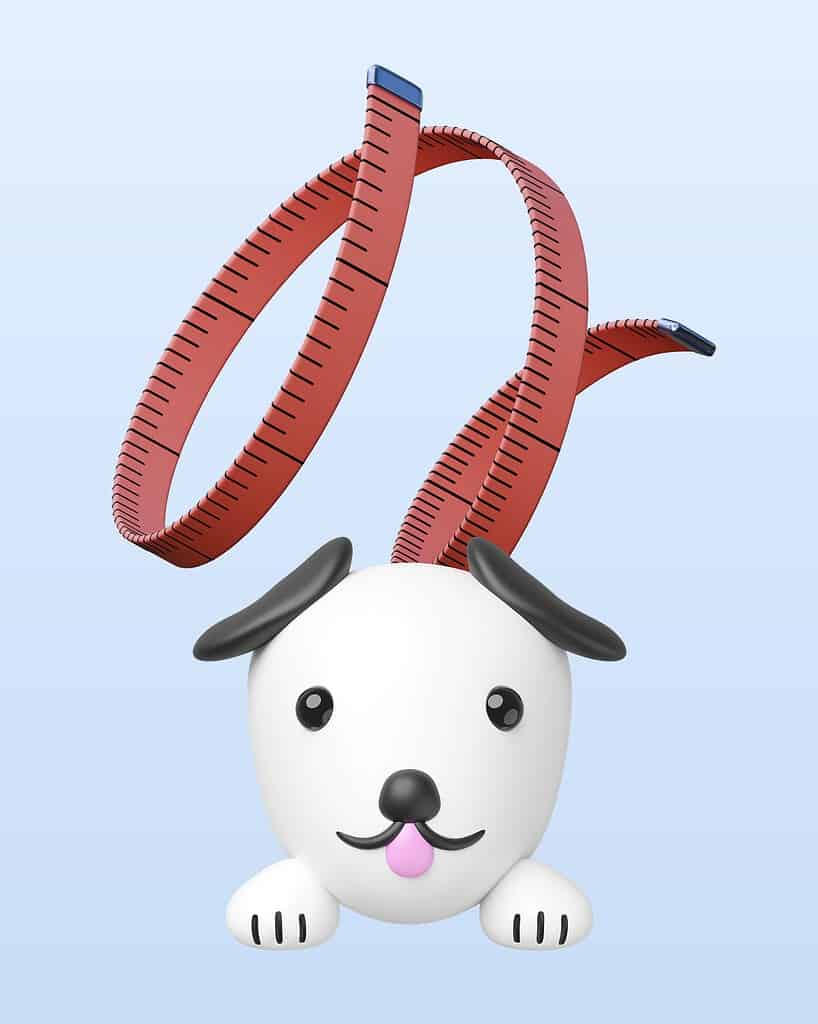
- Find the spot. Wrap the tape around the middle of the neck, below the ears and above the shoulders, where a collar naturally rests. Skip the narrow spot behind the ears unless you are sizing a martingale.
- Keep it snug, not tight. The tape lies flat on the coat without compressing it.
- Add room. The IWCT guide adds two inches for a standard dog, three for a large dog and one for a small one. That total is what the collar should measure at its middle hole.
- Measure twice. Take the tape off, let the dog shake, and measure again. If the numbers differ by more than half an inch, use the larger.
- Check it on the dog. Buckle the new collar, slide two fingers flat underneath, then try to pull it forward over the ears. It should not come off.
Posture matters. Dr. Barbara Hodges, a veterinary advisor with the Humane Society Veterinary Medical Association, told PetMD that skin and body fat redistribute when a dog sits or rolls over, so a collar that fits a standing dog may be too tight when it reclines. Repeat the two-finger test lying down.
What size collar does your dog need by weight?
Weight is a rough proxy for neck size, and most retailers sell by it. Here is PetSmart Canada’s published collar chart, which pairs neck range, strap width and weight for each size. Weight is the starting point and neck is the deciding number; a 50-pound Greyhound and a 50-pound Bulldog have very different necks.
| Collar size | Neck | Dog weight | Strap width | Example breeds (per chart) |
|---|---|---|---|---|
| XX small | 6 to 8 in | Up to 5 lb | 5/16 in | Chihuahua, teacup Yorkie |
| Extra small | 8 to 12 in | 5 to 10 lb | 3/8 in | Mini Dachshund, Maltese, Pomeranian, Toy Poodle, Yorkie |
| Small | 10 to 14 in | 10 to 25 lb | 5/8 in | Cavalier, Pekingese, Mini Schnauzer, Pug, Scottie |
| Medium | 14 to 20 in | Up to 55 lb | 3/4 in | Beagle, Border Collie, Boston Terrier, English and French Bulldog |
| Large | 16 to 26 in | Up to 75 lb | 1 in, 2-ply | Boxer, Dalmatian, Golden, Lab, Weimaraner |
| Extra large | 24 to 30 in | 75 lb and up | 1.5 in, 2-ply | Bernese, Great Dane, Mastiff, Rottweiler, Saint Bernard |
Notice how the width climbs with the dog. A wider strap spreads leash pressure across more neck, which is why the IWCT guide calls 1.5 inches a standard width, suggests wider for bigger dogs that pull, and recommends narrower straps for small dogs so the neck can still turn.
Width also sets the tag: one wider than the strap flops and snags. Our guide to choosing the right size pet tag goes deeper.
What is the average neck size by breed?
Breed charts are a sanity check, not a measurement. This table is drawn from the size chart published by collar maker Trish Hampton, which lists typical adult neck and weight ranges by breed.
| Breed | Typical adult neck | Typical adult weight |
|---|---|---|
| Yorkshire Terrier | 6 to 12 in | 6 to 9 lb |
| Chihuahua | 8 to 14 in | 2 to 6 lb |
| French Bulldog | 12 to 16 in | 18 to 28 lb |
| Beagle | 12 to 18 in | 18 to 30 lb |
| Border Collie | 14 to 18 in | 30 to 45 lb |
| Boxer | 16 to 22 in | 55 to 75 lb |
| Labrador Retriever | 18 to 24 in | 55 to 75 lb |
| German Shepherd | 18 to 24 in | 65 to 95 lb |
| Great Dane | 20 to 26 in | 125 to 135 lb |
| Rottweiler | 24 to 30 in | 100 to 120 lb |
The ranges overlap so much that breed alone cannot pick a size: a 16-inch neck could be a Beagle, a Boxer or a small Golden. The giants run past 30 inches, where many brands stop. Measure first, then shop for a collar that lists your number, and if you own a giant, read our notes on ID tags for large dogs.
A collar that fits deserves a tag a finder can use in one tap
A Shiloh’s House Smart Tag is laser-engraved premium acrylic with a “Tap Phone Here” NFC back. A finder taps it with any modern phone and sees your live profile with contacts, medical notes and voice messages, so the collar you just sized carries more than a phone number. About $38 one-time, no subscription, no battery, waterproof, scratch-resistant, UV-stable, made in the USA, 35 designs, 30-day returns.
How do flat collars, martingales and harnesses fit differently?
A flat buckle collar is the default tag holder, and it is sized by one number: the neck circumference you just took, plus the one to three inches of room described above. On a standing dog it should sit in the middle of the neck, lie flat without twisting, and pass the two-finger test from both sides. Then do the pull test. Hold the collar at the back and draw it gently forward toward the ears. If it clears the skull with modest pressure, it is too loose for a dog that stops short on a walk, and a dog that backs out of a collar on a sidewalk is a lost dog with no tag. Tighten one hole and test again.
A martingale, sometimes called a limited-slip or Greyhound collar, is built for dogs whose heads are narrower than their necks: sighthounds, some shepherds, many slim-skulled mixes. It has a large loop that goes around the neck and a small control loop that the leash clips to. When the dog pulls back, the small loop draws the large loop snug, just enough to stop the collar sliding over the head, and no further.
Sizing one takes two measurements. The Edmonton Humane Society’s 2023 fitting guide says to adjust the large loop so it slips over the head, pull the collar up right behind the ears, the narrowest point, and set it so two fingers slide underneath there. When you lift the leash ring, the small loop closes and the collar should not choke. At rest the martingale settles around the middle of the neck. Guides disagree on one detail: Edmonton says the two metal slides should touch when the loop closes, while sighthound collar makers such as The Trendy Whippet say they should come close but never touch, because touching means the collar is too loose. Either way, if it still passes over the ears with the loop closed, it is too loose.
Ruffwear gives the same instruction in its 2024 sizing guide: a martingale should fit comfortably when relaxed and tighten appropriately under tension, preventing escape without harm. Martingale fabric stretches over months, so re-fit it more often than a buckle collar, and the Edmonton guide cautions that the hardware can catch when a dog is unsupervised, a reason to treat it as walking gear rather than an all-day tag holder.
A harness is measured somewhere else entirely. Ruffwear’s guide is explicit: wrap the tape around the widest part of the rib cage, just behind the front legs, and use that chest girth to pick the size. Its harness bands run from 9 to 13 inches at the smallest up to 36 to 42 inches, and the company says a growing dog between sizes should go up. Neck circumference is a secondary number on many harnesses, so take both. Fit a harness so the chest strap sits behind the elbows, not in the armpit, the back plate lies flat, and two fingers fit under every strap. Too loose and it rotates when the dog pulls; too tight and it rubs bald patches behind the front legs.
The practical arrangement for most families is both: a harness for the leash, because Tufts’ behaviorists note that throat pressure can impair breathing in flat-faced breeds and aggravate collapsing trachea in small dogs, and a fitted flat collar for the tag. Our tested picks are in our guide to the best dog harnesses.
How can you tell if a collar is too tight or too loose?
Your dog will tell you before the tape does. Here are the signs veterinarians and fitting guides point to, in both directions.
- Hair loss or a worn ring in the coat. Dr. Hodges told PetMD that even a moderately tight collar causes skin irritation, hair loss and skin more prone to infection.
- Coughing or gagging on the leash. The IWCT guide warns that a collar left too tight can damage the muscles and trachea and cause a dog to choke. Loosen it, and move the leash to a harness.
- Constant scratching at the neck. Hodges says many clients wonder why their dog keeps scratching when the cause is low-grade irritation from the collar.
- A collar that pulls over the head. Too loose. IWCT notes a loose collar can slip off on a walk, putting the dog in danger of traffic and of being lost.
- A leg, jaw or tooth caught in it. Also too loose. Hodges describes dogs looping a leg through a slack collar while scratching, which can break a limb, and catching teeth in it while grooming.
“If I can get my whole hand in there, it’s too loose, and if I can’t even wedge a finger in there, it’s too tight.”
Dr. Barbara Hodges, veterinary advisor, Humane Society Veterinary Medical Association (PetMD, 2018)
Between those extremes, two fingers for a medium or large dog and one finger for a toy breed is where nearly every source lands. The too-loose failures are the ones that lose dogs, and they are usually made on purpose, by buying a collar to grow into.
How do you size a puppy collar and when should you re-measure?
Puppies get a shorter clock on every rule above. Size the collar for the puppy you have, not the dog it will become. Ruffwear’s advice for growing dogs is to fit from current measurements, choose the larger size when truly between two, and expect to replace gear, since many large breeds do not finish growing until 12 to 18 months.
Then check often. The IWCT guide says puppy collars may need adjusting every week, and that a puppy will go through several collars before it is grown. PetMD’s Dr. John Pacy describes the worst case, a puppy-sized collar left on a growing dog until it cuts into the neck. It only takes a busy month, so put the check on a schedule.
| Dog | Two-finger check | Re-measure with tape | Also re-check after |
|---|---|---|---|
| Puppy under 6 months | Every time the collar goes on | Weekly | Any growth spurt, first groom |
| Puppy 6 to 18 months | Weekly | Every 2 weeks; monthly for small breeds after 9 months | Neuter, diet change, coat blow |
| Adult | Monthly | Twice a year | Grooming, 5 percent weight change, new collar |
| Senior | Monthly | Quarterly | Muscle loss, illness, new medication |
The schedule is our suggestion, built from the IWCT’s weekly puppy checks, Ruffwear’s growth window and Dr. Hodges’ advice to re-check fit regularly. Grooming is the check people forget: a doodle that leaves the groomer with an inch less coat is wearing a collar an inch looser. For the tag side, see when a puppy can wear an ID tag.
When should the collar come off, and what about cats?
Night is a judgment call. Dr. Hodges recommends letting a dog sleep without a collar to let the skin air out, provided the dog is microchipped. We walk through the trade-offs in should you take your dog’s collar off at night.
Cats are different in two ways. Their collars should be breakaway, and the fit test is the same two fingers on a much smaller neck. The best evidence is a 2010 JAVMA trial of 538 pet cats by Linda Lord and colleagues: 72.7 percent wore a collar for the full six months, but 3.3 percent caught a forelimb in the collar, caught it on an object or got it in their mouth, and in every one of those incidents involving a breakaway buckle, the collar did not break away as designed. So buy breakaway, fit it to two fingers, and check it. The buckle is a backup, not a guarantee.
How should the ID tag attach to the collar or harness?
Every ID collar has a small ring, usually beside the D-ring or sewn onto the strap. Hang the tag there, not on the leash D-ring, so the leash clip never pries the tag ring open. Use a split ring, the tiny key-ring style, pushed all the way around. An S-hook has to be crimped fully shut with pliers; LuckyPet, a tag manufacturer, stopped shipping S-hooks after two dogs hooked a partially closed one into an eyelid. Attach the split ring directly to the collar ring, with no jump ring in between, so there is one less link to open. Our piece on why dog tags fall off covers the hardware failures.
Match the tag to the strap. A tag wider than a 5/8-inch strap on a 10-pound dog will flip and chip; a dime-sized tag on a 1.5-inch Mastiff collar is unreadable from standing height. Kissamo pairs tag height with collar size on its size guide, roughly 1 inch of tag for a 9-to-10.5-inch collar and 1.3 to 1.5 inches for a 17.5-to-19.5-inch collar, a sensible scale for any brand.
If the dog wears a harness for walks and nothing at home, put a tag on the harness too. Most harnesses have a ring on the back plate, and Kissamo’s FAQ notes that a tag there also stays away from a puppy’s teeth. The catch is that a harness comes off at the door, which is when a dog bolts, so the harness tag supplements a collar tag. We cover the setups in putting a dog ID tag on a harness.
Keep the information behind the tag current, because a perfectly fitted collar with an old phone number is a decoration. In the free Lohji app from Shiloh’s House, you keep a live pet profile with contacts, medical notes, voice messages and behavior notes that a Shiloh’s House NFC tag links to, so a new number after a move takes seconds and no re-engraving. It also turns pet photos into cartoon Lohji avatars, stickers and mini movies. Get it on the App Store or Google Play.
Frequently asked questions
How do I measure my dog’s neck for a collar?
Stand the dog up and wrap a soft tape, or string you then lay against a ruler, around the middle of the neck where a collar rests. Keep it snug on the coat without pressing in, then measure again. Add about two inches, one for a small dog and three for a large one, and buy a collar whose range puts that total near its middle.
How tight should a dog collar be?
Two flat fingers should slide between the collar and the neck on a medium or large dog, one finger on a toy breed, and the collar should not pull forward over the ears. Dr. Barbara Hodges of the Humane Society Veterinary Medical Association puts it simply: a whole hand underneath is too loose, and not even a finger is too tight. Check with the dog lying down too.
What size collar does a 50-pound dog need?
Usually a medium or large with a 3/4-inch to 1-inch strap, but weight is only a hint. PetSmart’s chart puts a medium at 14 to 20 inches of neck and a large at 16 to 26, and a 50-pound Greyhound and a 50-pound Bulldog sit at opposite ends of that spread. Measure the neck and choose by the number; use weight for the strap width.
How often should I check my dog’s collar fit?
Monthly for an adult, with a tape measurement twice a year, and after any grooming or a noticeable weight change. For a puppy, do the two-finger check every time the collar goes on and re-measure weekly, because the IWCT fitting guide says young dogs may need adjusting every week. Martingales stretch, so re-fit those more often.
Should my dog wear a collar in the crate?
No. The Atlanta Humane Society advises removing the collar in the crate because it can snag on the frame and choke the dog, and PetMD’s Dr. John Pacy says hanging tags are especially prone to catching on crate wire. Hang the collar on the crate and rely on the microchip while the dog is inside.
Does a cat collar fit the same way as a dog collar?
The two-finger test is the same, but a cat’s collar should be a breakaway style with a light, small tag. In a 2010 JAVMA trial of 538 cats, nearly three quarters wore a collar for six months, but about 3 percent caught a leg, mouth or object in it, and the breakaway buckles involved did not release. Check it often and treat the buckle as backup.
Sources
- Emily Weiss, Margaret Slater and Linda Lord, “Frequency of Lost Dogs and Cats in the United States and the Methods Used to Locate Them”, Animals, 2012 — https://www.mdpi.com/2076-2615/2/2/301
- Linda K. Lord, Thomas E. Wittum, Amy K. Ferketich, Julie A. Funk and Päivi J. Rajala-Schultz, “Search and identification methods that owners use to find a lost dog”, Journal of the American Veterinary Medical Association, 2007 — https://avmajournals.avma.org/view/journals/javma/230/2/javma.230.2.211.xml
- Linda K. Lord, Brenda Griffin, Margaret R. Slater and Julie K. Levy, “Evaluation of collars and microchips for visual and permanent identification of pet cats”, Journal of the American Veterinary Medical Association, 2010 — https://avmajournals.avma.org/view/journals/javma/237/4/javma.237.4.387.xml
- Lindsay Lowe, with Barbara Hodges, DVM, and John Pacy, DVM, “5 Ways Collars Can Harm Your Dog”, PetMD, 2018 — https://www.petmd.com/dog/care/5-ways-collars-can-harm-your-dog
- International Wildlife Coalition Trust, “How to fit a dog collar”, IWCT Education Programme, undated (archived July 2025) — https://iwct-uk.org/education/collar-fitting-guide/
- Cristina Stavro, “The Size is Right: How to Measure for Your Dog’s Gear”, Ruffwear, 2024 — https://ruffwear.com/blogs/explored/the-size-is-right-how-to-measure-for-your-dogs-gear
- PetSmart Canada, “Dog collar size chart”, PetSmart, undated (archived March 2025) — https://www.petsmart.ca/help/sizing-charts-H0012b.html
- Trish Hampton, “Size Chart for Dog Collars, Harnesses, Bandanas”, Trish Hampton, undated (archived February 2024) — https://trishhampton.com/pages/size-chart
- Amanda Buzzell, “Dog Resource Guide: Martingale Collars”, Edmonton Humane Society, 2023 — https://www.edmontonhumanesociety.com/wp-content/uploads/2024/05/2023-Martingale-Collars-EHS-Resources.pdf
- Nicole Pitts, “The ‘Crate’ Escape: How to Crate Train”, Atlanta Humane Society, 2023 — https://atlantahumane.org/blog/the-crate-escape-how-to-crate-train/
- Stephanie Borns-Weil, DVM, DACVB, “Dog Collars and Harnesses: Five things to know”, Cummings School of Veterinary Medicine at Tufts University, 2022 — https://vet.tufts.edu/news-events/news/dog-collars-and-harnesses
- LuckyPet, “The Best Way to Attach Cat & Dog ID Tags to a Collar”, LuckyPet, 2018 — https://www.luckypet.com/blogs/news/the-best-way-to-attach-your-pets-tag-to-a-collar
- Kissamo, “Size Guide” and “FAQ”, Kissamo, undated (archived August 2025) — https://www.kissamo.com/size-guide
- The Trendy Whippet, “Measuring for Martingale Collars”, The Trendy Whippet, 2017 — https://www.thetrendywhippet.co.uk/martingale-collars/