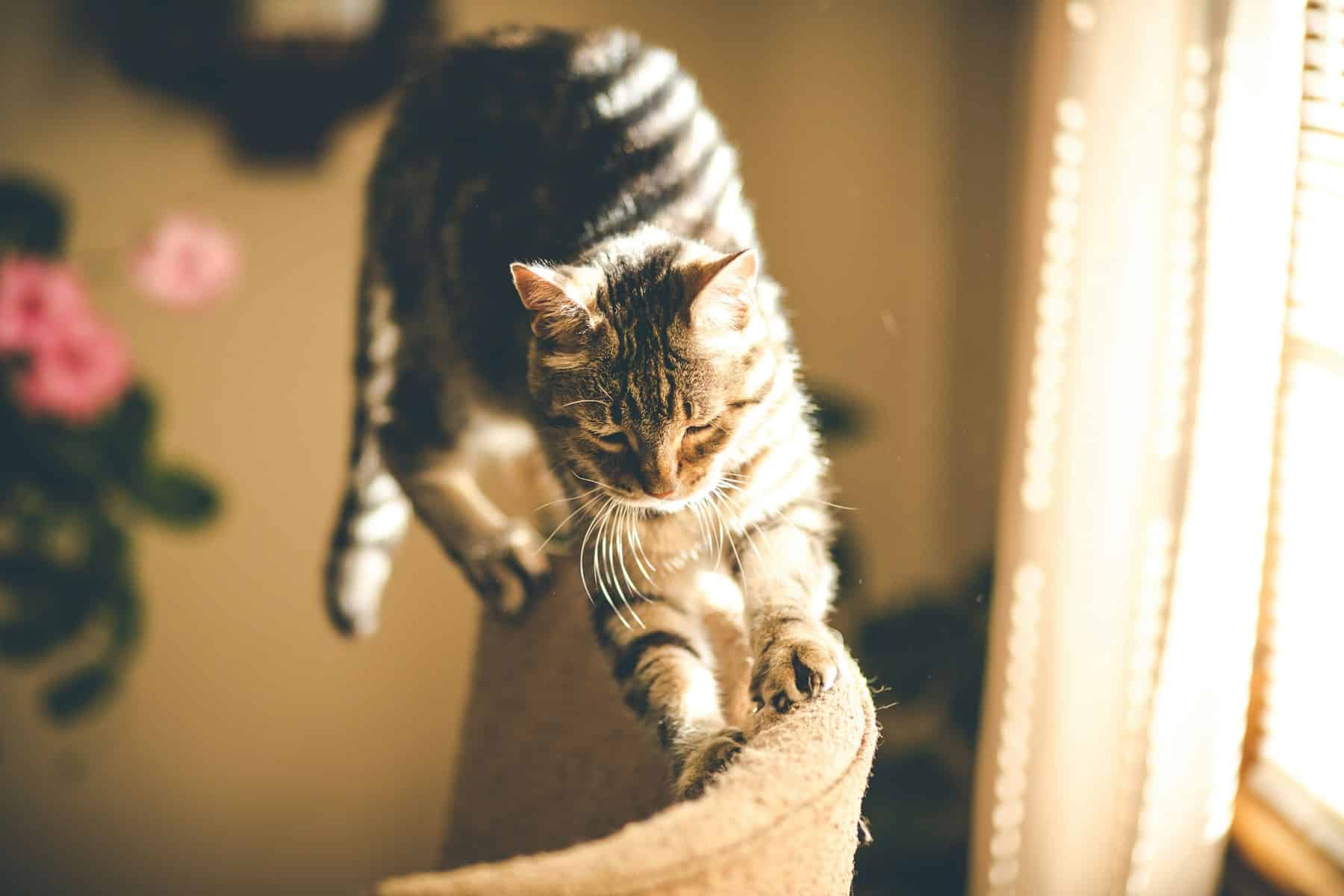
You stop a cat from scratching furniture by giving them a better place to scratch right next to the spot they already use, making the furniture itself unpleasant, and rewarding the switch — not by punishing them. Scratching is not misbehavior. Cats scratch to shed nail sheaths, stretch their whole spine, and leave scent from glands in their paws. You cannot train it away, and you do not want to. You redirect it. Here are the eight fixes that actually work, in the order to try them.
Why your cat scratches the couch in the first place
Because the couch is exactly what a good scratching surface should be: tall, sturdy, textured, and in the middle of everything. Cats pick scratching spots that do not wobble, that let them stretch fully, and that sit in high-traffic areas where their scent marking gets seen. A wobbly 16-inch carpeted post shoved in a spare bedroom loses that contest every time. Cats also scratch more when they are aroused or unsettled — after play, after a stranger visits, when a new pet arrives — which is why the problem often spikes after a change at home.
8 fixes that actually stop furniture scratching
1. Put the right post directly in front of the wrong spot
Not across the room. Directly in front of the arm of the couch they are shredding. Cats scratch where they scratch for a reason, and the replacement has to occupy the same real estate. Once they are reliably using it, you can inch it a few feet away over several weeks.
2. Match the surface and the angle they already chose
Watch what they attack. A cat working the vertical side of the sofa wants a tall vertical post; a cat shredding the rug wants a flat cardboard or sisal pad on the floor. Sisal rope and bare cardboard are the two surfaces most cats choose over carpet. If you have a multi-cat home, expect to need more than one style. Our roundup of the best cat scratching posts of 2026 breaks down which surfaces suit which scratchers.
3. Go taller and heavier than you think you need
A post has to be tall enough for a full stretch — roughly 30 inches or more for an adult cat — and heavy enough that it does not tip or shift. Any wobble tells the cat this surface is unsafe, and they go straight back to the couch, which never moves. This is the single most common reason a new post gets ignored.
4. Make the furniture boring and slightly unpleasant
Double-sided sticky tape, a slick furniture-protector panel, or a plastic guard on the corner removes the payoff. Cats dislike sticky paws. Keep the deterrent on for several weeks after they stop — pulling it off too early usually restarts the habit. Skip anything that scares them; the goal is a surface that is dull, not a cat who is anxious.
5. Reward the post the second they touch it
Keep treats near the post. The moment a paw lands on it, mark it and pay. You can also drag a wand toy up the post so they end up gripping it, then reward. A sprinkle of catnip or a silvervine spray on the post accelerates this for the roughly two-thirds of cats who respond to catnip.
6. Trim nails every 2 to 3 weeks
Blunt nails do far less damage even when a cat does sneak a scratch. Take only the clear tip, well ahead of the pink quick. If your cat will not tolerate clippers, ask your vet or groomer to do it and to show you the angle.
7. Try soft nail caps for stubborn cases
Vinyl nail caps glue over the claw and blunt it for four to six weeks. They are not a substitute for a good post and they are not right for every cat, but for a cat destroying an heirloom while you build the new habit, they buy time humanely. Have your vet fit the first set.
8. Fix the stress, not just the furniture
If scratching ramped up suddenly, look for a trigger: a new pet, a move, a change in your schedule, a cat outside the window. Add vertical space, predictable play sessions before meals, and, if needed, a pheromone diffuser. We compare the options in our guide to the best cat calming aids of 2026, and more territory usually helps too — see the best cat trees of 2026.
What works, what does not, and how fast
| Approach | Does it work? | Typical time to see change |
|---|---|---|
| Tall sisal post placed at the problem spot | Best single fix | Days to 2 weeks |
| Double-sided tape on the furniture | Works as a pair with a post | 1 to 3 weeks |
| Nail trims every 2 to 3 weeks | Reduces damage, not the behavior | Immediate |
| Catnip or silvervine on the post | Helps for cats who respond | Same day |
| Spray bottle or yelling | No — teaches fear of you, not of the couch | Backfires |
| Declawing | No — amputation, widely opposed by vets and banned in many places | Not recommended |
The two mistakes that keep this going
Punishing after the fact, and hiding the post. Cats do not connect a scolding with something they did thirty seconds ago; all they learn is that you are unpredictable. And a post tucked behind a door is a post that does not exist. If the post is somewhere you find slightly annoying, it is probably in the right place.
While you are down there checking their collar
Cats who scratch hard also work at their collars, and collar tags take a beating from all that stretching and gripping. Here is our honest bias, since we make one: the Shiloh’s House tag is a $38 designer acrylic NFC smart ID tag — lightweight enough for a cat, engraved on the back as a backup, and tappable by any phone with no app needed on the finder’s end and no subscription. If your cat is an indoor cat, that matters more, not less: indoor cats are the ones with no street sense who slip out during a delivery.
Frequently asked questions
Why does my cat scratch the couch and not the scratching post?
Almost always because the post is too short, too wobbly, the wrong texture, or in the wrong room. Cats want a stable surface tall enough for a full-body stretch, in a social part of the house. Move the post to the exact spot they are using and the problem usually solves itself.
Does aluminum foil stop cats from scratching furniture?
Sometimes, briefly. Foil and plastic carpet runners work as short-term deterrents, but they only redirect if there is a better option a foot away. Double-sided tape tends to work better and looks less like a science experiment in your living room.
How many scratching posts does a cat need?
At least one per cat plus one, and more than one type. A common setup is a tall vertical sisal post in the main living area, a flat cardboard scratcher near where they sleep, and a horizontal one by the rug they like.
Should I declaw my cat to stop the scratching?
No. Declawing removes the last bone of each toe; it is opposed by major veterinary organizations and banned or restricted in many places. It is also linked to lasting pain, litter box avoidance, and biting. Posts, tape, trims, and nail caps solve the problem without it.
Is scratching a sign my cat is stressed?
It can be. Normal scratching is routine and spread through the day. A sudden spike, especially with hiding, over-grooming, or litter box changes, usually points to a trigger — a new pet, a move, or something outside the window. That is worth addressing directly.
Do kittens grow out of scratching furniture?
No, but kittens are the easiest cats to redirect. Set up the right posts before the habit forms and reward every use, and you generally never fight this battle at all.
Get Your Tag
A lightweight acrylic NFC tag your cat will actually wear — one tap on any phone, engraved backup, no subscription.