Your cat hisses to say “back off.” A hiss is a defensive warning, usually driven by fear or feeling threatened rather than hostility: a new pet or person, unwanted handling, a vet trip, a strange smell or pain. Give your cat space, never punish or hiss back, and call your vet if a usually calm cat starts hissing out of nowhere.
What does it mean when a cat hisses?
A hiss sounds hostile, but it rarely means “I want a fight.” PetMD’s veterinarian-written guide calls hissing a normal way for cats to express fear, more defensive than offensive, whether it’s aimed at another animal or at you. The message is simple: I need space from whatever I’m hissing at.
The sound is a sudden burst of air pushed out through the open mouth, which PetMD compares to a snake’s hiss or air leaking from a car tire. Hisses range from a silent, open-mouthed display to a full hiss with spitting.
Cats usually prefer to avoid physical confrontation, so the hiss is designed to scare humans and other animals away before this happens.
Cats Protection
Cats Protection, the UK cat welfare charity, notes that cats usually show subtler warning signs first and tend to hiss when those are missed. The hiss is a last resort, not proof your cat dislikes you, though a cat that hisses regularly is under real stress.
International Cat Care calls hissing, growling, spitting and swiping “repelling behaviours”: signs a cat feels anxious, afraid or frustrated and wants more distance from a threat. They don’t make a cat “aggressive.” The cat is trying to keep itself safe or protect something it values, like food, a resting spot or the litter box.

Why is my cat hissing at me?
Most hissing aimed at people comes down to handling, smells or fear. PetMD’s list includes being petted or picked up when they don’t want it, small children who don’t know when to stop, grooming, nail trims, the carrier, being touched where it hurts, the vacuum, and the smell of an unfamiliar dog or cat on you.
Petting can tip over, too. The ASPCA describes petting-induced aggression as a cat who enjoys being stroked, then suddenly feels irritated, nips and runs off; Cornell’s Feline Health Center lists overstimulation as one possible explanation. Watch for the ASPCA’s early warning signs: a twitching or flipping tail, ears flattening or rotating back and forth, restlessness and dilating pupils. When your cat signals you to stop, stop. Our guide to why cats bite covers petting bites in more detail.
Sometimes you’re just the nearest target. In redirected aggression, a cat gets worked up by something it can’t reach, most often another cat seen through a window, and turns on whoever comes close; VCA Animal Hospitals lists hissing and growling among the signs. The ASPCA warns that the outburst can come hours after the trigger, which is why it can feel “out of the blue.”
Fear covers much of the rest. Cornell notes that fear aggression can follow anything unfamiliar, like a new person, animal or noise, or anything a cat links with a bad experience, such as a trip to the veterinarian.
Why is my cat hissing at the new kitten, the other cat or the dog?
Cats are territorial, and the ASPCA’s territorial triggers include a new cat joining the household and big changes such as moving house or someone moving in. PetMD says resident cats may hiss at a new kitten to set boundaries, especially when the kitten keeps pushing the older cat’s limits, and that hissing between cats is often a sign one wants to avoid a physical fight, not that it’s taunting the other.
Mother cats are a special case. PetMD notes that a female with kittens may hiss, growl or swat at a cat that approaches, even one she used to get along with, and the ASPCA says mothers can be especially protective in the first few days after birth. Cornell advises a quiet space and few visitors, and notes that this usually eases as the kittens grow more independent.
With dogs, the hiss is a request for distance, since cats generally don’t like confrontation with other animals, PetMD notes. International Cat Care advises giving the cat elevated perches and routes to food, water and litter that avoid the dog, keeping the dog on a loose lead early on, and never punishing either animal for reacting.
The fix in every case is a slower introduction. International Cat Care’s method starts with a separate room for the newcomer, then scent swapping with bedding, then short sessions of seeing each other through a barrier such as a stair gate. Hissing at that stage means slow down, not scold, and Cornell says the process can take weeks to months. Our step-by-step guides cover how to introduce two cats and how to introduce a cat to a dog.
Not tagged yet?
A frightened cat’s first instinct is usually to escape, and an open door during a move or a tense introduction is all it takes. A Shiloh’s House smart tag puts your phone number and your cat’s profile and medical notes one tap away for whoever finds them, with your number laser-engraved on the back as a backup. No battery, no subscription, and the finder doesn’t need an app.
Cat hissing for no reason? Rule out pain and illness
Hissing that seems to come from nowhere usually has a reason you haven’t spotted: redirected arousal from something your cat saw or smelled earlier, or pain. Cats Protection says a cat hissing when no people or animals are around is very unusual and worth raising with your vet, and that hissing when you touch one particular spot can mean it hurts.
PetMD calls pain one of the less common reasons for hissing, and says a vet exam is how you tell pain from fear. Cornell says the first step with any aggressive cat is ruling out medical causes such as hyperthyroidism, osteoarthritis, dental disease and central nervous system problems, and notes that cats with osteoarthritis may hiss, bite or scratch when their joints are handled. The ASPCA adds that even a well-socialized, normally gentle cat can lash out when something hurts.
What to do when your cat hisses
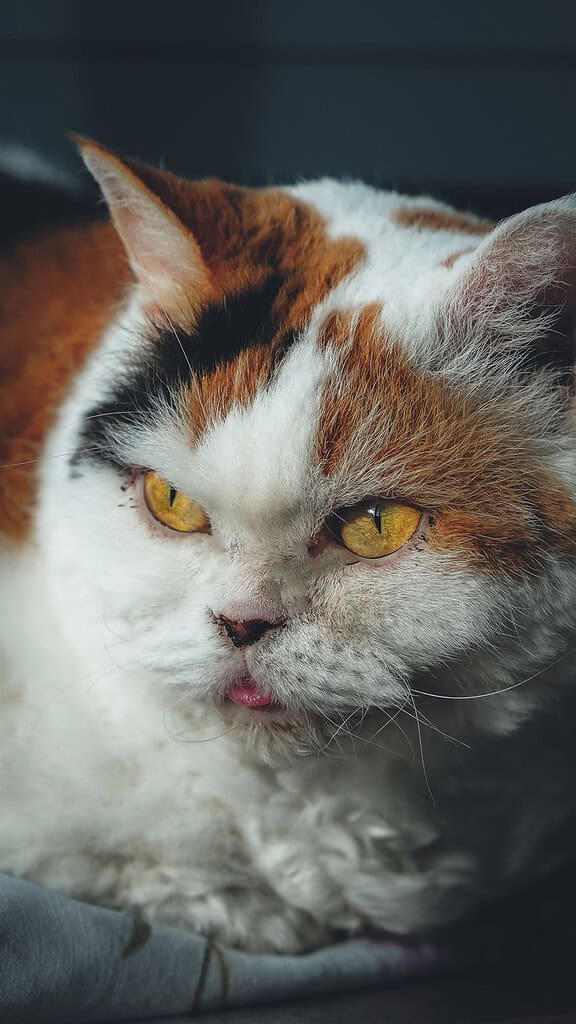
A hiss isn’t an attack, but it’s the warning before one, and Cornell notes that aggression can end in injuries or a cat losing its home. Respond well, and the warning stays a warning.
Back off first. PetMD advises stepping away, letting the cat hide, and not staring at them or trying to hold or comfort them. Cats Protection explains that frightened cats don’t want comforting, and that cuddling a stressed cat can push them to attack if they can’t get away. The ASPCA’s rule of thumb for any cat in a threat posture is not to touch, reassure or punish.
Make escape easy with high places such as cat condos and perches, as PetMD suggests, and let a nervous cat start any contact so they feel in control, as International Cat Care recommends. If your cat is hiding most of the day, our guide to why cats hide covers when it becomes a warning sign.
Give it time. VCA notes that a highly aroused cat may need minutes, hours or occasionally days to settle, ideally in a quiet, darkened room. Once your cat is calm, coax them out with treats, catnip or a toy, as PetMD suggests. Then work on the trigger: block the window view of outdoor cats, keep petting short, and never reach between fighting cats; Cornell suggests a barrier such as a baby gate or a piece of cardboard.
Should I hiss back at my cat?
No. Cats Protection says hissing back at a cat that has just hissed at you is likely to scare them and raise their stress, which can lead to more hissing or even an attack. Stay quiet and leave them alone for a while instead.
The same goes for punishment of any kind. Cats Protection says a punished cat won’t understand why and will only become more scared or stressed, Cornell warns that physical punishment can increase a cat’s fear and worsen aggression, and the ASPCA calls painful punishment ineffective.
The one place a person hissing shows up in veterinary advice is rough play: for play aggression, Cornell lists a brief, startling noise, such as a puff of compressed air or a person hissing, to interrupt the cat, with the goal of distracting it rather than scaring it. A frightened cat warning you off is a different situation, and the right answer there is distance.
Cat hissing body language: what goes with a hiss
The rest of the body tells you what kind of warning a hiss is. The ASPCA divides threat postures into defensive, where a cat tries to look smaller, and offensive, where it tries to look bigger. For what the tail is saying, see our guide to cat tail language.
| What you see with the hiss | What it usually means | Your move |
|---|---|---|
| Crouched low, head tucked, tail wrapped around the body, ears flattened, pupils wide | Fear; a defensive cat that wants distance | Back away, keep exits open, let them hide |
| Standing tall and stiff, rear end raised, direct stare, pupils narrow, growling | An offensive threat; an attack may follow | Don’t approach or reach in; remove or block the trigger |
| Tail flicking, ears rotating back, restless, pupils widening during petting | Overstimulated; a nip may be next | Stop petting and let them leave |
| Fixed on a window, hissing or growling at an animal outside | Highly aroused; risk of redirected aggression | Don’t touch; let them settle somewhere quiet and dark |
| Hissing when one spot is touched, or hissing that’s new for your cat | Possible pain or illness | Book a vet visit |
Frequently asked questions
Why is my cat hissing at me all of a sudden?
Common causes are unwanted petting or handling, the smell of another animal on you, a scare, or redirected arousal from an outdoor cat seen through a window, which can surface hours later. Pain is another. If hissing is new or comes with poor appetite, low energy or hiding, see your vet.
Should I hiss back at my cat?
No. Cats Protection advises against it, because hissing at a cat that’s already warning you is likely to scare them and make them more stressed, which can lead to more hissing or an attack. Stay quiet, back away and let them calm down.
Is it normal for my cat to hiss at a new kitten?
Some hissing is normal. PetMD notes that resident cats may hiss to set boundaries, especially with a pushy kitten. Introduce them gradually, starting with separate rooms, and slow down if the hissing continues. Cornell says introductions can take weeks to months.
Does hissing mean my cat is aggressive?
Not on its own. International Cat Care says hissing is one of the ways cats try to increase distance from a threat, and that it doesn’t mean a cat is aggressive. It is a warning, though, and a cat whose warnings are ignored may swat, scratch or bite.
Do cats hiss when they play?
Play fighting tends to be quiet. International Cat Care describes play between bonded cats as often silent, with gentle bites, claws retracted and a quick return to normal. Hissing, growling or staring points to a real conflict rather than play.
Sources
- PetMD — Why Do Cats Hiss? What To Know About Cat Hissing
- Cats Protection — Why Is My Cat Hissing?
- Cornell Feline Health Center — Feline Behavior Problems: Aggression
- ASPCA — Aggression in Cats
- VCA Animal Hospitals — Cat Behavior Problems: Aggression Redirected
- International Cat Care — Conflict Between Cats
- International Cat Care — Introducing Cats
- International Cat Care — Introducing Cats and Dogs
- International Cat Care — Anxious Cats