Why Do Cats Hate Water? 6 Real Reasons (and How to Bathe a Cat Safely)
 Shiloh’s House Team
·
·
6 min read
Shiloh’s House Team
·
·
6 min read
Cats hate water mainly because their coat is not built for it. Cat fur soaks through rather than shedding water, and a wet cat is heavy, cold, slow and unable to groom the smell of the bath off itself — a stack of things a self-reliant predator has every reason to avoid. Add desert ancestry, a coat that takes hours to dry, and the fact that most cats never met water as kittens, and the reaction makes sense. It is not fussiness; it is a rational objection.
1. Their coat soaks through instead of repelling water
This is the biggest single reason. A duck’s feathers or a Labrador’s double coat shed water. A typical cat’s fur absorbs it, right down to the skin.
A soaked cat is carrying meaningful extra weight, has lost most of its insulation, and cannot move at anything like normal speed. For an animal whose entire safety strategy is being quick and quiet, that is a genuinely vulnerable state, and it lasts until the coat dries — which can take hours.
2. Their ancestors came from dry country
Deep water was not part of daily life there, so unlike dogs — whose ancestors worked wetlands and rivers alongside people — cats had no evolutionary reason to develop comfort with swimming.
Cats did not lose an affinity for water. They never had one to lose.
3. Nobody introduced them to it as kittens
A kitten who meets gentle, shallow, warm water in the first couple of months of life often grows into a cat who tolerates baths without much drama.
Almost no kitten gets that experience. So the first bath usually happens to an adult cat who has been abruptly picked up, restrained and drenched — and that single event teaches a lesson that lasts.
4. Water wrecks their scent
Cats live in a world organised by smell, and a bath deletes it. The scent a cat spreads over itself when grooming is its own signature, and it is also how it marks the people and furniture it has claimed.
Shampoo replaces all of that with something foreign. The frantic grooming session after a bath is not just drying off — it is a cat urgently putting its own smell back on. It is also why some cats become briefly standoffish with each other after one of them has been washed.
5. They have no control over what is happening
Cats tolerate a great deal as long as they choose it, and very little when they do not. A bath involves being held, unable to leave, on a slippery surface, while something unpredictable happens to them.
The slippery footing matters more than people think. A rubber mat in the bottom of the sink or tub removes one of the biggest sources of panic on its own.
6. It is usually cold and loud
Cats run warmer than we do, so water that feels pleasantly warm to a human hand often feels cool to a cat. Combine that with a running tap echoing off a tiled bathroom and a hair dryer afterwards, and the sensory load alone is enough.
So why does my cat love the faucet?
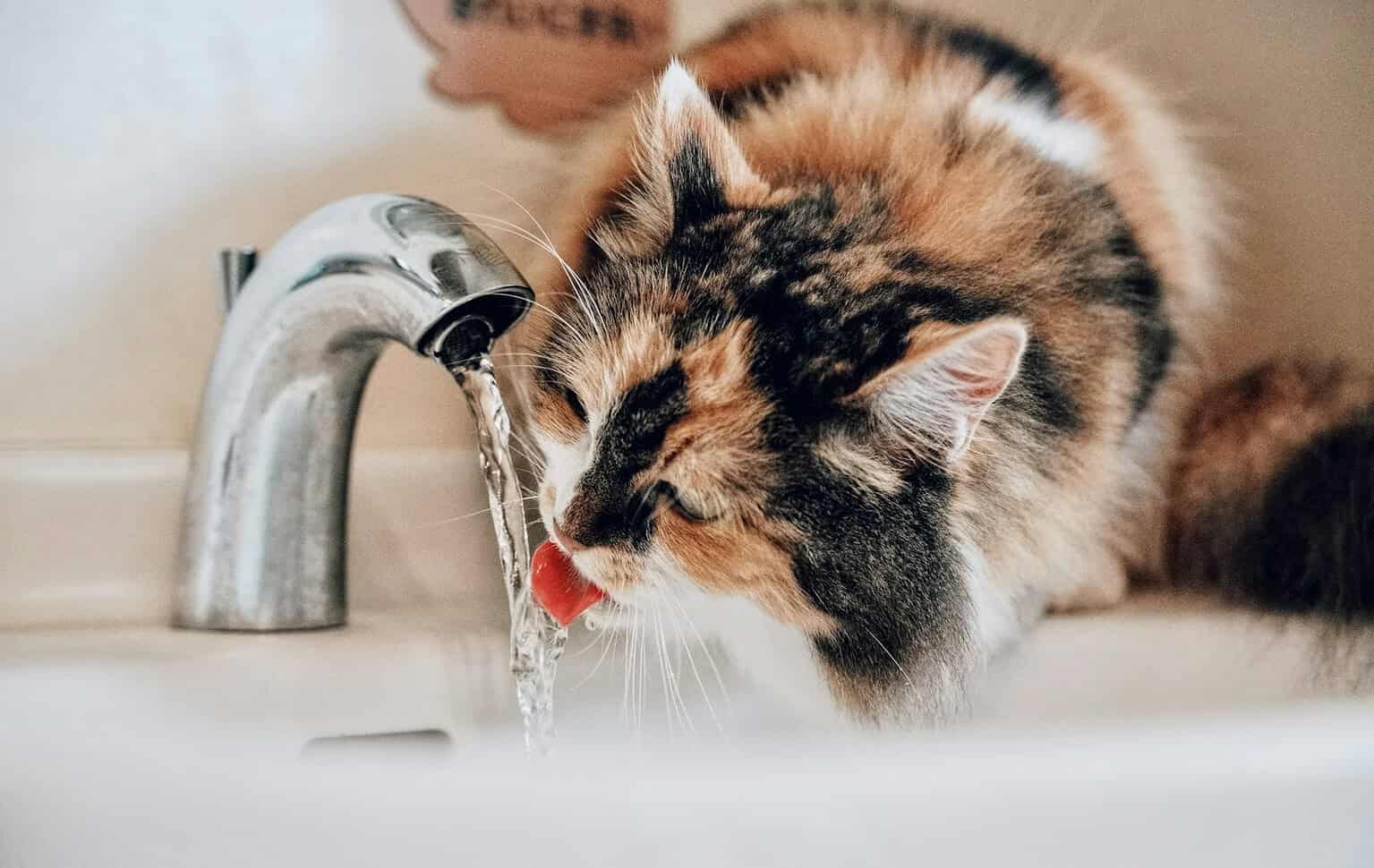
Because drinking water and being submerged in water are entirely different propositions. Many cats prefer running water to a still bowl — it is more obviously fresh, it is easier to see and hear, and it does not sit next to their food picking up smells.
Some cats will also dip a paw in and lick it rather than putting their face into a bowl, which is thought to relate to whisker comfort and to keeping their line of sight clear while drinking. If yours does the faucet thing constantly, a fountain is a tidier solution — we compared them in the guide to the best cat water fountains.
The cats that actually like water
Turkish Vans have a long-standing reputation for it, and Maine Coons, Bengals and Turkish Angoras are also frequently described as water-tolerant. Coat structure is part of it — some of these breeds have a more water-resistant texture — and early exposure is the rest. Individual temperament still beats breed every time.
Does my cat even need a bath?
Usually not. Cats are efficient self-groomers, and a healthy indoor cat may never need one. Bathe a cat when there is a reason: something toxic or sticky in the coat, a medicated shampoo prescribed by a vet, a senior or overweight cat who can no longer reach parts of itself, or a long-haired cat with matting that brushing has not solved.
Regular brushing removes most of the need. Our picks for the best cat brushes for shedding cover the deshedding tools that keep a coat clean without water anywhere near it.
How to bathe a cat without a fight
- Trim the claws a day or two before. This is for your benefit.
- Set everything out first. Cat shampoo, two towels, a jug, a rubber mat. Never human shampoo.
- Use a few inches of warm water in a sink, not a running shower. Warmer than you would expect, and shallow.
- Lower them in back feet first, and keep one hand steady on the shoulders throughout.
- Wash from the neck back, and keep water out of the ears and eyes. A damp cloth handles the face.
- Rinse thoroughly. Leftover shampoo irritates skin and gets swallowed during grooming.
- Towel, then let them retreat somewhere warm. Skip the hair dryer unless your cat has already proven it does not mind one.
If your cat becomes genuinely panicked — flat ears, dilated pupils, real biting rather than protest — stop. A groomer or vet who handles cats is a better answer than a second attempt, and pushing through teaches your cat that being handled is dangerous. On that theme, why does my cat bite me covers the overstimulation signals worth reading earlier.
Frequently asked questions
Can cats swim?
Yes — almost all cats can swim instinctively if they have to. Being able to and wanting to are separate questions, and a cat that falls into a pool may struggle to find an exit, which is the real hazard.
Why does my cat run away from the shower but sit on the edge of the bath?
Because watching water is interesting and being in it is not. Moving water is stimulating from a safe distance, which is the same instinct behind the faucet obsession.
Is it cruel to bathe a cat?
No, when there is a reason and it is done gently. It is unnecessary stress when there is not — routine bathing of a healthy cat has no benefit.
Why does my cat hate rain so much?
Same reason: a wet coat is cold, heavy and slow to dry. Outdoor cats are also more vulnerable when their hearing is masked by rain noise, which is worth remembering if yours goes out.
Do wipes work instead of a bath?
For light dirt, yes. Cat-specific grooming wipes handle muddy paws and minor messes without any of the drama. They will not fix matting or a chemical spill.
The one thing worth doing for an escape-artist cat
Cats bolt during stressful handling — a bath, a carrier, a vet trip — and an open door at the wrong moment is all it takes. Most indoor cats are found close to home, but only if whoever finds them can tell they belong to someone. That is the entire argument for a collar and a readable tag, even indoors: our lightweight acrylic NFC tags are tapped with any phone, need no app on the finder’s side, and carry engraved details as a backup. We sell them, so weigh that as you like — the underlying point is that an unidentified cat is assumed to be a stray.
Get Your Tag
Feather-light NFC cat tags with engraved backup — one tap, no app, no subscription.