Why Does My Cat Purr? What Purring Means, How It Works, and When It’s a Warning Sign
 Shiloh’s House Team
·
·
7 min read
Shiloh’s House Team
·
·
7 min read
Cats purr to communicate and to soothe themselves. Most purring is contentment: a cat on your lap, a kitten nursing, a cat greeting you at the door. But cats also purr when they’re hungry (a sharper purr with a hidden cry in it that researchers call the solicitation purr), when they’re frightened or in pain, and even while giving birth or dying. The purr itself is a 25 to 150 Hz vibration made in the larynx, and a 2023 study found cats need no brain signal to keep it going: special pads in the vocal folds do the work. So a purr is not always a smile. Read the rest of the cat.
How do cats purr?
For fifty years the textbook answer was that the cat’s brain fires a rhythmic signal to the laryngeal muscles 20 to 30 times a second, twitching the vocal folds open and shut on every breath in and out. That’s why a purr is continuous while a meow stops when the cat inhales. In 2023, researchers at the University of Vienna tested excised cat larynges on a bench and got them to produce purr-frequency sounds with air alone and no nerve input at all. The reason is anatomical: cat vocal folds contain unusual pads of fatty connective tissue that let a small animal vibrate at 20 to 30 Hz, lower than the deepest human bass. That doesn’t mean the brain plays no role in a living cat, but it does mean purring is partly a passive feature of cat anatomy, like a reed in a wind instrument. Most purrs land between 25 and 150 Hz, and cats purr on both the in-breath and the out-breath, which is why you can feel it as much as hear it.
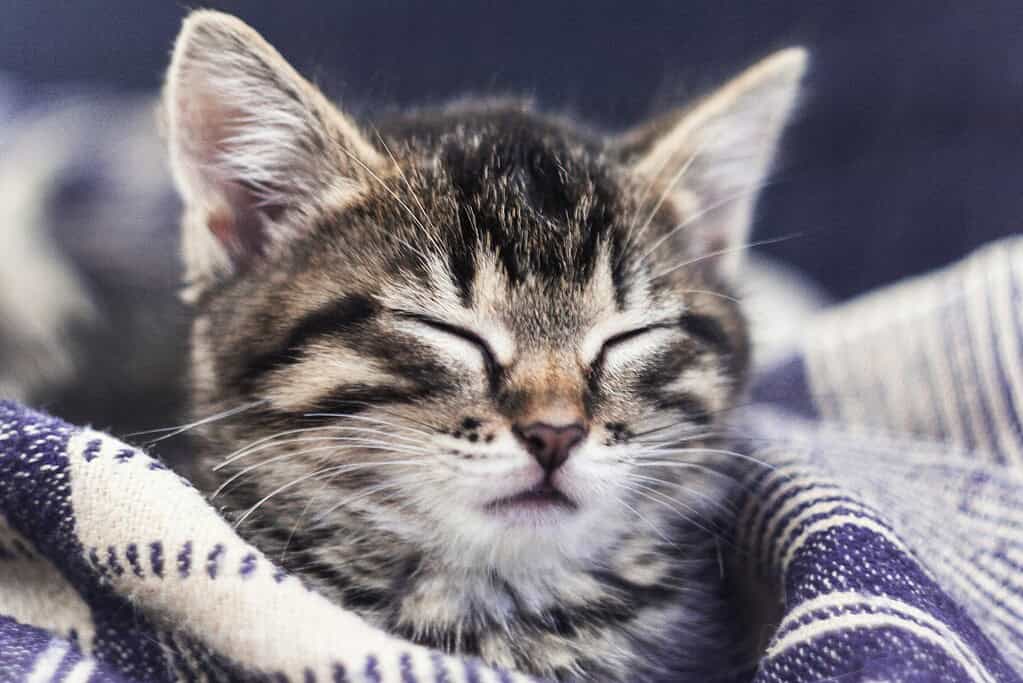
The six reasons cats purr
| Reason | What it looks like | What to do |
|---|---|---|
| Contentment | Relaxed body, half-closed eyes, kneading, on your lap or in the sun | Enjoy it |
| Kitten-to-mother bonding | Kittens purr within days of birth while nursing; mothers purr back | Nothing; it’s how they find each other before their eyes open |
| Solicitation (“feed me”) | Louder, more urgent purr with a high cry embedded in it, usually near the food bowl or at 5 a.m. | Feed on a schedule so the purr stops working as an alarm clock |
| Greeting and bonding with you | Purring while headbutting, rubbing or following you | Purr back (talk to them); it’s a compliment |
| Stress or fear | Purring at the vet, in the carrier, during a storm, with a tense body, flat ears, dilated pupils | Reduce the stressor; don’t assume the cat is fine |
| Pain, illness or injury | Purring while hiding, not eating, limping, breathing fast, or lying in an odd position | Call the vet; purring here is self-soothing, not comfort |
The solicitation purr: how your cat trained you
In 2009, researchers at the University of Sussex recorded cats purring at their owners in two situations, relaxed and hungry, and played the recordings to people, including people who’d never owned a cat. Listeners consistently rated the hungry purrs as more urgent and less pleasant. The difference was a high-frequency cry, around the pitch of a human infant’s, buried inside the low purr. Cats that live alone with one person use it most; cats in busy households use it less, apparently because it works best one-on-one. If your cat’s morning purr has an edge to it, that’s not your imagination. Scheduled feeding and an automatic feeder (we rated them in best automatic pet feeders) break the association between purring at you and breakfast appearing.
Do cats purr when they’re in pain?
Yes, and it’s the purr owners miss. Cats purr at the vet, during labor, after surgery, when badly injured, and sometimes in their final hours. The leading explanation is self-soothing: purring releases endorphins and appears to calm the cat the way rocking calms a child. A related and widely repeated idea is that purring heals. Frequencies in the 25 to 150 Hz range have been shown in some studies to promote bone density and tissue repair, and cats do recover from fractures and surgery remarkably well and show fewer bone and muscle problems than dogs. Scientific American’s veterinary geneticist Leslie Lyons has floated purring as a low-energy way to keep bones and muscles stimulated, like a cat’s built-in physiotherapy. It’s a hypothesis, not a proven mechanism, and the evidence in cats themselves is thin. What is proven: a purring cat that is also hiding, not eating, breathing fast or holding itself strangely is a cat that needs a vet, not a cat that’s fine. Our guides to why cats hide and why cats stop eating cover the signs.
Why does my cat purr so loudly (or not at all)?
Purr volume is individual, like a voice. Some cats rattle the sofa; some purr so quietly you only feel it with a hand on their ribs. A few cats never purr audibly, often cats that were orphaned early or feral-born, and that’s normal if it’s always been true. A change is the thing to notice: a cat that always purred and has stopped, or a purr that suddenly sounds hoarse, wet or rattly, can signal a respiratory infection, laryngeal problem or pain. Elderly cats purr less; cats with hyperthyroidism sometimes purr more. If the purr changes along with eating, breathing or energy, call the vet.
Why does my cat purr and then bite me?
Petting-induced overstimulation. The purr is real, right up until it isn’t: a twitching tail tip, skin rippling along the back, ears rotating sideways, and a sudden stillness are the warnings before the bite. Stop petting at the first twitch, not the bite, and keep sessions short and on the head and cheeks rather than the belly or base of the tail. The full breakdown is in why does my cat bite me?
Purring at the door
The greeting purr, the one you get when you walk in, is the sound of a cat that knows where home is. Indoor cats that slip out don’t: they bolt, hide within a few houses, and go quiet, which is why our lost cat guide says to search close and search at night. A breakaway collar with a Shiloh’s House smart tag means whoever finds a purring stranger on their porch can tap the tag with a phone and call you, and the tag is light enough for the smallest cat. We covered the collar question in do indoor cats need ID tags?
Not tagged yet?
Tap-to-find smart ID tags in a Micro size made for cats. $38, one-time, no battery, no subscription, made in the USA. Free Lohji app included.
Frequently asked questions
Why do cats purr?
Mostly to communicate contentment and bond, with their mothers as kittens and with people as adults. Cats also purr to ask for food, to calm themselves when stressed or frightened, and when they’re in pain or ill. Context and body language tell you which purr you’re hearing.
How do cats make the purring sound?
In the larynx. Fatty pads in the vocal folds let them vibrate at 20 to 30 Hz, and a 2023 University of Vienna study showed a cat larynx can purr with airflow alone, no brain signal needed. Purrs span roughly 25 to 150 Hz and continue on both the in-breath and out-breath.
Do cats purr when they are in pain?
Yes. Cats purr at the vet, after injury, during labor and when very ill, most likely to soothe themselves. A purring cat that is hiding, not eating, breathing fast or lying oddly needs a vet.
Does a cat’s purr heal?
It’s a hypothesis. Vibrations in the purr’s frequency range have been linked to bone density and tissue repair in some studies, and cats recover from injuries unusually well, but direct evidence that purring heals cats or people is thin.
Why does my cat purr when I pet her and then bite?
Overstimulation. The purr is real until petting tips past comfortable; a twitching tail, rippling skin and sideways ears are the warnings. Stop at the first sign and keep petting to the head and cheeks.
Sources
- Herbst, C. T. et al., “Domestic cat larynges can produce purring frequencies without neural input,” Current Biology, 2023 (University of Vienna) — vocal-fold pads, 20–30 Hz, excised-larynx experiments.
- McComb, K. et al., “The cry embedded within the purr,” Current Biology, 2009 (University of Sussex) — the solicitation purr.
- Scientific American, “Why do cats purr?” (Leslie A. Lyons, UC Davis School of Veterinary Medicine) — purring in stress and injury; 25–150 Hz; the bone-density hypothesis.
- Futura Sciences, “Scientists finally explain why cats purr, and it’s not just happiness” — summary of the 2023 study and the contexts of purring.
- Hepper, “Do cats purr when nervous or stressed?” — vet-reviewed overview of stress purring and overstimulation.