Why Does My Dog Roll in Poop? Reasons, Risks and Fixes
 Shiloh’s House Team
·
·
16 min read
Dogs roll in poop because strong, unfamiliar smells are deeply interesting to them, and the habit most likely comes from wolf ancestors who carried scent news back to the pack. Masking their own odor is the popular theory, but wolf research casts doubt on it, and plain enjoyment is part of the story too. Rolling is normal, yet poop and carcasses can carry parasites and bacteria, so prevent it with a leash, a strong recall and “leave it,” then bathe promptly.
Last updated: November 2025
Why does my dog roll in poop?
If your dog has ever stopped mid-walk, sniffed one patch of grass with total focus, then flipped onto a shoulder and wriggled with legs kicking at the sky, you have met scent rolling. Behaviorists call it that because the goal seems to be getting the odor onto the dog, usually the cheek, neck and shoulders, not eating it. It is a separate habit from eating feces, which we cover in why dogs eat poop.
The honest answer is that nobody knows for certain why dogs do it. BBC Future, reviewing the research in 2024, noted that there is surprisingly little science on exactly why dogs get such joy out of rolling in another animal’s waste. What researchers do have is a set of theories, most of them borrowed from watching wolves, which share a common ancestor with dogs and roll in carcasses and droppings too.
The main ideas fall into four groups:
- Scent masking. Smelling like dung or carrion might once have helped wild canines sneak up on prey.
- Scent communication. Carrying a new odor home may tell the rest of the pack what is out there, including where food is.
- Group identity. When one wolf rolls, others often follow, which may create a shared pack odor.
- Enjoyment. Even if the behavior once had a job, today it may simply feel rewarding.
None of these makes your dog dirty or spiteful. Rolling is normal. What matters is what your dog rolls in, whether it could make them sick, and how to stop the next roll.
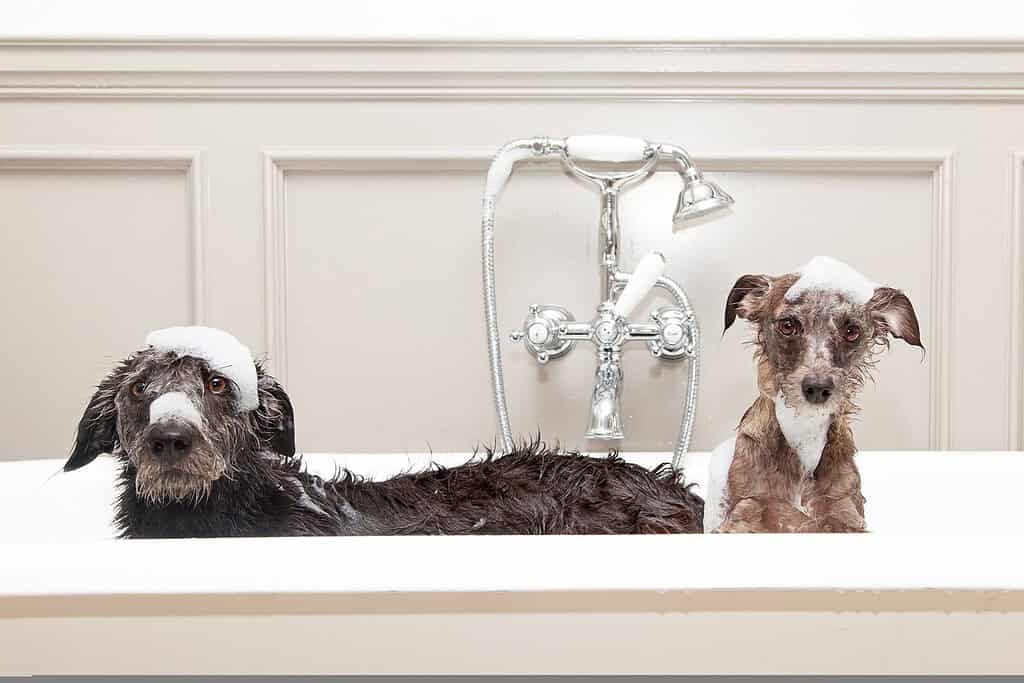
What do dogs like to roll in most?
Most dogs have a favorite. Some go for fox droppings every time, some for dead fish on the beach, some for goose poop at the park. Wolf studies suggest the common thread is novelty and intensity rather than “bad” smells specifically. In Pat Goodmann’s tests at Wolf Park in Indiana, wolves rolled in elk droppings and cat scent, but also in mint extract, Chanel No. 5, fly repellent and a fish sandwich with tartar sauce, according to CattleDog Publishing. Here is what pet parents report most often, and what each one means for your dog’s health and your cleanup.
| What they roll in | Main health risk | Cleanup |
|---|---|---|
| Fox poo | Parasite eggs and larvae; fox areas linked to lungworm via slugs | Scrape off, degreasing or fox poo shampoo, wash twice |
| Other dogs’ poop | Roundworm eggs, which CAPC says can stay infective for years | Gloves, dog shampoo, rinse well, wash your hands |
| Goose, deer or livestock manure | Bacteria such as Salmonella, intestinal parasites | Dog shampoo, one or two rounds |
| Dead birds, rodents or fish | Bacteria, botulism toxin if licked or eaten, poison the animal ate | Stop licking, bathe at once, call the vet if any was eaten |
| Skunk-sprayed ground | Eye and skin irritation | 1 quart 3% peroxide, 1/4 cup baking soda, 1 to 2 tsp dish soap |
| Fresh-cut grass or carpet | Usually none; frequent rolling may mean itchy skin | None needed; check skin if constant |
The top rows are the ones to take seriously. A roll in grass is a happy stretch; a roll in a carcass means a bath and sometimes a call to your vet.
Is rolling a way to bring news back to the pack?

Of all the explanations, scent communication has the most direct observation behind it, and much of it comes from one place: Wolf Park, a research and education facility in Battle Ground, Indiana. Pat Goodmann, a longtime curator there, spent years watching how the park’s wolves responded when new odors were placed in their enclosures. She described the pattern to CattleDog Publishing in 2011. A wolf that finds a novel odor first sniffs it, then rolls in it, working the scent onto its body, especially around the face and neck. When it returns, the pack greets it and investigates the scent thoroughly during the greeting. Goodmann said staff observed several cases in which one or more pack members then followed the scent directly back to where it came from.
For a social hunter that also scavenges, that is useful: the smell on one wolf’s fur works like a message to the others. Goodmann told BBC Future in 2024 that she has seen scent rolling tied to food. When the wolves were given small pieces of elk, they simply ate them. When they were given a large side of elk, they ate and rolled. She speculated that food scent on a wolf’s breath and fur signals there are more leftovers to scavenge for any wolf willing to backtrack to the source. Wolf Park’s founder, Erich Klinghammer, called this “non-insightful communication,” meaning the wolf probably is not consciously delivering a message, but the information travels anyway.
Other studies point the same way. BBC Future describes a 1986 study of two groups of captive wolves in Canada, later published in the Canadian Journal of Zoology, in which the wolves ignored herbivore droppings such as sheep and horse manure and showed little interest in food. Their favorite scents to rub in were artificial ones like perfume and motor oil, followed by the droppings of other carnivores such as cougars and black bears. A two-year study at a zoo in Croatia found something similar. The wolves sniffed deer and guinea pig dung for a long time, but the odors that set off the most rolling were unfamiliar ones, like curry, rosemary and sheep’s wool. The researchers suggested that rolling is a response to new smells and a way to share them with the group.
There may also be an identity piece. Simon Gadbois, a Canadian researcher who studies wolves, foxes and coyotes, told BBC Future that in the packs he studied, the lead animal tended to roll first and the others followed. “It could be that this is about establishing a group odour,” he said. More recent work led by Roberto Cazzolla Gatti at the University of Bologna found that captive wolves never rolled in their own scent but did roll in odors from other wolves, an unfamiliar dog and anise oil, which he took as a sign that wolves recognize “not me” smells and want to collect them.
So when your dog comes trotting back, proud and reeking, the wolf-research view is that they may be doing exactly what their ancestors did: bringing home a report on the most interesting thing they found. You are the pack. You just happen to be the pack member who does not want the news.
Is my dog trying to disguise its own scent?
This is the explanation you will hear most often, and it has a respected supporter. Psychologist and dog behavior author Stanley Coren has said it makes the most evolutionary sense. As he put it to Treehugger, “The suggestion is that we are looking at a leftover behavior from when our domestic dogs were still wild and had to hunt for a living.” The logic is that an antelope that smells a wolf will run, while one that smells its own dung or a carcass may not.
Many researchers are skeptical. Applied animal behaviorist Patricia McConnell has pointed out that most prey animals rely heavily on sight and sound, which is why hoofed animals have eyes on the sides of their heads and swiveling ears. She added that any prey with a nose good enough to rely on scent could likely still smell the dog under the coating, and that the theory does not explain dogs’ intense love of fox poop. Wolves also tend to chase prey down rather than ambush it, which needs less stealth.
“Here at Wolf Park, the wolves are willing to roll in the scent of alien canids and domestic cats. It raises a strong possibility that wild wolves may roll in predator scent too. This would not be a helpful hunting disguise.”
Pat Goodmann, senior animal curator, Wolf Park (BBC Future, 2024)
The idea may fit one case. BBC Future describes camera-trap footage of gray foxes in California rubbing their cheeks where mountain lions had scent-marked, possibly to hide from coyotes. That is hiding from predators, not stalking dinner. For your dog, masking is a possible piece of the puzzle, not the answer.
Do dogs roll in stinky things just because it feels good?
Quite possibly, yes. Even if scent rolling started as a pack-communication tool, a behavior can stick around long after its original job disappears. Gadbois told BBC Future that it “may have had a very important function at some point a long time ago,” and that over time the function has vanished, but dogs still do it.
Alexandra Horowitz, who runs the dog cognition lab at Barnard College and wrote “Inside of a Dog,” has suggested a nose-to-brain link: a powerful odor that lights up the olfactory part of the brain also seems to drive the urge for full-body contact with it. As she told the New York Times, in a quote reported by Treehugger, “There’s no ‘noxious scent’ receptor in the dog’s brain.” In other words, your dog does not sort smells into gross and nice the way you do. Odors you find disgusting can be the most fascinating thing on the walk.
That fits what owners see: a loose, wiggly, happy body. Rolling in a strong scent seems to be self-rewarding, which is why it is hard to call a dog off mid-roll. The reward is instant, and no treat in your pocket smells half as good. It is the same kind of instinct-meets-fun drive that makes so many dogs dig, which we explain in why dogs dig.
Is it dangerous when my dog rolls in poop or dead animals?
The roll itself is rarely the problem. The trouble is what comes with it, because dogs lick their coats afterward and some take a bite.
Parasites in feces. Roundworms are common in dogs, and their eggs are tough. The Companion Animal Parasite Council (CAPC) says ascarid eggs are hardy and can survive and remain infective for years, and that common disinfectants do not kill them. Roundworms can also infect people, so wash your hands afterward.
Fox poop and lungworm. The lungworm Angiostrongylus vasorum lives in foxes and dogs, mainly in the UK and parts of Europe, with pockets in North America such as Newfoundland. CAPC explains that slugs and snails pick up larvae by feeding on the feces of infected canids, and dogs get infected by eating those slugs or snails, sometimes by accident while chewing grass or toys left outside. Rolling in fox poo does not give a dog lungworm directly, but it is a sign foxes are using the area. Ask your vet whether your parasite prevention covers it if you live in or travel to a lungworm region.
Bacteria and toxins in carcasses. UrgentVet notes that dead birds and small mammals may carry Clostridium botulinum, whose toxin can cause rapid paralysis, and that wild animals can host leptospirosis and Salmonella. A carcass may also carry the rat poison or pesticide that killed it. The AVMA’s outdoor advice is simple: do not let your dog eat dead wildlife.
How do I stop my dog from rolling in poop?
You cannot remove the instinct, but management, timing and a couple of practiced cues make the next roll far less likely.
Know the pre-roll sequence. A UK vet resource, Ask A Vet, describes the build-up as slowing down, planting the feet, pressing the nose to the ground, tilting the head and starting to lower one shoulder. That shoulder drop is the last warning. Interrupt at the intense-sniff stage, before it drops.
Use a leash where the smells are. Wooded trails, beaches with dead fish, farm edges and fox-heavy parks are rolling hot spots. A standard leash or a long line gives your dog room to sniff while keeping you close enough to step in.
A cue has to be learned before it can compete with fox poo. Practice “leave it” at home with boring items, then outdoors with mild distractions, and reward heavily for turning away. Use your best treats for this; our guide to dog training treats lists high-value options. A cheerful, well-rewarded recall works the same way. Never punish after the fact.
A dog locked onto an amazing scent can also drift farther than you expect, which is when ID matters. A Shiloh’s House Smart Tag lets a finder tap the tag with their phone to see your contacts, and in the free Lohji app you can add behavior notes such as “food-motivated, comes to a whistle” and update them any time. Download it from the App Store or Google Play.
Nose down, wandering off?
Scent-driven dogs can follow a smell a long way. A tap-to-open Smart Tag shows a finder how to call, text or get directions to you in one tap.
How do I get poop smell off my dog?
Speed helps, since residue works deeper and gets licked the longer it sits. Start by putting on gloves and scraping off any solid matter with a bag or paper towel. Do not rub, which pushes it deeper. Then wet the coat thoroughly with warm water, lather a dog shampoo into the affected area, let it sit a few minutes and rinse. Most strong smells need a second round. Fox poo is oily and clings to hair, which is why plain water just spreads it. Shampoos made for it, such as Animology Fox Poo Shampoo in the UK, use degreasing, deodorizing formulas. In the US, an odor-control or enzyme-based dog shampoo does a similar job; our best dog shampoo roundup covers good picks for smelly dogs. Clean the collar or harness too, since it holds smell.
For skunk spray, the classic recipe from Penn State Extension and others is 1 quart of fresh 3% hydrogen peroxide, 1/4 cup of baking soda and 1 to 2 teaspoons of liquid dish soap, mixed in an open container and used right away. Leave it on about 5 minutes, keep it away from the eyes and mouth, and rinse. Never store it in a closed bottle, and be aware it can lighten dark fur.
An extra bath after a roll is fine, but frequent washing can dry the skin. See how often to bathe a dog for a coat-by-coat schedule. If your dog smells bad even without a recent roll, the cause may be medical; our guide to why your dog smells bad walks through ears, teeth, skin and anal glands.
Could rolling mean my dog has itchy skin?
Sometimes. Not every roll is about smell. Dogs cannot reach every spot to scratch, so they roll on their backs to relieve an itch. Veterinarian Hanie Elfenbein, writing for PetMD, says an occasional itch-roll is fine, but frequent rolling, or rolling paired with constant scratching, can be a sign of a skin problem. Dogs who rub their ears and face along the ground may have an ear infection.
Veterinary dermatology sources list rolling right alongside scratching. Texas A&M’s veterinary college notes that biting, licking, rubbing, rolling, head shaking and scooting can all mean a pet is itchy, and that infections and parasites need to be ruled out before anyone blames allergies. Flea prevention is the first step for any itchy dog. AAHA’s client materials on allergic skin disease also include “excessive rolling, rubbing or scooting” as a telltale sign, together with hair loss, redness, greasy skin and body odor.
Here is a simple way to tell the two apart. A scent roll is targeted: your dog finds one spot, sniffs hard, and rubs the cheek, neck and shoulder into it. An itch roll is more random, happens indoors on carpet as often as outside, and usually comes with other clues like licking paws, chewing at the flank or redness on the belly. If the rolling is seasonal, our guide to fall allergies in dogs explains what to look for.
Frequently asked questions
Why does my dog roll in poop right after a bath?
Some dogs seem to dislike strong shampoo perfume and may roll to replace it with a smell that feels more normal, and post-bath excitement plays a part too. Towel-dry well, keep your dog inside or leashed until dry, and try a mildly scented or unscented shampoo to make the outdoor roll less tempting.
Why do dogs love rolling in fox poop so much?
Fox droppings are oily, musky and packed with strong-smelling compounds, which makes them one of the most intense odors a dog can find on a walk. Wolf research suggests canines are drawn to the scent of other carnivores, and novel, powerful smells trigger the most rolling. Fox poo seems to tick every box, which is why it is the classic complaint in fox country.
Is rolling in poop a sign of a behavior problem?
No. Scent rolling is a normal canine behavior seen in wolves, foxes, coyotes and pet dogs. It is not spite, dominance or a lack of training. It can still be managed with supervision, a leash in hot spots and practiced cues. The only time rolling points to a problem is when it is frequent and paired with scratching or licking, which can mean itchy skin.
Can I catch anything from my dog after they roll in poop?
Possibly. Feces can carry roundworm eggs and bacteria such as Salmonella, and some of these can infect people, with young children most at risk. Wear gloves to clean your dog, keep them off furniture until bathed, and wash your hands well afterward. Keeping your dog on year-round parasite prevention prescribed by your vet also lowers the risk for the whole household.
Do all dogs roll in smelly things?
No. Many dogs do it, but some show little interest, and each dog tends to have a favorite smell. Personality, past experience, environment and how often they are off leash in wild areas all play a part. Dogs who spend lots of time on trails, farms or beaches simply have more chances to find something irresistible, so the habit can look more common in outdoorsy dogs.
Should I let my dog finish rolling once they start?
If the substance is harmless, like grass or a muddy patch, letting them finish does no damage beyond a bath. If it is a carcass, feces from wildlife or anything that might be poisoned, calmly call or lead your dog away, then clip on the leash. Do not chase or yell, which can turn the moment into a game, and reward them generously when they come.
Sources
- Chanel No 2: The many reasons why dogs love to roll in poo, BBC Future, 2024
- Scent Rolling: Why Do Dogs Like to Roll in Smelly Scents?, CattleDog Publishing, 2011
- Why Do Dogs Roll in Disgusting Stuff?, Patricia McConnell, The Other End of the Leash, 2015
- Why Do Dogs Like to Roll in Smelly Things?, Treehugger, 2017
- Factors driving lungworm spread and the need for ongoing diagnosis and prevention, The Veterinary Nurse, 2020
- Angiostrongylus vasorum, Companion Animal Parasite Council, 2021
- Ascarid guidelines, Companion Animal Parasite Council
- My Pet Ate a Dead Animal: What Should I Do?, UrgentVet, 2022
- Why Dogs Roll in Grass, PetMD, 2021
- Scratch Beneath the Surface: Allergic Skin Disease in Pets, Texas A&M School of Veterinary Medicine, 2019
- Is it true that tomato sauce will get rid of the smell of a skunk?, Scienceline, 2006
- Sprayed by a Skunk, Penn State Extension