How to Play With Your Cat: Games, Toys and How Long Cats Need Each Day
 Shiloh’s House Team
·
·
15 min read
The best way to play with your cat is to act out a short hunt: move a wand toy like prey, let your cat stalk, chase and pounce, then let them catch it and follow up with a treat or meal. Most cats do well with two or three sessions of about 10 to 15 minutes a day, timed for dawn and dusk when they are naturally most active. Short, frequent bursts beat one long session, and hands should never be the toy.
Last updated: March 2026
Why does play matter so much for cats?
Your cat may sleep on the sofa all afternoon, but their brain is still wired for hunting. Every pet cat carries the same predatory sequence as a farm cat: watch, stalk, chase, pounce, catch, kill and eat. Without an outlet, that energy often shows up at 3 a.m. or on your ankles.
Veterinary groups treat play as a basic need, not a bonus. The AAFP and ISFM Feline Environmental Needs Guidelines list five “pillars” of a healthy cat environment, and Pillar 3 is “Provide opportunity for play and predatory behavior.” The guidelines say cats should be able to engage in pseudo-predatory play and feeding behaviors through toys, interactive play with their owner and feeding methods that make them work for food.
Play also changes what cats want to do. In the University of Exeter study led by Martina Cecchetti, owners in the play group spent a few minutes a day moving a feather toy on a wand so their cats could stalk, chase and pounce, then handed over a toy mouse to “kill.” Those households recorded 25% fewer prey animals brought home, and 76% of owners in the play group said they planned to keep doing it after the trial ended.
“At iCatCare, we are particularly excited about the positive effects of play – this is an activity that owners can easily introduce at no or little cost, takes little time and is very cat-friendly.”
Dr Sarah Ellis, Head of Cat Advocacy, International Cat Care (University of Exeter news release)
Many behaviorists sum up the natural rhythm as hunt, catch, eat, groom, sleep. If you play first and feed right after, your cat gets to run through the whole loop, and a satisfied cat usually settles down for a wash and a nap.

How much should I play with my cat each day?
There is no single number, but the American Animal Hospital Association (AAHA) offers a useful starting point: on average, two or three play sessions of 10 to 15 minutes a day. AAHA notes that a few short bursts spread through the day work better than one long session, because cats lose interest when a game drags on.
International Cat Care puts it another way: cats are sprinters, not marathon runners, so one minute of frenzied activity is a good result. Don’t judge a session by the clock. Judge it by whether your cat stalked, chased, caught something and walked away looking content.
| Life stage | Sessions per day | Minutes per session | What to adjust |
|---|---|---|---|
| Kitten (under 1 year) | 3 or more short bursts | 5 to 10 | Higher intensity; size-appropriate toys; never hands |
| Young adult (1 to 2 years) | 2 to 3 | 10 to 15 | Most energy and most likely to play rough |
| Adult (3 to 10 years) | 1 to 3 | 10 to 15 | Match the toy to air or ground hunting style |
| Senior (11 years and up) | 1 to 2 gentle sessions | 5 to 10 | Slower moves, floor-level play, no big jumps |
Treat these numbers as a starting point drawn from AAHA’s general guidance, then adjust for breed, personality and energy. AAHA says kittens typically need several short sessions a day, adult cats may thrive with one or two, and seniors still enjoy play at a slower pace and for shorter stretches.
How do you play with a cat using a wand toy?

A wand toy, sometimes called a fishing-pole or teaser toy, is the single most useful tool for interactive play. It keeps your hands out of the action, lets you control the “prey,” and lets your cat go all out with teeth and claws. The trick is to stop waving it and start thinking like a mouse or a bird.
Start by watching your cat. AAHA suggests figuring out whether your cat prefers air prey or ground prey. Some cats leap and twist after anything that flutters overhead. Others crouch low and wait for something to scurry past the couch. Once you know which type you have, pick a lure to match: feathers for bird hunters, a fuzzy mouse or a snake-like ribbon for ground hunters.
Next, move the toy the way real prey moves. Prey does not run toward a predator, and it does not hang in front of a cat’s face. The AAFP and ISFM guidelines describe two basic patterns: swoop the lure through the air like a flying bird, or move it in straight lines swiftly away from the cat like ground prey. Feline behavior experts add that small, subtle movements can be more compelling than giant arcs, and that a start-and-stop pattern usually draws more interest than constant motion. A few moves to try:
- Drag the lure slowly along the floor, then dart it behind a chair leg so it disappears.
- Let it freeze for a few seconds, then twitch it, the way a mouse holds still and then panics.
- Run it under a blanket or around the edge of a box so your cat has to hunt for it.
- For bird hunters, flutter it near the floor, then lift it in a short hop rather than a high swing.
Give your cat time to plan. A cat staring hard at a toy with a twitching tail and wiggling rear end is not bored. They are lining up the pounce. Hold the toy still long enough for the attack to happen.
Then let them win. This is the step most people skip. VCA Animal Hospitals behaviorists point out that cats need to be successful or they will lose interest, and a cat who never catches anything can end up frustrated. Let your cat catch the lure several times during a session, not just at the end. When they grab it, let them hold it, bite it and rake it with their back feet for a few seconds before it “escapes” again.
Wind the game down slowly. As the session nears its end, make the prey move more slowly, as if it were tired, and let your cat make one last decisive catch. The University of Exeter researchers had owners finish each hunt by handing the cat a toy mouse to play with, mimicking a real kill. AAHA recommends giving a treat at the end to complete the hunting sequence. Even better, time play right before a meal so the “kill” is followed by real food.
Finally, put the wand away. Strings, elastic and feathers can be swallowed or wrapped around a neck or leg. VCA warns never to leave cats unattended with wand or fishing-pole toys, so store them in a closet between sessions. Bonus: a toy that only appears at playtime stays exciting much longer than one that lies on the floor all day. For favorite models, see our roundup of the best cat wand toys.
What are the best cat play ideas for kittens, adults and seniors?
All cats can benefit from play, but the right game changes with age. The AAFP and ISFM guidelines note that kittens generally need more intense and longer play, while older cats still need to play, though the type and intensity may need to be modified.
Kittens. Kittens are learning how to hunt, so they will chase almost anything. Use wand toys, crinkle balls, ping pong balls and soft “kick” toys they can grab with their front paws and rake with their back legs. International Cat Care says to avoid pipe cleaners, ribbon, string and balls of wool, which can cause serious intestinal problems if swallowed. Catnip may not interest kittens under about three months old, so save it for later.
Adults. Adult cats often like variety and a bit of challenge. Mix wand sessions with fetch (some cats are natural retrievers), treat hunts around the house and simple trick training, which VCA counts as play if your cat enjoys it. Our guide to indoor exercise for cats has more ideas for days when everyone is stuck inside.
Seniors. Older cats may have stiff joints, weaker eyesight or less stamina. Keep the action on the floor or on low furniture, use slow, gliding movements, and avoid games that require high jumps or sharp turns on slippery floors. A senior who bats at a feather a few times and then watches is still getting mental exercise. If your older cat suddenly stops playing or seems painful when moving, mention it to your veterinarian, since reduced activity can be a sign of arthritis or another health issue.
Why won’t my cat play?
A cat who ignores every toy is not always lazy. International Cat Care describes a spectrum: some cats play spontaneously at any time of day and tire you out first, while others play only at certain times, are fussy about toys and need a lot of persuasion. Both are normal. Common reasons a cat won’t play include:
- Wrong toy or wrong movement. A ground hunter may ignore a feather that swings through the air but jump at a mouse that skitters behind a door.
- Wrong time. Midday is nap time for many cats. Try early morning or evening.
- Too much, too fast. Shaking a toy in a cat’s face can feel threatening, not fun.
- Shyness or fear. Timid cats, or cats separated from their mother too early, may not know how to play with people yet.
- Boredom with old toys. A toy that has been lying around for weeks is no longer interesting prey.
- Pain or illness. AAHA notes that a cat who sleeps all day and shows no interest in toys may be depressed or have unmet needs, and a vet visit is worth it.
For hesitant cats, keep sessions short and gentle. Sit on the floor at a distance, and let the toy creep slowly across the floor within swatting range, then retreat. A single swat counts as a win. Many cats also warm up to people through quiet signals first, so try a few slow blinks before you start.
How do you stop play aggression toward hands and feet?
If your cat ambushes your ankles or bites your hand during petting, you are not alone. The ASPCA says play aggression is the most common type of aggressive behavior cats direct toward their owners. It is especially common in kittens and young cats under two, in cats who were orphaned or weaned early and never learned to soften their bites, and in cats who spend long hours alone without play.
The root cause is often that hands and feet became toys. Wiggling fingers under a blanket is cute with a tiny kitten, but VCA behaviorists note that once the kitten grows into a larger, stronger cat, pouncing on hands and feet can cause real injuries, and even small bites can get infected. To turn it around:
- Use toys for every game, and make sure everyone in the house follows the rule.
- Give more interactive play, especially before the times your cat usually ambushes you.
- Watch for pre-pounce signals such as dilated pupils, a swishing tail or a low crouch, and toss a toy away from you before the attack.
- If your cat does grab you, go still and quiet. The San Francisco SPCA advises against jerking away, since that is how prey moves, and against physical punishment or loud reactions.
- End the game calmly and walk away. Don’t hand over a toy right after a bite, which can reward the behavior.
Many cats improve once their hunting energy has a better outlet. For the ankle-ambush version in detail, read why your cat attacks your feet.
Are laser pointers bad for cats?
Laser pointers are easy and they get a cat running, but they have one big flaw: the cat can never catch the dot. International Cat Care explains that a laser lets a cat stalk, chase and pounce but not catch, which can leave them frustrated.
Research backs up the concern. In a 2021 survey of 618 cat owners, published in the journal Animals by Lori Kogan of Colorado State University and Emma Grigg of UC Davis, 45.5% said they used laser toys with their cats. The more often owners used a laser, the more likely they were to report abnormal repetitive behaviors, such as chasing lights or shadows, staring at reflections or fixating on one toy. The study was correlational, so it does not prove lasers cause these behaviors, but laser play frequency was the strongest predictor in the authors’ model.
If your cat loves the laser, you don’t have to throw it out. Use it sparingly, as a warm-up, and always switch to a wand toy or a toy mouse at the end so the game finishes with a real catch. Never shine a laser in your cat’s eyes.
What about food puzzles, cardboard boxes and solo toys?
Interactive play matters most, but your cat also needs things to do while you are at work. The AAFP and ISFM guidelines suggest hiding food in several places, scattering or tossing kibble for your cat to chase, and using puzzle feeders so cats work for small, frequent meals. International Cat Care suggests homemade puzzles: a few dry treats inside a paper bag, an egg carton or a toilet roll tube. Count anything your cat eats this way as part of their daily food.
Puzzle feeders are not a replacement for you, though. In the University of Exeter trial, households given puzzle feeders recorded 33% more prey brought home, not less, and many owners said their cats lost interest. The researchers’ takeaway was that object play with a person reduced hunting, while a feeder alone did not.
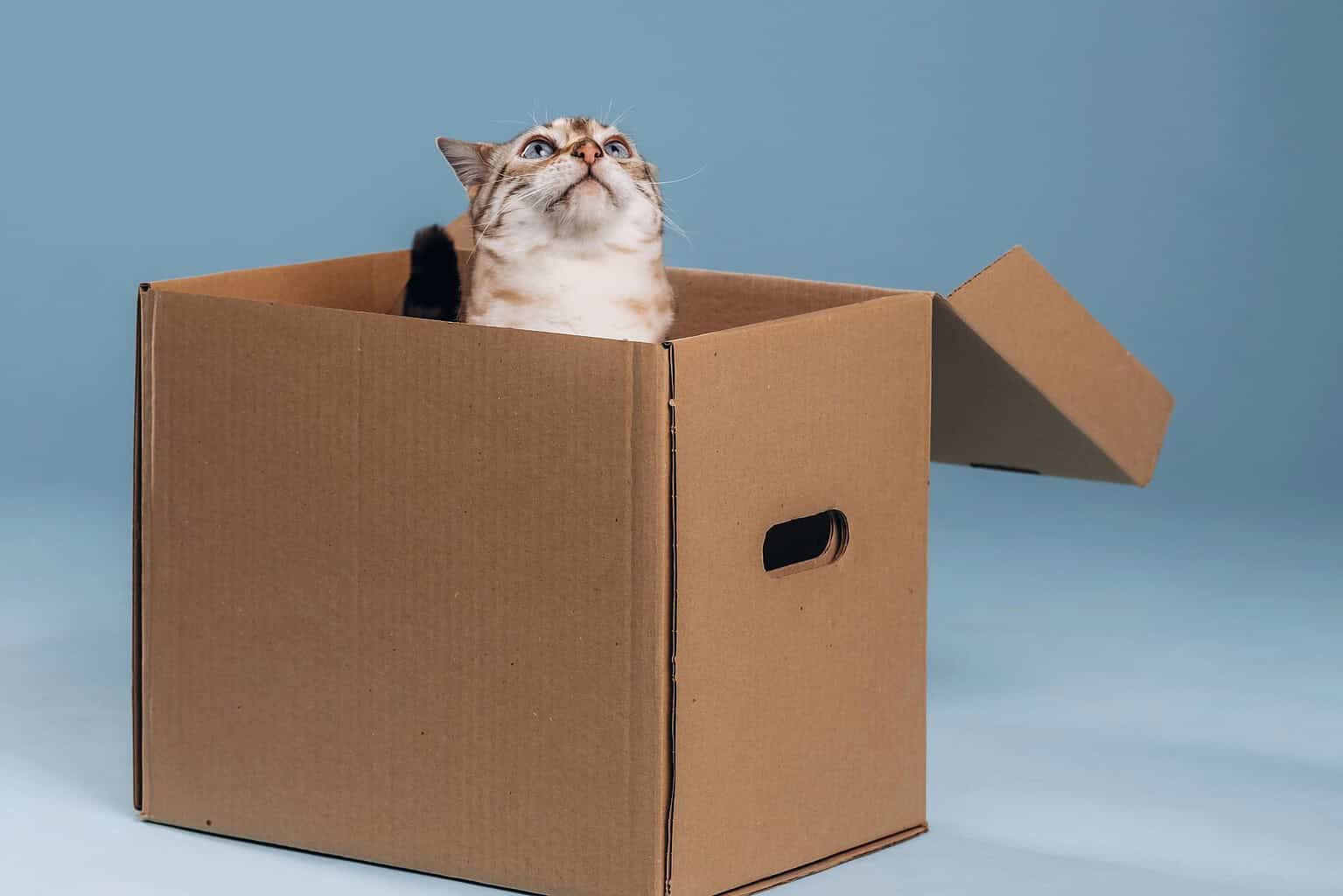
Cardboard boxes are another cheap winner. International Cat Care suggests offering a new box two or three times a week, and Cornell’s Feline Health Center lists paper bags, boxes and ping pong balls as tremendously entertaining. If you’ve ever wondered why, we covered why cats like boxes. Remove handles from paper bags and never leave plastic bags out.
For solo toys, rotation is the secret. VCA recommends keeping about 20 toys on hand but offering only four or five at a time, swapping them weekly. Cornell also recommends rotating toys and avoiding small parts, feathers or strings that can come loose and be swallowed. Battery toys and track balls can fill gaps, but they should never be your cat’s only source of play.
How do you keep a playful indoor cat from slipping out the door?
A well-played indoor cat is usually a calmer cat, but playful, curious cats are also the ones most likely to dash past your legs when a door opens. A delivery, a guest or a child running outside can be all it takes. If your cat chases things that move, an open door with birds on the porch looks a lot like a wand toy.
A few habits help. Play before guests arrive so your cat is tired, give your cat a treat away from the door every time it opens, and keep a perch or box in another room where your cat likes to hang out. Above all, make sure your indoor cat wears ID. A lightweight tag on a breakaway collar, which releases if it snags, gives anyone who finds your cat a fast way to reach you. Our guides on cat ID tags and what information to put on a pet tag walk through the details.
While you are at it, capture those hunting moments. The free Lohji app from Shiloh’s House turns one photo of your cat into a 3D animated-style character, and from there you can make stickers or a short 6- or 10-second video of your cat mid-pounce. The same app holds your cat’s pet profile, including medical and behavior notes and up to three contacts. Download it on the App Store or Google Play.
Ready for the next great escape?
A Shiloh’s House smart tag is lightweight, quiet acrylic engraved with your cat’s name and your phone number, and anyone who taps it with a phone sees your cat’s live profile with one-tap Call, Text and Map. No app needed for the finder.
Frequently asked questions
How much should I play with my cat?
A good starting point is two or three sessions of about 10 to 15 minutes a day, according to AAHA. Kittens often need more short bursts, while seniors do well with one or two gentle sessions. Watch your cat rather than the clock. If they stalk, chase, catch the toy and then settle down to eat or groom, the session did its job.
What time of day is best to play with a cat?
Cats are crepuscular, meaning they are most active around dawn and dusk, so early morning and evening are ideal. A play session right before bedtime, followed by a meal, helps many cats sleep through the night instead of waking you at 3 a.m. Avoid trying to start a big game during your cat’s midday nap.
Is it OK to play with my cat using my hands?
No. International Cat Care, VCA and the AAFP all advise against using hands or feet in play. A kitten who learns that fingers are prey grows into an adult cat with bigger teeth and claws, and bites can become infected. Use a wand toy, kick toy or a ball you can roll away so the target is always something other than your body.
Why does my cat stop playing after a minute?
Short bursts are normal. International Cat Care calls cats sprinters, not marathon runners, and VCA notes that a cat who plays for a few minutes and then stops does not necessarily dislike the toy. Try pausing, moving the toy out of sight and bringing it back, or switching to a different lure. Several short games often work better than one long one.
Are laser pointers safe for cats?
Used occasionally and never aimed at the eyes, a laser can be part of play, but it should not be the whole game. A 2021 survey linked more frequent laser use to more reported repetitive behaviors such as chasing lights and shadows. End every laser session by switching to a toy your cat can catch, or toss a treat where the dot stopped.
Do older cats still need to play?
Yes. The AAFP and ISFM guidelines say older cats still need to play, though the type and intensity may need to change. Keep the toy low and slow, skip high jumps, and keep sessions short. Gentle play helps keep senior cats moving and mentally engaged. If your older cat suddenly loses interest or seems stiff, ask your vet about pain or arthritis.
Sources
- Current Biology — Cecchetti et al., Provision of High Meat Content Food and Object Play Reduce Predation of Wild Animals by Domestic Cats (2021)
- University of Exeter — Play and meaty food reduce hunting by cats (2021)
- Journal of Feline Medicine and Surgery — AAFP and ISFM Feline Environmental Needs Guidelines (2013)
- AAHA — How Often Should You Play with Your Cat? (2025)
- International Cat Care — Playing with your cat (2024)
- VCA Animal Hospitals — Cat Behavior and Training: Play and Play Toys (n.d.)
- Cornell Feline Health Center — Safe toys and gifts (n.d.)
- Animals — Kogan and Grigg, Laser Light Pointers for Use in Companion Cat Play (2021)
- ASPCA — Aggression in Cats (n.d.)
- San Francisco SPCA — Play Aggression (2019)