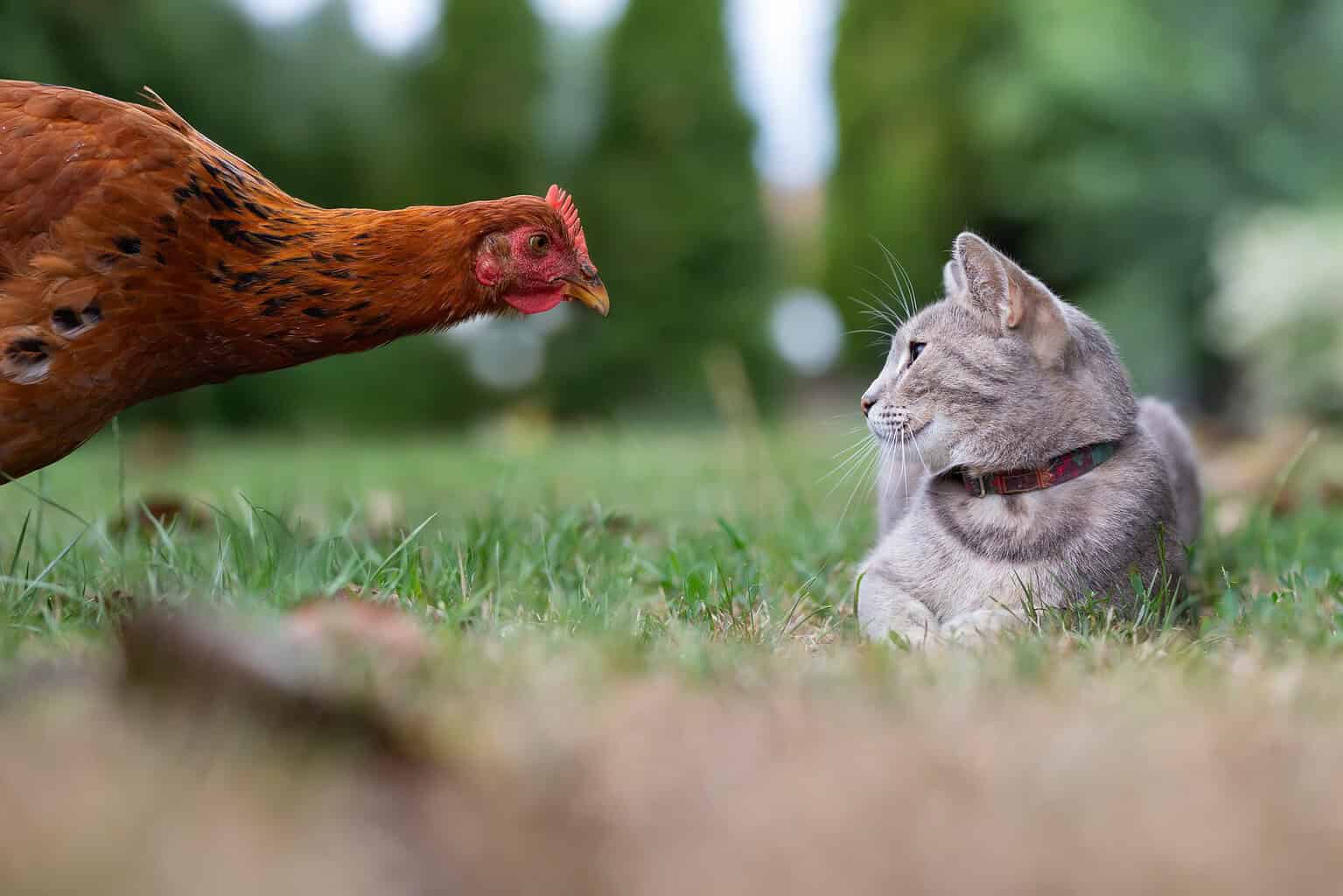
Yes, cats can eat chicken when it is plain, fully cooked, boneless and skinless. A few shreds of baked or boiled breast make an excellent high-protein treat for an obligate carnivore. Chicken alone is not a complete diet, though, because it lacks the calcium balance and other nutrients cats need. Skip raw chicken, which can carry Salmonella, Campylobacter and even H5N1 bird flu, never offer cooked bones, and avoid seasoned, rotisserie and deli chicken. Keep all treats to about 10% of daily calories.
Last updated: October 2025
Can cats eat chicken safely?
For most healthy adult cats, plain cooked chicken is one of the safest people foods you can share. Cats are obligate carnivores, which means their bodies are built around nutrients from animal tissue, and chicken is a staple ingredient in commercial cat foods. A little plain breast meat works as a reward, a pill pocket, or a topper to tempt a picky eater.
The safe version follows four rules:
- Cooked all the way through. No pink meat and no raw scraps from the cutting board.
- Off the bone. Pull every piece of meat away from the bone before it reaches the bowl.
- Skin and fat removed. The skin is where most of the calories hide.
- Completely plain. No garlic, onion, butter, salt, broth cubes, sauces or spice rubs.
The bigger issue with cats is portion size. A cat is a small animal, and the number in the box above is not a typo. Twenty calories is roughly one heaping tablespoon of diced breast meat, and that budget has to cover every treat the cat gets that day. Most of the problems people run into with chicken come from what travels with it, such as bones, greasy skin, garlic seasoning or a raw drumstick left on the counter, and each of those gets its own section below. If you also share your home with a dog, our guide to whether dogs can eat chicken covers the canine side, which has a few different risks.

How many calories and how much protein are in different kinds of chicken?
The cut you choose and whether the skin stays on changes the numbers far more than most cat owners expect. Here is what USDA FoodData Central lists for five common forms, converted to a single ounce, which is about the size of two or three bites for a person.
| Per 1 oz (28 g) | Calories | Protein | Fat | Sodium |
|---|---|---|---|---|
| Breast, meat only, roasted | 47 | 8.8 g | 1.0 g | 21 mg |
| Thigh, meat only, roasted | 51 | 7.0 g | 2.3 g | 30 mg |
| Skin only, roasted | 129 | 5.8 g | 11.5 g | 18 mg |
| Rotisserie BBQ breast, meat and skin | 50 | 7.5 g | 2.2 g | 93 mg |
| Deli breast, rotisserie seasoned, sliced | 28 | 4.9 g | 0.5 g | 292 mg |
A few things stand out. One ounce of plain roasted breast is 47 calories, more than double the daily treat budget of a 10-pound cat, so a cat’s portion is a fraction of an ounce. An ounce of skin carries almost three times the calories of the meat and more than eleven times the fat. Deli chicken looks lean, but it carries about 14 times the sodium of plain roasted breast.
Breast meat is the best pick: it has the most protein, the least fat and almost no sodium. Thigh meat is fine in small amounts for a healthy cat but is fattier.
Is chicken a complete diet for a cat?
No. Cats need meat, but they need more than muscle meat. Cats require dietary taurine, arginine, arachidonic acid, preformed vitamin A and several B vitamins in amounts that plain chicken breast does not reliably supply. Veterinary nutritionist Debra Zoran explained in JAVMA that cats cannot make enough taurine from other amino acids and constantly lose it in bile, and that a deficiency lasting several months can lead to blindness, reproductive failure and a heart muscle disease called dilated cardiomyopathy. Taurine also leaches out of meat during boiling.
Calcium is the other gap. USDA lists just 15 mg of calcium against 228 mg of phosphorus in 100 grams of roasted breast, a ratio of roughly 1 to 15. The Merck Veterinary Manual warns that feeding mostly meat to dogs or cats can cause calcium deficiency and nutritional secondary hyperparathyroidism, a condition that leaches minerals from the skeleton.
Homemade recipes are not an easy fix. A UC Davis team led by Sarah Wilson evaluated 114 home-prepared maintenance diet recipes for cats from books and websites, and published the results in JAVMA in 2019. Choline, iron, thiamine and zinc were the nutrients most often short.
“Only 94 recipes provided enough information for computer nutritional analysis and, of those, none of them provided all the essential nutrients to meet the National Research Council’s recommended allowances for adult cats.”
Jennifer Larsen, DVM, PhD, DACVN, veterinary nutritionist, UC Davis, dvm360 (2019)
Pet foods labeled complete and balanced to AAFCO nutrient profiles, which draw on National Research Council data, are formulated to cover these needs. Use chicken as a treat or topper, and if you want to cook for your cat full time, work with a board-certified veterinary nutritionist. The same rule applies to other favorite proteins, as we explain in can cats eat tuna.
Can cats eat raw chicken?

We do not recommend it, and over the past year the case against raw chicken for cats has become much stronger. Raw feeding is popular in some circles because cats evolved eating raw prey, but a wild mouse and a package of supermarket chicken thighs are not the same thing, and the risks now go well beyond an upset stomach.
Start with the familiar bacteria. Dr. Sandra Mitchell, writing for PetMD, notes that Salmonella and Campylobacter can both be found in raw chicken, and that even a cat with no signs of illness can pass them to the people in the household. Cats groom constantly and walk across counters, beds and couches, so whatever is on their paws and fur tends to spread through the home. Toddlers, older adults, pregnant people and anyone with a weakened immune system are most at risk from that kind of contamination.
The newer and more serious concern is H5N1, the highly pathogenic avian influenza virus that has been spreading through wild birds, poultry and dairy cattle in the United States. The FDA says felines, including domestic cats, are particularly sensitive to H5N1, and that several investigations point to transmission to cats through food, most often unpasteurized milk or uncooked meat. Dogs can catch it too but usually have milder illness than cats. For cats the disease is often severe, with fever, lethargy, loss of appetite, breathing trouble and neurologic signs such as tremors, seizures, poor coordination and blindness.
The cases have kept coming. In Los Angeles County, public health officials linked a cluster of 9 confirmed and 10 suspected feline cases in December 2024 and January 2025 to raw milk, raw pet food and raw meat. In September 2025 the county reported that two indoor-only cats in one household died after eating a commercially available raw pet food, and one tested positive for H5N1. That same month, the FDA announced that certain lots of RAWR Raw Cat Food Chicken Eats tested positive for H5N1 after a San Francisco cat that ate the product became ill and was euthanized. The FDA noted that the same virus genotype had previously been found in other brands of raw poultry-based pet foods tied to the illness or death of cats.
Indoor-only status did not protect any of these cats, because the virus came to them in the bowl. Freeze-dried raw products are not a safe workaround either, since freeze-drying is not the same as cooking. Raw milk deserves the same caution, and our article on whether cats can drink milk explains why most cats do better without dairy anyway.
The good news is that the fix is simple. The FDA says heat treatments have been shown to inactivate H5N1 in meat, milk and egg products, and recommends following USDA guidelines for handling and thoroughly cooking raw meat before feeding it. That means cooking chicken to an internal temperature of 165°F, the same standard used for people. The FDA also notes that both the CDC and the American Veterinary Medical Association discourage feeding uncooked meat diets to companion animals, and it advises keeping cats from hunting and eating wild birds.
If your cat has eaten raw chicken or a raw pet food and develops a fever, stops eating, seems unusually tired, has red or runny eyes, struggles to breathe, or shows any neurologic changes, call your veterinarian right away and mention the diet. Wash your hands, bowls and counters thoroughly after handling any raw product, and keep the cat away from food preparation areas.
Can cats eat chicken bones?
No. PetMD calls chicken bones perhaps the most dangerous part of the chicken for a cat. Cooked bones turn brittle and splinter into sharp pieces that can damage the mouth, throat and organs, while small bones and fragments can wedge in the mouth or throat or block the intestines. Raw bones splinter less, but they still carry choking and blockage risks along with all the raw-meat germs described above.
Cats are less likely than dogs to gulp a whole drumstick, but they are expert scavengers. A cat on the counter after dinner, a wing in an open trash can, or a carcass left on the stove can all end in an emergency visit. Holiday meals bring the same problem with bigger bones, which we cover in can cats eat turkey.
If your cat swallows a bone, call your veterinarian. Do not try to make your cat vomit at home. The Merck Veterinary Manual lists hydrogen peroxide as an emetic for dogs only, and when vomiting is appropriate for a cat, vets use an injectable sedative instead. Watch for gagging, drooling, pawing at the mouth, repeated swallowing, vomiting, a tender belly, hiding or not eating. Our guide to why your cat is throwing up explains which vomiting patterns need a same-day visit.
Can cats eat rotisserie, deli or seasoned chicken?
Only in tiny amounts and only if you are certain of what is on it, which for most store-bought chicken you are not. These products are cooked for people, and that creates two problems for cats.
The first is salt. In the table above, the rotisserie breast carries more than four times the sodium of plain roasted breast, and sliced deli breast carries about 14 times as much. For a cat eating only a few grams, one taste will not cause salt poisoning, but deli meat is a poor habit, and it is a real concern for cats with kidney or heart disease whose diets are carefully controlled.
The second problem is seasoning, and it matters even more for cats than for dogs. The Merck Veterinary Manual names cats as the species most susceptible to onion and garlic toxicosis, and reports cases in cats after less than a teaspoon of cooked onion. Garlic is three to five times more toxic than onion, and concentrated forms such as garlic powder, onion powder and dry soup mixes cause the most trouble. These are standard ingredients in rotisserie rubs, marinades, gravies, broths and deli meats.
The damage is Heinz body hemolytic anemia, in which oxidizing compounds destroy red blood cells. Merck notes that signs usually appear several days after the meal, so a cat can seem perfectly fine on the evening it eats seasoned chicken. Watch for lethargy, weakness, pale or yellowish gums, fast breathing and reddish urine.
Make sure a finder knows what your cat can’t eat
Shiloh’s House Smart Tags open a live profile with medical notes, vet details and one-tap call and text for up to three guardians. No app needed for the finder, just a tap of any modern phone.
Can kittens eat chicken?
Yes, once they are fully weaned and eating a kitten food well, a few tiny shreds of plain cooked breast are fine. Kittens need even more care with portions than adults, for two reasons.
Kittens are growing fast, and the Merck Veterinary Manual notes that dogs and cats need more calcium and phosphorus during growth than at maintenance. Because meat is so low in calcium relative to phosphorus, a kitten that fills up on chicken instead of a food labeled complete and balanced for growth is at real risk of nutritional secondary hyperparathyroidism. Merck describes a typical history in these cases as a diet made almost entirely of meat, liver, fish or poultry, and the bones of young animals are the first to suffer.
Kittens are also small. A 4-pound kitten’s treat budget is only a few calories, which works out to a couple of shreds about the size of a fingernail. Chop the chicken very finely so it cannot become a choking hazard, introduce it slowly, and stop if you see loose stool or vomiting. Never give kittens raw chicken; young animals are among those most at risk from H5N1 and foodborne bacteria.
Can cats with kidney disease or allergies eat chicken?
Possibly, but this is a question for your veterinarian rather than a general rule.
Kidney disease is common in older cats, and the core of treatment is usually a prescription kidney diet with controlled phosphorus and sodium. Chicken is a protein and contains phosphorus, about 228 mg in 100 grams of roasted breast according to USDA, so even healthy-sounding extras can push a carefully balanced plan off course. Some vets do allow small amounts of plain chicken to encourage eating, but the amount should come from them.
Chicken is also one of the recognized food allergens in cats, although it is not the most common one. A 2016 review in BMC Veterinary Research by Ralf Mueller, Thierry Olivry and Pascal Prélaud pooled published cases of cats with skin reactions confirmed by elimination diet and food challenge. Across 78 cats, the most frequent culprits were beef (18%), fish (17%) and chicken (5%), followed by wheat, corn and dairy (4% each). The authors caution that most cats were challenged with only a few foods, so the true share is likely higher. If your vet suspects a food allergy, the usual next step is a strict elimination diet trial, and chicken-flavored treats are often the first thing to go.
Once you know your cat cannot have chicken, the hard part is making sure sitters, neighbors and anyone who finds your cat knows too. If your cat wears a Shiloh’s House Smart Tag, add a line to the medical notes on its profile, such as “Chicken allergy, no treats please” or “Kidney diet only.” You can update those notes anytime in the free Lohji app on the App Store or Google Play, which can also turn your cat’s photo into a cartoon Lohji for the profile.
How much chicken can a cat eat?
Tufts University’s veterinary nutritionists recommend keeping treats and table food under 10% of daily calories, and estimate that a 10-pound cat needs just over 200 calories a day, or roughly 20 calories per pound. Tufts also lists one tablespoon of diced boiled or baked chicken breast (9 grams) at about 15 calories. Using those figures, here is our suggested daily maximum of plain, skinless breast for healthy adult cats at a lean weight.
| Cat weight | Approx. daily calories (about 20 per lb) | 10% treat budget | Our suggested max of diced cooked breast |
|---|---|---|---|
| 6 lb | 120 | 12 calories | About 7 g (a scant tablespoon) |
| 8 lb | 160 | 16 calories | About 10 g (1 tablespoon) |
| 10 lb | 200 | 20 calories | About 12 g (1 heaping tablespoon) |
| 12 lb | 240 | 24 calories | About 15 g (1.5 tablespoons) |
| 15 lb | 300 | 30 calories | About 18 g (2 tablespoons) |
Calorie needs vary widely with age, activity and whether a cat is spayed or neutered, and an overweight cat should be fed for its ideal weight, not its current one. Our cat feeding chart by weight walks through the math in more detail.
Looking for another lean protein treat? Our guide to whether cats can eat eggs explains why cooked egg is fine, why raw egg is not and how much fits a cat’s treat budget.
Frequently asked questions
Can cats eat chicken every day?
Yes, a small portion of plain, cooked, skinless chicken every day is fine for most healthy adult cats, as long as it stays within the 10% treat budget and the rest of the diet is a complete and balanced cat food. Chicken lacks enough calcium and other nutrients cats need, so it should never replace meals unless a veterinary nutritionist designed the recipe.
Is boiled chicken good for cats?
Boiling is one of the best ways to prepare chicken for a cat because it adds no fat, salt or seasoning. Use boneless, skinless breast, cook it until no pink remains, then shred it into small pieces and let it cool. Do not use store-bought broth, which often contains onion, garlic and a lot of sodium.
Can cats eat raw chicken if it is fresh?
Freshness does not remove the risk. Raw chicken can carry Salmonella and Campylobacter no matter how recently it was bought, and the FDA has linked H5N1 bird flu infections in cats to uncooked meat and raw pet foods. Cooking chicken to 165°F inactivates these germs, so cooked chicken is the safer choice for both your cat and your household.
Can cats eat chicken skin?
A tiny scrap usually will not hurt a healthy cat, but we would leave it off. According to USDA data, one ounce of roasted chicken skin has about 129 calories and 11.5 grams of fat, which is several days of treat calories for an average cat. Skin also tends to hold most of the seasoning, including onion and garlic.
Can cats eat chicken nuggets or fried chicken?
It is best to skip them. Breaded and fried chicken is high in fat, salt and calories, and the breading or batter frequently contains onion or garlic powder, which are especially dangerous for cats. If your cat steals a bite, watch for vomiting or diarrhea, and call your veterinarian if the coating was seasoned or your cat ate a large amount.
Is chicken cat food the same as giving my cat chicken?
No. A chicken cat food labeled complete and balanced has added taurine, calcium, vitamins and other nutrients so it can be fed as a whole diet. Plain chicken from your kitchen is just meat. That is why chicken works well as a treat or topper, while the commercial food does the real nutritional work.
Sources
- Chicken, broilers or fryers, breast, meat only, cooked, roasted (FDC 171477), with thigh (FDC 172388), skin (FDC 171055), rotisserie BBQ breast (FDC 171125) and deli rotisserie breast (FDC 173874) entries, USDA FoodData Central, SR Legacy, 2019
- The Most Popular Holiday Foods That Your Pet Should Avoid (2023) and Treat Options for Dogs and Cats Without Unbalancing Their Diet (2021), Petfoodology, Tufts Cummings School of Veterinary Medicine
- Evaluation of the nutritional adequacy of recipes for home-prepared maintenance diets for cats, Wilson, Villaverde, Fascetti and Larsen, Journal of the American Veterinary Medical Association, 2019
- UC Davis study: Homemade feline diets nutritionally inadequate, dvm360, 2019
- The carnivore connection to nutrition in cats, Debra L. Zoran, Journal of the American Veterinary Medical Association, 2002
- Nutritional Requirements of Small Animals, Sherry Lynn Sanderson, Merck Veterinary Manual, 2023
- Garlic and Onion (Allium spp) Toxicosis in Animals, Cristine Hayes, Merck Veterinary Manual, 2024
- Can Cats Eat Chicken?, Sandra C. Mitchell, DVM, PetMD, 2024
- FDA Outlines Ways to Reduce Risk of HPAI in Cats, U.S. Food and Drug Administration, 2025
- FDA Notifies Pet Owners That Tests Show H5N1 Contamination in Certain Lots of RAWR Raw Cat Food Chicken Eats, U.S. Food and Drug Administration, 2025
- Animal Health Alert: H5 Bird Flu confirmed in Los Angeles County in another domestic cat that consumed commercially available raw pet food, Los Angeles County Department of Public Health, 2025
- Critically appraised topic on adverse food reactions of companion animals (2): common food allergen sources in dogs and cats, Mueller, Olivry and Prélaud, BMC Veterinary Research, 2016