Cats are not scared of cucumbers. They are scared of something unfamiliar suddenly appearing behind them while their head is down in the food bowl. That triggers a hard-wired startle response, the same one a toy snake, a plastic spider or a rolled-up sock could set off. The popular idea that cucumbers look like snakes is a guess, not a proven fact. The prank stresses cats, can cause injuries and can make them wary of their own feeding spot, so skip it.
Last updated: October 2025
Why are cats scared of cucumbers?
The short version is that the cucumber is not the point. Watch the viral clips closely and you will notice a pattern. The cat is almost always eating, drinking or relaxing with its back turned. Someone quietly sets a cucumber on the floor behind it. The cat turns, sees an object that was not there a moment ago, and launches itself straight up or sideways to get away.
That reaction is a startle response. Animal behaviorist Jill Goldman told National Geographic in 2015 that cucumbers trigger cats’ natural startle responses because they “would not normally see cucumbers on the floor.” The leap is about distance first and questions later.
Cats are built for this kind of vigilance. They are predators, but they are also small enough to be prey for coyotes, birds of prey, large snakes and bigger cats. An animal in that position survives by reacting first to anything that appears without warning. A cat that pauses to investigate a sudden shape at its tail does not always get a second chance.
Three things stack up in the classic cucumber video:
- Surprise. The object appears silently, with no sound or movement to warn the cat.
- Location. It shows up right behind the cat, in its blind spot, at close range.
- Context. The cat is eating, a moment when it feels safe and has let its guard down.
Take away any one of those and most cats barely react. Set a cucumber in the middle of the room while your cat watches and you will usually get a sniff, maybe a bat with a paw, and then boredom.
Is it really the cucumber, or just the surprise?
All the evidence points to the surprise. When the trend first took off in late 2015, The Telegraph asked animal behavior specialist Dr. Roger Mugford why cats were reacting so strongly. His answer was clear: “I think that the reaction is due to the novelty and unexpectedness of finding an unusual object secretly placed whilst their heads were down in the food bowl.”
He went further, suggesting that the same reaction would likely happen with “a model spider, a plastic fish or a human face mask,” and summed it up as “not an inherent feature of cucumbers, just their unusual context.”
So where did the snake theory come from? Both Mugford and Goldman mentioned it as a possibility. Goldman told National Geographic that cats may associate the long green shape with snakes, which can be deadly predators. Mugford said cats “have to be suspicious of the unknown” because it could represent a snake or another predator.
Notice the hedging. Neither expert said the snake link was proven, and we are not aware of any controlled study that tested whether cats react more strongly to cucumbers than to other long, unfamiliar objects. The snake idea makes intuitive sense, and it makes a better headline, but it is speculation. What we can say with confidence is that a sudden, silent, out-of-place object near a cat’s food bowl is enough to set off a fear response, whatever its shape.
That matters for how you think about the videos. If the reaction were about cucumbers, the prank would be a quirky food fact. Because the reaction is about fear of the unexpected, the prank is really a way of making a cat feel unsafe in the place it eats.
How did the cat cucumber videos go viral?
The trend spread in 2015. By October of that year, The Telegraph reported that people were placing cucumbers behind their cats while they ate and filming the results, and that a Reddit thread devoted to cucumbers scaring cats had become one of the fastest-growing on the site. Compilations collected millions of views within weeks.
Then the experts weighed in. On November 17, 2015, National Geographic published “People Are Scaring Their Cats with Cucumbers. They Shouldn’t.” The piece quoted Goldman, who said that if you cause an animal stress for laughs, “it makes me question your humanity.” It also quoted John Bradshaw of the University of Bristol, author of Cat Sense, who called the videos “despicable,” and Pam Johnson-Bennett, author of Think Like a Cat, who called the prank “a cruel thing to do.”
Johnson-Bennett made a point that often gets lost. The cucumbers were usually placed near feeding stations, which cats tend to associate with safety and security. Scaring a cat there does not just give it a jolt. It undermines one of the places it relies on to feel secure.
“With a startle response, a cat will often try to get out of there as quickly as possible and then reassess from a distance.”
Jill Goldman, certified animal behaviorist, National Geographic (2015)
Not everyone agreed the prank was cruel. NPR covered the debate a day later and found its own staff split between amused and appalled, with one producer noting that still objects are a normal part of a cat’s world. That is fair as far as it goes. The issue is not the object. It is the deliberate ambush. National Geographic later listed the story among its most popular animal pieces of 2015, and the clips still circulate today, which is why the question keeps coming back.
What happens inside a startled cat’s body?
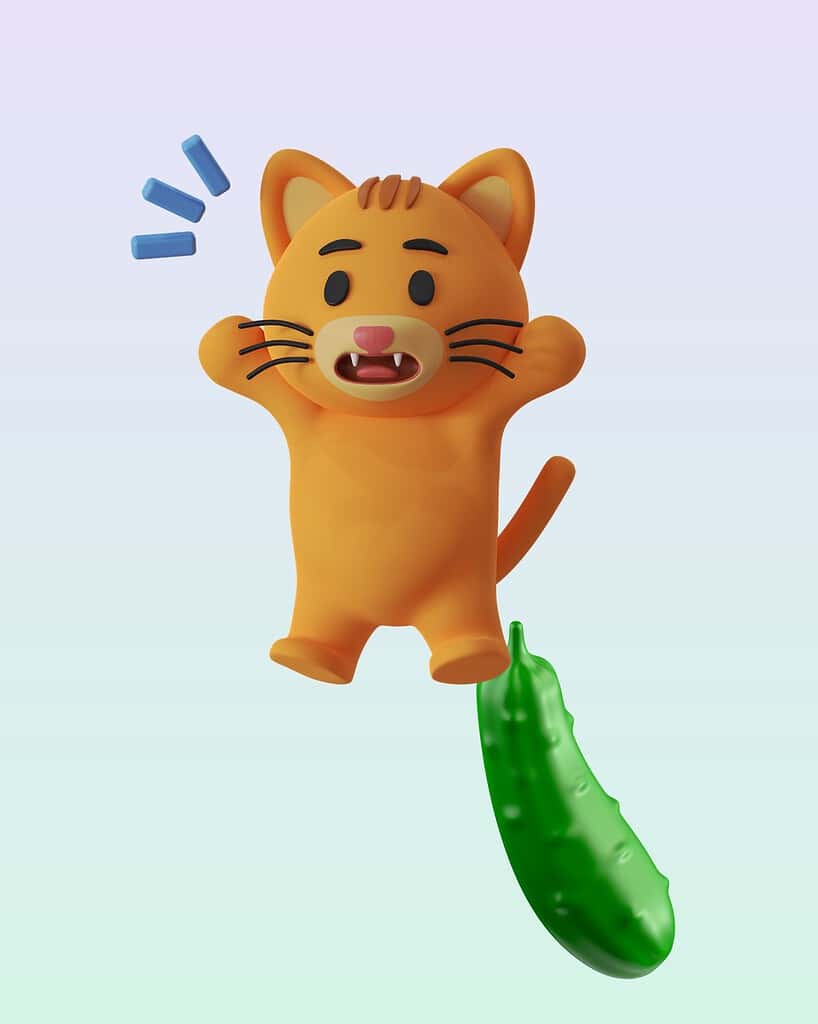
That leap you see on video is the visible tip of a much bigger reaction. A startle is the body’s emergency system switching on in a fraction of a second, before the cat has had time to work out what it is looking at.
VCA Animal Hospitals describes fear as a basic emotion that prepares an animal to react quickly to danger. It sets off a cascade of physical changes for fight or flight. Heart rate and breathing speed up. The pupils dilate. Some animals urinate, defecate or release strong-smelling secretions from their anal glands. Blood is shunted away from the core and toward the muscles, which is exactly what a cat needs to clear a couple of feet straight up from a standing start.
A veterinary lecture on feline stress presented at the 2015 WSAVA congress explains the chemistry behind this. The sympathoadrenal system releases epinephrine and norepinephrine, the hormones behind the classic “fight, flight or freeze” response. They raise heart rate and blood pressure and mobilize sugar and fat for quick energy. A second system, the hypothalamic-pituitary-adrenal axis, raises cortisol. In short bursts this is healthy. It is how a cat survives a real threat. Afterward, heart rate and breathing settle back to normal.
The trouble starts when scares happen again and again, or when a cat cannot predict when the next one is coming. VCA notes that a stress response has an immediate phase and a delayed phase. The immediate phase includes reduced rational thinking, fear-based aggression and something especially relevant here: memory consolidation that can produce “flashback” reactions in the future. In plain terms, the brain files the event away so the cat can avoid it next time. A cat that was ambushed at its food bowl may remember the bowl.
The delayed phase is driven by cortisol that stays high over time. VCA lists effects on the gut, such as diarrhea and inflammatory bowel disease, on the skin and coat, on healing and immunity, and on the urinary tract, including feline lower urinary tract disease. Cats are well known for showing stress through their bladders and bowels rather than through obvious distress.
Research backs this up. In a study published in the Journal of the American Veterinary Medical Association in 2011, researchers at The Ohio State University watched 12 healthy cats and 20 cats with feline interstitial cystitis for 77 weeks. During weeks with unusual events, such as a change of caretaker, a delayed feeding time or a disrupted routine, both groups were 3.2 times more likely to show sickness behaviors. Decreased food intake was 9.3 times more likely and defecating outside the litter box was 9.8 times more likely. Healthy cats were affected just as much as sick ones.
None of those events was as dramatic as a cucumber ambush. They were routine changes. The study also found that individual cats sometimes reacted to events that seemed harmless to people, such as one cat who urinated outside his box whenever a particular caregiver entered the room. What feels trivial to us can register as a real threat to a cat.
VCA also warns that when fear is triggered by something that is not actually dangerous, and the reaction is out of proportion, it can become maladaptive and lead to hypervigilance and chronic stress. One startle will not ruin a confident cat. Repeated pranks, or a single bad scare for a nervous cat, can tip a pet toward being jumpier, more withdrawn or more reactive than it was before.
Is the cucumber prank bad for cats?
Yes, and the experts who first commented on the trend agreed on why. Goldman told National Geographic that deliberately startling a cat could cause it to injure itself, break something or suffer prolonged stress. Those are three separate problems.
- Physical injury. A cat that explodes into the air does not choose where it lands. It can crash into furniture, a wall, a hot stove or a glass table, or knock over something that falls on it. Older cats and cats with arthritis are at extra risk from awkward twists and landings.
- Food-area aversion. Johnson-Bennett pointed out that cats associate feeding stations with safety. Being ambushed there can make a cat hesitant to eat in that spot, and the Ohio State study above found that disruptive events made skipped or reduced meals far more likely.
- Lost trust. Cats learn quickly who and what predicts unpleasant surprises. A cat that links a scare with you may become wary when you approach while it is eating or resting.
- Defensive behavior. VCA notes that a frightened cat that cannot escape may fight. A startled cat can scratch or bite a person or another pet nearby, and redirected aggression can strain relationships between cats in the same home.
There is also the bolt. A panicked cat runs first and thinks later. If a door or window is open, that run can take it outside, which is how many indoor cats go missing.
If a scared cat ever slips out
Our laser-engraved acrylic NFC smart tags let a neighbor tap with any phone, no app needed, to see your cat’s live profile with your contacts, medical notes and one-tap call, text and directions.
What should you do instead of scaring your cat?
If the appeal of the cucumber video is seeing your cat leap, pounce and react, you can get all of that through play, without the fear. The AAFP and ISFM Feline Environmental Needs Guidelines, written by feline veterinarians and behaviorists, list “opportunity for play and predatory behavior” as one of five pillars of a healthy cat environment. Their suggestions are simple:
- Move a wand toy like flying prey, swooping through the air, or like ground prey, darting in straight lines away from the cat.
- Let your cat actually catch the toy at the end, then offer a treat, so the hunt feels finished.
- Hide kibble in several spots, toss pieces to chase, or use puzzle feeders.
- Rotate toys so they stay interesting, and never use hands or feet as toys.
- Put away anything with string after play so it cannot be swallowed.
Our step-by-step guide on how to play with your cat covers games and how long to play each day, and our roundup of cat puzzle feeders helps turn mealtime into a hunt instead of an ambush. If your cat already has energy to burn at night, a good evening play session is also one of the best fixes for 3 a.m. zoomies.
New objects can be enriching, too. Goldman suggested introducing novel items gradually and from a distance, so the cat can choose to investigate. A cardboard box is the classic example, and our look at why cats love boxes explains why hiding spots help cats feel safe.
Want something fun to share instead of a scare video? The free Lohji app from Shiloh’s House turns a photo of your cat into a cartoon avatar, called a Lohji, and lets you make stickers, slideshows and collector cards. It also holds the pet profile your Shiloh’s House smart tag opens when a finder taps it. Get it on the App Store or Google Play.
Can cats eat cucumber?
Yes, in small amounts. The ASPCA lists cucumber (Cucumis sativus) as non-toxic to cats. Plain cucumber is mostly water, and USDA FoodData Central (FDC ID 168409) lists raw cucumber with peel at 15 calories per 100 grams, or about 8 calories in a half-cup of slices.
That does not make it a necessary food. Cornell’s Feline Health Center explains that cats are obligate carnivores, relying on nutrients found only in animal products, and that treats should not exceed 10 to 15 percent of daily calories. Tufts University’s Petfoodology team uses a 10 percent limit and estimates that a 10-pound cat needs about 300 calories a day, which leaves roughly 30 calories for all treats. Cucumber barely dents that budget, which is part of its appeal for cats that enjoy something crunchy.
The calories per 100 grams below come from USDA FoodData Central. The “per 10 g” column is our own calculation from those numbers, to show roughly what a small, cat-sized piece adds.
| Vegetable (plain) | USDA FDC ID | kcal per 100 g | kcal per 10 g piece (our calc) |
|---|---|---|---|
| Cucumber, with peel, raw | 168409 | 15 | 1.5 |
| Zucchini, with skin, raw | 169291 | 17 | 1.7 |
| Pumpkin, canned, without salt | 168450 | 34 | 3.4 |
| Green beans, boiled, no salt | 169141 | 35 | 3.5 |
| Broccoli, boiled, no salt | 169967 | 35 | 3.5 |
If you want to offer cucumber, wash it, cut it into small, thin pieces your cat can chew easily, and start with one or two bites to see how its stomach handles it. Serve it plain. Pickles are a different food: they are salty, and pickle brines and dips often include garlic or onion, which are toxic to cats. Our list of foods cats can’t eat covers what to keep off the plate.
Frequently asked questions
Why are cats scared of cucumbers?
Cats are reacting to the surprise, not the vegetable. In the viral videos, the cucumber appears silently behind a cat that is eating or relaxing, which triggers a natural startle response. Animal behavior specialist Roger Mugford said the same reaction would likely happen with a model spider or a plastic fish. Shown a cucumber openly, most cats sniff it and lose interest.
Do cats think cucumbers are snakes?
Possibly, but nobody has proven it. Experts quoted in 2015 mentioned snakes as one explanation because cats have to be wary of predators. There is no controlled study showing cats react more strongly to cucumbers than to other unexpected objects. The most reliable explanation is that anything sudden, silent and out of place near a cat’s food bowl can frighten it.
Is the cucumber prank bad for cats?
Yes. A startled cat can injure itself jumping into furniture or walls, lash out at people or pets nearby, or bolt through an open door. Because the prank usually happens at the food bowl, it can also make a cat nervous about eating there. Behavior experts quoted by National Geographic called the trend cruel and advised owners not to try it.
Can cats eat cucumber?
Yes, plain cucumber is non-toxic to cats according to the ASPCA, and USDA data lists it at 15 calories per 100 grams. Offer a few small, thin pieces as an occasional treat, not a meal. Cats are obligate carnivores and do not need vegetables. Skip pickles and anything seasoned with garlic or onion, and check with your vet if your cat has a health condition.
What should I do if I already scared my cat with a cucumber?
Remove the cucumber, keep the room calm and let your cat settle on its own. Do not chase or pick it up while it is wide-eyed or hiding. Offer food in its usual spot later and play with it gently once it relaxes. If it hides for more than a day, stops eating or starts eliminating outside the litter box, call your vet.
Are some cats more easily startled than others?
Yes. Just like people, cats vary in temperament, and some react strongly to surprises while others barely flinch. Cats that were poorly socialized as kittens, have had frightening experiences, or live in busy or unpredictable homes may be jumpier. Predictable routines, safe hiding spots and daily play help nervous cats feel more secure over time.
Sources
- People Are Scaring Their Cats with Cucumbers. They Shouldn’t., National Geographic (2015)
- Cats are terrified of cucumbers and no one knows exactly why, The Telegraph (2015)
- Back Away From That Cucumber, Say Some Cat Lovers, NPR (2015)
- Sickness behaviors in response to unusual external events in healthy cats and cats with feline interstitial cystitis, Journal of the American Veterinary Medical Association (2011)
- Fears, Phobias, and Anxiety in Cats and Dogs, VCA Animal Hospitals
- Fear Free for Cats, VCA Animal Hospitals
- The Role of Stress in Feline Medicine and What to Do About It, WSAVA Congress via VIN (2015)
- AAFP and ISFM Feline Environmental Needs Guidelines, Journal of Feline Medicine and Surgery (2013)
- Cucumber, ASPCA Animal Poison Control Center
- Cucumber, with peel, raw (FDC ID 168409), USDA FoodData Central (2019)
- Treat Options for Dogs and Cats Without Unbalancing Their Diet, Tufts University Petfoodology (2021)
- Feeding Your Cat, Cornell University College of Veterinary Medicine