Why Does My Cat Knead Me? 7 Real Reasons (and Why They Picked You)
 Shiloh’s House Team
·
·
6 min read
Shiloh’s House Team
·
·
6 min read
Your cat kneads you because it is a leftover kitten behaviour that still means comfort — nursing kittens push against their mother to get milk flowing, and adult cats keep doing it when they feel safe and content. Layered on top of that are scent marking (there are scent glands in their paw pads), an old nesting instinct for flattening a sleeping spot, a stretch after a nap, and, most flatteringly, a bond signal. If your cat kneads you specifically, you are being treated as family.
What does it mean when a cat kneads you?
Cats do not knead in the presence of things that worry them. The behaviour usually arrives with the whole contentment package — purring, half-closed eyes, a slow blink, drooling in some cats, and occasionally a faraway look that suggests they have gone somewhere very pleasant.
| What you notice | What it most likely means |
|---|---|
| Kneading on your lap while purring, eyes half shut | Contentment and bonding — the classic version |
| Kneading a blanket, then circling and lying down | Nesting — preparing a bed |
| Kneading with suckling, on fabric or on your sleeve | Retained nursing behaviour, common in early-weaned cats |
| Kneading right after waking up | A stretch — the feline equivalent of a yawn and a shoulder roll |
| Kneading a specific person, chair or spot repeatedly | Scent marking with the glands in their paws |
| Kneading that starts suddenly, with pacing, yowling or restlessness | Worth a vet call — could be heat behaviour, pain or stress |
1. It is left over from kittenhood
Adult cats keep the behaviour the way people keep habits from childhood — it soothed them once, so it soothes them now. Cats who were weaned early or hand-raised often knead more, and are the likeliest to add suckling on a blanket or a jumper sleeve.
2. They are marking you as theirs
Cats have scent glands in the soft pads of their paws, so every knead leaves a small, invisible signature you cannot smell but other cats can. This is the same reason cats headbutt, cheek-rub furniture and rub your ankles when you get home. It is not possessiveness in a jealous sense — it is a cat organising the world into “mine and safe” versus “not yet mine.” Being kneaded means you have been filed under the first one.
3. They are building a bed
Wild cats trample grass, leaves and undergrowth to flatten a sleeping spot and check for anything sharp or alive underneath, and domestic cats still run the routine on your duvet. This is why kneading so often comes just before the circling-and-settling ritual. Your lap is being tested for suitability. Congratulations, it passed.
4. They are stretching
Some kneading is plain physiotherapy. Cats sleep enormous amounts and wake stiff; slowly extending and retracting the toes and working the shoulders is a good way to loosen up. If your cat’s kneading is short, businesslike and happens right after a nap, that is probably all it is.
5. They are telling you they trust you
Kneading leaves a cat briefly off balance and slow to react, so they only do it where they feel genuinely safe. For a rescue cat or a nervous cat, the first time they knead on you is a real milestone — usually a bigger one than the first head-butt. It is worth noticing.
6. It is self-soothing
Some cats knead when they are mildly unsettled rather than blissful — after a move, when a new pet arrives, or during a noisy evening. The behaviour is comforting in itself, the way some people fidget. Context tells you which version you are seeing: relaxed body and purring is contentment; tense body, flattened ears or a twitching tail alongside kneading suggests your cat is coping with something.
7. Hormones, sometimes
Unspayed female cats often knead more when they are in heat, usually alongside rolling, extra vocalising and a low, crouched posture. If your cat’s kneading arrives suddenly with those signs and she is not spayed, that is the explanation. Spaying resolves it, along with a long list of other things.
Why does my cat knead me and then bite?
Usually overstimulation — your cat drifted into a happy trance, the petting continued past their tolerance, and the nervous system flipped. The warning signs come first and are easy to miss: tail flicking, skin rippling along the back, ears rotating sideways, a pause in the purr. Stop stroking before the bite rather than after, and let the kneading continue on its own. It is not aggression and it is not personal.
How to stop the claws hurting
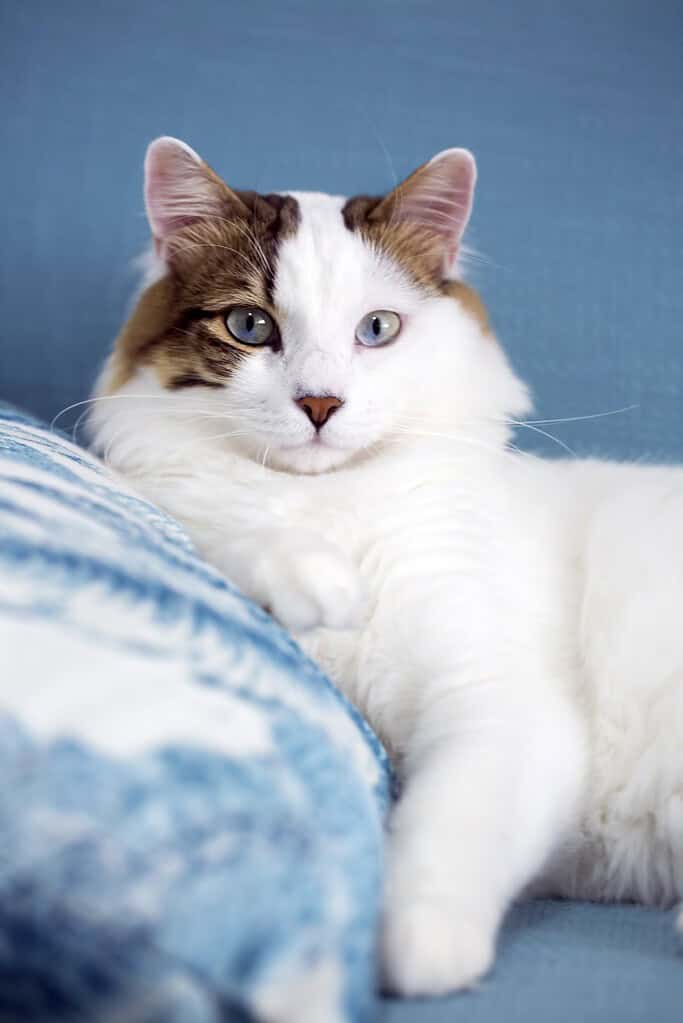
Kneading with claws out on bare legs genuinely hurts. Things that work, none of which involve stopping the behaviour:
- Keep a folded blanket nearby and slide it onto your lap when the kneading starts. Most cats accept the substitution within days.
- Trim the front claws every couple of weeks. Just the sharp translucent tip — stay well clear of the pink quick.
- Give them better things to knead. A thick fleece blanket or a soft mat on their favourite perch usually gets adopted quickly.
- Redirect the claws elsewhere. A cat with good scratching posts and a decent cat tree keeps their claws in better shape, which makes lap kneading less painful for everyone.
- Never punish it. Pushing a cat off mid-knead teaches them that showing affection to you ends badly.
What not to do: declawing. It is amputation of the last bone of each toe, it is banned or heavily restricted in a growing number of places, and it causes lasting pain and behaviour problems.
Frequently asked questions
Why is it called making biscuits?
Because the motion — alternating front paws pushing rhythmically into something soft — looks exactly like kneading dough. “Making biscuits” is the internet’s name for it and it has thoroughly won.
Do all cats knead?
No. Plenty of perfectly affectionate cats never knead, or knead only on blankets and never on people. It is a personality trait, not a scoreboard for how much your cat loves you.
Why does my cat knead me but not my partner?
Cats form separate relationships with each person in a household, and pick their kneading spot by scent, warmth, lap texture and how still that person sits. Being the chosen lap usually says more about who is calm and predictable than who feeds them.
Why does my cat drool while kneading?
Because kneading traces back to nursing, and the association can trigger salivation. Occasional happy drooling during deep contentment is normal. Constant drooling, bad breath or dropping food is not — that is a dental check.
Is kneading ever a sign of pain?
Rarely on its own. Be more concerned if kneading changes suddenly and comes with hiding, appetite changes, litter box problems, or crying. Any abrupt behaviour change in a cat deserves a vet call, because cats hide illness extremely well.
Should I stop my cat from kneading?
No. It is a healthy sign of a relaxed, well-bonded cat. Manage the claws, not the behaviour.
The cat who trusts you should also be findable
A cat kneading your lap is a cat who has decided this is home — which makes it worth knowing that only around 3% of lost cats who reach a shelter are ever reunited with their owner, and that indoor cats are the most at risk precisely because nobody expects them to get out. Full disclosure: we make them. Our Shiloh’s House NFC smart tags are $38 designer acrylic tags light enough for a cat collar, and anyone who finds your cat can tap them with any phone — no app on their end — to see your cat’s profile and reach you, with your number engraved on the back as a backup and no subscription. If you are not convinced an indoor cat needs one, we made the case in do indoor cats need ID tags? And if you are collecting cat behaviour explanations, why your cat licks you is the natural next one.
Get Your Tag
A $38 designer acrylic NFC tag any phone can tap — engraved backup, made in USA, no subscription, ever.