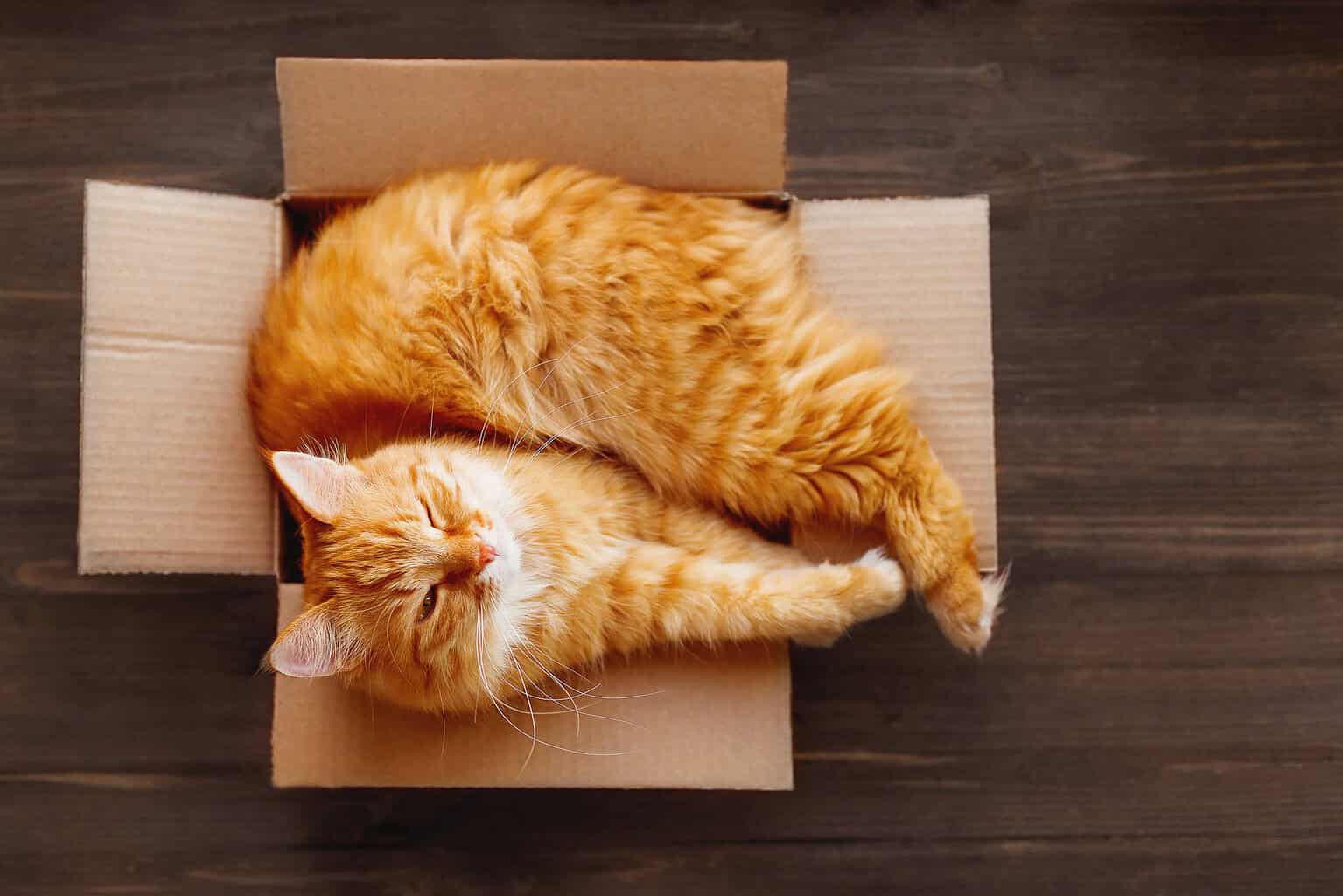
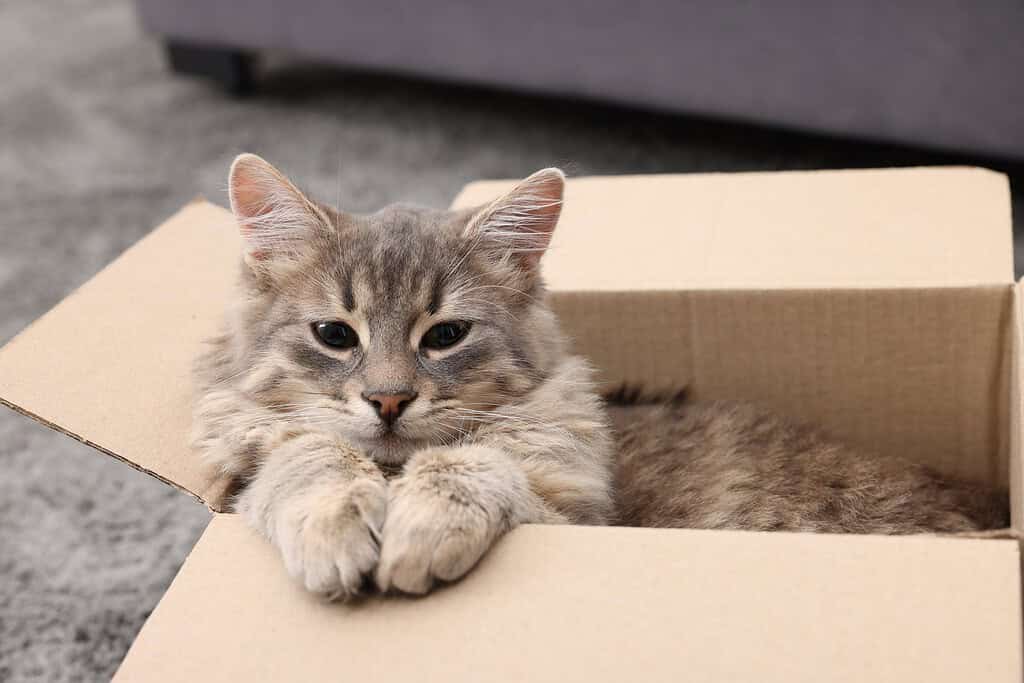
Cats like boxes because a snug, enclosed space makes them feel safe, warm and in control. A Dutch shelter study found cats given a hiding box reached a calm stress level by about day 3, while cats without one took about two weeks. Boxes also hold body heat (cats are comfortable at 86 to 97 °F), give an ambush predator cover, and offer a great surface to scratch and scent-mark. Even a taped square on the floor can trigger the same pull.
Last updated: February 2026
You spend real money on a plush cat bed, and your cat climbs into the shipping box instead. Every cat parent has lived some version of this joke. The good news is that the box obsession is not random. Researchers have measured it in shelters, tested it with optical illusions, and connected it to the way cats regulate body temperature and cope with stress.
Below, we walk through what the science actually says, why your cat also sits in laundry baskets and squares of tape, when hiding stops being cute and starts being a warning sign, and how to turn a free cardboard box into safe, useful enrichment.
Why do cats like boxes so much?
The strongest evidence comes from a 2014 study by Claudia Vinke and colleagues at Utrecht University. They took 19 cats newly admitted to a Dutch shelter and randomly split them into two groups: 10 cats received a hiding box in their cage and 9 did not. For 14 days, observers scored each cat on the Kessler and Turner Cat-Stress-Score, a behavior-based scale that runs from 1 (fully relaxed) to 7 (terrified).
The box cats had significantly lower stress scores on days 3 and 4. Their scores were also remarkably consistent, which suggests the box helped nearly every cat, not just a few. By day 14 both groups had leveled out, but the box group had reached that recovered level about 11 days sooner. The authors called the hiding box “an important enrichment” for helping cats cope in a new environment.
That lines up with the American Association of Feline Practitioners (AAFP) and International Society of Feline Medicine guidelines, which list “provide a safe place” as the very first of their five pillars of a healthy feline environment. Their reasoning is simple: cats tend to avoid and evade rather than confront threats, and having a place to withdraw gives them a sense of control.
| Finding | Number | Source |
|---|---|---|
| Shelter cats studied (box vs. no box) | 19 cats (10 vs. 9), 14 days | Vinke et al., 2014 |
| Days with significantly lower stress in box group | Days 3 and 4 (p < 0.01) | Vinke et al., 2014 |
| Time to reach settled stress level | About day 3 with a box, day 14 without | Vinke et al., 2014 |
| Cats enrolled in the “If I fits I sits” study | 561 enrolled, 30 finished all 6 trials | Smith et al., 2021 |
| Shape choices: real square / illusory square / control | 8 / 7 / 1 (of 16 choices) | Smith et al., 2021 |
| Cat thermoneutral zone | 30 to 38 °C (86 to 97 °F) | National Research Council, via Veterinary Ireland Journal |
| Comfortable range for people | 18 to 25 °C (64 to 77 °F) | Veterinary Ireland Journal |
Why do cats sit in squares of tape, paper and laundry baskets?
In 2017, cat owners on Twitter started taping square outlines on their floors and filming their cats walking straight into them. The hashtag #CatSquare took off, and a few years later researchers decided to test it properly.
Gabriella Smith and colleagues at Hunter College ran a citizen science study during the summer of 2020, published in Applied Animal Behaviour Science in 2021 under the memorable title “If I fits I sits.” Owners printed paper shapes, taped them to the floor in pairs, and filmed what their cats did over six daily trials. The shapes were a real square outline, a Kanizsa square (four “Pac-Man” corners that trick the eye into seeing a square that is not actually drawn), and a control made of the same Pac-Man pieces turned outward so no square appears.
Of the 30 cats that completed every trial, nine sat or stood with all four paws inside a shape. They chose the real square 8 times, the illusory square 7 times and the control just once. The researchers concluded that cats appear to treat the illusory square much as they treat a real one. In other words, a cat does not need walls to feel the pull of a defined space; a border is enough.
“What we know is that it is a form of comfort. This makes sense from an evolutionary standpoint. Side pressure is comforting.”
Gabriella Smith, comparative cognition researcher, speaking to Live Science
That helps explain the laundry basket, the shoebox lid, the sheet of paper on the floor and the open suitcase. Each one offers clear edges, a little separation from the open room, and often a bit of texture or warmth. The sample was small, and the authors say it should be repeated in controlled settings, but it fits what owners see every day.
Do boxes help cats stay warm?
Yes, and this may be the most overlooked reason. According to the National Research Council, the thermoneutral zone for cats, the range where they do not have to spend extra energy to stay warm or cool, is about 30 to 38 °C, or roughly 86 to 97 °F. Writing in the Veterinary Ireland Journal in 2023, veterinarian Aine Seavers points out that people prefer about 18 to 25 °C, which means a home that feels comfortable to us can feel chilly to a cat.
The Ohio State University Indoor Pet Initiative gives a similar figure, noting that cats prefer temperatures of 85 to 100 °F. Its enrichment handout lists boxes as a basic resource, saying cats use them “to keep warm, to escape threats, and to scratch and perch on.”
A small box traps the heat your cat gives off, blocks drafts and cuts contact with a cold floor. That is also why many cats seem to pick the tightest box available. Less air space means faster warming.
How do boxes tap into hunting, scent and curiosity?
Cats are both predator and prey. A box gives them cover from anything that might threaten them and a hidden launch point for anything they might want to chase. Smith told Live Science that her own cat hides behind objects during play so she can pounce, and many owners know the feeling of being ambushed from inside an Amazon box. If your cat stalks your ankles from cover, the box is basically a hunting blind.
Then there is texture and smell. Cardboard is easy to shred, and scratching it lets cats file their claws and leave scent from the glands between their toes. Cat writer Celia Haddon told Newsweek that a box “just smells of cardboard,” a natural scent cats are used to, compared with a new bed that may still smell of factory fabric. Scent-marking a box is closely related to other comfort behaviors, which we cover in our guide to why your cat kneads you.
Finally, a new box is simply a new object in a cat’s territory, and cats investigate change. Sniffing, rubbing, climbing in and sitting down is how a cat checks out and claims something unfamiliar.
When does hiding in a box mean your cat is stressed or sick?

Most box sitting is perfectly healthy. A cat that naps in a box in the afternoon, comes out for dinner, plays in the evening and greets you at the door is just enjoying a cozy spot. The thing to watch is not the box itself but a change in your cat’s usual pattern.
Veterinary behaviorists stress this point. In a review in the Journal of Feline Medicine and Surgery, Debra Horwitz and Ilona Rodan explain that cats descend from solitary animals for whom hiding illness was important for survival, so they show very few outward signs of pain, sickness or distress. They note that a change in normal behavior is often the first clue that something is wrong, and they list prolonged hiding, living in only one spot, hypervigilance and withdrawing from the family among the signs of chronic distress.
Cornell’s Feline Health Center makes a similar point. Its guide to warning signs of cancer says that if a cat is hiding more, interacting less, or no longer lounging in favorite sunny nap spots, “something may be wrong.” Cornell also describes how cats with sore joints often become more reclusive and seek out warm, comforting places to rest, which can look a lot like ordinary box love.
So how do you tell the difference? Watch for these patterns:
- Your cat used to nap in the box for an hour and now stays in it most of the day.
- Your cat skips meals, eats much less, or stops coming out for treats.
- Litter box habits change, including going outside the box or straining.
- Your cat hisses, flinches or growls when you reach in, when that is new behavior.
- The cat is hunched, tense, breathing fast, or not grooming.
- Hiding started right after a change at home, such as a new pet, a new baby, visitors, construction or a move.
If hiding comes with any physical signs, such as appetite loss, vomiting, litter box changes or trouble jumping, call your veterinarian. Cats can hide pain very well, and a box can become the place where an illness goes unnoticed for days.
If the cause seems to be stress rather than illness, the box is actually part of the solution. The Vinke study and the AAFP guidelines both show that a safe hiding place helps cats calm down faster. Do not pull a frightened cat out of a box or take the box away. Instead, leave it where it is, keep the household quiet and predictable, put food, water and a litter box within easy reach, and let the cat come out on its own schedule. Sit nearby and talk softly, or toss a treat near the opening, so the cat learns that coming out is safe.
New cats and newly moved cats deserve extra patience. In the shelter study, most of the benefit showed up in the first few days, and two weeks was the window it took cats without a box to settle. A box in a quiet room is one of the cheapest ways to shorten that adjustment period at home, too. For a deeper look at the reasons cats hide and when to worry, see our guide to why your cat is hiding.
Are cardboard boxes safe for cats?
A plain cardboard box is one of the safest toys you can give a cat, as long as you prep it first. Veterinarian Bethany Hsia told Chewy to remove staples, tape and handles before letting a cat play, and to clear out packing materials like peanuts, bubble wrap and plastic. Here is a quick checklist:
- Pull out staples and peel off packing tape, which can stick to fur or be chewed and swallowed.
- Cut off rope or paper handles, and never leave plastic bags out. Cats can get their heads stuck in handles, and plastic bags pose a suffocation risk.
- Skip boxes that held chemicals, cleaners or strongly scented products.
- Keep dryers, washers and drawers closed. VCA Animal Hospitals notes that cats and kittens are known for sleeping in dryers, and the Animal Medical Center in New York has warned about cats injured or killed when a dryer was turned on with them inside.
- Check the garage, car and storage bins before closing them up.
The same goes for any day the door is open a lot. Strong box instincts mean your cat may slip into a delivery box on the porch or a bag in the garage. Our tips on keeping an indoor cat from escaping cover door routines that help.
If your box-loving cat slips out, make the way home easy
Indoor cats who hide in boxes, bags and moving cartons are often the ones who end up outside by accident. A Shiloh’s House Smart Tag on a breakaway collar has your number laser-engraved on the front, and anyone who taps the back with a phone gets one-tap call, text and directions to you, no app needed.
How can you use boxes for enrichment?
Because cats already love boxes, they are an easy and nearly free way to add hiding, hunting and play to an indoor cat’s day. A few ideas:
- The basic hideout. The AAFP guidelines suggest a box on its side, which gives easy access and a roof. Add a folded towel or a T-shirt that smells like you.
- The lookout. Set a sturdy box on its side with a flat top so your cat can hide inside or perch on top. The guidelines describe this hide-and-perch combo as a near-ideal safe place.
- The puzzle box. Cut paw-sized holes in a shoebox lid and drop in kibble or treats. Your cat has to fish them out, which taps into hunting behavior. Once your cat gets the idea, a commercial puzzle may be the next step; see our roundup of the best cat puzzle feeders.
- The tunnel. Tape two or three open-ended boxes together, using tape only on the outside, for a short run to dash through.
- The rotation. Swap boxes in and out every week or two so there is always something new to investigate.
Want to capture your cat’s best box moment? The free Lohji app (Lohji: Cartoon Your Pet on the App Store and Lohji: Cartoon Pet Avatar on Google Play) turns one photo into a 3D cartoon character for wallpapers, watch faces, stickers, collector cards and short videos. It also runs the Smart Tag’s finder profile.
How do boxes help multi-cat homes and carrier training?
In homes with more than one cat, boxes can ease tension. The AAFP guidelines recommend at least as many safe places, each sized for one cat, as there are cats in the household, placed in separate areas, and ideally with more than one entrance so one cat cannot trap another inside. A few cheap boxes spread around the house can give a shy cat a way to stay out of a bossy housemate’s path.
Boxes also teach a useful lesson: a cat that likes a box can learn to like a carrier. The guidelines call a carrier “a transportable, safe place” and recommend leaving it out where the cat can reach it. The AAFP’s Cat Friendly program suggests keeping the carrier in a room your cat already uses, lined with familiar bedding, with treats or toys tucked inside. VCA adds that some cats quickly adopt the carrier as a sleeping or hiding spot when it is left out instead of stored in the garage.
A carrier-trained cat is also easier to evacuate in an emergency, and that is another reason indoor cats benefit from visible ID. See why in do indoor cats need ID tags and our guide to what cat parents actually need in a cat ID tag.
Frequently asked questions
Why do cats like boxes more than expensive beds?
A box offers walls on every side, a dark interior, cover from view and good heat retention, while many beds are open and flat. Cardboard also smells natural and is satisfying to scratch. To win your cat over to a bed, choose one with high sides, put it where the box used to be, and reward your cat with treats whenever it explores the new spot.
Do big cats like boxes too?
Yes. Zoo observations reported by Live Science describe lions, tigers and pumas sitting in and playing with boxes of many sizes. That suggests the attraction is a broad feline trait rooted in the need for safe cover, warmth and a place to ambush prey, not just a quirk of house cats that grew up around shipping boxes and online shopping.
Why does my cat sit in a square of tape on the floor?
A 2021 citizen science study found that cats chose to sit inside real squares and illusory squares far more often than a control shape. Researchers think the visible border gives cats a sense of a defined, enclosed space, even without walls. It is the same instinct that sends cats into boxes, laundry baskets and open suitcases left on the floor.
Is it bad if my cat hides in a box all day?
Occasional long naps are normal, especially in a warm spot. Hiding most of the day, especially when paired with eating less, litter box changes, hissing when touched or reluctance to jump, can signal pain, illness or stress. Cats hide sickness well, so contact your veterinarian if the change lasts more than a day or two or comes with any physical symptoms.
How many boxes should I have for multiple cats?
Feline practitioner guidelines recommend at least one safe place per cat, each sized for a single cat and spread across different areas of the home. Boxes with two openings work best because one cat cannot block the only exit. Rotating a few spare boxes keeps things interesting and reduces competition over a single favorite hiding spot.
Can a cardboard box replace a cat carrier for vet trips?
No. Cardboard can be scratched through, collapse when wet, or open if your cat pushes hard, and a frightened cat may bolt in a parking lot. Use a sturdy, secure carrier for travel. A box is still a great training tool, though, because it helps your cat get comfortable with enclosed spaces before the carrier becomes part of daily life.
Sources
- Will a hiding box provide stress reduction for shelter cats?, Vinke, Godijn and van der Leij, Applied Animal Behaviour Science, 2014
- If I fits I sits: A citizen science investigation into illusory contour susceptibility in domestic cats, Smith, Chouinard and Byosiere, Applied Animal Behaviour Science, 2021
- Why do cats love boxes so much?, Live Science, 2022
- The heat is on: the feline TNZ, Veterinary Ireland Journal, 2023
- Environmental Enrichment for Confined Cats, The Ohio State University College of Veterinary Medicine
- AAFP and ISFM Feline Environmental Needs Guidelines, Journal of Feline Medicine and Surgery, 2013
- Behavioral awareness in the feline consultation, Horwitz and Rodan, Journal of Feline Medicine and Surgery, 2018
- Warning signs of cancer, Cornell Feline Health Center
- Is Your Cat Slowing Down?, Cornell Feline Health Center
- Why do cats love boxes? Let us count the ways, Utrecht University, 2016
- Why Do Cats Love Boxes?, Chewy
- Why Do Cats Like Boxes so Much?, Newsweek, 2022
- Pet-Proofing Your House, Room by Room, VCA Animal Hospitals
- 5 Hidden Household Hazards for Cats, The Animal Medical Center, 2024
- Getting Your Cat to the Veterinarian, AAFP Cat Friendly, 2025