Black Cat Facts: Myths, Genetics and Halloween Truths
 Shiloh’s House Team
·
·
14 min read
Black cats are not unlucky, and the science behind them is more interesting than the folklore. A single recessive gene change makes a domestic cat black. Several shelter studies find black cats wait a few days longer for homes, but the effect is small and some shelters see no gap at all. People do not rate black cats as less friendly. Black cats are lucky in the UK and Japan, and there is no evidence that Halloween adoptions put them at risk.
Last updated: October 2026
Are black cats really adopted less often?
Shelter workers have talked about “black cat syndrome” for decades. The research mostly backs them up, but with a big asterisk: the effect is real in some places, small in most and absent or reversed in others.
The best-known study comes from Colorado State University researcher Lori Kogan and colleagues, who analyzed records from two Colorado shelters. At one, adult cats with all-black coats averaged 26.55 days to adoption, compared with 20.64 days for cats of other colors. Black kittens averaged 18.03 days, compared with 13.99 days for kittens of other colors. Even tuxedo-style cats that were mostly black did slightly better than solid black ones.
A larger Kentucky study looked at 7,983 cats that entered an urban public shelter in 2010 and 2011. Black cats had the lowest adoption rate (10.0%) and white cats the highest (18.8%). The authors were careful to add that the overall link between coat color and outcome was weak. Here is how several studies compare.
| Study | Where | Cats studied | What it found about black cats |
|---|---|---|---|
| Kogan et al., 2013 | Two Colorado shelters | Adults and kittens | Longest wait of any color; adults about 6 days longer, kittens about 4 days longer |
| Brown & Morgan, 2014 | No-kill shelter, New York | Average stay 61.2 days | Darker adults waited longer, but yellow (orange) cats waited longest; color did not matter for kittens |
| Kubesova et al., 2017 | Three Czech shelters | 2,170 | Dark-colored cats had a longer median stay than light or medium shades |
| Miller, Ward & Beatty, 2019 | Urban shelter, Australia | 2,584 | White cats stayed significantly longer than black cats |
| Carini et al., 2020 | Public shelter, Kentucky | 7,983 | 10.0% of black cats adopted vs 18.8% of white cats; overall effect weak |
The fair summary: black cats often wait a little longer, the gap varies a lot by shelter and region, and coat color is only one of many things adopters weigh. A few extra days still matters to a cat in a kennel, which is why many shelters run black cat promotions.
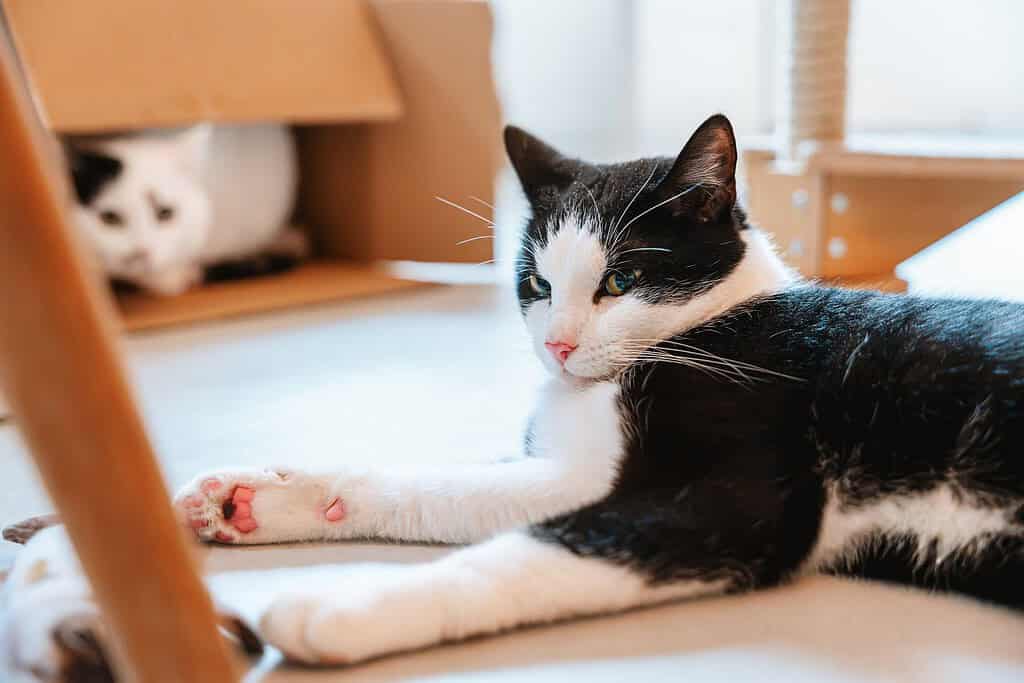
What makes a cat black?
A black coat is a genetics story about two pigments. Eumelanin is the dark brown-black pigment. Pheomelanin is the red-yellow one. A protein called ASIP (agouti signaling protein) normally switches hair production back and forth between them, which is what creates the banded, ticked hairs you see on a tabby.
In 2003, a team at the US National Cancer Institute, led by Eduardo Eizirik with Stephen O’Brien, reported in Current Biology that a 2 base-pair deletion in the ASIP gene specifies black coloration in domestic cats. With that switch broken, the hair keeps producing dark pigment, and the cat is solid black. This is called melanism.
A few practical things follow from that:
- It is recessive. A cat needs two copies of the ASIP change to be black. That is why two non-black parents can produce a black kitten if both carry one copy.
- It shows up across the cat family. New Scientist reported that 11 of the 37 cat species can have black coats. Later work in PLOS One found melanism arose independently at least five times in wild cats, with different gene changes in leopards, jaguars, jaguarundis and others.
- Black is not a breed. The Bombay is bred to be black, but any mixed-breed domestic cat can carry the gene.
Could a black coat protect cats from disease?
This is the most tantalizing black cat fact, and also the one that gets exaggerated most often. Here is what was actually said.
When the 2003 melanism study came out, New Scientist pointed out that the other gene involved in cat melanism, MC1R, belongs to the same broad gene family as a human gene called CCR5. CCR5 makes a protein that HIV and some other viruses use as a doorway into cells. Stephen O’Brien, one of the study’s senior scientists, told Reuters that “perhaps the mutations cause resistance of the cats to bugs.”
That is a hypothesis, not a finding. A few points keep it in perspective:
- The domestic cat’s black coat comes from ASIP, not MC1R. The MC1R changes were found in jaguars and jaguarundis.
- Eizirik, the study’s lead author, told New Scientist the most likely benefit of a black coat was camouflage for hunting.
- A 2012 PLOS One paper on leopard and Asian golden cat melanism stated there is “so far no evidence” of other effects linked to melanism in domestic or wild cats, which suggests the change may affect only pigmentation.
So no study has shown that black house cats are healthier or live longer than cats of other colors. What the genetics does show is that black coats have evolved again and again across the cat family, which hints that they are at least neutral and sometimes useful in the wild. Whether that usefulness is camouflage, disease resistance or something else is still an open question.
For your own cat, color tells you nothing about health. Regular vet visits, a healthy weight and keeping them indoors do far more than any gene.
Do people judge black cats’ personalities differently?
If black cats wait longer in shelters, a natural guess is that people think they are less friendly. Researchers at UC Berkeley tested that idea in 2012.
Mikel Delgado and colleagues surveyed 189 people with cat experience and asked them to rate five coat colors (orange, tri-colored, white, black and bi-colored) on 10 personality traits, from friendly and calm to aloof and intolerant. Clear stereotypes appeared. Orange cats were seen as friendly. White cats were seen as aloof, shy and calm. Tortoiseshell and calico cats were rated as more aloof and intolerant.
Black cats were the surprise. The researchers expected them to get more negative ratings, but black cats were not rated differently from more than one other color on any trait. Their scores were the least extreme of the group.
“To date there is little evidence that these perceived differences between differently colored cats actually exist, but there are serious repercussions for cats if people believe that some cat colors are friendlier than others.”
Mikel Delgado, lead author and UC Berkeley psychology doctoral student, Berkeley News
The authors concluded that factors other than personality, such as appearance or old bad-luck superstitions, likely explain why black cats are adopted less often. Shelter staff often say black cats are hard to photograph and can look “plain” next to a flashy tabby in a kennel row.
Another detail from the survey is worth knowing. When asked what mattered in choosing a cat, 94.7% of respondents said personality was important or very important. Only 26.1% said color was. The lesson for adopters is simple: spend time with the cat, not the coat. If you already live with a black cat, you know they show affection in all the same ways, from head bumps to the famous cat slow blink.
Why are black cats lucky in some countries and unlucky in others?

Few animals carry as many contradictory superstitions as the black cat. Whether one crossing your path is good or bad news depends almost entirely on where you grew up.
From sacred to suspect
According to the UK charity Cats Protection, cats, including black ones, were worshipped in ancient Egypt and admired by the Romans, and killing one was treated as a serious crime. Attitudes in Europe shifted sharply later on. By the 17th century, cats were linked with witchcraft, and in witch trials owning a cat could be taken as evidence against a person. That association is where the Halloween witch and her black cat come from.
Cats Protection notes that black cats are still widely considered unlucky in the United States, Belgium and Spain. Reuters described the classic North American version: it is bad luck if a black cat crosses your path and good luck if a white cat does.
Where black cats bring good luck
In the UK, the belief flipped long ago. Meeting a black cat, especially one that crosses your path, is generally considered good luck there. Cats Protection lists a string of British and European beliefs:
- In Scotland, a strange black cat arriving on your doorstep is a sign of prosperity.
- In England, giving a bride a black cat on her wedding day is said to bring her good luck.
- In Yorkshire, it is lucky to own a black cat but not to meet one.
- In the UK theater world, a black cat in the audience on opening night is said to mean a long run.
- In the south of France, black cats are sometimes called “matagots,” or magician cats, and treating one well is said to bring good fortune.
- In Italy, hearing a black cat sneeze is considered lucky.
Japan is the other famous black cat fan. Both Cats Protection and Reuters report that in Japan, a black cat crossing your path is often seen as lucky.
Sailors, fishermen and mixed signals
The sea produced some of the strongest black cat beliefs, and they did not always agree. Cats Protection notes that in parts of Europe, keeping a black cat on board was thought to ensure safe passage. The Guardian, drawing on the Oxford Dictionary of Superstitions, cited an 1866 source describing sailors’ wives in Scarborough, England, who kept black cats to protect their husbands at sea, and a 1907 account of football teams bringing a black cat onto the pitch for luck.
The same dictionary also records the opposite: a diary entry from 1797 by someone who saw three black cats and skipped market that day out of fear. Scottish folklore archives at the University of Edinburgh hold similar stories of fishermen and miners who turned back home for the day after meeting a black cat.
Elsewhere, Reuters reported that black cats are sometimes seen as harbingers of famine in China, while in Germany the direction matters: a black cat crossing from right to left is a bad sign, and from left to right is a good one.
What this means today
The takeaway is that “unlucky” is a cultural habit, not a fact about the cat. Britain has leaned into the lucky version so firmly that Cats Protection celebrates National Black Cat Day every October 27. If you share your home with a black cat, you get to pick which tradition you follow.
Should shelters pause black cat adoptions at Halloween?
For years, many US shelters stopped adopting out black cats in the weeks around Halloween. The worry was that people might adopt them as living decorations or, in the darker version of the story, for ritual harm. It sounds protective. The evidence says it is not.
As early as 2003, the ASPCA had stopped advising shelters to ban black cat adoptions at Halloween. An ASPCA spokesperson told Capital News Service that there were no statistics showing that black cats adopted around Halloween faced a higher risk of harm, and “There’s really no evidence.” Best Friends Animal Society has made the same point, and several shelters have since dropped the practice.
The research adds a second problem: pausing adoptions keeps black cats in the shelter longer, and they may already wait longer than other cats. In the Kentucky study of 7,983 cats, researchers looked separately at 1,219 all-black cats and found that their adoption and transfer rates in October were no better, and sometimes worse, than in other months. Robert Carini, the lead author, told AAHA’s Trends magazine that October restrictions can backfire, leading to fewer black cats adopted.
Today most shelters rely on normal adoption counseling to screen every adopter, every month, rather than a blanket color ban. Many go the other way and run Halloween black cat specials.
How do you keep a black cat safe on Halloween night?
Halloween risks are mostly the same for every cat: open doors, strangers, noise and candy. We cover the full checklist in our Halloween pet safety guide. For black cats, a few points deserve extra attention.
- Keep them inside, in a closed room. Trick-or-treaters mean the front door opens dozens of times. A quiet bedroom with a litter box, water and a hiding spot beats a frightened dash outside. Our guide on how to keep an indoor cat from escaping covers door-dashing habits.
- Remember they are hard to see. A black cat in a dark yard or on a dark road is easy to miss. If your cat does get out after sunset, a flashlight and a reflective collar make spotting them far easier.
- Make sure they wear ID. A breakaway collar with an ID tag is the fastest way for a neighbor to get your cat home. Indoor cats need this too, as we explain in do indoor cats need ID tags, and our best cat collars roundup compares breakaway and reflective options.
- Know the plan if they slip out. Most escaped indoor cats hide close to home. Our step-by-step guide on how to find a lost cat tells you where to look first.
Help your black cat get home fast
A Shiloh’s House Smart Tag lets any finder tap with a modern phone, no app needed, to see your cat’s live profile with one-tap call, text and directions.
How can you celebrate your black cat this Halloween?
Black cats tend to get overlooked in photos, which is part of the problem shelters describe. The fix is to show them off, and Halloween is the perfect excuse.
The free Lohji app from Shiloh’s House turns one photo of your pet into a 3D, animated-movie-style cartoon character. For a black cat, that means bright eyes and a glossy coat that actually show up on screen. From there you can send your cat as iMessage stickers, including seasonal Halloween designs and costume stickers such as Dinosaur, Superhero, Pirate and Unicorn, or turn the cartoon into a phone wallpaper or watch face for spooky season.
You sign in with your phone number and a text code, and new accounts get 10 free Lohji Coins that never expire. Download the Lohji app on the App Store or Google Play.
The same app manages your cat’s Smart Tag profile, so the photo or Lohji a finder sees, your contacts and any medical notes stay current all year, not just on October 31.
Frequently asked questions
Are black cats adopted less than other cats?
Often, but not everywhere. A Colorado study found adult black cats waited about six days longer for adoption, and a Kentucky study found black cats had the lowest adoption rate of any color. However, the effect was weak in the Kentucky data, coat color did not matter for kittens at a New York shelter, and an Australian shelter found white cats waited longer than black ones.
What gene makes a cat black?
In domestic cats, a small deletion in the ASIP (agouti signaling protein) gene causes a solid black coat. ASIP normally switches hair between dark and light pigment, creating tabby banding. When it does not work, the hair stays dark. The trait is recessive, so a cat needs two copies, and two non-black parents that each carry one copy can have black kittens.
Are black cats healthier than other cats?
There is no evidence of that. A geneticist on the 2003 cat melanism study suggested the mutations might help cats resist disease, but that was a hypothesis. The domestic cat’s black coat comes from a different gene than the one linked to that idea, and a later paper found no evidence that melanism affects anything besides color.
Are black cats good luck or bad luck?
It depends on the culture. In the US, Belgium and Spain, black cats are often called unlucky, a belief tied to old witchcraft associations. In the UK and Japan, a black cat crossing your path is considered good luck, and Scottish folklore says a strange black cat on your doorstep brings prosperity. The cat itself has no effect on your luck either way.
Why do some shelters stop black cat adoptions at Halloween?
Some shelters worried that people would adopt black cats as decorations or to harm them. The ASPCA stopped advising such bans by the early 2000s, saying there was no evidence of increased risk. Research also shows black cats did not get better outcomes in October, and pausing adoptions only keeps them in shelters longer. Most shelters now use standard adoption screening instead.
Should my black cat go outside on Halloween?
No. Keep every cat indoors on Halloween night, ideally in a quiet closed room away from the front door. Black cats are especially hard to spot in the dark if they escape. Make sure your cat wears a breakaway collar with a current ID tag, and confirm their microchip registration is up to date before the trick-or-treaters arrive.
Sources
- Cats in Animal Shelters: Exploring the Common Perception that Black Cats Take Longer to Adopt, The Open Veterinary Science Journal, 2013
- Coat Color and Cat Outcomes in an Urban U.S. Shelter, Animals, 2020
- Age, Breed Designation, Coat Color, and Coat Pattern Influenced the Length of Stay of Cats at a No-Kill Shelter, Journal of Applied Animal Welfare Science, 2014
- Population Characteristics of Cats Adopted from an Urban Cat Shelter and the Influence of Physical Traits and Reason for Surrender on Length of Stay, Animals, 2019
- After Years of Fears, Shelters Drop Ban on Black Cat Adoptions at Halloween, Capital News Service, 2003
- Don’t be so fast to judge a cat by its color, study warns, Berkeley News, 2012
- Black cats may be the more fortunate felines, New Scientist, 2003
- How the Leopard Hides Its Spots: ASIP Mutations and Melanism in Wild Cats, PLOS One, 2012
- Black cat superstitions, Cats Protection, 2014
- Black cat bias: How coat color impacts shelter outcomes for cats, AAHA Trends, 2025